

How Distracted Driving Affects Your Car Insurance in 2026: Complete Driver Guide

How Distracted Driving Affects Your Car Insurance in 2026: Complete Driver Guide
How distracted driving affects car insurance is one of the most financially consequential questions any driver can ask — and one of the least understood until the renewal notice arrives. The fine for a first texting violation may be $75 in Arizona or $30 in Florida. The insurance consequence of that same citation can cost a driver thousands of dollars over the following three to five years.
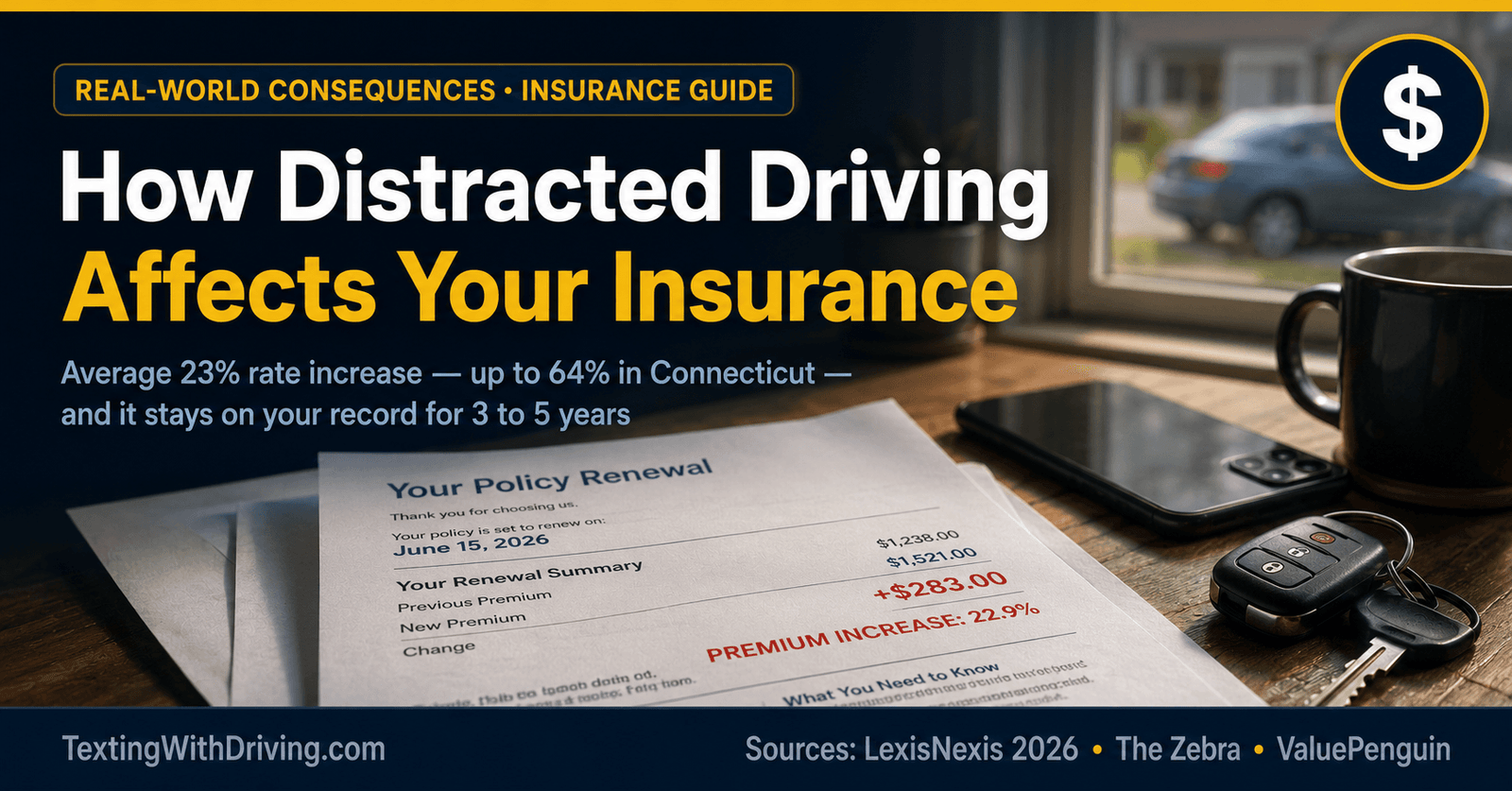
A texting while driving ticket results in an average 23 percent increase in car insurance premiums. In Connecticut, the worst state for insurance penalties, that increase averages 64 percent — $1,083 in additional premium per year. In Vermont it averages 56 percent. In Michigan it averages 42 percent. And because the violation stays on your driving record for three to five years depending on your state and insurer, the total cost of a single citation can reach $3,000 to $5,000 in additional premiums before the record clears.
Understanding exactly how distracted driving affects car insurance — the mechanism, the timeline, the state-by-state variation, the strategies that reduce the impact, and the states where the law actually limits what insurers can do — is what this guide covers in full.
How Insurance Companies Learn About a Distracted Driving Citation
The first question most drivers have after receiving a distracted driving citation is: will my insurance company find out? The answer is almost always yes, through one of two pathways.
Insurers routinely review motor vehicle records during underwriting and renewal. A distracted driving ticket may affect rating tiers, discounts, or eligibility.
The motor vehicle record review is the primary mechanism. When your auto insurance policy comes up for renewal — typically every six or twelve months — your insurer pulls your current MVR from your state’s DMV. Any citations that have been processed and added to your driving record since the last renewal will appear on that report. The insurer then applies its rating algorithms to the updated record and calculates your new premium.
The second pathway is telematics. Many insurers now offer usage-based or behavior-based insurance programs that use your smartphone or a plug-in device to monitor actual driving behavior. A driver enrolled in a telematics program who handles their phone while driving may trigger behavioral flags that affect their rates independently of any citation on their MVR.
The timing of when an insurer sees the violation depends on when it appears on your MVR and when your policy renews. A citation issued in January may not show up on your renewal until June or December, depending on how quickly your state processes the conviction and when your policy period ends. If your rate goes up, it won’t happen until it’s time to renew your policy.
The Average Rate Increase: What the National Data Shows
The national average increase after a distracted driving citation is the most-cited figure in this conversation, and multiple sources produce consistent estimates.
According to recent data from Insurance.com, a texting violation results in an average 28 percent increase in car insurance premiums. Depending on state laws and your insurance company, this range could be as small as 9 percent or as steep as 51 percent. That translates to paying an additional $150 to $900 more per year.
The InsuranceOpedia analysis, updated March 2026, concludes that a single ticket for texting while driving can increase your auto insurance premium by 23 percent on average.
Premium surcharges for texting violations currently average higher due to increasingly severe accident rates.
The 23 to 28 percent national average sits within a wide state-by-state range. A driver in New York may see only a 4 percent increase ($62). A driver in Connecticut faces a 64 percent average increase ($1,083 per year). Vermont averages 56 percent. Michigan averages 42 percent. The variation reflects differences in state insurance regulation, baseline premium levels, and how individual insurers classify distracted driving violations relative to other moving violations in their rating systems.
Against a 2026 national average of $2,496 per year for full coverage auto insurance, a 23 percent increase adds $574 per year. Over three years, that is $1,722 in additional premiums from a single citation. At 28 percent, the three-year total is $2,097. In Connecticut at the 64 percent level, three years of enhanced premiums adds $3,249 above the baseline premium.
The fine you pay at the courthouse is not the real cost of a distracted driving citation. The real cost lives in your insurance renewal notices for the next three to five years.
How Long a Distracted Driving Citation Stays on Your Insurance Record
A violation for texting while driving typically stays on your record for three to five years, depending on your state and your insurer. You’ll likely pay higher premiums during this period.
The distinction between how long the violation stays on your driving record and how long it affects your insurance rate is important and frequently confused.
Your driving record (the MVR your insurer pulls) retains violation records for three to five years in most states. After that point, the violation is no longer visible to insurers pulling your standard MVR, and your rate should return to clean-record levels assuming no additional violations.
However, your insurer’s rating window — the period during which they factor the violation into your premium — may be different from the MVR retention period. Some insurers apply surcharges for three years. Others look back five years. And violations associated with a crash, rather than a standalone citation, may affect rates for longer than a citation without a crash.
Even a single distracted driving offense can keep your rates elevated for three to five years — so it pays to put the phone down, as The Zebra’s analysis of this data concludes.
For drivers who receive multiple citations within the retention window, the rate impact compounds. The LexisNexis 2026 US Auto Insurance Trends Report documents that distracted driving violations are up 57 percent since 2022, and bodily injury claim severity has risen 7.5 percent in the same period. Insurers responding to this environment are treating distracted driving violations with increasing severity in their rating algorithms. Distracted-driving violations now have a heavier weight in points in many states, which directly affects how car insurance companies judge a driver’s risk profile.
The State-by-State Variation: Where the Impact Is Highest and Lowest
How distracted driving affects car insurance varies dramatically based on where the driver lives. The Zebra’s research provides the most comprehensive state-level breakdown.
Highest insurance penalty states:
Connecticut: 64% average increase ($1,083 additional per year). Vermont: approximately 56%. Michigan: approximately 42%. Maryland: high baseline rates plus significant citation surcharge.
Lowest insurance penalty states:
New York: 4% average increase ($62 additional per year). New York’s low insurance penalty for distracted driving citations is particularly striking given the state’s aggressive fine and points structure — 5 points per violation, fines up to $450. The insurance market in New York has specific regulatory constraints that limit how insurers can factor moving violations into premium calculations for certain violation categories.
The geographic variation in insurance penalties is not always correlated with the fine amount or the legal severity of the citation. A state with a strict law and a $500 fine may have lower insurance consequences than a state with a $100 fine, depending on how the state’s insurance market is regulated and how individual insurers within that market classify distracted driving relative to other violations.
The States Where Distracted Driving Citations Cannot Raise Your Rates
One of the most practically important pieces of information about how distracted driving affects car insurance is that some states specifically limit or prohibit insurers from using certain types of distracted driving citations as a rating factor.
Some states — such as Idaho, Massachusetts, North Carolina, and Washington — limit or prohibit insurers from factoring texting-while-driving tickets into your premiums. However, these protections can vary by violation type, so it’s worth reviewing your local regulations.
This is a significant protection for drivers in these states. A driver in Washington State who receives a $136 E-DUI citation may face no insurance rate increase at all, depending on the specific insurer and the specific violation classification, because Washington limits insurer use of these citations as rating factors. A driver in Connecticut who receives a comparable first-time distracted driving citation faces a potential 64 percent increase.
Understanding whether your state restricts insurer rating of distracted driving violations requires checking your state’s insurance department regulations or asking your insurer directly, because the protection varies by violation type and insurer within the same state.
It is also worth noting that these protections typically cover standalone distracted driving citations. A distracted driving citation that is also associated with a crash, or that accompanies other violations issued at the same stop, may fall outside the protected category and be factored into rates regardless of the general limitation on citation-based rating.
The LexisNexis 2026 Industry Picture: What Insurers Are Seeing
The most comprehensive industry data on how distracted driving affects car insurance at the macro level comes from the LexisNexis 2026 US Auto Insurance Trends Report released May 19, 2026.
Distracted driving violations are up 57 percent since 2022, with increases of 70 percent or more among drivers aged 36 to 45 and 66 and older.
Bodily injury severity has risen 7.5 percent since 2022. Bodily injury claims now represent 26 percent of all claim dollars, up from under 20 percent in 2022.
The industry-level consequence of this data is straightforward: insurers are paying more for bodily injury claims, those claims are increasingly linked to distracted driving crashes, and the underwriting response is to assign higher risk scores to drivers with distracted driving violations on their records. This creates a direct and traceable chain from the citation on your driving record to the premium increase on your renewal notice.
The 57 percent violation increase since 2022 means that the pool of drivers carrying distracted driving citations on their records is dramatically larger in 2026 than it was before the wave of new primary enforcement hands-free laws in 2023, 2024, and 2025. Ohio, Michigan, Missouri, Pennsylvania, Iowa, Louisiana, South Carolina, and Colorado all entered primary enforcement in this window. As citation volumes have surged in these states, the actuarial data that insurers use to price distracted driving violations has been updated to reflect the demonstrated crash risk associated with cited drivers.
The Rate Increase Versus the Fine: The Real Math
Most drivers who receive a first distracted driving citation focus on the fine amount as the primary financial consequence. The insurance analysis reverses this focus.
A first-offense fine in Texas is $25 to $99. A first-offense fine in Ohio is up to $150. A first-offense fine in Arizona is $75 to $149. These are real costs and they are due immediately.
But applied against the insurance consequence at the national average of 23 to 28 percent, the fine is a small fraction of the total financial impact. Here is the math for a driver paying the national average of $2,496 per year for full coverage:
Fine paid at courthouse: $99 to $150.
Year 1 insurance increase at 23%: $574.
Year 2 insurance increase at 23%: $574.
Year 3 insurance increase at 23%: $574.
Three-year total additional premium: $1,722.
Total cost of the citation including fine: $1,821 to $1,872.
In Connecticut at 64%:
Fine: $99 to $150.
Year 1 insurance increase: $1,083.
Year 2: $1,083.
Year 3: $1,083.
Three-year total: $3,249.
Total cost including fine: $3,348 to $3,399.
The $75 citation you paid in a state with a low base fine can still cost you $1,800 over three years in additional insurance premiums at the national average. The real financial deterrent for distracted driving is not the courthouse fine — it is the insurance renewal.
What Happens After a Crash: The Rate Impact Escalates
The insurance consequence analysis above covers standalone citations — tickets issued without an accompanying crash. The rate impact after a distracted driving citation that is also associated with a crash is substantially higher.
If distracted driving leads to a crash, the at-fault driver may face fines, license points, increased insurance premiums, and potential civil liability for injuries or property damage.
Multiple violations or a distracted driving citation tied to a crash may move a driver into a higher-risk rating tier or limit access to preferred insurance programs.
When a crash accompanies the citation, insurers consider both the violation and the at-fault accident in their rating. At-fault accidents typically produce larger rate increases than violations alone and remain on the rating record for longer. A driver who causes a crash while texting faces: the fine for the citation, the at-fault accident premium surcharge (averaging 43 to 50 percent depending on state), points on their license, and potential civil liability for damages.
If the crash produces a bodily injury claim — which 26 percent of all insurance claim dollars now represent — the driver’s rating trajectory becomes dramatically more challenging. Multiple violations or serious at-fault accidents can result in policy non-renewal in severe cases, forcing a driver into the non-standard or assigned risk insurance market where rates are significantly higher.
As we covered in detail in our distracted driving insurance statistics article, the LexisNexis data shows the full industry-level picture. This companion article addresses the individual driver question: what specifically happens to my insurance after a citation.
Strategies That Reduce the Insurance Impact
Several strategies are available to drivers who have received a distracted driving citation and want to minimize the insurance consequence.
Shopping the market at renewal. Not all insurers treat violations the same way. Some may penalize you less for a first offense, so comparing rates can help you find a more lenient provider. At the renewal date when the citation first affects your rate, comparing quotes from multiple insurers is the most direct available action to reduce the impact.
Completing a defensive driving course. Some insurers offer accident or violation forgiveness programs that may waive a first offense or prevent a rate increase for minor infractions. Completing an approved driver improvement course can earn you a discount with some insurance companies, which could help offset any rate increase.
In Ohio specifically, completing the state-approved distracted driving safety course within 90 days of the first citation waives the fine and the points — meaning the insurer sees no points on the MVR and the premium impact is reduced or eliminated. The first-offense course option in Ohio directly affects the insurance consequence, not just the points. As we covered in our Ohio distracted driving law guide, this is one of the most practically significant financial benefits of the course completion pathway.
Maintaining a completely clean record for the retention period. As time passes without any additional violations, your rates should gradually return to normal. The single most effective long-term strategy is the obvious one: no additional violations for the duration of the retention window, which prevents the compounding that multiple violations within the rating period produce.
Telematics programs that reward current safe behavior. Some insurers offer usage-based programs where current driving behavior can offset historical violations. A driver who receives a citation but then demonstrates consistently safe behavior through a telematics program may find their rate trajectory improves faster than the standard retention timeline.
First-violation forgiveness. Some insurance companies offer first violation forgiveness as a policy feature. If this is available in your policy, it is worth invoking at the first citation rather than waiting for the renewal to see what happens.
The States Where Insurers Cannot Add Points
Beyond the states that limit rating of distracted driving violations, several states have no-points structures for first-offense distracted driving citations that directly limit the insurance impact. North Carolina’s distracted driving citation does not add points to the driver’s license on the first offense, which means an insurer pulling the MVR sees a non-moving-violation citation that has less rating impact than a moving violation with points.
Florida’s first-offense texting citation is a non-moving violation ($30 fine, no points), which means most Florida insurers cannot rate it the same way they rate a moving violation. This is a specific protection that reduces the insurance consequence of Florida first-offense distracted driving citations compared to states where the first offense is a moving violation with points.
Understanding how your specific state classifies the citation you received — moving or non-moving, points or no points — is the first analytical step in understanding the specific insurance impact you face.
What Every Driver Should Know Before Their Next Renewal
How distracted driving affects car insurance in 2026 comes down to a specific sequence: citation on your record, MVR pulled at renewal, insurer applies violation-specific surcharge, premium increases at next renewal, and continues at elevated level for three to five years until the retention window closes.
The financial argument against picking up a phone while driving in 2026 is not primarily about the fine. It is about the $574 to $1,083 per year in additional insurance premiums, multiplied across three to five years, that a single citation produces in the insurance market environment documented by LexisNexis, The Zebra, and ValuePenguin.
The two-minute pre-drive setup — phone in mount or back seat, GPS pre-set, Driving Focus active — costs nothing and eliminates both the crash risk and the insurance risk simultaneously. Two minutes per drive. Hundreds of dollars per year in avoided premium increases. Lives that do not become part of the 3,208 deaths that NHTSA documented for 2024.
For the complete state-by-state law guide that determines what citation you might receive in your state, our hands-free driving laws by state 2026 guide covers all 50 states. For the broader industry picture of what distracted driving costs the insurance system, our distracted driving insurance statistics article covers the LexisNexis data in full. For the technology setup that eliminates the distraction risk before it can produce any of these consequences, our Do Not Disturb while driving setup guide covers both iPhone and Android.
Sources Used in This Article
All links verified working before publication.
The Zebra: Ticketed for Distracted Driving Prepare to Pay 23% More for Car Insurance — Connecticut 64% $1,083, New York 4% $62, Vermont 56%, national average 23%
AAA Club Alliance: Texting While Driving Hidden Insurance Costs — 28% average increase, $150-$900 range per year, 3-5 year record duration, June 2025
InsuranceOpedia: Does Texting While Driving Affect Your Auto Insurance Rates — 23% national average, 3-5 years on record, state-by-state variation, March 2026
LexisNexis Risk Solutions: 2026 US Auto Insurance Trends Report — 57% violation increase since 2022, bodily injury 26% of all claim dollars, 7.5% severity increase, May 2026
Mercury Insurance: Distracted Driving Statistics by State 2026 — 1-5 points by state, tier and eligibility impact, February 2026
Progressive: Does Distracted Driving Increase Insurance Rates — State restriction on factoring, renewal timing, policy comparison guidance
ValuePenguin: State of Auto Insurance 2026 — $2,496 national average full coverage, 54% average increase after ticket or accident, North Carolina 137% after incident
InsuranceNewsNet: Big Changes in 2026 Traffic Laws — Points heavier weight in many states 2026, camera ticket assignment to vehicle owner
Wealthvieu: Auto Insurance Rate Increases by State 2026 — $2,300-$2,500 national average 2026, 8-12% general market increase, April 2026
NHTSA: Distracted Driving — 3,208 deaths 2024, national context
TextingWithDriving.com is professionally built and maintained to ensure accurate, accessible safety information reaches every driver who needs it. Website development and ongoing support is handled by Budgetic, a digital agency specializing in purpose-driven WordPress websites.

About Texting With Driving
TextingWithDriving.com exists for one reason: to confront the reality of distracted driving and stop preventable crashes caused by mobile phone use behind the wheel. Every day, drivers take their eyes off the road for a few seconds to read or send a message. Those few seconds are enough to cause life-altering consequences. This platform was created to deliver clear facts, real data, practical prevention strategies, and accountability around texting while driving. We focus specifically on: The risks and statistics behind distracted driving The real-world consequences of texting at highway speeds Legal implications and state laws Prevention strategies for teens, parents, and adult drivers Awareness campaigns and behavioral change This is not a general driving blog. It is a focused awareness initiative built around one critical issue: phone distraction behind the wheel. Our content is direct, research-driven, and practical. We prioritize accuracy over opinion and education over sensationalism. The goal is simple — reduce distracted driving incidents by increasing awareness and responsibility. If one article causes one driver to put their phone down, the mission is working. For inquiries or partnerships, contact: privacy@textingwithdriving.com
View all posts by Texting With Driving