

Texting While Driving vs. Drunk Driving: Which Is Actually More Dangerous?

Texting While Driving vs. Drunk Driving: Which Is Actually More Dangerous?
Most people reading this have a quick answer ready. Drunk driving, obviously. Drunk driving is the one that gets the PSAs, the sobriety checkpoints, the billboard campaigns, the criminal charges. Drunk driving is what society decided decades ago was unacceptable.
But the research tells a more complicated story. And once you see the data side by side, the way most people think about phone use behind the wheel becomes very difficult to defend.
This is not a case against fighting drunk driving. Drunk driving kills nearly 12,000 Americans every year and every one of those deaths is preventable. The point of this comparison is something different. It is about whether the social and legal weight we attach to driving while impaired matches what the science tells us about the actual danger of picking up a phone behind the wheel.
The Death Toll: Where Each Behavior Stands in 2024
Start with the most direct comparison available: verified 2024 deaths from NHTSA.
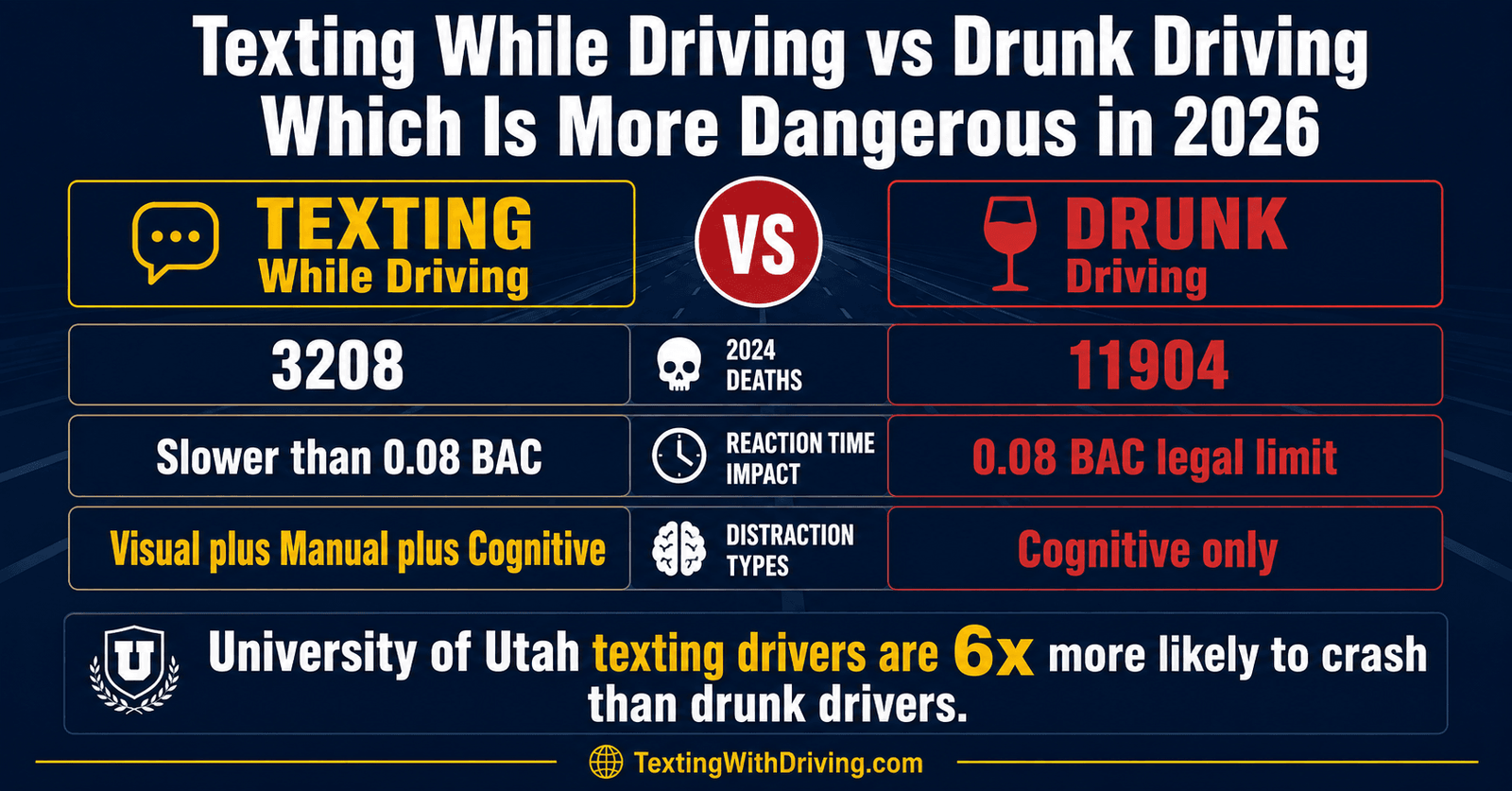
In 2024, there were 11,904 people killed in alcohol-impaired driving crashes in the United States, according to NHTSA. About 30 percent of all traffic crash fatalities involved drunk drivers. Every day, about 32 people in the United States die in drunk-driving crashes, one person every 44 minutes.
Now the distracted driving figure for the same year. In 2024, there were 3,208 people killed and more than 315,000 people injured in traffic crashes involving distracted drivers, according to NHTSA’s most current campaign data. Bachus & Schanker
On raw death numbers alone, drunk driving kills significantly more people annually. That is a fact and it is important to acknowledge clearly. Alcohol-impaired driving caused 11,904 deaths in 2024. Distracted driving caused 3,208 officially attributed deaths in the same year.
But stop there and you are only reading part of the story.
NHTSA has acknowledged that distraction-related injuries and deaths are likely underreported. A 2023 NHTSA report found that in 2019, distraction was involved in 29 percent of all crashes, resulting in an estimated 10,546 fatalities, rather than the approximately 3,100 officially recorded for that year. Driving School
That gap between what is officially documented and what research estimates is the actual number is enormous. Alcohol impairment is measurable at the crash scene with a breathalyzer. Phone distraction almost never is, unless a driver admits to it or a witness observed it. When you account for underreporting, the two behaviors become much closer in actual lethality than the raw annual figures suggest.
The Research That Changed Everything: University of Utah
The most cited comparison between texting while driving and drunk driving comes from a landmark series of studies conducted by Dr. David Strayer and colleagues at the University of Utah Department of Psychology, published in the journal Human Factors.
The University of Utah research found that people are as impaired when they drive and talk on a cell phone as they are when they drive intoxicated at the legal blood-alcohol limit of 0.08 percent, which is the minimum level that defines illegal drunken driving in most US states. Study co-author Frank Drews, assistant professor of psychology, stated that driving while talking on a cell phone is as bad as or maybe worse than driving drunk, which is completely unacceptable and cannot be tolerated. Penske Truck Leasing
That study compared cell phone conversations, both handheld and hands-free, against driving at the legal BAC limit. Texting is a significantly more demanding task than a phone conversation, because it requires visual and manual attention on top of the cognitive load. If phone calls produce impairment equivalent to 0.08 BAC, texting produces impairment that exceeds it.
In a controlled driving simulator, it was found that drivers using their phone actually had a slower reaction time than individuals with a 0.08 blood alcohol content, the legal intoxication limit. The study by Strayer, Drews, and Crouch, published in Human Factors in 2006, found that when drivers were conversing on either a handheld or hands-free cell phone, braking reactions were delayed and they were involved in more traffic accidents than when they were not conversing on a cell phone. By contrast, when drivers were intoxicated from ethanol they exhibited a more aggressive driving style, following closer to the vehicle immediately in front of them and applying more force while braking. NAHB
This is one of the most interesting distinctions the research reveals. Drunk drivers and distracted drivers are impaired in measurably different ways.
Two Very Different Types of Impairment
This is where the comparison gets genuinely nuanced, and understanding the difference matters for understanding the actual danger each behavior creates.
Alcohol impairment primarily affects judgment, coordination, and reaction time. A drunk driver at 0.08 BAC has slowed reflexes and compromised decision-making. But critically, their eyes are on the road. They are receiving visual information from their environment even if they are processing it more slowly than they should. Their impairment is a degraded version of normal driving.
Drunk drivers usually still watch the road. Texting drivers do not pay attention at all. Research from the University of Utah says texting drivers are six times more likely to crash than drunk drivers. Another study shows texting slows reaction times more than alcohol does. Texting distracts your eyes, hands, and mind all at once, making it one of the most dangerous driving habits.
The three-distraction combination is what makes texting uniquely dangerous. The driver’s eyes leave the road entirely for an average of five seconds per text. Their hands leave the wheel to hold and type on the phone. And their cognitive attention shifts to reading and composing a message. All three simultaneously. Not a degraded driving state but an absent one.
Distracted drivers can immediately eliminate their risk by simply putting their phones away. Drunk drivers remain at risk until they are sober. NAHB
That last distinction is worth pausing on. A drunk driver behind the wheel is impaired for the entire duration of the drive, whether they want to be or not. A distracted driver can eliminate their impairment at any moment with a single decision. The risk is entirely within their control in a way that alcohol impairment is not. That makes the continued choice to text while driving something researchers describe as particularly preventable.
What the Crash Data Specifically Shows
The autoinsurance.com 2026 State of Distracted Driving report found that 86 percent of drivers say texting while driving is extremely or moderately dangerous, yet 33 percent do it while actively driving. The behavior is widely condemned and widely practiced. Federal Motor Carrier Safety Administration
That 33 percent figure for drivers who admit to texting while driving is striking in this context. The social norm around texting while driving has not shifted in the way that drunk driving norms shifted after MADD’s campaigns in the 1980s and 1990s. Most people know it is wrong. Many do it anyway.
In the 2024 survey by autoinsurance.com, 63 percent of drivers who knew their state’s texting and driving laws admitted to knowingly violating them. Awareness alone clearly is not enough to change behavior. Federal Motor Carrier Safety Administration
Compare this to the social norm around drunk driving. Most Americans today would not get in the car after four or five drinks. Most would not let a visibly drunk friend drive home. The social prohibition is sufficiently established that the behavior, while still tragically common, carries real social cost for those who engage in it.
Phone use while driving does not yet carry the same social stigma, despite the comparable or greater impairment. That gap between what the science shows and how the behavior is socially treated is arguably the central challenge of distracted driving prevention.
The Legal Treatment: A Striking Asymmetry
Here is where the comparison between these two behaviors becomes most unequal.
Drunk driving is a criminal offense in every US state. A first DUI offense typically carries potential jail time, substantial fines, mandatory license suspension, and required alcohol education programs. Repeat offenders face felony charges. The legal system treats impaired driving as a serious crime worthy of criminal prosecution.
Texting while driving in most states is a traffic infraction, roughly equivalent legally to speeding. The fines are modest in most states, ranging from $25 in Alabama and Texas to around $200 in New York. There is no possibility of jail time for a texting violation in the vast majority of states, no mandatory education program, and no automatic license suspension for a first or even a second offense.
Drivers with BACs of 0.08 g/dL or higher involved in fatal crashes were 3 times more likely to have prior convictions for driving while impaired than were drivers with no alcohol. The legal system generates a documented record of prior offenses that can escalate consequences for repeat drunk drivers.
No equivalent escalation system exists for distracted driving in most states. A driver who has been cited for texting while driving multiple times typically faces the same small fine each time, with no escalating deterrent.
This legal asymmetry does not reflect what the science says about the comparative risks. It reflects the historical timeline of when each issue became a public concern. Drunk driving laws were forged over decades of advocacy beginning in the 1970s and 1980s. Distracted driving laws are still catching up to a behavior that became widespread only in the past fifteen years. The legal framework will evolve. It simply has not evolved as fast as the technology created the problem.
Where the Numbers Look Similar: Young Drivers
One demographic where both behaviors converge on similarly alarming statistics is young adult drivers aged 18 to 34.
Men ages 21 to 34 were the highest percentage of alcohol-impaired drivers involved in fatal traffic crashes in 2023. One person died every 42 minutes in an alcohol-impaired driving crash in 2023.
NHTSA’s 2026 Put the Phone Away or Pay enforcement campaign specifically targeted drivers ages 18 to 34, who according to NHTSA data are more likely to die in distraction-affected crashes than any other age group. Driving School
The same demographic sits at the peak of risk for both behaviors. This is not coincidental. The factors that make young adult drivers most likely to drink and drive overlap significantly with the factors that make them most likely to text and drive. Social pressure, optimism bias about personal risk, high social media engagement, and less established safe-driving habits that have become automatic.
What differs is that the social norms around drunk driving have shifted most significantly for younger generations. Young Americans today have grown up with designated driver culture, Uber, and aggressive anti-drunk-driving education. Many would never drink and drive but do not think twice about checking their phone at highway speed. The generational norm shift that happened for alcohol has not yet happened for phones.
The Comparison That Should Change Your Behavior
Here is the practical takeaway from all of this research.
If you would not drive after four drinks, the impairment data says you should not drive while texting. The reaction time is comparable or worse. The crash risk per University of Utah research is actually higher. The only meaningful distinction is social acceptability, and social acceptability is a poor guide to actual danger.
The estimated economic cost of alcohol-impaired driving crashes in the United States in 2019 was $58 billion. NHTSA’s broader distracted driving economic estimate for the same year put the cost of all distracted driving crashes at $98.2 billion, with distraction involved in 29 percent of all crashes.
At the economic level, distracted driving costs the country more than drunk driving annually, even accounting for the underreporting issue. The problem is large enough and costly enough that it belongs in the same conversation about dangerous driving that drunk driving has occupied for forty years.
None of this changes the fact that drunk driving remains one of America’s most serious road safety crises. In 2024, 11,904 people were killed in alcohol-impaired crashes, with about 30 percent of all traffic fatalities involving drunk drivers. The advocacy work of organizations like MADD, the legal framework built over decades, and the cultural shift around designated driving have all produced real reductions in alcohol-related deaths from the historic highs of the early 1980s. That progress is genuine and worth acknowledging.
The point is not that one behavior is acceptable because another is worse. Both are dangerous. Both are illegal in every state in some form. Both kill people who did not choose to be on the road with an impaired driver. The point is that the level of social seriousness Americans attach to texting while driving should match what the research says about its actual danger, and right now it does not.
For the full death toll data from distracted driving, see our distracted driving statistics 2026 overview. For the specific science behind why five seconds of looking at a phone is so dangerous, see our breakdown of the real danger of texting while driving. For the legal picture of what your state’s laws actually say about phone use behind the wheel, see our texting while driving laws by state 2026 guide.
Sources Used in This Article
All links verified working before publication.
NHTSA: Drunk Driving Statistics and Resources — National Highway Traffic Safety Administration, 2024 data
NHTSA: Distracted Driving Campaign Data — 2024 death and injury figures
NHTSA: Alcohol-Impaired Driving Countermeasures — Legislative and behavioral data
NHTSA CrashStats: 2023 Alcohol-Impaired Driving Report — DOT HS 813 713, May 2025
University of Utah: Drivers on Cell Phones Are as Bad as Drunks — Dr. David Strayer original study summary
PubMed: A Comparison of the Cell Phone Driver and the Drunk Driver — Strayer, Drews, Crouch, Human Factors 2006
EndDD.org: Research and Statistics — University of Utah study summary and driving simulator results
Autoinsurance.com: The State of Distracted Driving 2026 — March 2026 national driver survey
MADD: More Than 13,000 Deaths in Alcohol-Related Crashes — Mothers Against Drunk Driving
GHSA: Distracted Driving State Laws — Governors Highway Safety Association
TextingWithDriving.com is professionally built and maintained to ensure accurate, accessible safety information reaches every driver who needs it. Website development and ongoing support is handled by Budgetic, a digital agency specializing in purpose-driven WordPress websites.

About Texting With Driving
TextingWithDriving.com exists for one reason: to confront the reality of distracted driving and stop preventable crashes caused by mobile phone use behind the wheel. Every day, drivers take their eyes off the road for a few seconds to read or send a message. Those few seconds are enough to cause life-altering consequences. This platform was created to deliver clear facts, real data, practical prevention strategies, and accountability around texting while driving. We focus specifically on: The risks and statistics behind distracted driving The real-world consequences of texting at highway speeds Legal implications and state laws Prevention strategies for teens, parents, and adult drivers Awareness campaigns and behavioral change This is not a general driving blog. It is a focused awareness initiative built around one critical issue: phone distraction behind the wheel. Our content is direct, research-driven, and practical. We prioritize accuracy over opinion and education over sensationalism. The goal is simple — reduce distracted driving incidents by increasing awareness and responsibility. If one article causes one driver to put their phone down, the mission is working. For inquiries or partnerships, contact: privacy@textingwithdriving.com
View all posts by Texting With Driving