

Missouri Hands-Free Driving Law 2026: What Every Driver Must Know

Missouri Hands-Free Driving Law 2026: What Every Driver Must Know
If you drive in Missouri, the rules around your phone changed significantly in recent years. And in 2026, those rules are fully in force with real fines, escalating penalties, and in the most serious cases, the possibility of years in prison.
Missouri’s Siddens Bening Hands-Free Law is now one of the most significant pieces of traffic safety legislation in the state’s history. It extended phone restrictions to all adult drivers for the first time, replacing a patchwork of age-based rules that left most Missouri adults without any meaningful legal restriction on phone use behind the wheel.
This guide covers everything you need to know: exactly what the law bans, what it still allows, how the fines work, how enforcement operates, and why the law came to be named after two people whose deaths might have been prevented if it had existed sooner.
The Name Behind the Law
Missouri’s hands-free law is formally known as the Siddens Bening Hands-Free Law, named for two Missouri residents killed by distracted drivers.
The Siddens Bening Hands-Free Law is named for two Missouri motorists killed by distracted drivers. Missouri’s Governor Mike Parson signed the law after two years of increased distracted driving accidents in Missouri, which had made distracted driving the leading cause of car accidents in the state. Wikipedia
The decision to attach the names of real victims to the legislation is significant. It is a reminder that the law did not emerge from abstract policy discussion. It emerged from specific, preventable deaths on Missouri roads, and from the advocacy of families who refused to let those deaths go unaddressed.
There were over 800 distracted driving fatalities in Missouri between 2012 and 2021, a number believed to be greatly underreported since it is not always possible to prove that a driver was looking at a phone during an accident. Wikipedia
That 10-year death toll, spanning more than 800 lives with the real number almost certainly higher, is the context in which the legislature finally acted. Missouri had been one of the last states to extend restrictions to all adult drivers, and the cost of that delay is documented in those crash reports.
Timeline: When Did the Law Actually Take Effect?
Understanding the timeline matters because there has been some confusion among Missouri drivers about when exactly the law became enforceable.
The Siddens Bening Hands-Free Law took effect on August 28, 2023, prohibiting drivers from having a device in hand, sending texts, recording or posting video, or watching movies while operating a vehicle, as the Missouri Department of Transportation confirmed. USClaims
However, the August 2023 date was not when fines began.
Under the law there was a 16-month grace period to allow law enforcement to educate drivers about the new law. During the grace period, only warnings could be given out. On January 1, 2025, law enforcement could start handing out citations for the hands-free violation.
So the current position in 2026 is this: the law has been in full enforcement mode since January 1, 2025. The grace period is over. If you are caught violating the Siddens Bening Hands-Free Law in Missouri today, you receive a citation and a fine, not a warning.
What the Law Specifically Bans
The Missouri law is written broadly enough to cover virtually every common form of phone use while driving. Understanding exactly what counts as a violation helps you stay compliant.
In Missouri, it is illegal to hold or support a cell phone or an electronic communication device in your hand, lap, or other parts of the body while driving on Missouri roads. With very few exceptions, anything that involves typing, scrolling, holding, or supporting a device while driving is off-limits.
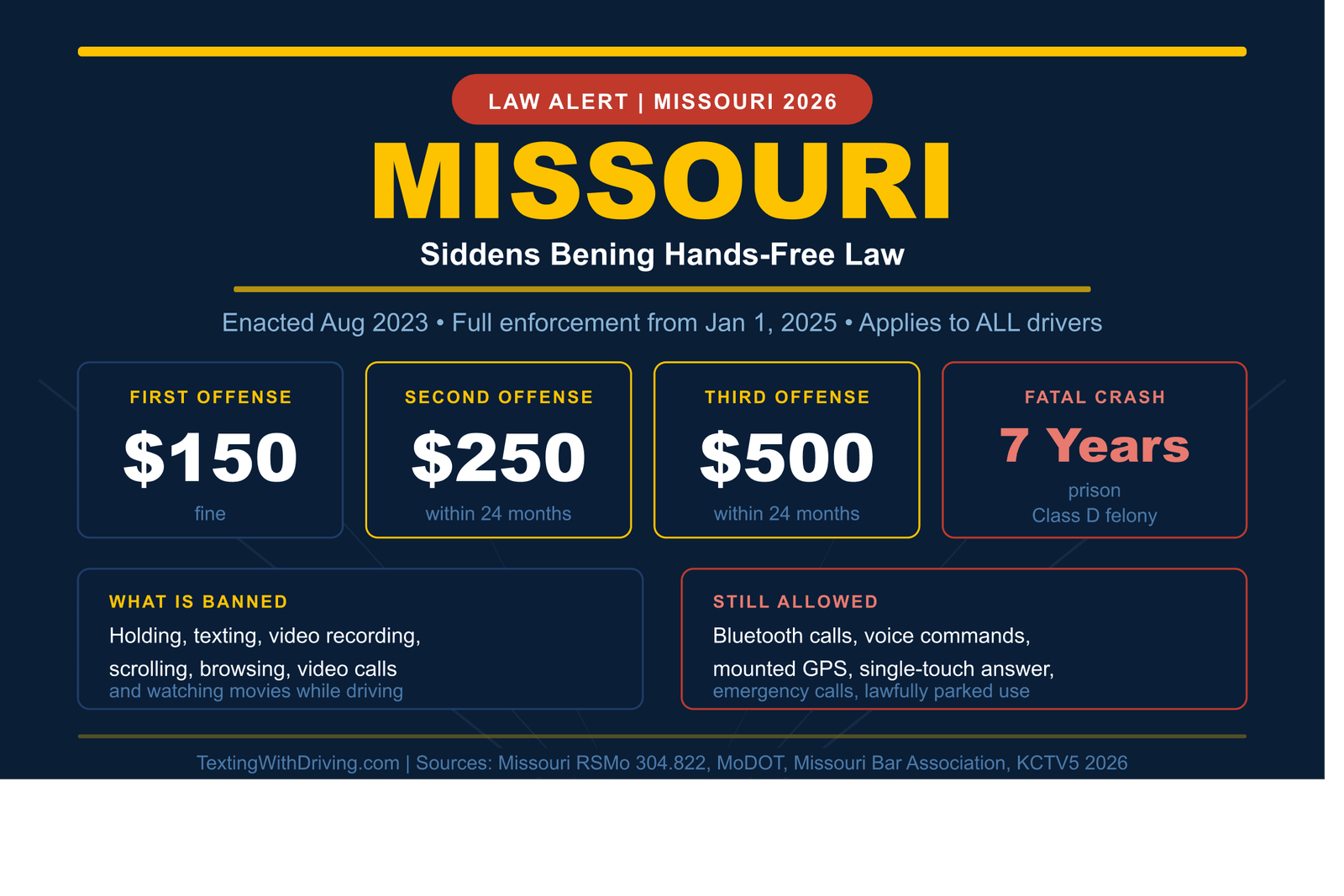
Under Missouri’s hands-free law, all drivers are now prohibited from using handheld devices for various activities. The law bans: holding or supporting your phone with any part of your body, sending or reading text-based communications including emails and social media posts, recording, posting, or broadcasting video content including live video calls, and watching movies or other video content while driving.
The definition of electronic communication device under the law is intentionally broad. According to Missouri Revised Statute 304.822, the definition of a device under this law includes cell phones, tablets, laptops, portable gaming systems, and other electronic devices capable of communication, data storage, or video display. USClaims
This broad scope means the law is not limited to smartphones. A driver holding a tablet on their lap, using a portable gaming device, or watching content on a laptop while driving is equally in violation.
One specific and important restriction that many drivers are unaware of relates to video recording. The law prohibits watching movies and videos as well as recording, posting, sending, or broadcasting videos, even if the phone is securely mounted.
That last clause is significant. Mounting your phone on the dashboard does not give you legal cover to record or livestream while driving. The mounting exemption covers navigation and audio. It does not cover video activity.
What the Law Still Allows
Missouri’s law is a hands-free requirement, not a total phone ban. Drivers have meaningful legal options for staying connected on the road.
Drivers can make or receive calls via hands-free devices such as Bluetooth systems, speakerphones, or dashboard mounts. The law allows the use of hands-free or voice-operated functions including voice-to-text or virtual assistants. Drivers may navigate with GPS map displays while the cell phone or device is mounted, and may engage navigation features while parked and prior to driving. Playing music or audio apps while the cell phone or device is mounted is also permitted.
The law allows a single touch to answer or end a call. Hands-free calling through Bluetooth, speakerphone, or a car’s built-in system is permitted. Mounted navigation with GPS is allowed as long as the phone is properly mounted in the vehicle. NHTSA
The single-touch rule is a practical concession that allows drivers to answer an incoming call without asking them to completely ignore their phone. The key word is single. One tap to accept, one tap to end. Any interaction beyond that, scrolling, typing, adjusting settings, moves into violation territory.
Specific exemptions under the law include drivers reporting an emergency or crime to law enforcement, fire department, hospital, or similar emergency entity. Drivers holding or using cell phones while lawfully stopped or parked are also exempt. First responders including law enforcement, fire, EMS, emergency roadside service, and public utility workers using electronic devices as part of their official duties are exempt. Commercial truck drivers using a mobile data terminal are exempt, as are transit, for-hire, and network company drivers provided that the device is mounted or affixed to the vehicle.
The parked vehicle exemption is straightforward and important. If you need to send a message, check your navigation, or deal with your phone, pull over and park completely. The law does not apply to a driver sitting in a legally parked vehicle.
The Fine Structure: What a Violation Actually Costs
For a conviction under this section where there is no prior conviction within the preceding twenty-four months, the court shall impose a fine of up to one hundred fifty dollars. For a conviction where there is one prior conviction within the preceding twenty-four months, the court shall impose a fine of up to two hundred fifty dollars.
A third offense within 24 months costs the driver five hundred dollars. Drivers caught texting and driving in school or construction zones will receive enhanced fines of up to five hundred dollars for a first offense.
The full penalty structure escalates significantly when a phone violation contributes to a crash:
If a violation causes serious physical injury, the charge escalates to a class B misdemeanor with up to six months in jail and fines up to one thousand dollars. If a violation is the proximate cause of the death of another person, the driver faces a class D felony charge with up to seven years in prison. Drivinglaws101
Seven years in prison for a violation that causes a fatality. That penalty transforms what begins as a modest traffic infraction into something with potentially life-altering legal consequences the moment a crash occurs.
For commercial drivers, the stakes are higher still. A violation of this section while operating a commercial motor vehicle shall be deemed a serious traffic violation, which can affect commercial driver’s license status and create long-term career consequences for professional drivers.
The Enforcement Challenge Missouri Faces in 2026
Here is the part of the Missouri law that is generating real conversation in 2026, and that every Missouri driver should understand.
Missouri State Highway Patrol Corporal Justin Ewing confirmed that troopers cannot stop a driver solely for using their phone. State law says troopers cannot pull you over just for using your phone. Corporal Ewing said that if hands-free became a primary violation, it would be easier for law enforcement to act. He noted that the numbers would hopefully go up over the coming years as officers gain better strategies for enforcing the law.
Drivers cannot be stopped solely for a violation of the hands-free law. The law is a secondary offense, meaning officers must have another reason, such as a different moving violation, before they can stop someone for a hands-free violation.
This secondary enforcement status is the most significant limitation on the law’s deterrent effect. In states where handheld phone use is a primary offense, meaning an officer can pull you over specifically for phone use without any other reason, the research consistently shows faster reductions in phone-related crashes after the law passes. Missouri’s law, as written, requires another infraction first.
However, there is an important nuance here that some sources have described differently.
Breaking the hands-free law is treated as a primary offense for every driver under Missouri’s new law, marking a change from the older texting law which counted as a secondary offense for most people. NHTSA
This apparent contradiction in reporting reflects genuine ambiguity in how the law has been applied and interpreted since full enforcement began in January 2025. The Missouri Bar Association’s own guidance and the Missouri State Highway Patrol’s public statements have both indicated secondary enforcement in practice. If you are a Missouri driver, the safest assumption is that an officer who stops you for another reason can and will add a hands-free citation if they observe phone use.
KCTV5 Investigates reached out to the Kansas City, Lee’s Summit, and Independence police departments about this law. All three said they cannot currently enforce the hands-free law because it is a state law and blocks cities from creating their own ordinances.
That local preemption clause means Missouri municipalities cannot pass stricter local phone use ordinances than the state law. The state law is the floor and the ceiling simultaneously for local governments.
The Impact After One Year of Enforcement
Distracted driving in Missouri dropped by 7.8 percent since the state enacted the Siddens Bening Hands-Free Law prohibiting Missouri drivers from holding a cell phone while behind the wheel. Wikipedia
Recent news reports indicate that Missouri has already seen positive results one year after the new hands-free law’s passage. Driver phone use has reportedly decreased substantially since the law took effect, leading to fewer accidents and traffic fatalities statewide. World Population Review
A 7.8 percent reduction in distracted driving after a single year of enforcement is a meaningful result, particularly given the secondary enforcement limitation. The research on what hands-free laws produce in other states suggests that this improvement would likely be more pronounced if enforcement shifted to primary status, allowing officers to stop drivers specifically for phone use without needing another violation.
For comparison, states like Iowa that enacted hands-free laws with primary enforcement saw phone distraction fall 3.9 percent in the first month alone, according to Cambridge Mobile Telematics data. Missouri’s result over a full year, while positive, reflects what secondary enforcement typically produces: real but more gradual behavioral change.
How This Compares to Other States
Missouri’s law is now broadly consistent with the majority of US states that have enacted hands-free legislation, though it remains a secondary enforcement law where most similar state laws are primary.
Before the statewide change, only drivers younger than 21 were prohibited from texting while driving in Missouri, but now the law extends to every driver regardless of age, making the restrictions uniform across the state. NHTSA
For the complete picture of how Missouri’s law compares to all 50 states including fine structures, enforcement types, and exemption categories, see our full texting while driving laws by state 2026 guide. For the national distracted driving data that provides context for why Missouri’s law was necessary, the distracted driving statistics 2026 overview has everything in one place.
What Missouri Drivers Should Do Right Now
The practical steps for compliance are straightforward.
Mount your phone before you start driving if you use it for navigation. A properly mounted phone used only for GPS display is legal. A phone resting on your lap being used for the same purpose is not. The difference is physical contact with your body.
Set up voice activation for calls and messages before you drive. Missouri law explicitly permits hands-free calling and voice-to-text when the phone is not being held. Apple’s Siri, Google Assistant, and most car Bluetooth systems handle this without any physical phone interaction.
If you need to interact with your phone beyond a single tap, pull over and park completely before doing so. The law is explicit that a lawfully parked driver is not subject to the hands-free restriction.
For teen drivers in Missouri and their parents, the law’s application to all drivers regardless of age means the same rules now apply to a 16-year-old learner and a 50-year-old experienced driver. The conversation about phone-free driving habits is no longer just about teen-specific restrictions. It is about the law that applies to everyone in the family vehicle. For guidance on having that conversation effectively, see our article on why teen drivers are the most at-risk group for distracted driving.
Sources Used in This Article
All links verified working before publication.
Missouri Revisor of Statutes: Section 304.822 — Official text of the Siddens Bening Hands-Free Law
Missouri Department of Transportation: Phone’s Down It’s the Law — MoDOT official law summary
Missouri Bar Association: Phones Down Missouri’s Hands-Free Driving Law — Legal guidance and fine structure
KCTV5: Why Missouri’s Hands-Free Law Isn’t Stopping Drivers — January 2026 enforcement investigation
Beck Law: Missouri Distracted Driving Laws 2026 — January 2026 legal overview
Ryan R. Cox and Associates: Missouri’s Hands-Free Law Reduces Distracted Driving — January 2026, one-year impact report
Montee Law Firm: Hands-Free Law Missouri — Comprehensive legal breakdown
DM Injury Law: Missouri Hands-Free Driving Law 2025 — Fine structure and personal injury implications
GHSA: Distracted Driving State Laws — National state law comparison
NHTSA: Distracted Driving — National distracted driving data
TextingWithDriving.com is professionally built and maintained to ensure accurate, accessible safety information reaches every driver who needs it. Website development and ongoing support is handled by Budgetic, a digital agency specializing in purpose-driven WordPress websites.

About Texting With Driving
TextingWithDriving.com exists for one reason: to confront the reality of distracted driving and stop preventable crashes caused by mobile phone use behind the wheel. Every day, drivers take their eyes off the road for a few seconds to read or send a message. Those few seconds are enough to cause life-altering consequences. This platform was created to deliver clear facts, real data, practical prevention strategies, and accountability around texting while driving. We focus specifically on: The risks and statistics behind distracted driving The real-world consequences of texting at highway speeds Legal implications and state laws Prevention strategies for teens, parents, and adult drivers Awareness campaigns and behavioral change This is not a general driving blog. It is a focused awareness initiative built around one critical issue: phone distraction behind the wheel. Our content is direct, research-driven, and practical. We prioritize accuracy over opinion and education over sensationalism. The goal is simple — reduce distracted driving incidents by increasing awareness and responsibility. If one article causes one driver to put their phone down, the mission is working. For inquiries or partnerships, contact: privacy@textingwithdriving.com
View all posts by Texting With Driving