

Pennsylvania Paul Miller’s Law Day 1: What Happened When Full Enforcement Began

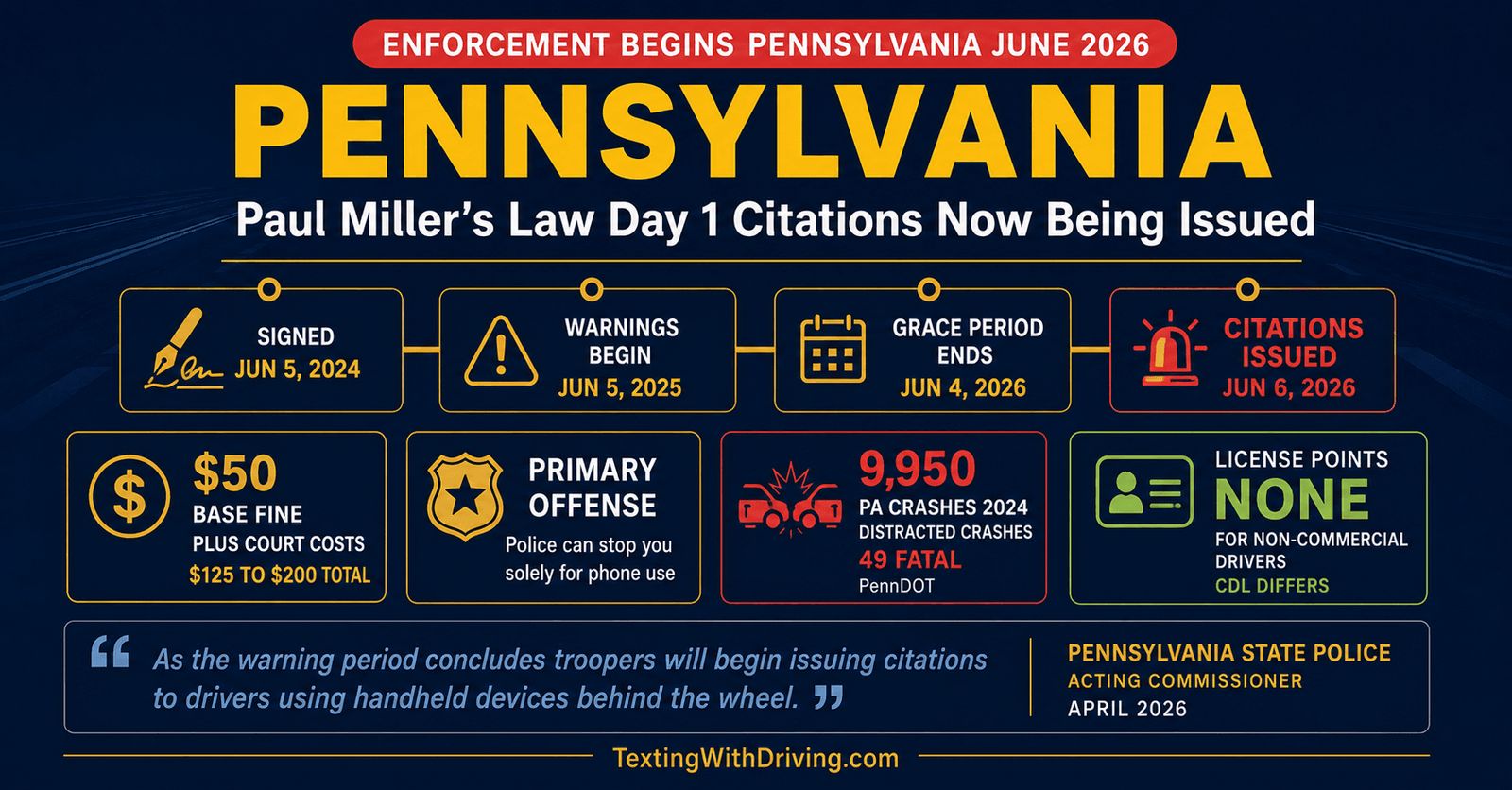
Pennsylvania Paul Miller’s Law Day 1: What Happened When Full Enforcement Began
For twelve months, Pennsylvania State Police and local law enforcement across the commonwealth had been stopping drivers, observing handheld phone violations, and issuing written warnings. Explaining the new law. Handing over educational materials. Documenting the violation without imposing a fine.
That phase ended on the morning of June 5, 2026.
Beginning June 6, 2026, the warnings became citations. The $50 base fine became real. And Pennsylvania’s 9 million licensed drivers entered a new legal reality on the road: holding a phone while driving is a primary offense, enforceable by any officer anywhere in the state, no other violation required.
This article covers exactly what happened on Day 1 of full enforcement, what the law now requires, what drivers can expect from officers going forward, and what the one-year warning period accomplished in terms of public awareness and behavioral change.
The Precise Timeline: Understanding What Changed When
Before getting into the enforcement details, the timeline of Paul Miller’s Law is worth stating with complete precision, because there has been genuine public confusion about exactly when each phase of the law took effect.
Governor Josh Shapiro signed Senate Bill 37 into law on June 5, 2024. That was the legislative moment, not the enforcement moment.
Effective June 5, 2025, the law known as Paul Miller’s Law prohibits the use of hand-held devices while driving, even while stopped temporarily due to traffic, a red light, or other momentary delay. Beginning June 5, 2025, law enforcement will begin issuing written warnings for violations of Senate Bill 37. Law enforcement will have the ability to issue summary citations to violators beginning June 6, 2026. EndDD
So the correct sequence is:
June 5, 2024: Governor Shapiro signs SB 37. The law exists but is not yet active.
June 5, 2025: The law takes full effect. From this date, holding a phone while driving is illegal in Pennsylvania. Officers begin issuing written warnings. No fines yet.
June 4, 2026: The grace period ends. The final day of written-warning-only enforcement.
June 6, 2026: Full citation enforcement begins. Officers issue $50 summary citations plus court costs from this date forward.
The June 6 date rather than June 5 is confirmed in both the official PennDOT announcement and in the Pennsylvania State Police communications about the enforcement transition. The distinction matters if you received a citation on June 5, 2026, specifically, but for all practical purposes, the morning of Friday June 6, 2026 was the day every Pennsylvania driver woke up in a state where a phone in your hand while driving carried a real financial consequence.
What Paul Miller’s Law Actually Bans: The Full Scope
Because Pennsylvania already had a texting ban since 2012, some drivers assumed that Paul Miller’s Law was simply a stronger version of the texting ban they had known for years. It is substantially broader than that.
Since 2012, Pennsylvania has banned text-based messaging while a vehicle is moving. But that rule let drivers hold a phone to talk, browse social media, or stream video, and it applied only when the car was in motion. Paul Miller’s Law prohibits holding or supporting any interactive mobile device for almost any purpose, even while stopped at a red light. Police can use the violation itself as the reason for a traffic stop as a primary offense, closing a gap that let many drivers slide by. Marylandinjuryattorneyblog
The scope difference between the 2012 texting ban and Paul Miller’s Law is significant and worth being specific about for every Pennsylvania driver.
The 2012 texting ban: prohibited reading, writing, or sending text-based communications while the vehicle was in motion. Holding the phone for a voice call was legal. Holding it to scroll social media was legal. Holding it to use the GPS map was legal. And none of it was a primary offense.
Paul Miller’s Law: prohibits holding or physically supporting a phone or any interactive mobile device while operating a motor vehicle on a public road, including while stopped at a red light, in a traffic jam, or at any other momentary stop. The phone must not be in your hand for any reason while you are behind the wheel of a vehicle on a public road.
Paul Miller’s Law is a new law in Pennsylvania that prohibits drivers from holding cellphones or other electronic devices while operating a motor vehicle. An interactive mobile device includes any handheld phone, smartphone, tablet, personal digital assistant, or similar wireless device capable of calling, texting, emailing, browsing the internet, using apps, playing games, recording or sharing media, or sending and receiving electronic data. New Hampshire DOT
That definition of interactive mobile device is deliberately comprehensive. It covers every smartphone in existence, every tablet, every portable gaming device with communication capability, and every similar device. It is not limited to iPhones and Android phones. It covers the full range of handheld connected technology.
The Red Light Clarification: The Most Common Misconception
One aspect of Paul Miller’s Law that was generating active confusion on social media and in news coverage in the days leading up to June 6 was the red light question. Drivers assumed that being stopped at a red light created a legal window to use their phone. It does not.
Officers can pull you over solely for holding your phone, even if your car is not moving. This has been the law since June 5, 2025, with fines beginning June 5, 2026. Michigan Auto Law
The legal basis for this is in how the law defines operating a motor vehicle. Pennsylvania law defines operating to include any time the driver is in control of the vehicle on a public road, regardless of whether the vehicle is moving. A driver stopped at a red light is operating the vehicle. A driver stopped in a traffic backup is operating the vehicle. A driver waiting to make a left turn is operating the vehicle.
The only situations in which the handheld restriction does not apply are when the driver is lawfully stopped or parked, meaning they have pulled completely off the roadway and are no longer in the traffic lane. A parking lot, a designated pull-off, a street-legal parking space with the vehicle stopped: these qualify as lawfully parked. A red light, a stop sign, a backup, a construction zone delay: none of these qualify.
The practical implication is simple: if you are in the driver’s seat and you are on a public road, the phone stays down. The only legal exception to this is a single-touch answer to an incoming call, which does not require lifting or holding the device, or a call made through a mounted device or Bluetooth system that requires no physical phone handling.
What the $50 Fine Actually Costs You
The headline fine is $50. But as with most traffic citations, the headline figure understates the actual cost.
Beginning June 5, 2026, drivers convicted of using a hand-held device while driving will pay a $50 fine, plus court costs and other fees. Court costs in Pennsylvania typically add $75 to $150 on top of the base fine, so the real out-of-pocket cost is closer to $125 to $200 per violation. Michigan Auto Law
That total of $125 to $200 for a first offense is still on the lower end of the national range for distracted driving first offenses. Oregon’s first offense is $1,000. Connecticut’s is $200. Alaska treats texting while driving as a criminal misdemeanor with fines up to $10,000. Pennsylvania’s $50 base fine reflects a legislative decision to start with a modest financial deterrent and rely more heavily on the primary enforcement mechanism for behavioral change. The ability to stop any driver for phone use alone, without needing another violation, is the law’s primary deterrent tool. The fine level is secondary.
The violation carries no points as a penalty and will not be recorded on the driver record for non-commercial drivers. That is important: a citation under Paul Miller’s Law will not directly affect your driver’s license or cause automatic insurance surcharges the way a moving violation would. However, many insurance companies treat handheld-device violations as risk indicators. A citation could lead to increased premiums. Your insurer may learn of the violation even without points attaching. Michigan Auto Law
No license points for non-commercial drivers. This distinguishes Paul Miller’s Law from New York’s handheld law, which adds five points per violation, one of the most significant point penalties in the country. Pennsylvania’s approach prioritizes deterrence through enforcement visibility rather than through license record consequences.
However, the no-points designation should not create false comfort about insurance impact. As we covered in detail in our article on what happens to your car insurance after a distracted driving ticket, most major insurers access motor vehicle records when quoting or renewing policies and treat distracted driving citations as elevated risk indicators regardless of whether points were assigned. A Paul Miller’s Law citation that costs $150 at the courthouse can cost several hundred dollars per year in increased insurance premiums for three to five years afterward.
For commercial drivers, the consequences are more serious. The violation will be recorded on commercial drivers’ records and can affect CDL status with significant career implications. Commercial drivers operating under FMCSA regulations already face stricter phone restrictions than standard state law requires. A Paul Miller’s Law citation adds to their violation record in a way that can affect future driving employment.
The Primary Enforcement Mechanism: Why This Law Carries More Weight
The most significant feature of Paul Miller’s Law, the one that distinguishes it from most previous Pennsylvania traffic enforcement on this issue, is its classification as a primary offense.
Police can use the violation itself as the reason for a traffic stop as a primary offense, closing a gap that let many drivers slide by. Marylandinjuryattorneyblog
Under the 2012 texting ban that Pennsylvania had previously, phone use while driving was a secondary offense. Officers needed another violation before they could legally initiate a stop for phone use. A driver who was texting but not speeding, not weaving, and not violating any other traffic law could not be pulled over specifically for phone use under the 2012 law.
Paul Miller’s Law is explicitly primary. An officer who observes a driver holding a phone in any position on any public road has the legal authority to immediately initiate a traffic stop based solely on that observation. No other violation is required, no additional justification is needed. The observation is the probable cause.
This primary enforcement status, combined with active enforcement deployment from Pennsylvania State Police, local police departments, and county sheriffs across the state, creates a deterrent environment that the secondary-offense framework never could. Drivers in primary enforcement states know that phone use at any moment on any road carries the real risk of an immediate traffic stop.
Comparative data from other states that transitioned from secondary to primary enforcement, including Ohio, Michigan, and Oregon, shows measurable reductions in observed handheld phone use within weeks of the transition. Pennsylvania’s enforcement trajectory will be watched closely by road safety researchers, and PennDOT has committed to tracking and publishing distracted driving crash data to assess the law’s impact over the coming years.
What the One-Year Warning Period Accomplished
The transition to citations on June 6, 2026 is the end of a twelve-month process that was itself part of the law’s strategy. Understanding what that warning period was designed to accomplish helps evaluate whether the approach worked.
The warning period served two distinct purposes. First, it gave every Pennsylvania driver a full year of exposure to the law’s existence, its requirements, and the knowledge that enforcement was coming. Officers who issued written warnings during this period were simultaneously educating drivers about exactly what the law prohibited, which is a function that pure citation enforcement cannot replicate because drivers who receive citations already know they violated the law.
Second, the warning period allowed law enforcement agencies across the commonwealth to develop their own enforcement protocols, train officers in what constitutes a violation under the new law’s specific language, and identify operational questions about how the law applies in edge cases. Twelve months of warning-stage enforcement produced organizational learning that made citation enforcement more consistent and legally defensible when it began.
As the warning period for Paul Miller’s Law concludes, troopers will begin issuing citations to drivers using handheld devices behind the wheel, said Pennsylvania State Police Acting Commissioner Lieutenant Colonel George L. Federal Communications Commission
The Pennsylvania State Police statement acknowledges the transition explicitly. The warning period was the designated preparation window. Its conclusion is not a surprise to any driver who was paying attention. The law, its enforcement mechanism, and its June 2026 citation date were publicly communicated from the moment Governor Shapiro signed the bill in June 2024.
Any driver who received a written warning during the twelve-month grace period and continued to use their phone while driving was essentially choosing to accept the certainty of eventual citation enforcement. That choice becomes significantly more expensive from June 6, 2026 forward.
The Anti-Bias Data Collection Requirement
One element of Paul Miller’s Law that distinguishes it from most comparable state legislation is the mandatory data collection provision related to traffic stop demographics.
Paul Miller’s Law will also work to prevent bias in policing by requiring law enforcement to collect data on drivers pulled over during traffic stops, including race, ethnicity, and gender. The data will be made publicly available in an annual report. This amendment which the Governor advocated for in conjunction with the Legislative Black Caucus builds on the Shapiro Administration’s work to ensure Pennsylvanians can have the utmost faith in the law enforcement officers serving and protecting them every day. EndDD
This provision reflects a recognition that primary enforcement traffic laws create discretionary stop authority that has historically been applied unequally across racial and demographic groups in some jurisdictions. By requiring detailed stop-level data collection from the first day of enforcement, the law creates accountability infrastructure that will allow the public, legislators, and oversight bodies to evaluate whether Paul Miller’s Law is being enforced equitably across Pennsylvania’s diverse communities.
The annual reports produced under this requirement will be public documents, available to anyone who wants to analyze enforcement patterns. This transparency mechanism was specifically advocated for by the Legislative Black Caucus during the bill’s legislative process, reflecting the deliberate choice to pair expanded enforcement authority with expanded accountability requirements.
What Eileen Miller Said When Enforcement Finally Began
Behind every law is a person or a family whose loss made the legislation necessary. Paul Miller’s Law was created by fourteen years of advocacy from Eileen Miller, whose son Paul was killed in 2010 when a distracted tractor-trailer driver crossed the median on Route 33 in Monroe County and struck his vehicle.
Nearly 15 years ago, two Dunmore state troopers knocked on my door to tell me that my son was killed. My son did everything right. He was killed by someone else’s unsafe choices behind the wheel. This law is for every family in Pennsylvania that doesn’t have to experience two state troopers knocking on their door to tell them that their loved one was killed by distracted driving. Paul Miller’s Law will be a beacon of protection for every driver and passenger in Pennsylvania, said Eileen Miller. Federal Communications Commission
Fourteen years of advocacy. Fourteen years of testimony before legislative committees, fourteen years of speaking at public events, fourteen years of being the living consequence of someone else’s decision to reach for a phone. When Eileen Miller speaks about what it means for citation enforcement to finally begin, she speaks with a specificity that no policy document can capture.
Paul Miller Jr. was 21 years old. The driver who killed him was looking at his phone. A law that exists because of that specific moment, now in full enforcement across the entire commonwealth with real financial consequences for violation, is what her advocacy produced.
The data from the law’s first year of citation enforcement will eventually tell us how many crashes were prevented, how many citations were issued, and whether the behavioral shift that other states experienced after similar legal transitions is happening in Pennsylvania. That data is the measure of whether the law is working.
But the law’s existence and its full enforcement from June 6, 2026 forward is already the measure of whether fourteen years of advocacy was worth it. By that measure, it was.
What Pennsylvania Drivers Need to Do Right Now
If you drive in Pennsylvania and this article is your first detailed encounter with what Paul Miller’s Law requires, here is the practical checklist.
Your phone cannot be in your hand while your vehicle is on a public road in Pennsylvania. Not while moving. Not at a red light. Not in a traffic jam. Not while waiting to turn. The only exceptions are emergency calls to 911 and single-touch call answering where the phone remains unmounted and untouched beyond that single interaction.
To use your phone legally while driving in Pennsylvania: mount it on the dashboard or windshield before the drive begins and use it for GPS navigation only, activate Bluetooth for calls so the phone remains untouched, or use your vehicle’s built-in hands-free system. For message management, activate iPhone Driving Focus or Android’s driving mode before you start the car. Our step-by-step guide to setting up Do Not Disturb While Driving on iPhone and Android covers both platforms in under two minutes.
If you have questions about what specifically is and is not permitted under the law’s language, our complete Pennsylvania distracted driving law 2026 guide covers the full statutory framework including what counts as an interactive mobile device, what constitutes lawfully parked, and how the single-touch exception works in practice.
For the complete national picture of which states have comparable laws and how Pennsylvania’s law compares in terms of fine structure and enforcement type, see our hands-free driving laws by state 2026 overview.
Sources Used in This Article
All links verified working before publication.
PennDOT: Paul Miller’s Law Effective June 5 — Official PennDOT announcement with enforcement timeline, June 5, 2025
CrimeWatch: Paul Miller Law Fines Go Into Effect June 5, 2026 — Pennsylvania State Police Acting Commissioner statement, April 2026
AllAboutLawyer.com: Paul Miller’s Law Pennsylvania — Fine structure, court costs, no-points detail, May 2026
Atlee Hall: Paul Miller’s Law PA New Hands-Free Rule — Primary offense analysis and 2012 ban comparison
KBG Injury Law: What Is Paul Miller’s Law — Fine details, CDL consequences, criminal escalation
North Penn Now: New PA Distracted Driving Law Takes Effect Thursday — Day one reporting, warning period launch
Bradford Era: Hands Off Paul Miller’s Law Takes Effect June 5 — Eileen Miller quote and DA statement on 12-month warning approach
Fox56: Paul Miller’s Law Takes Effect in Pennsylvania — Local reporting on what law means for drivers
Yahoo News: What to Know About New PA Law Banning Hand-Held Cellphone Use — PennDOT Secretary Carroll quotes
GHSA: Distracted Driving State Laws — National comparison context
TextingWithDriving.com is professionally built and maintained to ensure accurate, accessible safety information reaches every driver who needs it. Website development and ongoing support is handled by Budgetic, a digital agency specializing in purpose-driven WordPress websites.

About Texting With Driving
TextingWithDriving.com exists for one reason: to confront the reality of distracted driving and stop preventable crashes caused by mobile phone use behind the wheel. Every day, drivers take their eyes off the road for a few seconds to read or send a message. Those few seconds are enough to cause life-altering consequences. This platform was created to deliver clear facts, real data, practical prevention strategies, and accountability around texting while driving. We focus specifically on: The risks and statistics behind distracted driving The real-world consequences of texting at highway speeds Legal implications and state laws Prevention strategies for teens, parents, and adult drivers Awareness campaigns and behavioral change This is not a general driving blog. It is a focused awareness initiative built around one critical issue: phone distraction behind the wheel. Our content is direct, research-driven, and practical. We prioritize accuracy over opinion and education over sensationalism. The goal is simple — reduce distracted driving incidents by increasing awareness and responsibility. If one article causes one driver to put their phone down, the mission is working. For inquiries or partnerships, contact: privacy@textingwithdriving.com
View all posts by Texting With Driving