

10 Proven Ways to Stop Texting While Driving for Good in 2026

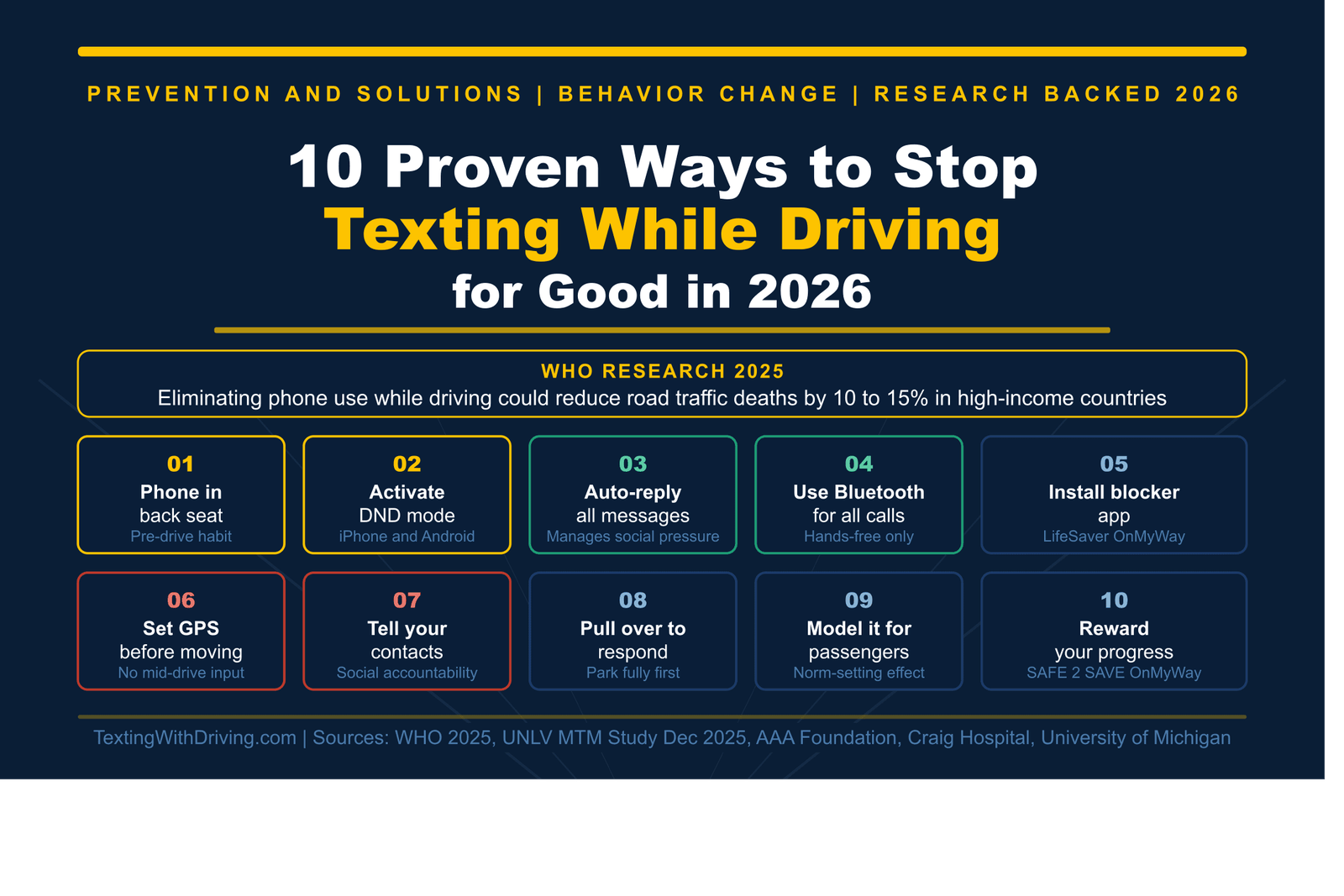
10 Proven Ways to Stop Texting While Driving for Good in 2026
You already know you should not text while driving. Every driver reading this knows that. The statistics, the laws, the campaigns, the personal knowledge of the danger have been part of public awareness for more than a decade.
And yet.
A 2024 survey found that 47 percent of American drivers admitted to texting while driving in the previous 30 days. According to research published in December 2025 by the University of Nevada Las Vegas using NHTSA data, texting while driving is a major preventable cause of road traffic injuries and deaths and remains a leading behavioral risk factor comparable to alcohol-impaired driving in younger age groups.
The World Health Organization estimates that eliminating phone use while driving could reduce road traffic deaths by up to 10 to 15 percent in high-income countries, representing a high-impact opportunity for primary prevention using multi-level approaches covering education, enforcement, and engineering. Myknowledgebroker
10 to 15 percent fewer road deaths. From one behavioral change. That is what the WHO estimates is available if every driver simply stopped using their phone while driving.
This article is not about awareness. You have that. This is about the specific, research-backed strategies that behavioral science and driving safety research have identified as actually effective at producing lasting change. Not tips. Not reminders. Proven methods organized by how they work and why.
Why Knowing the Danger Is Not Enough
Before the ten strategies, one paragraph about why the knowledge gap is not the problem and why closing it further will not solve what awareness has not already solved.
The UNLV research published in December 2025 applied the Multi-Theory Model of health behavior to texting while driving among college students and found that the strongest predictors of stopping the behavior were not knowledge of danger but rather participatory dialogue, which means talking about the behavior with peers, changes in the physical and social environment that make stopping easier, and emotional transformation tied to personal commitment rather than fear.
Knowledge of danger was a weak predictor of behavior change. Environmental changes were among the strongest. What this tells us is that the ten strategies below work not because they remind drivers of danger but because they change the environment in which the temptation arises, the social context around the behavior, and the automatic routines that govern what happens when a notification arrives.
As we covered in our article on the psychology of phone addiction and distracted driving, the decision to reach for a phone while driving is not a rational choice made with full awareness of risk. It is a habituated response to a dopamine trigger. Strategies that change the environment before the trigger fires are far more effective than strategies that ask willpower to override the habituated response in the moment.
With that framing in place, here are ten strategies the research supports.
Strategy 1: Put Your Phone in the Back Seat Before the Car Starts
This is the most research-supported single behavior change available to any driver. It requires no technology, no subscription, no reminder, and no willpower once the habit is formed.
One of the simplest ways to avoid texting while driving is to keep your mobile device out of reach, such as in the glove box or back seat. Nexar
The behavioral mechanism behind this strategy is physical separation from the temptation before the drive begins. A phone that is in the back seat cannot be reached impulsively when a notification arrives. The driver would have to make a deliberate, conscious decision to pull over and retrieve the device, which introduces exactly the kind of conscious deliberation that overcomes habituated impulse responses.
A phone in the cupholder or on the passenger seat, even face down, remains within reach. The physical proximity means the temptation is always immediately available. When a notification arrives and the phone lights up within reach, the dopamine response fires and the habituated reach behavior competes directly with the willpower not to reach.
Remove the phone from the equation before it starts. This is the single most effective behavior change available and it costs nothing.
The research from University of Michigan Transportation Research Institute finding that teens are 2.5 times more likely to engage in distracted driving behaviors when they observe their parents doing it works in both directions. Parents who visibly place their phone in the back seat before driving model the behavior that produces the same outcome in their teen drivers. Do it in front of them. Name it. Make it a visible family ritual.
Strategy 2: Activate Do Not Disturb While Driving Before Every Drive
The second strategy addresses the incoming stimulus that triggers the temptation in the first place.
iPhone’s Driving Focus and Android’s equivalent driving mode automatically silence all notifications the moment the phone detects vehicle motion. No vibration. No sound. No screen light. Nothing arrives to trigger the dopamine response or create the awareness that something might need attention.
This strategy is particularly powerful because it removes the trigger before the habituated response can fire. The psychology of phone addiction research we covered in our dedicated article shows that even the notification sound alone, without looking at the device, produces measurable cognitive distraction. Driving mode eliminates the sound, the vibration, and the screen activity entirely.
Setup takes approximately 90 seconds and requires no ongoing effort or willpower after the initial configuration. On iPhone: Settings, Focus, Driving, set to activate automatically. On Android: Settings, Digital Wellbeing, Driving mode. Full step-by-step instructions are in our Do Not Disturb while driving setup guide.
The combination of Strategy 1, phone in the back seat, and Strategy 2, driving mode active, means the phone is physically inaccessible and generating no incoming stimuli. Together they address both the physical temptation and the notification trigger. Use both.
Strategy 3: Set Up Auto-Reply Messages for Every Drive
The social pressure to respond to messages is one of the most powerful drivers of phone use behind the wheel, as we covered in our article on Gen Z texting while driving statistics. The SADD and Liberty Mutual research found that 55 percent of teens who text while driving are doing it specifically to update their parents or coordinate with friends. The urgency is social, not informational.
Auto-reply messaging removes that social pressure by managing the communication obligation automatically. When Driving Focus is active on iPhone, anyone who texts you receives an automatic reply explaining that you are driving and will respond when you arrive. Android’s equivalent feature works the same way. If the situation is genuinely urgent, the sender can reply with the word Urgent and the message comes through.
Setting up automatic replies is another effective method to manage communications while driving. These features, often built into smartphones or available through third-party apps, can send messages to callers and texters, informing them that you are driving and will respond later. Nexar
The auto-reply strategy works on a specific behavioral mechanism: it transfers the social contract of responsiveness from the driver to the technology. You are not ignoring people. The technology is communicating on your behalf that you are unavailable and will respond. This removes the guilt and social anxiety that drive the impulse to respond immediately, which are emotions that willpower alone cannot easily override while driving.
Strategy 4: Set Up Bluetooth for All Calls Before Every Drive
For drivers who need to be reachable for calls during driving, the Bluetooth strategy is the legal and behaviorally safest solution available.
A Bluetooth-connected call keeps both hands on the wheel, keeps eyes on the road, and allows voice-only communication without any physical phone interaction. It does not eliminate cognitive distraction, as we documented in our article on whether voice-to-text is safe while driving, but it eliminates the visual and manual distraction components and is legal in all 50 states.
Discourage others from calling or texting you while you are driving. Have passengers manage your phone for you. Prepare before you drive by reviewing maps, adjusting your radio, eating, and making any phone calls needed before you drive. The Zebra
The pre-drive preparation principle from Craig Hospital’s distracted driving program extends to Bluetooth: pair your phone to your vehicle’s Bluetooth system before starting the engine, not after. If your vehicle does not have Bluetooth, a standalone clip-on Bluetooth speakerphone is a low-cost solution that takes one purchase and one setup.
For drivers in states with primary enforcement hands-free laws, including Pennsylvania, Missouri, Louisiana, and 30 others, Bluetooth is not optional. It is the legal standard for any phone interaction while driving.
Strategy 5: Install a Phone-Blocking App
For drivers who want an additional layer of automatic protection beyond the phone’s built-in features, purpose-built blocking apps provide a third-party enforcement mechanism that runs independently of the phone’s own settings.
Apps like LifeSaver automatically lock the phone screen at driving speed and send auto-replies to anyone who messages. OnMyWay pays drivers for every phone-free mile, using a positive incentive model. SAFE 2 SAVE gamifies safe driving with a points system. Canary and the parental version of LifeSaver allow parents to monitor whether teen drivers are complying with phone-free driving and receive alerts if the app is disabled.
We covered all of these in detail with download links and cost information in our guide to the best apps to block texting while driving. The most important feature to look for in any blocking app is automatic activation. An app that requires the driver to manually activate it before each drive adds a step that can be skipped. Apps that activate automatically when motion is detected do not require any ongoing willpower to maintain.
For teen drivers specifically, the accountability apps that report to parents produce measurably better compliance outcomes than self-only blocking apps, because they add the external accountability component that the UNLV research identifies as a strong predictor of behavior change.
Strategy 6: Set Your GPS Before the Car Moves
One of the most common reasons drivers pick up their phones during a drive is navigation: entering an address, rechecking a route, zooming in on a map. Each of these interactions is a manual and visual distraction event that also creates cognitive distraction from the destination-finding task.
The solution is pre-drive preparation. Enter your complete destination and review the route before starting the engine. If you are using Google Maps, Apple Maps, or Waze, have the entire navigation session active and audio guidance running before the car moves. Once you are driving, the navigation continues passively through voice guidance that requires no screen interaction.
Prepare before you drive. Review maps, adjust your radio, eat, and make any phone calls needed before you drive. The Zebra
The pre-drive GPS setup is also a legal requirement under most hands-free laws. Pennsylvania’s Paul Miller’s Law, Missouri’s Siddens Bening Law, and Louisiana’s HB 519 all permit GPS navigation when the phone is mounted, but all prohibit touching the screen to enter addresses or adjust the route while driving. Setting your destination before you move keeps you on the right side of these laws and eliminates one of the most common temptations to pick up the phone mid-drive.
If you miss a turn or need to adjust the route, the right response is to pull over to a safe, fully parked location and update the navigation before resuming driving. Not a shoulder stop. A parking lot or side street where the vehicle is fully stopped off the travel lane.
Strategy 7: Tell Your Contacts You Do Not Text While Driving
This strategy addresses the social context directly rather than the technology or the behavior. And the research suggests it is one of the most powerful tools available for sustained behavior change.
The Multi-Theory Model research published by UNLV in December 2025 found that participatory dialogue, which includes open conversation with peers, family, and social contacts about personal behavioral commitments, was among the strongest predictors of successfully stopping texting while driving. When drivers make their commitment explicit and social, the commitment is reinforced continuously through the social environment rather than relying on individual willpower. Myknowledgebroker
Tell the people you communicate with regularly: your family, your friends, your colleagues, your manager. Tell them that you do not respond to messages while driving and that they should not expect a response until you arrive. Explain that you have auto-reply set up so they will always receive confirmation that you are driving.
This social norm-setting strategy works through two mechanisms simultaneously. It changes others’ expectations so they are not generating social pressure for immediate responses. And it creates an external commitment that makes violating the behavior more socially costly than maintaining it. A driver who has publicly committed to phone-free driving and then texts a friend from behind the wheel faces a small but real social accountability cost. A driver who made no such commitment faces none.
The same SADD and Liberty Mutual research that found 55 percent of teens text while driving to update others found that social peer commitments were among the strongest positive predictors of safe driving behavior. The peer influence that makes distracted driving socially permissible can be redirected to make it socially unacceptable, but only when the commitment is made explicitly rather than assumed.
Strategy 8: Commit to Pulling Over Completely for Any Urgent Response
This strategy establishes a specific behavioral protocol for the moments when something feels genuinely urgent. Because the honest reality is that some situations do require a response, and having a plan for those situations is more effective than a blanket “never check your phone” rule that breaks down under genuine pressure.
The protocol is specific: if you receive a message or call that feels urgent enough to require response before you reach your destination, you pull completely off the road into a parking lot or legal parking space, put the vehicle in park, and then handle the communication. Not the highway shoulder. Not a quick glance at a red light. A full stop in a legally parked position.
This protocol works because it acknowledges the reality of urgent communication needs while establishing an unambiguous standard for what legitimate phone use while driving looks like. It removes the gray area that allows rationalization: “I’ll just glance at it at the next light” or “I’ll just respond at this stop sign.” The standard is pull over and park, every time, without exception.
Pull over and park in a safe location if a call or text is absolutely necessary. Change your voicemail greeting to inform callers you are on the road and will return their call when you can do so safely. The Zebra
The voicemail greeting suggestion is a simple extension of the auto-reply strategy: proactively communicating to people who call that you are driving and will return their call when safely stopped. This manages expectations before they generate urgency.
Strategy 9: Model Phone-Free Driving Visibly for Everyone in Your Vehicle
Research from the University of Michigan Transportation Research Institute found that teens are 2.5 times more likely to engage in distracted driving behaviors if they frequently observe their parents doing it. And research from SADD and Liberty Mutual found that the proportion of teens who text while driving is 14 percent higher when they have observed their parents doing the same.
Modeling is not passive. It is an active behavioral influence that operates continuously through observation. Every time a passenger sees you put your phone in the back seat before a drive, they observe the behavior. Every time they are in your vehicle and your phone is silent and untouched throughout the drive, they normalize that standard. Every time you pull over before responding to an urgent message, they see what responsible phone management looks like in practice.
For parents of teen drivers, this is arguably the highest-leverage single behavior you can engage in. Not the conversation, though that matters. The behavior you consistently model in front of them. As we covered in our parent’s guide to talking to your teen about phone use while driving, parent modeling is one of the most consistently evidence-supported predictors of teen driver behavior outcomes.
For everyone else: the passengers in your vehicle observe your driving habits. The colleagues who carpool with you observe them. The friends who ride with you observe them. Modeling creates a norm that operates beyond your own vehicle through social observation and imitation.
Strategy 10: Use a Reward App to Reinforce the Habit
The final strategy draws on the positive reinforcement principle rather than the restriction and deterrence approach that drives most distracted driving prevention efforts.
OnMyWay pays drivers cash for every phone-free mile. You earn points that can be redeemed as gift cards, travel deals, and cash. SAFE 2 SAVE awards points for safe driving behaviors that can be redeemed at local businesses and enters drivers into competitions with friends and family. Both apps use the behavioral principle that positive reinforcement builds habits more durably than negative consequences alone, because positive reinforcement creates intrinsic motivation rather than fear-avoidance motivation.
Research shows that point system rewards assigning points for various safe driving behaviors, accumulated and redeemed for rewards such as extended curfews for teens, additional driving privileges, monetary incentives like gas money, or contributions toward car insurance payments, are particularly effective at building safe driving habits. The key is to choose rewards that are meaningful and motivating for the specific driver. Defensivedriversinstitute
For teen drivers especially, the gamification and reward approach is neurologically compatible with how younger brains respond to incentives. The same dopamine response system that makes phone notifications feel compelling can be redirected toward safe driving rewards. An app that produces a notification saying you earned $2.50 for your last phone-free drive activates the reward system in a direction that reinforces safe behavior rather than unsafe behavior.
For any driver who is resistant to the restriction-based approaches in the first nine strategies, reward apps provide a genuinely different behavioral pathway to the same outcome.
Putting It All Together: The Pre-Drive Checklist
The ten strategies above work best as a system rather than individual choices. Here is how a complete pre-drive routine incorporating all of them looks in practice.
Before starting the engine: destination entered in GPS. Driving Focus or driving mode activated on the phone. Phone placed in the back seat or glove box. Bluetooth confirmed connected. Engine started. Drive begins.
During the drive: no incoming notifications arrive. No visual or auditory stimulus triggers the dopamine response. Hands remain on the wheel. Eyes remain on the road.
After the drive: phone retrieved from back seat. Reward app credits the safe miles. Auto-replies have managed any messages that came in during the drive.
The entire pre-drive setup takes approximately 90 seconds once the habits are established. The ongoing benefit is every drive completed without a crash, citation, insurance increase, or insurance claim attributable to phone distraction.
For the technology tools that support this system, see our guide to the best apps to block texting while driving and our Do Not Disturb setup guide. For the national death toll that explains why this matters at scale, our distracted driving statistics 2026 overview covers the full picture. And for the legal consequences of not making these changes, the texting while driving fines by state 2026 guide covers what a citation actually costs across all 50 states.
Sources Used in This Article
All links verified working before publication.
PMC: Theory-Based Antecedents of Stopping Texting While Driving Using Multi-Theory Model — UNLV School of Public Health, December 2025
Craig Hospital: Taking Action Against Distracted Driving — 10 Tips — Evidence-based tip framework
The Law of We: 5 Proven Strategies to Curb Teen Texting While Driving — University of Michigan Transportation Research Institute data, October 2024
NY Traffic Lawyer: Limiting the Lure of the Screen — Environmental and technology strategies, April 2024
The Zebra: Texting and Driving Statistics 2026 — 47 percent admission rate and behavioral data, January 2026
OnMyWay: Official Website — Reward-based safe driving app
SAFE 2 SAVE: Official Website — Gamified safe driving rewards
LifeSaver Mobile: Official Website — Automatic phone blocking app
NHTSA: Distracted Driving — National data context
AAA Foundation: Distracted Driving Research — Behavioral research library

About Texting With Driving
TextingWithDriving.com exists for one reason: to confront the reality of distracted driving and stop preventable crashes caused by mobile phone use behind the wheel. Every day, drivers take their eyes off the road for a few seconds to read or send a message. Those few seconds are enough to cause life-altering consequences. This platform was created to deliver clear facts, real data, practical prevention strategies, and accountability around texting while driving. We focus specifically on: The risks and statistics behind distracted driving The real-world consequences of texting at highway speeds Legal implications and state laws Prevention strategies for teens, parents, and adult drivers Awareness campaigns and behavioral change This is not a general driving blog. It is a focused awareness initiative built around one critical issue: phone distraction behind the wheel. Our content is direct, research-driven, and practical. We prioritize accuracy over opinion and education over sensationalism. The goal is simple — reduce distracted driving incidents by increasing awareness and responsibility. If one article causes one driver to put their phone down, the mission is working. For inquiries or partnerships, contact: privacy@textingwithdriving.com
View all posts by Texting With Driving