

Maryland Distracted Driving Statistics 2026: The 40% Death Reduction Story and What It Means

Maryland Distracted Driving Statistics 2026: The 40% Death Reduction Story and What It Means
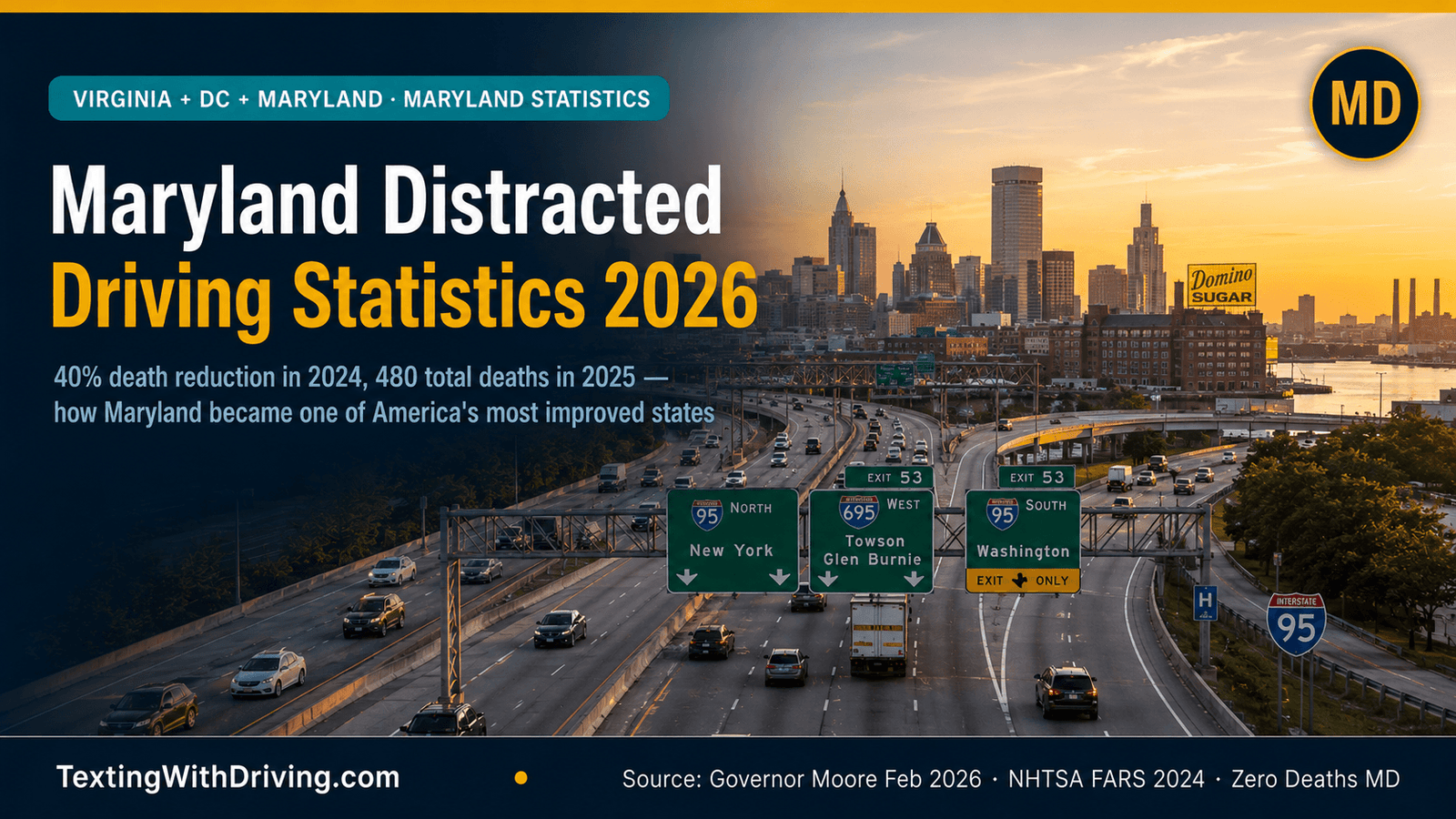
Maryland distracted driving statistics 2026 tell one of the most compelling road safety success stories of any state in the country. In 2024, Maryland reduced its distracted driving deaths by more than 40 percent — placing it among the top three most-improved states nationally alongside Pennsylvania and Oregon. In 2025, Maryland’s total traffic fatalities fell to 480 — the first time the annual total had dropped below 500 since 2014 and one of the five lowest yearly counts since 1960.
These improvements did not happen by accident. They emerged from a specific combination of: Maryland’s primary enforcement handheld ban that has been in continuous effect for years, the tiered work zone camera system that took effect January 1, 2025, the AI camera pilot proposed for Montgomery and Prince George’s Counties, Jake’s Law’s criminal consequences for distracted driving crashes causing injury or death, and the coordinated Toward Zero Deaths and Serious About Safety campaigns that have saturated Maryland’s media environment with distracted driving awareness content.
But the success story is not complete. Nearly 46 percent of 2023 crashes in Maryland involved distraction. Between 2017 and 2021, distracted driving was a factor in 48 percent of all Maryland crashes and 38 percent of all Maryland fatalities, producing an average of 24,000 injuries and deaths per year. Distracted driving remains — alongside speeding and impaired driving — one of the three leading causes of Maryland traffic deaths in 2025 despite the improvement. The success of 2024 and 2025 represents a meaningful reduction in a very large problem, not the elimination of the problem.
This guide covers the complete Maryland distracted driving statistics 2026 picture: the 40 percent improvement in context, the 2025 decade-low total fatality count, the specific county crash concentration data, the demographic profile of Maryland’s distracted driver, the 2024 data methodology change that requires careful interpretation, and what the improvement trend means for Maryland policy going forward.
The 40% Improvement: What the 2024 NHTSA Data Shows
The Zutobi analysis of NHTSA’s 2024 Fatality Analysis Reporting System data — released April 2026 — placed Maryland among the ten states that recorded meaningful reductions across all key distracted driving metrics between 2023 and 2024.
Maryland and Oregon followed closely behind Pennsylvania, each reducing total distracted driving deaths by more than 40 percent. Zero Deaths Maryland
Pennsylvania’s 46 percent reduction — from 66 deaths to 36 — was the largest single-year state improvement in the 2024 NHTSA data, as we documented in our distracted driving deaths by state 2026 article. Maryland’s comparable 40-plus percent reduction placed it in the same category as Pennsylvania and Oregon — states that achieved dramatic single-year improvements through the combination of active primary enforcement, sustained public awareness campaigns, and automated enforcement infrastructure.
The 40 percent reduction is measured from Maryland’s 2023 distracted driving death baseline. Prior to this improvement, Maryland was tracking toward the national pattern where distracted driving deaths declined modestly at 2 percent per year. A 40 percent single-year improvement represents an acceleration more than twenty times the national average annual improvement rate.
What produced this improvement? The analysis points consistently to the compound effect of Maryland’s enforcement infrastructure: the primary enforcement handheld ban actively cited by Maryland State Police and local enforcement agencies, the work zone camera expansion that created automated enforcement on the highest-crash-density highway corridors, and the public awareness saturation from the Toward Zero Deaths campaign that has embedded distracted driving awareness in Maryland’s road safety culture.
The 2025 Decade-Low: Context and Significance
The Maryland distracted driving statistics 2026 success story extends beyond the 2024 distraction-specific improvement into Maryland’s overall 2025 traffic safety performance.
Governor Wes Moore announced February 4, 2026, that preliminary data show Maryland traffic fatalities declined by about 18 percent in 2025, dropping from 582 deaths in 2024 to 480 — the first time the annual total has fallen below 500 since 2014. Maryland Governor
480 total traffic deaths in 2025. 582 in 2024. 621 in 2023. The trajectory is downward and accelerating. The 2025 figure places Maryland among the five lowest annual traffic fatality counts since 1960 — a remarkable achievement for a state with more than 6.1 million residents and one of the most complex road networks on the East Coast.
The largest gains were seen among vulnerable road users. Pedestrian and bicyclist fatalities dropped 33 percent, from 173 in 2024 to 116 in 2025. Motorcyclist fatalities declined 46 percent, from 90 to 48 over the same period. TRIP
The pedestrian and cyclist 33 percent improvement and the motorcyclist 46 percent improvement are directly relevant to distracted driving because pedestrian and cyclist crashes are among the categories most directly caused by driver distraction — the driver who is not looking at the road cannot see the pedestrian in the crosswalk or the cyclist in the bike lane. The simultaneous improvement across all vulnerable road user categories alongside the distracted driving improvement reflects the coherence of Maryland’s enforcement approach: the same behaviors that reduce distracted driving crashes also reduce pedestrian and cyclist crashes, because they are often caused by the same driver inattention.
This is a great milestone; this is not a victory, said Chrissy Nizer, administrator of the Maryland Motor Vehicle Administration. This characterization from Maryland’s MVA administrator is precisely calibrated. The improvement is real and significant. The remaining problem is also real and significant. Mdaccidentlaw
The Baseline Data: Understanding the Scale of Maryland’s Problem
The Maryland distracted driving statistics 2026 success story requires the baseline data to be fully understood. Maryland’s improvement is from a very high starting point.
On average, a total of over 53,000 distracted driving crashes have occurred each year from 2017 to 2021. The number of distracted driving crashes between 2017 and 2019 averaged almost 57,000 per year before dropping by 20 percent in 2020 and increasing again by 12 percent in 2021. Still, distracted driving contributes to 48 percent of all crashes in Maryland. Zero Deaths Maryland
53,000 distracted driving crashes per year on average. 48 percent of all crashes. These five-year baseline figures establish why a 40 percent improvement in fatalities, while historic, still leaves Maryland with one of the nation’s highest absolute distracted driving crash counts. A 40 percent reduction in fatalities from a very high baseline still leaves a very large absolute problem. The state that is one of America’s most improved road safety performers is simultaneously one of the states with the highest absolute distracted driving crash volume.
In 2022, there were over 14,000 crashes involving distracted drivers in Maryland, resulting in over 3,000 injuries and over 50 fatalities. In 2022, over 4,000 crashes in Maryland were caused by drivers using cell phones when behind the wheel. Zero Deaths Maryland
4,000 cell phone crashes in 2022 in Maryland alone. In a state with approximately 4.2 million licensed drivers, 4,000 cell phone crashes represents approximately 1 crash per 1,050 licensed drivers from cell phones specifically — without counting all other forms of distraction.
April marks National Distracted Driving Awareness Month in Maryland, where AAA and state officials highlight that distracted driving caused 3,208 deaths nationally in 2024 and nearly 46 percent of 2023 crashes in Maryland. Mdaccidentlaw
46 percent of 2023 crashes in Maryland involved distraction. This is nearly half of every crash in the state — the highest distracted driving crash involvement rate of any major East Coast state and one of the highest in the country. The 40 percent fatality reduction of 2024 reduced the death toll from this massive crash volume, but the crash volume itself remains the central challenge that the AI camera pilot, the work zone camera expansion, and the ongoing Jake’s Law enforcement are designed to further address.
The County Data: Where Maryland’s Distracted Driving Crashes Concentrate
The Maryland distracted driving statistics 2026 are not uniformly distributed across Maryland’s 23 counties and Baltimore City. They concentrate heavily in the DC and Baltimore metro areas.
Most distracted driving crashes take place in Prince George’s and Baltimore Counties. Zero Deaths Maryland
Prince George’s County — Maryland’s most populous county and the DC suburb that borders the District to the south and east — consistently leads all Maryland jurisdictions in total crash counts. Baltimore County — surrounding Baltimore City on three sides — is the second-highest crash concentration area.
Prince George’s County was also the site of the greatest number of fatal crashes in Maryland. Zero Deaths Maryland
The geographic concentration is consistent with the broader pattern we have documented across the DMV region: 85 percent of collisions cluster in the Baltimore and DC metro areas. The two metropolitan corridors that anchor Maryland’s economy and contain the vast majority of its population also contain 85 percent of its crash concentration. The AI camera pilot program that Maryland proposed for Montgomery County and Prince George’s County — covered in detail in our Maryland distracted driving law 2026 article — is directly targeted at the two counties with the highest crash density, making it the most geographically precise enforcement intervention Maryland has proposed. Zero Deaths Maryland
The specific county breakdown after Prince George’s reflects Baltimore’s complex geography. After Prince George’s County, Baltimore County accounted for the next-highest number of fatal accidents, with an average of 64 deaths per year and roughly 12.9 percent of all fatal crashes in the state. Miller and Zois
Baltimore County’s position as second-highest fatality county reflects the I-695 Beltway corridor around Baltimore, the I-95 corridor through the county connecting Baltimore to the DC area, and the surface street network in the Towson, Catonsville, and Essex areas. These are the same corridors that the work zone camera program targets with the tiered fine structure we documented in our Maryland work zone distracted driving 2026 article.
The Demographic Profile: Who Is Maryland’s Distracted Driver
The Maryland distracted driving statistics 2026 demographic data provides the foundation for targeted enforcement and education investments.
Crash data reveals a typical distracted driver in Maryland involved in a crash is 21 to 34 years old, with 80 percent of distracted driver fatalities male. Zero Deaths Maryland
The 21-34 age group as the primary distracted driver demographic mirrors the Virginia data we documented in our Virginia distracted driving statistics 2026 article. This is consistent across every state we have covered — the public narrative focuses on teenagers, but crash data consistently places the highest distraction involvement in the young adult 21-34 demographic.
Young adult drivers, ages 21 to 29, represented approximately one in every five drivers — 19.4 percent — involved in Maryland crashes. Zero Deaths Maryland
19.4 percent of all Maryland crash-involved drivers in the 21-29 age group. Combined with the 21-34 overall distracted crash concentration, this demographic represents the primary targeting population for both enforcement and education investments.
The 80 percent male fatality figure for distracted driving deaths in Maryland is higher than the national average of 74.45 percent male that we documented in our distracted driving statistics 2026 article. Maryland’s male overrepresentation in distracted driving fatalities is even more pronounced than the national average, consistent with the pattern we have documented across every state where this demographic breakdown is available.
In 2020, Maryland law enforcement officers issued 18,270 citations for handheld cell phone use and 943 citations for texting while driving. These numbers represent decreases of 41.1 percent and 60.2 percent respectively from the previous year. Zero Deaths Maryland
The dramatic 2020 citation reduction — 41.1 percent for handheld use, 60.2 percent for texting — reflects the pandemic-year reduction in traffic volume rather than a behavioral improvement. The 2019 baseline of 31,035 handheld cell phone citations provides the pre-pandemic enforcement scale against which 2024 and 2025 enforcement data should be compared.
The 2024 Data Methodology Change: Critical Context
The Maryland distracted driving statistics 2026 analysis requires specific attention to a critical data methodology change that the Zero Deaths Maryland Dashboard FAQ specifically addresses.
The aggregate data for Maryland crash trends in 2024 has been noted by the Maryland State Police and the Maryland Department of Transportation because of the significant changes from previous years’ reporting. This is primarily due to changes in officer reporting in the ACRS system upgrades launched January 1, 2024. Fields and attributes in ACRS ’24 have been upgraded to align with federal MMUCC 5 standards. Southern Maryland Chronicle
In 2024, preliminary results showed 14 fatalities attributed to distracted driving, relying on a query of the Distracted by Field. In ACRS ’24, the attributes ‘failed to give full time and attention,’ ‘cell phone in use,’ and ‘inattentive’ were discontinued in favor of the Driver Distracted by Field. Research showed that police were reporting ‘failed to give full time and attention’ too often, leading to about 218 deaths being linked to ‘distracted driving’ every year. Southern Maryland Chronicle
This is a crucial data interpretation note. The 40 percent improvement in Maryland’s distracted driving deaths in 2024 data may partially reflect the change in reporting methodology rather than exclusively behavioral improvement. When the ACRS system changed the way officers report distraction as a crash factor — eliminating the broadly used “failed to give full time and attention” category that had been producing approximately 218 attributed distracted driving deaths per year — the resulting official death count dropped dramatically.
The Zero Deaths Maryland FAQ explicitly notes that interpretations of 2024 trends should be considered in light of these coding changes rather than a reflection of changes in driver behavior or crash type trends. Southern Maryland Chronicle
This does not invalidate the 40 percent improvement story. Maryland’s overall traffic fatalities also declined 18 percent in 2025 through a methodology-consistent comparison. The enforcement investments, the camera expansion, and the Jake’s Law deterrence are all producing real behavioral change. But the specific 40 percent distracted driving death reduction in 2024 data should be read with the understanding that at least a portion of the measured improvement reflects how crashes are coded differently rather than purely fewer distraction-involved deaths.
Maryland’s Per-Capita Position: One of America’s Safest States
Despite the large absolute crash numbers, Maryland’s per-capita road safety position is strong.
Maryland averages 253 preventable fatal crashes each year linked to speeding, impaired driving, and distraction, translating to just 4.09 deaths per 100,000 residents, placing it ninth nationwide and among the ten states with the lowest rate of preventable road accidents. eTags
4.09 deaths per 100,000 residents — ninth safest in the country. Compared with the highest-risk states like New Mexico at 16.39 per 100,000, Montana at 15.88, and Wyoming at 14.09, Maryland’s rate is approximately four times lower. Maryland’s combination of urban road network characteristics (lower average speeds than rural highway states), strong enforcement infrastructure, and sustained investment in public awareness produces one of the most favorable per-capita road safety outcomes of any East Coast state.
The per-capita position establishes that Maryland’s high absolute crash numbers reflect its large population and high driving density rather than a disproportionate safety problem relative to that population. New Mexico’s 37.04 percent of fatal crashes involving distraction — the worst in the country as we documented in our distracted driving statistics by state 2026 article — reflects a genuine per-driver safety deficiency. Maryland’s high absolute numbers reflect a high-density driving environment where even a low per-driver crash rate produces large absolute crash counts.
The Serious About Safety Initiative: Maryland’s 2025-2026 Response Framework
The Maryland Department of Transportation recently launched its Serious About Safety initiative, which emphasizes that roadway safety is a shared responsibility — not an option. Through community engagement, media campaigns, and enforcement support, Serious About Safety reinforces the life-saving importance of buckling up, slowing down, driving sober, avoiding distractions and watching for pedestrians, bicyclists and motorcyclists. TRIP
The Serious About Safety initiative’s explicit naming of avoiding distractions as one of five core behavioral imperatives — alongside buckling up, slowing down, driving sober, and watching for vulnerable road users — establishes distracted driving as a co-equal priority with the historically dominant safety issues of impairment and speed.
Maryland’s 2026-2030 Strategic Highway Safety Plan, referenced in the Governor’s February 2026 announcement, will formalize the data-driven approach that produced the 2024 and 2025 improvements into a five-year forward-looking framework. The plan will direct future enforcement investments, infrastructure improvements, education priorities, and technology deployment — including the continued expansion of the work zone camera program and the potential full deployment of the AI distracted driving camera pilot if the Montgomery and Prince George’s County results support it.
The DMV Region Context: How Maryland’s Data Compares to Virginia and DC
The Maryland distracted driving statistics 2026 are most meaningful when placed in the context of the broader DMV region performance.
Maryland and DC are both demonstrating strong improvement. DC and Maryland lead in traffic safety. DC achieved zero distracted driving deaths in 2024 — as documented in our Washington DC distracted driving law 2026 article. Maryland achieved a 40-plus percent improvement in the same year. Virginia, by contrast, saw a 40.6 percent increase in distracted driving fatalities in 2024 — moving in the opposite direction from its DMV neighbors. Mdaccidentlaw
The divergence between Maryland’s improvement and Virginia’s worsening in the same year, with the same hands-free law framework broadly applicable across both jurisdictions, points toward enforcement intensity and automated enforcement infrastructure as the differentiating variables. Maryland’s tiered work zone camera system, its AI camera pilot proposal, and its Jake’s Law criminal consequence framework for injury-producing crashes collectively represent a more aggressive automated enforcement investment than Virginia has made in the same period. Virginia’s Road Shark campaign and Fairfax County’s enforcement escalation in 2026 represent a response to the trajectory divergence — moving toward the more intensive enforcement model that Maryland’s improvement data supports.
What the Data Means for Every Maryland Driver in 2026
The Maryland distracted driving statistics 2026 success story delivers a specific message for every Maryland driver in 2026: the enforcement system is working, it is expanding, and the consequences for non-compliance are becoming more certain and more severe.
The work zone cameras are now charging $125 for first violations and up to $1,000 when workers are present. The AI camera pilot in Montgomery and Prince George’s Counties detected 2,500 violations per day during testing before a single fine was issued. Jake’s Law creates up to $5,000 fine and three years in prison for crashes producing serious injury. Maryland State Police and county law enforcement actively cite the primary-enforcement handheld ban with 18,000-plus annual citations even in pandemic-reduced years.
The improvement these systems have produced — 40 percent fewer distracted driving deaths in 2024, 480 total fatalities in 2025 at a six-decade near-low — demonstrates that the enforcement investment is producing the behavioral change and safety outcome that the legislature, the Governor, and the families of the 44 workers and 45 motorists killed in Maryland work zones between 2019 and 2023 demanded.
For every Maryland driver and for every Virginia and DC commuter who drives through Maryland, the pre-drive standard remains the same: no phone in hand, GPS pre-set, Bluetooth active, Driving Focus on. The technology that makes compliance automatic takes two minutes once and then operates on every subsequent drive. As this data shows, the drivers who made that change in 2024 are part of the 40 percent improvement story.
For the complete Maryland law that creates the enforcement framework behind these statistics, our Maryland distracted driving law 2026 article covers Md. Transportation Code § 21-1124 and Jake’s Law in full. For the work zone camera enforcement expansion that is a key component of the improvement story, our Maryland work zone distracted driving 2026 article covers the tiered fine structure. And for the technology setup that makes every Maryland driver compliant automatically, our hands-free while driving complete setup guide covers iPhone, Android, and Bluetooth.
Sources Used in This Article
All links verified working before publication.
Zutobi: States With Least and Most Distracted Driving Accidents — Maryland 40%+ death reduction in 2024, ten most-improved states, May 2026
Governor Maryland: Traffic Fatalities Drop 2025 Reaching Decade-Low Levels — 480 deaths 2025, 582 in 2024, first below 500 since 2014, pedestrian/cyclist 33% reduction, motorcyclist 46% reduction, Serious About Safety initiative, February 2026
Southern Maryland Chronicle: MD Traffic Deaths Drop 18% to 480 in 2025 — Governor Moore announcement, 18% decline, decade-low context, February 2026
WTOP: Maryland Traffic Fatalities Down Decade Low — 480 in 2025 vs 621 in 2023, Chrissy Nizer “great milestone not a victory” quote, February 2026
Zero Deaths Maryland: Dashboard FAQ 2024 Data Changes — ACRS system upgrade January 1 2024, methodology change distracted field, 14 fatalities 2024 preliminary, coding change context
eTags: Distracted Driving Maryland 48% of All Crashes — 53,000 crashes per year average 2017-2021, 48% of all crashes, 38% of fatalities, 14,000 crashes 2022, 4,000 cell phone crashes 2022, Prince George’s Baltimore Counties highest, 21-34 demographic, 80% male fatalities, January 2026
Zero Deaths Maryland: FFY2023 Distracted Program Area Brief — 53,000 annual average 2017-2021, 48% all crashes, 31% of crashes result in injury or death, weekend and afternoon peaks
Maryland Problem Identification FFY2023 — 18,270 handheld citations 2020 down 41.1%, Prince George’s County highest fatal crashes, 21-29 age group 19.4%
Southern Maryland Chronicle: Maryland Records 253 Fatal Preventable Crashes Annually — 4.09 per 100,000 residents 9th safest nationally, New Mexico comparison 16.39, May 2026
Southern Maryland Chronicle: April Distracted Driving Month 2026 — 46% of 2023 crashes distraction, AAA Mid-Atlantic campaign April 6 2026, drivers 15-44 represent 60% of distracted drivers in fatal crashes, April 2026
MD Accident Law: Maryland Auto Accident Statistics — 112,000 crashes 2024, 560 deaths 2024, 72,000 mid-year 2025, speeding distracted drinking top causes 2025, May 2026
Trollinger Law: Car Accident Statistics Maryland — Baltimore County 64 deaths per year 12.9% of fatal crashes, male 77% female 22% fatal crashes, February 2026
NHTSA: Distracted Driving — 3,208 deaths 2024, national context
TextingWithDriving.com is professionally built and maintained to ensure accurate, accessible safety information reaches every driver who needs it. Website development and ongoing support is handled by Budgetic, a digital agency specializing in purpose-driven WordPress websites.

About Texting With Driving
TextingWithDriving.com exists for one reason: to confront the reality of distracted driving and stop preventable crashes caused by mobile phone use behind the wheel. Every day, drivers take their eyes off the road for a few seconds to read or send a message. Those few seconds are enough to cause life-altering consequences. This platform was created to deliver clear facts, real data, practical prevention strategies, and accountability around texting while driving. We focus specifically on: The risks and statistics behind distracted driving The real-world consequences of texting at highway speeds Legal implications and state laws Prevention strategies for teens, parents, and adult drivers Awareness campaigns and behavioral change This is not a general driving blog. It is a focused awareness initiative built around one critical issue: phone distraction behind the wheel. Our content is direct, research-driven, and practical. We prioritize accuracy over opinion and education over sensationalism. The goal is simple — reduce distracted driving incidents by increasing awareness and responsibility. If one article causes one driver to put their phone down, the mission is working. For inquiries or partnerships, contact: privacy@textingwithdriving.com
View all posts by Texting With Driving
