

Maryland Distracted Driving Law 2026: AI Cameras, Jake’s Law and What Every Driver Must Know

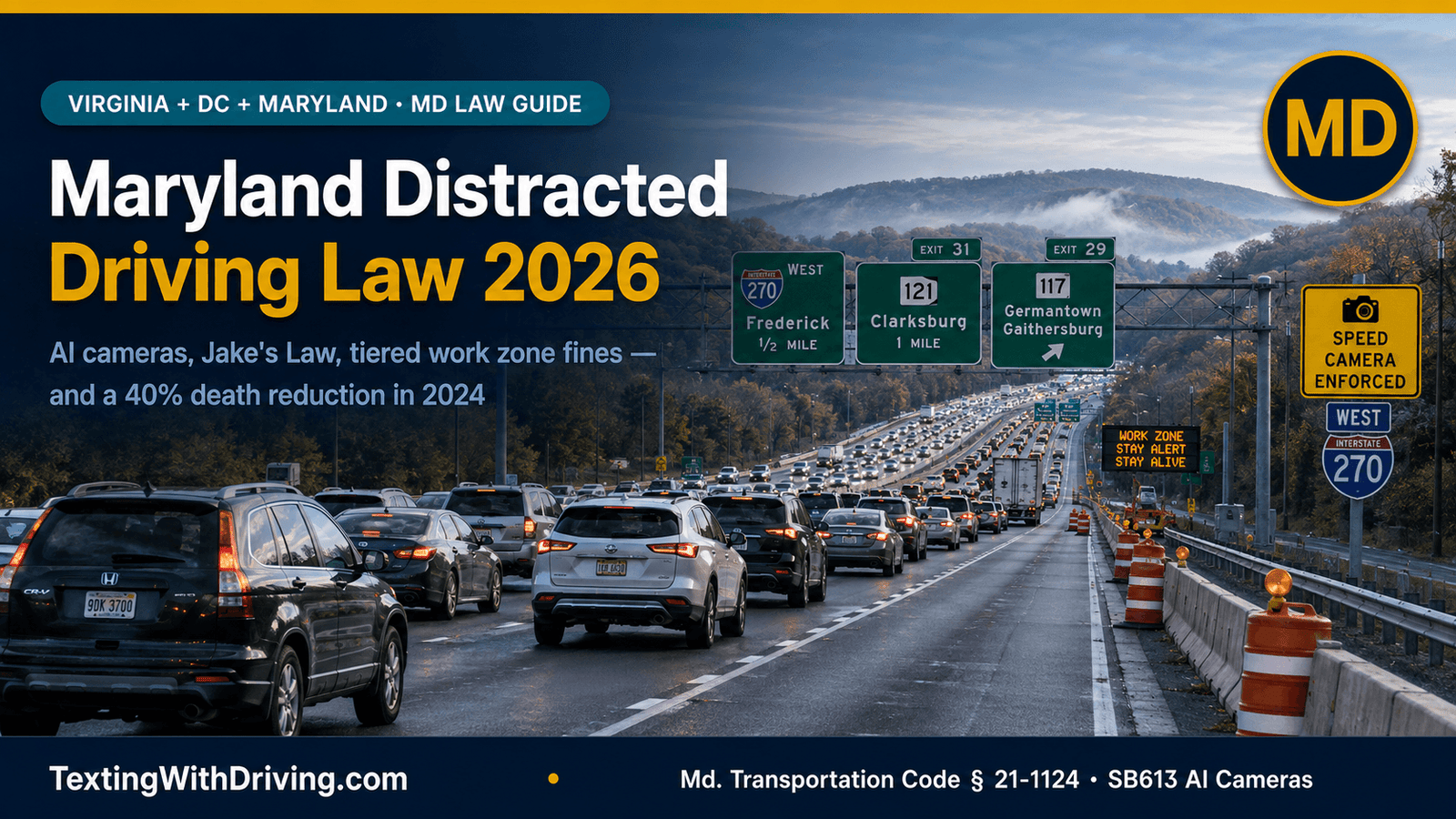
Maryland Distracted Driving Law 2026: AI Cameras, Jake’s Law and What Every Driver Must Know
The Maryland distracted driving law is undergoing its most significant transformation in more than a decade. In 2026, Maryland is piloting AI-powered cameras capable of detecting phone use through vehicle windshields without facial recognition, expanding its work zone speed camera program with tiered fines reaching $500, and enforcing a primary-offense hands-free standard that has already contributed to one of the largest single-year distracted driving death reductions of any state in the country.
Maryland’s 40-plus percent reduction in distracted driving deaths in 2024 — placing the state among the top three most-improved states nationally per NHTSA data as we documented in our distracted driving deaths by state 2026 article — is the result of a law that combines one of the most severe injury-crash penalties in the country (Jake’s Law, up to $5,000 and three years in jail) with primary enforcement authority and a rapidly expanding automated enforcement network.
This guide covers everything every Maryland driver and the millions of Virginia and DC commuters who drive through Maryland daily need to know about the Maryland distracted driving law in 2026: the specific prohibitions under Maryland Transportation Code § 21-1124, the complete fine and points structure, Jake’s Law and when criminal penalties apply, the AI camera pilot program and what SB613 proposes, the tiered work zone fine structure now in effect, teen driver rules, and the crash data that explains why Maryland’s enforcement is intensifying.
What the Maryland Distracted Driving Law Prohibits
The Maryland distracted driving law operates under two primary statutes: Maryland Transportation Code § 21-1124.1 governing the general handheld device ban, and § 21-1124.2 governing the specific texting prohibition.
Under Maryland’s Communications Traffic Safety Act, you cannot use your hands to operate a handheld phone while your vehicle is in motion. The law allows you to touch your phone only to start or end a call and to turn the device on or off. Everything else, such as scrolling, dialing a number, or checking a notification, must be done through a hands-free system like Bluetooth, a dashboard mount with voice commands, or a built-in vehicle system.
The prohibited behaviors under the Maryland distracted driving law cover the full range of handheld device interactions while driving:
Holding a phone for a call. You cannot hold your phone to your ear for any voice call while the vehicle is in motion. Bluetooth, speakerphone on a mounted device, or vehicle-integrated systems are required.
Texting and all electronic messaging. Reading, composing, or sending text messages, emails, or any electronic communication is prohibited. The ban prohibits the use of handheld devices for text messaging, whether composing, reading, or sending them, as well as any other electronic communications such as emails or social media posting.
Scrolling, dialing, or checking notifications. The single-touch exception is the boundary. Any interaction beyond starting or ending a call, or powering the device on or off, is prohibited. Scrolling a contact list to find a number, checking a notification that appeared on the screen, adjusting music — all prohibited under the Maryland distracted driving law unless done through a hands-free or voice command system.
Holding the phone while using GPS. You can’t hold your phone while using GPS if it’s not in a hands-free mount. GPS navigation is legal in Maryland but the device must be mounted. A driver who holds their phone to check a navigation app while moving is in violation even though GPS use itself is not prohibited.
Primary Enforcement: Officers Can Stop You for Holding the Phone Alone
This is a primary offense, meaning an officer can pull you over solely for seeing a phone in your hand. You do not need to be speeding, weaving, or committing any other violation first. The trigger is simple: if the car is moving and your hand is operating the phone, you can be cited.
Maryland’s primary enforcement authority has been in effect for handheld device use for several years, establishing the same enforcement standard that we have documented producing significant crash reductions in Ohio, Michigan, and Colorado. An officer who observes a driver holding a phone — regardless of what the driver is doing with it — has immediate authority to initiate a traffic stop based solely on that observation.
The Fine and Points Structure: What a Maryland Citation Costs
The Maryland distracted driving law fine structure separates handheld violations from texting violations, and both escalate significantly if a crash is involved.
Handheld device violation (no crash):
Tickets for distracted driving start at $83.
Texting violation (no crash):
If no crash occurs, offenders are fined $70 and have one point added against their driving record.
Texting violation contributing to a crash:
If texting contributes to a crash, offenders are fined $110 and have three points added against their driving record.
More precisely, as Cars Counsel’s May 2026 updated guide documents, the full fine escalation structure is:
First offense: $83 fine
Second offense: $140 fine
Third offense: $160 fine plus license points
In 2022 alone, over 14,000 crashes in Maryland involved distracted drivers, claiming 3,000 injuries and 50 deaths. The fine structure reflects a graduated approach that becomes significantly more consequential at the crash-involvement level through Jake’s Law.
Jake’s Law: Maryland’s Criminal Escalation Framework
The most distinctive and most severe element of the Maryland distracted driving law is Jake’s Law — named after Jake Owen, a five-year-old Abingdon, Maryland boy who was killed in 2011 when a driver using a cellphone ran a red light and struck the car in which he was a passenger.
Since the passage of Jake’s Law in 2014, if a driver causes serious injury or death to another while violating the state’s distracted driving laws, they may be fined up to $5,000 and face up to three years in prison.
Jake’s Law: cause serious injury while distracted — face up to $5,000 fine and a year behind bars.
Jake’s Law creates the most severe criminal consequence framework for injury-producing distracted driving crashes of any DMV region state. Compared to DC (up to $1,000 fine and 180 days jail for crashes causing injury or significant property damage) and Virginia (Class 1 misdemeanor reckless driving pathway with up to 12 months jail and $2,500 fine as covered in our Virginia distracted driving law article), Maryland’s Jake’s Law three-year prison exposure and $5,000 fine represents the highest ceiling for crash-based distracted driving consequences in the tri-state DMV region.
The named-victim origin of Jake’s Law is significant for how it shapes Maryland’s enforcement culture. Laws named after specific victims killed by specific behaviors carry a cultural weight that generic statute numbers do not. Maryland’s law enforcement community, prosecutorial culture, and general public all know what Jake’s Law is and why it exists. This public salience affects everything from judicial sentencing philosophy to the willingness of prosecutors to charge Jake’s Law violations to the social stigma attached to a Jake’s Law conviction.
The AI Camera Pilot: What SB613 Proposes
The most significant new development in Maryland distracted driving law enforcement in 2026 is the proposed AI camera pilot program, Senate Bill 613, which would deploy artificial intelligence cameras capable of detecting phone use through vehicle windshields.
Maryland lawmakers are taking steps to address distracted driving by exploring AI-powered traffic enforcement cameras. These cameras, being tested in Montgomery County, are designed to detect when drivers are using their cell phones behind the wheel. A bill proposes launching a pilot program in Montgomery and Prince George’s counties.
According to Bill SB613, an in-camera feature allows for the focus to be on phones or other mobile devices being held behind the wheel, without capturing facial recognition. Obvio manufactures the cameras — AI-powered traffic monitors that automatically detect and deter traffic violations.
The technology works by analyzing what is visible through the windshield — the driver’s posture, the presence of a device in the hand area, the specific visual signature of phone-holding behavior — and triggering a citation workflow without capturing or storing the driver’s face. Maryland Senator Michael Jackson confirmed: “For privacy reasons, we have chosen to blur the image of the driver and not allow for facial recognition. The citation would be sent to the owner of the vehicle who would be subject to the payment of the civil fine.”
Initially the program would run until September 2028 and the participating counties would have to report data in late 2027 to see if the program is working. The citations would not add points to your driving record and would be treated like parking violations.
The no-points, parking-violation treatment of AI camera citations is a specific legislative design choice. By not assigning points, the camera citations avoid the insurance rate impact that standard distracted driving citations carry — a concession to privacy advocates who argued that automated camera enforcement of driver behavior crosses a different threshold than license-plate-based speed and red light camera enforcement.
The choice of Montgomery County and Prince George’s County for the pilot program is strategically targeted at Maryland’s two highest-population and highest-crash-density counties, both within the DC metro area. About 85% of collisions cluster in the Baltimore and DC metro areas, making Montgomery and Prince George’s the highest-priority deployment targets by any crash-density metric.
The Work Zone Camera Program: Tiered Fines Now in Effect
Separate from the AI distracted driving camera pilot, Maryland’s work zone automated speed enforcement program underwent significant expansion in 2024 that directly affects every driver on Maryland’s major highway corridors.
Governor Moore signed HB513/CH17 into law on April 9, 2024. The new law expands the Automated Speed Enforcement program, allowing more work zones to deploy speed cameras. The law also increases the fines associated with speed cameras.
The tiered fine structure that took effect January 1, 2025 is:
Vehicle exceeds posted speed limit by between 12 and 15 mph — $60. Vehicle exceeds posted speed limit by between 16 and 19 mph — $80. Vehicle exceeds posted speed limit by between 20 and 29 mph — $140. Vehicle exceeds posted speed limit by between 30 and 39 mph — $270. Vehicle exceeds posted speed limit by 40 mph or more — $500.
Between 2018 and 2022, there were 7,193 work zone crashes in Maryland, or roughly 1,500 each year. Forty-four people were killed in those crashes and 2,769 were injured.
The work zone camera program is directly relevant to the Maryland distracted driving law because distracted driving is explicitly identified as a leading cause of work zone crashes — the same pattern we documented for Washington State’s work zone camera program in our Washington State distracted driving law article. A driver who is both speeding and handling a phone in a Maryland work zone faces simultaneous risk of both a tiered speed camera fine and a handheld device citation.
Maryland’s major highway work zones — on I-270 in Montgomery County, I-695 around Baltimore, I-95 from the DC border to Baltimore, and US-50 toward Annapolis — all fall within the expanded camera program’s deployment scope.
What Remains Legal Under the Maryland Distracted Driving Law
The Maryland distracted driving law permits specific uses that every Maryland driver needs to know clearly.
Hands-free calls through Bluetooth earpiece, speakerphone on a mounted device, or vehicle-integrated system are fully legal. The key is that the device must not be held.
Maryland carves out a handful of situations where using a handheld phone is allowed: Emergency calls — you can use a handheld phone to contact 911, a hospital, an ambulance provider, a fire department, a law enforcement agency, or a first aid squad. Law enforcement and emergency personnel acting within the scope of their official duties are exempt. Push-to-talk commercial devices — commercial motor vehicle operators using push-to-talk technology are exempt from the handheld ban. GPS navigation systems — the texting ban specifically excludes GPS navigation systems.
Voice commands for any phone function — calls, navigation, music, messages — requiring no manual device contact are fully legal.
Single touch to start or end a call, or to power the phone on or off, is within the permitted single-touch standard.
Mounted GPS navigation where the phone is in a secure mount and the destination is pre-set before driving. The GPS exclusion from the texting ban means that navigation app use on a mounted phone is permitted provided no manual scrolling or destination entry occurs while moving.
Teen Driver Rules Under the Maryland Distracted Driving Law
Maryland prohibits all novice drivers, regardless of whether they hold a learner’s permit or a provisional driver’s license, from using any handheld device or cell phone, with or without a hands-free aid.
If you’re under 18, skip all phone use entirely, even hands-free, except for 911 emergencies.
The under-18 complete ban in Maryland covers both handheld and hands-free use — consistent with the majority of states in this series. A Maryland teen with a learner’s permit or provisional license cannot use Bluetooth for a call. Cannot use voice commands through a phone connection. Cannot use any phone function except a 911 call in a genuine emergency.
The novice driver ban’s enforcement is noted as secondary — this is considered a secondary offense for novice drivers, meaning that a law enforcement officer must first notice you committing some other violation before ticketing you for this infraction. This secondary enforcement standard for novice drivers contrasts with the primary enforcement standard that applies to adult handheld violations, creating an enforcement gap for teen drivers that the AI camera pilot program could potentially address if extended to school zone corridors.
Maryland’s Crash Data: Why Enforcement Is Intensifying
The Maryland distracted driving law enforcement escalation in 2026 is directly driven by Maryland’s crash statistics, which reveal both the scale of the problem and the specific patterns that targeted enforcement must address.
In 2022, over 14,000 crashes in Maryland involved distracted drivers, causing 3,000 injuries and 50 deaths. Cell phone use contributed to more than 4,000 crashes. Incidents clustered during peak travel (6 to 9 a.m. and 3 to 6 p.m.), so the commute is high risk.
Young driver statistics are alarming: drivers under 25 made up nearly 40% of distracted crashes. 85% of collisions happened in the Baltimore and Washington metro areas, so urban driving demands extra focus.
Over 60% of all distracted driving crashes in Maryland occur during the rush hour periods of 6 a.m. to 9 a.m. and 3 p.m. to 6 p.m. Over 70% of all fatal distracted driving crashes in Maryland occurred on highways and interstates. Distracted driving-related collisions comprise 45 percent of all collisions.
45 percent of all Maryland collisions involve distracted driving. 70 percent of fatal distracted driving crashes occur on highways and interstates. 85 percent of all distracted driving collisions cluster in the Baltimore and DC metro areas. These three statistics together define exactly where the AI camera pilot should be deployed, which corridors the work zone camera expansion should prioritize, and which time windows enforcement campaigns should target.
Against this backdrop, Maryland’s 40-plus percent reduction in distracted driving deaths in 2024 — which placed it among the three most-improved states nationally — is a significant achievement. The reduction reflects the compound effect of primary enforcement, Jake’s Law deterrence for serious crashes, the expanding camera network, and the Maryland Toward Zero Deaths campaign’s sustained public education investment.
The Toward Zero Deaths Campaign
Maryland’s Maryland distracted driving law enforcement operates within the broader Toward Zero Deaths (TZD) framework that the Maryland Department of Transportation coordinates.
The Maryland Department of Transportation’s Toward Zero Deaths campaign aims to eliminate traffic-related fatalities and injuries. One of their major focus areas includes distracted driving. Their “Park the Phone Before You Drive” campaign provides materials and resources on distracted driving prevention. They also provide law enforcement outreach to ensure that Maryland’s distracted driving laws are properly enforced.
The TZD campaign’s six emphasis areas — speeding, impaired driving, distracted driving, occupant protection, intersection safety, and road departure — mirror the NHTSA framework that most state highway safety offices use to structure their enforcement and education investments. The distracted driving emphasis area is supported by the fine structure, Jake’s Law, the work zone camera expansion, and the proposed AI camera pilot — all working together as a multi-layered enforcement and deterrence system.
What Every Maryland Driver and DMV Commuter Must Know in 2026
The Maryland distracted driving law in 2026 creates a specific compliance standard that every driver on Maryland roads must meet: no phone in hand, no manual device interaction beyond a single touch to start or end a call, all navigation on a mounted device with destination pre-set, all calls through Bluetooth or vehicle-integrated system.
For the hundreds of thousands of Virginia drivers who commute into Maryland daily via the American Legion Bridge (I-495), the Woodrow Wilson Bridge (I-95/I-495), and the various surface road crossings, Maryland’s law applies from the moment they cross the state line. Virginia’s primary enforcement standard is comparable, but Maryland’s Jake’s Law consequence structure — up to $5,000 and three years in prison for crashes causing serious injury — creates a more severe criminal exposure than Virginia’s reckless driving upgrade pathway for the same type of crash.
For DC residents driving into Maryland on New Hampshire Avenue, Georgia Avenue, Eastern Avenue, or any of the other DC-Maryland border crossings, Maryland’s law applies immediately. The DC distracted driving standard covered in our Washington DC distracted driving law article is comparable to Maryland’s for adult drivers.
The AI camera pilot in Montgomery and Prince George’s counties means that drivers on I-270, MD-355 (Wisconsin Avenue/Rockville Pike), US-29, and other high-volume Montgomery and Prince George’s County corridors may face camera-based detection of phone handling as the pilot program deploys in 2026. Unlike police officer-observed citations, AI camera citations arrive by mail based on license plate identification. The first indication a driver may have of a violation is a citation in their mailbox.
For the complete technology setup that makes Maryland compliance automatic, our hands-free while driving complete setup guide covers iPhone, Android, Bluetooth, and CarPlay. For the cross-border guide covering all three DMV jurisdictions together, our DC to Virginia Maryland commuter distracted driving guide covers each crossing. And for the full national comparison, our distracted driving laws all 50 states 2026 covers every state’s specific provisions.
Sources Used in This Article
All links verified working before publication.
LegalClarity: Maryland Cell Phone Driving Laws and Penalties Explained — Transportation Code § 21-1124.2, single-touch standard, emergency exceptions, push-to-talk exemption, May 2026
Cars Counsel: Maryland Distracted Driving Laws 2026 — Complete fine structure $83/$140/$160, Jake’s Law criminal penalties, primary enforcement, 14,000 crashes 2022, 85% metro area concentration, May 2026
Zero Deaths Maryland: Distracted Driving Statistics — $83 starting fine, crash penalties, Toward Zero Deaths campaign, Park the Phone campaign
Zero Deaths Maryland: Work Zone Safety — Tiered fine structure $60-$500, Governor Moore HB513 signing, 7,193 work zone crashes 2018-2022
MDOT SHA: Enhanced Work Zone Safety Laws — January 2025 tiered fine system effective, 44 work zone deaths, 2,769 injuries, June 2024
WJLA: Maryland Lawmakers Propose AI Cameras for Distracted Driving — SB613, Obvio AI cameras, Montgomery and Prince George’s pilot, Senator Jackson privacy quote, 34% of Maryland road fatalities from distracted driving, February 2025
Goldberg Finnegan: Maryland Considers Distracted Driving Cameras — Initial warnings only before fines, $40 eventual camera fine, Obvio technology background, April 2025
Maryland Accident Lawyer Blog: Distracted Driving in Maryland and Jake’s Law — Under-25 drivers 40% of crashes, 60% during rush hours, 70% fatal crashes on highways, 45% of all collisions distracted, TZD emphasis areas
Cullen Burke: Legality of Maryland Traffic Stops for Cell Phone Use While Driving — Transportation Article § 21-1124.1 text, primary offense confirmation, GPS mount requirement, June 2025
Insured Better: Your Guide to Maryland Distracted Driving Laws — 30,000 annual infractions, Jake’s Law $5,000 and three years, DMV.com points structure reference
NHTSA: Distracted Driving — 3,208 deaths 2024, national context
TextingWithDriving.com is professionally built and maintained to ensure accurate, accessible safety information reaches every driver who needs it. Website development and ongoing support is handled by Budgetic, a digital agency specializing in purpose-driven WordPress websites.

About Texting With Driving
TextingWithDriving.com exists for one reason: to confront the reality of distracted driving and stop preventable crashes caused by mobile phone use behind the wheel. Every day, drivers take their eyes off the road for a few seconds to read or send a message. Those few seconds are enough to cause life-altering consequences. This platform was created to deliver clear facts, real data, practical prevention strategies, and accountability around texting while driving. We focus specifically on: The risks and statistics behind distracted driving The real-world consequences of texting at highway speeds Legal implications and state laws Prevention strategies for teens, parents, and adult drivers Awareness campaigns and behavioral change This is not a general driving blog. It is a focused awareness initiative built around one critical issue: phone distraction behind the wheel. Our content is direct, research-driven, and practical. We prioritize accuracy over opinion and education over sensationalism. The goal is simple — reduce distracted driving incidents by increasing awareness and responsibility. If one article causes one driver to put their phone down, the mission is working. For inquiries or partnerships, contact: privacy@textingwithdriving.com
View all posts by Texting With Driving