

Washington State Distracted Driving Law 2026: E-DUI, Work Zone Cameras and What’s New

Washington State Distracted Driving Law 2026: E-DUI, Work Zone Cameras and What’s New
The Washington State distracted driving law is one of the strictest and most broadly written in the country, covering far more than just phone calls and text messages. Since July 23, 2017, Washington has operated under what it calls the E-DUI law — Electronic Driving Under the Influence — a framework that treats any use of a personal electronic device while driving with the same seriousness that the name implies.
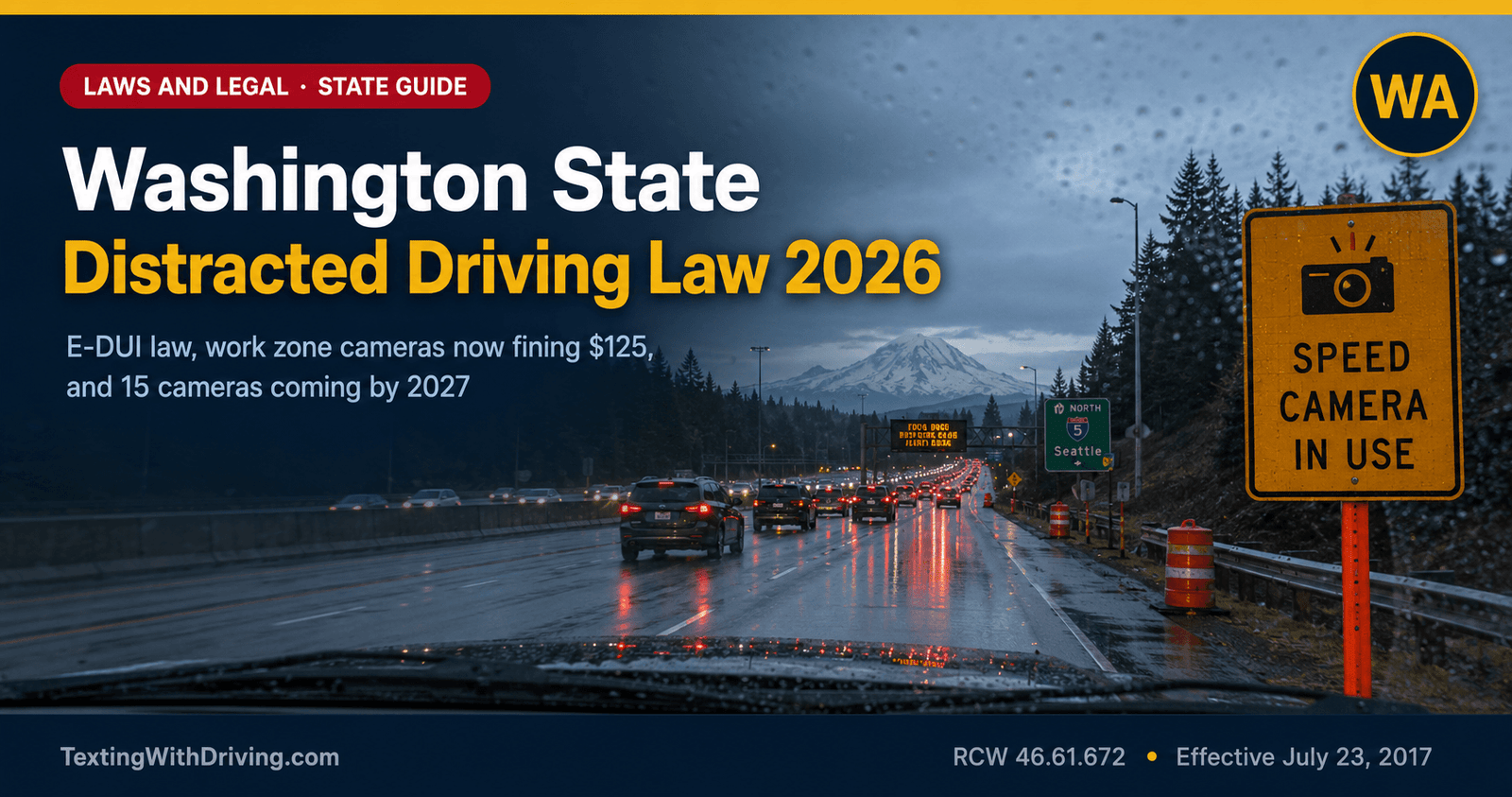
And starting July 1, 2026, the Washington State distracted driving law enforcement picture changed again: work zone speed cameras that previously issued warnings only now carry a $125 first-offense fine, with a program expanding to 15 cameras by 2027 including the first deployments in eastern Washington.
This guide covers everything every Washington driver and visitor needs to know about the Washington State distracted driving law in 2026: what the E-DUI law prohibits, the fine structure, the work zone camera program and its July 2026 changes, the teen driver rules, what remains legal, and the crash data that explains why Washington is pushing enforcement harder than ever.
What the Washington State Distracted Driving Law Prohibits
Washington’s distracted driving law, primarily focused on the use of electronic devices while driving, is strict and heavily enforced. With the implementation of the E-DUI law, the state has made it clear that any action that takes a driver’s attention off the road can result in a ticket.
The governing statute is RCW 46.61.672, which states that a person who uses a personal electronic device while driving a motor vehicle on a public highway is guilty of a traffic infraction.
The definition of personal electronic device under the Washington State distracted driving law is intentionally broad. It covers cell phones, tablets, laptops, and any other device that may distract a driver from keeping their eyes on the road. Washington’s new cell phone law prohibits no handheld devices including tablets, laptops, and any other device that may distract a driver from keeping their eyes on the road.
The E-DUI law bans all of the following while the vehicle is moving on a public highway in Washington State: holding a phone to make or receive calls, texting or sending messages of any kind, browsing the internet, using apps, watching videos, taking photos or videos, adjusting GPS or navigation using the device screen, and any other manual interaction with a handheld or unsecured personal electronic device.
Prohibited at traffic stops: the Washington State distracted driving law applies even when the vehicle is stopped at a red light or stop sign. Driving while using handheld devices is prohibited, including at stop signs and red lights. Washington is not alone in this — as we documented for Illinois, New York, and Michigan in previous articles in this series — but it is worth stating clearly for any driver who believes a red light creates a legal window for phone interaction.
The E-DUI Name: What It Means for Enforcement
The name Electronic DUI reflects a deliberate policy statement by Washington’s legislature. By framing handheld electronic device use while driving as a DUI-equivalent in name and treatment, Washington has positioned the Washington State distracted driving law as a serious behavioral impairment issue rather than a minor traffic violation.
The practical enforcement consequence of the E-DUI framing is that Washington law enforcement agencies have integrated distracted driving enforcement into the same high-visibility, high-priority enforcement culture that surrounds drunk driving. Officers are trained to identify distracted behaviors, such as texting, excessive interaction with a GPS device, or eating while driving.
The E-DUI law is primary enforcement — Washington State officers can pull over any driver they observe using a personal electronic device without any other traffic violation being required. An officer who sees a driver looking at their phone at a red light, holding a device to their ear, or manipulating any electronic device while moving has immediate authority to initiate a traffic stop based solely on that observation.
Washington State Distracted Driving Fines: The Current Structure
For the first offense, the fine is $136, and for subsequent offenses, it increases to $235. These fines apply to any use of handheld devices, including texting, browsing the internet, or making calls.
First offense: $136 base fine. Washington’s first offense fine is among the more significant in the country for a first violation, landing between the modest base fines of states like Texas ($25) and the high-end first offense fines of New York ($50 to $200 plus surcharge).
Subsequent offenses: $235 fine. The escalation to $235 for repeat violations reflects the E-DUI policy philosophy: repeated phone use while driving is not a minor oversight but a persistent behavioral choice that warrants a meaningful financial consequence.
These fines are in addition to any court costs or additional fees that may apply. A distracted driving ticket in Washington is recorded as a moving violation, meaning it carries the insurance implications of any moving violation.
The insurance dimension of a Washington distracted driving citation is one of the most significant long-term consequences. A distracted driving ticket can cause your insurance premiums to rise. Insurance companies often consider such tickets as moving violations, which means they can lead to higher rates.
The July 1, 2026 Work Zone Camera Change: Everything You Need to Know
The most significant recent development in the Washington State distracted driving law enforcement landscape is not a change to the primary E-DUI law itself. It is the July 1, 2026 change to the work zone speed camera program that directly intersects with distracted driving enforcement.
Last year, the Legislature voted to change the fine for a first-time infraction from $0 to $125, beginning July 1. Penalties for second and all subsequent infractions remain $248.
Before July 1, 2026: First-time work zone speed camera infractions carried no financial penalty. They were warnings only. Second and subsequent: $248.
After July 1, 2026 — today: First-time work zone speed camera infractions: $125. Second and subsequent: $248.
The work zone speed camera program began enforcement on April 16, 2025, on Interstate 5 near Joint Base Lewis-McChord. In its first year the program expanded from a single camera to six cameras rotating through work zones across western Washington and was used in more than 675 deployments at 46 job sites. Since the program began, troopers issued 65,000 infractions, of which 59,000 were first-time infractions that did not carry a financial penalty.
That is 59,000 first-time work zone violators who received warnings but no fine. Beginning July 1, every one of those drivers would have paid $125. The change creates a meaningful new financial reality for every Washington driver who passes through an active work zone.
Why the Work Zone Camera Data Matters for Distracted Driving
The work zone speed camera program is not a distracted driving enforcement tool specifically — it targets speeding. But its relevance to the Washington State distracted driving law story is direct and documented.
According to preliminary statistics, the total number of work-zone-related crashes was 1,557 in 2025, a slight decrease from the year before. There was an increase in fatal collisions, from seven in 2024 to nine in 2025. In 2025, the top three causes for work zone crashes in Washington were following too closely, speeding and distracted driving — all of which are preventable.
Distracted driving is explicitly identified as one of the three leading causes of Washington work zone crashes. As we documented in our distracted driving in work zones article, the work zone environment — with its sudden speed changes, lane shifts, concrete barriers close to the travel lane, and the presence of workers on or adjacent to the roadway — demands maximum driver attention at exactly the moment that an incoming notification or an unread message creates maximum temptation.
The behavioral impact of the cameras is already documented. Before cameras were deployed on I-5 near JBLM, more than 60 percent of drivers were speeding through the work zone. After camera deployment, the percentage dropped to as low as 30 percent. A 50 percent reduction in the speeding behavior is among the strongest single-site enforcement outcome in the program’s first year.
For 30 days after deployments stopped at one construction project, the construction project saw a more than 20 percent reduction in the number of vehicles speeding through that part of the work zone. The behavioral change produced by camera enforcement persists beyond the camera deployment period. Drivers who have learned that a specific work zone has cameras modify their behavior, and some of that modification carries forward even when cameras are no longer present.
The Camera Expansion: What Is Coming by 2027
The second year of the work zone camera program will bring additional cameras, with up to 15 in operation by 2027 and expansion to eastern Washington.
Washington State Standard confirmed that the cameras recently arrived in eastern Washington for the first time, as part of a paving project on Interstate 90 near Spokane.
The expansion to eastern Washington is significant because eastern Washington road characteristics differ substantially from the I-5 and I-405 western Washington corridors where the program began. Eastern Washington has longer rural highway stretches, higher speed limits, and different traffic density patterns. The camera program’s expansion into this environment creates coverage in road segments where distracted driving enforcement has historically been less intensive due to lower patrol density per road mile.
The 15-camera target by 2027, combined with the rotating deployment strategy that moves cameras between active job sites, means that Washington drivers in 2027 will face a substantially higher probability of encountering an active work zone camera than in 2025 or 2026. The perceived enforcement risk that camera programs create extends beyond the specific locations where cameras are deployed to the broader work zone driving environment, as drivers become aware that cameras could be present in any active Washington work zone.
What Remains Legal Under Washington’s E-DUI Law
The Washington State distracted driving law is comprehensive but includes specific permitted uses that drivers need to understand.
Hands-free device use is required while driving, but hands-free use is genuinely permitted. Using a hands-free device such as a Bluetooth headset or a speakerphone is allowed under certain conditions.
The specific permitted activities under Washington’s E-DUI law include: Bluetooth calls through any certified hands-free system. Voice commands for navigation, calls, and media controls. GPS navigation on a device that is mounted and pre-set before driving with no manual interaction required while moving. Vehicle-integrated systems operated through steering wheel controls or voice commands. Single-touch call acceptance or rejection on a mounted device.
The GPS and navigation rule contains a specific nuance. The law also specifically addresses the use of GPS systems and other in-car navigation tools. While these devices are allowed, they must be set up before driving, and any interaction with them while driving must be minimal and should ideally be done through voice commands.
Pre-set is the operative standard. A destination entered before the car moves is legal. A driver reaching for a mounted phone to type a new destination or scroll through a map while moving is in violation of the Washington State distracted driving law even though the device is mounted.
The minimal finger use exception also applies to accepting calls or activating a voice command on a mounted device. A single touch to accept a call or activate voice control is within the law’s minimal interaction standard. Multiple touches, scrolling, or typing are not.
The Teen Driver Standard Under Washington Law
Washington applies a stricter standard to teen drivers consistent with the GDL framework we documented in our distracted driving laws for teen drivers state guide. Novice drivers under the Washington State distracted driving law face greater restrictions than adult drivers, with emergency exception provisions similar to those in most states with comprehensive handheld bans.
The standard practical guidance for Washington teen drivers is the complete device restriction: phone in the back seat before driving, all navigation pre-set, calls prohibited entirely during the novice driving period.
The E-DUI Secondary Offense: What Negligent Driving Adds
One dimension of the Washington State distracted driving law that distinguishes it from most other states is the secondary negligent driving escalation pathway.
While the basic E-DUI infraction produces the $136 or $235 fine, driving while distracted that produces unsafe behavior can be cited under Washington’s negligent driving law as a separate and more serious offense. In the case where distracted driving endangers other persons or property, a driver may face a misdemeanor charge in addition to the E-DUI infraction. Repeat offenses may lead to felony charges.
The felony pathway for extreme repeat offenders places the Washington State distracted driving law among the country’s most serious consequences frameworks, alongside Illinois’s Class 4 felony for fatal distracted driving crashes that we covered in our Illinois distracted driving law article.
Washington’s Crash Context: Why This Enforcement Matters
Washington is a state that appears in the distracted driving statistics by state 2026 data in an unexpected position — ranked among the worst ten states nationally despite having one of the oldest and most comprehensive handheld bans in the country.
The explanation for this apparent paradox is not that the law fails to work. It is that Washington combines a large and rapidly growing population concentrated in the Seattle-Tacoma-Bellevue metropolitan corridor with high-volume traffic on the I-5, I-90, I-405, and SR-99 corridors, and simultaneously has a large rural eastern Washington road network where enforcement density is lower per road mile. The combination produces a state that is better in its densely enforced urban corridors and weaker in its rural stretches — and the aggregate state-level statistics reflect both.
The work zone camera expansion into eastern Washington directly addresses the rural enforcement gap that partially explains Washington’s statistical position. If the rural eastern Washington corridors approach the behavioral compliance rates achieved on heavily enforced western Washington interstates, the state-level statistics should improve substantially in future reporting years.
What Every Washington Driver Should Do Right Now
The Washington State distracted driving law as it exists in July 2026 requires: no personal electronic device in hand while any Washington public highway vehicle is moving, under any circumstances, for any purpose. At red lights. In slow traffic. On rural highways. In construction zones. Everywhere on every public road in Washington State.
The $136 first offense fine is real, active, and enforceable from the first incident. The work zone camera program is now producing $125 fines for first violations effective this month. The 15-camera expansion by 2027 means more active enforcement than at any point in the program’s history.
The practical pre-drive checklist for every Washington drive: GPS destination entered before moving. Bluetooth connected for any calls. iPhone Driving Focus or Android driving mode activated. Phone in a mount or back seat where it requires no manual interaction. Any work zone entered with the assumption that a speed camera may be active regardless of visible signage.
For the complete technology setup that makes Washington compliance automatic, our Do Not Disturb while driving setup guide covers both iPhone and Android. For the national comparison showing where Washington stands among all 50 states, our hands-free driving laws by state 2026 covers every state’s specific provisions.
Sources Used in This Article
All links verified working before publication.
WSDOT: Speed Camera Fines Increase Work Zones Beginning July 1 — $125 first offense July 1, $248 subsequent, 85,000 infractions, 900 deployments, June 2026
WSDOT: Speed Cameras Bring Added Safety to Work Zones Program Prepares for Expansion — 60% to 30% speeding reduction, 1,557 work zone crashes 2025, distracted driving top 3 cause, April 2026
Washington State Standard: Work Zone Speed Camera Fines Rise to $125 on July 1 — Legislative change from $0 to $125, 77,000 first-time warnings, eastern Washington expansion, June 2026
KGW: Washington State to Impose Fines in Work Zones Starting July — Chief Batiste quote, 9% repeat offenders, 6,000 fined drivers, April 2026
Elsner Law: Washington Cell Phone Law 2026 — $136/$235 fine structure, E-DUI law scope, July 2026
Cars Counsel: Washington Distracted Driving Laws 2026 — RCW 46.61.672, prohibited activities, minimal finger use exception, December 2025
RCW 46.61.672 Official Statute Text — Official Washington State statute
RCW 46.63.200 Speed Safety Camera Systems Work Zones — Official camera program statute, effective July 1, 2026
NHTSA: Distracted Driving — 3,208 deaths 2024, national context
TextingWithDriving.com is professionally built and maintained to ensure accurate, accessible safety information reaches every driver who needs it. Website development and ongoing support is handled by Budgetic, a digital agency specializing in purpose-driven WordPress websites.

About Texting With Driving
TextingWithDriving.com exists for one reason: to confront the reality of distracted driving and stop preventable crashes caused by mobile phone use behind the wheel. Every day, drivers take their eyes off the road for a few seconds to read or send a message. Those few seconds are enough to cause life-altering consequences. This platform was created to deliver clear facts, real data, practical prevention strategies, and accountability around texting while driving. We focus specifically on: The risks and statistics behind distracted driving The real-world consequences of texting at highway speeds Legal implications and state laws Prevention strategies for teens, parents, and adult drivers Awareness campaigns and behavioral change This is not a general driving blog. It is a focused awareness initiative built around one critical issue: phone distraction behind the wheel. Our content is direct, research-driven, and practical. We prioritize accuracy over opinion and education over sensationalism. The goal is simple — reduce distracted driving incidents by increasing awareness and responsibility. If one article causes one driver to put their phone down, the mission is working. For inquiries or partnerships, contact: privacy@textingwithdriving.com
View all posts by Texting With Driving