
DC to Virginia Maryland Commuter Guide: Distracted Driving Laws Across the State Line

DC to Virginia Maryland Commuter Guide: Distracted Driving Laws Across the State Line
DC Virginia Maryland commuter distracted driving laws create a legal landscape that changes at every bridge crossing and every state line — and the millions of daily commuters who navigate this tri-jurisdiction region are frequently unaware of exactly when the law they are complying with is replaced by a different law with different provisions, different fine structures, and in one case a completely different enforcement mechanism that can result in civil lawsuits against out-of-state drivers.
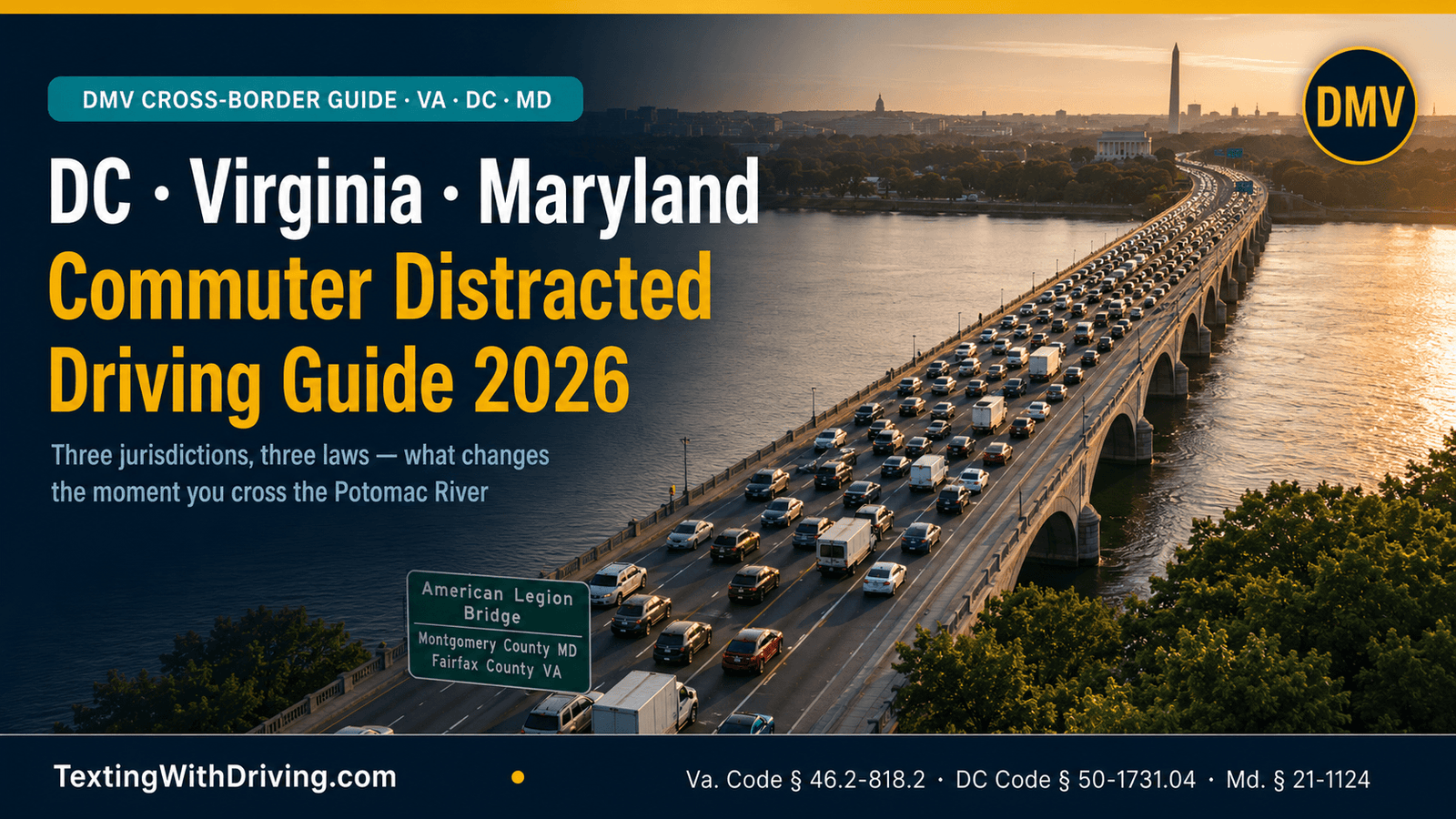
Every business day, approximately 1 million people commute across the borders of Virginia, Washington DC, and Maryland. They cross the Woodrow Wilson Bridge — the only bridge in America that passes through three simultaneous state-level jurisdictions. They cross the American Legion Bridge carrying 232,000 vehicles per day between Fairfax County and Montgomery County. They cross the Key Bridge, the Roosevelt Bridge, the Memorial Bridge, and the George Mason and Rochambeau bridges connecting Virginia to DC. At every crossing, the distracted driving law that governs their behavior changes the moment the front bumper passes the jurisdictional line on the bridge.
This guide covers the complete DC Virginia Maryland commuter distracted driving laws picture for every crossing: what the law is in each jurisdiction, exactly where the law changes on each major crossing, the specific provisions that differ between the three jurisdictions, the STEER Act enforcement mechanism that makes DC fines collectible from Virginia and Maryland drivers through civil lawsuits, and the single pre-drive setup that makes a driver fully compliant in all three jurisdictions simultaneously.
The Three Laws: What Each Jurisdiction Requires
Before the crossing-by-crossing guide, understanding what each of the three DMV jurisdictions requires establishes the framework for everything that follows.
Virginia — Va. Code § 46.2-818.2:
No holding a phone or any personal communications device for any purpose while operating a motor vehicle on any Virginia public road. Primary enforcement. $125 first offense, $250 second offense, $250 mandatory in work zones and school zones. 3 demerit points. Reckless driving criminal upgrade pathway under § 46.2-868(C). Full provisions in our Virginia distracted driving law article.
Washington DC — DC Code § 50-1731.04:
No using a mobile telephone or other electronic device while operating a moving motor vehicle in DC unless equipped with a hands-free accessory. Operating includes sitting at a red light or in traffic. No headphones while driving (except hearing-assistive devices). Complete ban for learner’s permit holders and bus drivers. $100 first offense, $150 second offense within 18 months, $200 plus 30-90 day suspension for third offense within 18 months. First offense dismissable with proof of hands-free device purchase. Full provisions in our Washington DC distracted driving law article.
Maryland — Md. Transportation Code § 21-1124:
No using hands to operate a handheld phone while vehicle is in motion. Primary enforcement. $83 first offense, $140 second, $160 third offense. Points on driving record. Jake’s Law: up to $5,000 fine and three years in prison for causing serious injury or death while distracted. Complete under-18 ban including hands-free. AI camera pilot proposed for Montgomery and Prince George’s Counties. Full provisions in our Maryland distracted driving law 2026 article.
The key similarities: all three jurisdictions prohibit handheld phone use while driving and enforce it as a primary offense. The key differences are in the fine levels, the red light treatment, the headphone rules, and the consequences that stack on top of the basic fine.
The American Legion Bridge: Virginia to Maryland (I-495)
The American Legion Bridge is the highest-volume Potomac River crossing in the region — carrying 232,000 vehicles per day, with traffic studies showing 300,000 vehicles per day during peak periods — and the primary crossing point for the vast majority of Northern Virginia to Maryland commuters using I-495.
The American Legion Bridge connects Fairfax County Virginia to Montgomery County Maryland. It carries 10 lanes of I-495, with 8 through lanes and 2 auxiliary lanes. There are no facilities for pedestrians or cyclists.
The law change on the American Legion Bridge:
Eastbound (Virginia to Maryland): You are under Virginia law from the George Washington Memorial Parkway approach on the Virginia side through the midpoint of the bridge. At the midpoint where the jurisdictional line crosses the Potomac River, you transition to Maryland law for the remainder of the crossing and onto the Clara Barton Parkway and I-495 Maryland side.
The practical difference at this crossing: both Virginia and Maryland prohibit handheld phone use as a primary offense, so the core behavioral standard — no phone in hand — does not change. What changes is the specific fine structure and the points consequence. A citation issued on the Maryland side of the bridge is a Maryland citation ($83 first offense, 1 DMV point) rather than a Virginia citation ($125 first offense, 3 DMV points). For a first-time violator, the Maryland citation is actually less expensive at the courthouse — but Maryland’s Jake’s Law for crash-involving violations creates a more severe criminal exposure than Virginia’s standard structure.
Congestion on the American Legion Bridge and commuter travel between the western Washington suburbs in both states has fueled support for a western bridge around the Loudoun County/Fairfax County line. The bridge’s chronic congestion — particularly during the morning inbound rush from Northern Virginia to Maryland and DC destinations — creates exactly the stop-and-go traffic environment where distracted driving violations are most likely to be observed and cited. An officer in a marked or unmarked vehicle positioned on the Maryland approach to the American Legion Bridge has a clear sight line into vehicle interiors during the slow merge-and-stop traffic that characterizes peak hour crossings.
The Woodrow Wilson Bridge: Virginia, DC, and Maryland Simultaneously
The Woodrow Wilson Memorial Bridge is unique in American road infrastructure: it is the only bridge in the United States that crosses the borders of three state-level jurisdictions simultaneously — the District of Columbia, Maryland, and Virginia. The section in Washington DC is also the shortest segment of Interstate Highway between state lines.
The Woodrow Wilson Bridge carries I-95/I-495 between Alexandria Virginia and Prince George’s County Maryland, with a brief passage through DC jurisdiction. The bridge is approximately 1.5 miles total, with jurisdictional boundaries placing the southernmost Virginia section, a short DC section, and the northernmost Maryland section in close proximity.
The law changes on the Woodrow Wilson Bridge:
Northbound (Virginia to Maryland via DC): Virginia law governs from the Alexandria approach. DC law begins at the Virginia-DC jurisdictional line on the bridge. Maryland law begins at the DC-Maryland line. All three jurisdictions are traversed within approximately 1.5 miles. The practical consequence: a driver who is holding their phone at any point on the Woodrow Wilson Bridge is violating the law of whichever jurisdiction that exact point falls within — Virginia, DC, or Maryland — and the citation issued reflects the law of that jurisdiction.
The DC section of the bridge is brief — the shortest interstate segment between state lines in the country — but it is a real jurisdictional zone where DC Code § 50-1731.04 applies. A driver who picks up their phone for a two-second check as they cross the Wilson Bridge may technically pass through all three jurisdictions’ enforcement zones within the span of their bridge crossing.
The Woodrow Wilson Bridge is one of the most camera-monitored road segments in the DMV region, with enforcement camera systems maintained by multiple agencies reflecting its multi-jurisdictional status.
The Key Bridge, Roosevelt Bridge, and Memorial Bridge: Virginia to DC
The Francis Scott Key Bridge, Theodore Roosevelt Bridge, and Memorial Bridge (George Mason Memorial Bridge and Rochambeau Memorial Bridge) are the primary direct Virginia-to-DC crossings for Northern Virginia commuters going to the Georgetown, Foggy Bottom, and Southwest DC employment centers.
All three of these crossings connect Virginia directly to DC with no Maryland segment. The jurisdictional transition is binary: Virginia law on the Virginia side, DC law on the DC side.
The Key Bridge: Connects the Rosslyn area of Arlington County Virginia to Georgetown DC. The midpoint of the bridge is approximately the Virginia-DC jurisdictional boundary. This is confirmed in the Potomac River Bridge Towing Compact among Virginia, Maryland, and DC as one of the bridges passing through the territorial jurisdiction of two or more of the three parties.
The Theodore Roosevelt Bridge: Carries I-66 from Rosslyn Virginia to the Roosevelt Memorial area of DC and connects to I-66 eastbound toward downtown DC. The jurisdictional transition occurs at the river midpoint. This is the primary I-66 crossing into DC — one of the highest-volume DC commuter entry points in the region.
The George Mason and Rochambeau Memorial Bridges: The Memorial Bridge complex connects Arlington Virginia to the Lincoln Memorial area of DC. Jurisdictional transition at river midpoint.
The law change at these crossings:
The specific provision that catches Virginia commuters driving into DC is the headphone rule. Virginia does not prohibit wearing headphones while driving. DC Code § 50-1731.04 explicitly prohibits wearing headphones while driving, with an exception only for hearing-assistive equipment for hearing-impaired drivers.
A Virginia commuter who routinely uses earbuds for music during their Northern Virginia commute and continues wearing them across the Key Bridge or Roosevelt Bridge into DC is violating DC law the moment they enter DC jurisdiction — even if they are not on a phone call, even if they are not using the earbuds to communicate. The music-listening headphone use that is legal in Virginia becomes illegal in DC at the moment of crossing.
The red light rule difference is less practically significant because Virginia’s hands-free law also applies at red lights. But the headphone provision creates a real compliance distinction between Virginia and DC law that thousands of daily commuters likely do not know.
The STEER Act: DC’s New Tool Against Virginia and Maryland Drivers
The most significant recent development in DC Virginia Maryland commuter distracted driving laws enforcement is the DC STEER Act — Strengthening Traffic Enforcement, Education and Responsibility — which fundamentally changed the consequences for Virginia and Maryland drivers who accumulate unpaid DC traffic citations.
The STEER Act went into effect in 2024 and aims to hold dangerous drivers accountable and deter repeat offenders. It gives DC more authority against dangerous drivers in three main ways:
First: The DC Attorney General can now sue Virginia and Maryland drivers who haven’t paid large DC traffic fines, even if they live outside the District. This will affect drivers who have tens of thousands of dollars in unpaid tickets, not people with just a ticket or two.
Second: The DC DMV can install intelligent speed limiters in vehicles of individuals convicted of reckless driving.
Third: A new point system that could result in vehicle booting or towing for excessive violations.
The enforcement results from the STEER Act are documented and specific. DC Attorney General has already secured $531,192 from dangerous Maryland and Virginia drivers through nine judgments and five settlements under the Act.
The specific STEER Act cases reveal the scale of unpaid DC citation accumulation from Virginia and Maryland drivers:
One Virginia driver had 345 traffic citations and owed $95,508 to DC, accumulated across a New Jersey driver’s license and plates from multiple states.
One Maryland driver had 323 citations and owed $102,222, including 259 speeding tickets, 48 constituting reckless driving, and 11 constituting aggravated reckless driving.
One Maryland driver owed $284,000 for 910 violations.
In FY 2023, out-of-state plates — primarily Maryland and Virginia — received 808,933 citations in DC totaling $160.7 million in unpaid fines.
808,933 citations in a single year. $160.7 million unpaid. This is the scale of the cross-border citation compliance gap that the STEER Act is designed to address. For the individual commuter, the STEER Act changes the risk calculus around DC traffic violations: where a Virginia or Maryland driver previously might have ignored DC camera citations with limited consequence (since DC could not suspend Virginia or Maryland licenses and had limited cross-border enforcement), the STEER Act enables civil lawsuits in DC court that can be enforced in Virginia and Maryland courts through the Full Faith and Credit Clause.
DC officials cannot suspend Virginia or Maryland licenses, even for drivers with substantial unpaid fines. Without an agreement for ticket reciprocity among DC, Maryland, and Virginia, it’s difficult to enforce penalties across state lines. However, the STEER Act’s civil lawsuit pathway specifically addresses this gap through judicial channels rather than DMV channels.
If OAG wins a case against a driver and obtains a judgment, the District can demand through the Full Faith and Credit Clause of the U.S. Constitution that Virginia and Maryland courts enforce that judgment — potentially including wage garnishment, bank account attachment, and other civil enforcement tools that Virginia and Maryland courts routinely apply to domestic judgments.
The practical implication for commuters: a DC distracted driving citation from a camera system — the $100 DC fine — is not safely ignorable for Virginia or Maryland drivers who believe they can simply not respond to a DC citation. Multiple unpaid DC citations create the accumulated balance that puts drivers within the STEER Act lawsuit target range.
Route-Specific Law Changes: The Daily Commute Corridors
I-66 Eastbound (Virginia to DC):
Virginia law applies from any Virginia origin through the Fairfax and Arlington segments of I-66. DC law begins at the Theodore Roosevelt Bridge midpoint crossing the Potomac. The I-66 traffic stream during peak hours is among the most-monitored in Northern Virginia with both marked and unmarked Virginia State Police enforcement targeting the specific violations that produce the 26-deaths-in-2026 Fairfax County death count that prompted the Road Shark enforcement escalation.
I-395 North (Virginia to DC/Maryland):
Virginia law applies from Springfield through Pentagon approach and into the I-395 corridor approaching DC. The transitional point at the 14th Street Bridge complex (which includes the George Mason Memorial Bridge and the 14th Street Bridge carrying I-395) is where Virginia law transitions to DC law. Continuing north into Maryland via I-695 or connecting roads transitions to Maryland law.
I-295 and Baltimore-Washington Parkway:
These routes connect DC and Maryland primarily for Baltimore-bound commuters. DC law applies in DC, Maryland law begins at the Maryland border on the Maryland side of the Anacostia bridges.
Route 50 (New York Avenue) Eastbound:
Virginia law through Falls Church and Arlington. DC law begins at the DC-Arlington boundary near the Custis Trail crossing. Maryland law begins at Eastern Avenue where Route 50 crosses into Prince George’s County.
Route 1 (Richmond Highway) North:
Virginia law from Alexandria through Mount Vernon through Woodbridge. This route does not cross into DC directly — it continues north into Alexandria and then connects to I-95/I-395 corridors for DC access.
The Single Pre-Drive Setup That Covers All Three Jurisdictions
The DC Virginia Maryland commuter distracted driving laws compliance challenge for a daily cross-border commuter appears complex. The solution is straightforward: the pre-drive setup that covers all three jurisdictions simultaneously is the same setup that covers the most restrictive of the three.
Since all three jurisdictions prohibit handheld phone use as a primary offense, the core behavioral requirement — phone not in hand while moving — is identical across all three. The additional DC-specific rule on headphones means that the pre-drive setup should address headphones specifically for any commuter who enters DC jurisdiction.
The complete cross-border commuter pre-drive setup:
Phone mounted before leaving home or office. On the dashboard or windshield mount. Destination entered. No handheld contact required throughout the Virginia, DC, and Maryland portions of any commute.
Bluetooth active for all calls. All three jurisdictions permit hands-free Bluetooth calls. Bluetooth coverage satisfies the hands-free standard in Virginia, DC, and Maryland simultaneously.
Driving Focus or Android DND active. All notifications silenced. Auto-reply active. The notification pressure of the DMV region’s professional workforce — that drives the checking impulse at every red light on every bridge — is addressed before the drive begins.
Earbuds removed before entering DC. For commuters who use earbuds for music during their Virginia commute: remove them before crossing into DC. A single earbud in one ear is legal in Virginia. It is prohibited in DC for any use except hearing assistance. The simplest solution is no earbuds during any portion of the commute that enters DC jurisdiction, which covers every bridge crossing from Virginia into DC.
Phone secured during DC transit. For commuters whose route passes through DC — including every commuter using the Wilson Bridge who technically passes through a DC jurisdictional zone — the most conservative and fully protective approach is phone in mount with no manual contact throughout the entire DC portion of the route.
This setup covers Virginia, DC, and Maryland compliance simultaneously with one pre-drive routine completed before leaving the driveway.
What the STEER Act Means Specifically for Virginia Commuters
The DC Virginia Maryland commuter distracted driving laws STEER Act dimension requires specific guidance for Virginia drivers who drive regularly in DC.
A single $100 DC distracted driving citation is not a STEER Act target. The STEER Act targets drivers with tens of thousands of dollars in accumulated fines. But the accumulation pathway matters: a commuter who routinely receives DC camera citations — speed, distracted driving, red light — and routinely ignores them is building the exact citation accumulation that has already produced STEER Act lawsuits against specific Virginia drivers.
The DC camera network is extensive and actively monitored. The 808,933 out-of-state citations in FY 2023 demonstrate that DC camera enforcement of Virginia and Maryland plates is consistent, systematic, and occurring at very high volumes. The STEER Act does not change the citation issuance — it changes the consequence of non-payment by giving DC the civil lawsuit tool that enables collection from out-of-state drivers.
For the Virginia commuter who drives regularly in DC, the practical guidance is clear: every DC citation should be treated as a mandatory payment obligation, not an optional Maryland-or-Virginia-doesn’t-care-about-DC-tickets convenience. The STEER Act has ended the era when ignoring DC citations was a consequence-free choice for Virginia and Maryland plate holders.
Sources Used in This Article
All links verified working before publication.
DC OAG: Attorney General Schwalb Secures First STEER Act Judgment — Virginia driver 345 citations $95,508, Maryland driver 323 citations $102,222, STEER Act authority, September 2025
DC OAG: Attorney General Secures $531,192 from Dangerous Maryland and Virginia Drivers — Nine judgments five settlements $531,192 total, Maryland driver $284,000 910 violations, March 2026
WUSA9: The STEER Act Is Here What It Means for Maryland Virginia Drivers — STEER Act provisions three ways, DMV stolen vehicle protection, point system
Traub Law: DC New Traffic Enforcement Rules Cracks Down on Maryland and Virginia Drivers — Cannot suspend VA/MD licenses, no ticket reciprocity, STEER Act limitations, attorney general sue authority, June 2025
Fox 5 DC: New DC Law Aims to Curb Reckless Driving by Out-of-State Drivers — FY 2022 757,268 citations $151M, FY 2023 808,933 citations $160.7M, Maryland Virginia plates overwhelming majority
Washington Examiner: DC Cracks Down on Dangerous Drivers from Maryland and Virginia — 2,100 vehicles 40+ dangerous speeding tickets, Councilmember Allen quotes, 12-year-old pedestrian struck by driver with 94 citations
Charles Allen DC Council: STEER Act — Full Faith and Credit Clause enforcement, OAG civil suit authority details
Wikipedia: Woodrow Wilson Bridge — Only US bridge crossing three state-level jurisdictions, shortest interstate segment between state lines
Wikipedia: American Legion Memorial Bridge — 10 lanes I-495, Montgomery County Maryland to Fairfax County Virginia, 232,000 daily traffic
Virginia Code § 46.2-1239.1: Potomac River Bridge Towing Compact — Official list of bridges crossing multiple jurisdictions including Wilson Bridge Key Bridge Roosevelt Bridge
Fox Baltimore: Gridlock Nation American Legion Bridge — 300,000 daily commuters American Legion Bridge, congestion context, April 2026
NHTSA: Distracted Driving — 3,208 deaths 2024, national context
TextingWithDriving.com is professionally built and maintained to ensure accurate, accessible safety information reaches every driver who needs it. Website development and ongoing support is handled by Budgetic, a digital agency specializing in purpose-driven WordPress websites.

About Texting With Driving
TextingWithDriving.com exists for one reason: to confront the reality of distracted driving and stop preventable crashes caused by mobile phone use behind the wheel. Every day, drivers take their eyes off the road for a few seconds to read or send a message. Those few seconds are enough to cause life-altering consequences. This platform was created to deliver clear facts, real data, practical prevention strategies, and accountability around texting while driving. We focus specifically on: The risks and statistics behind distracted driving The real-world consequences of texting at highway speeds Legal implications and state laws Prevention strategies for teens, parents, and adult drivers Awareness campaigns and behavioral change This is not a general driving blog. It is a focused awareness initiative built around one critical issue: phone distraction behind the wheel. Our content is direct, research-driven, and practical. We prioritize accuracy over opinion and education over sensationalism. The goal is simple — reduce distracted driving incidents by increasing awareness and responsibility. If one article causes one driver to put their phone down, the mission is working. For inquiries or partnerships, contact: privacy@textingwithdriving.com
View all posts by Texting With Driving