

Hawaii Distracted Driving Law 2026: Deaths Jumped 64%, Now 2nd Worst State

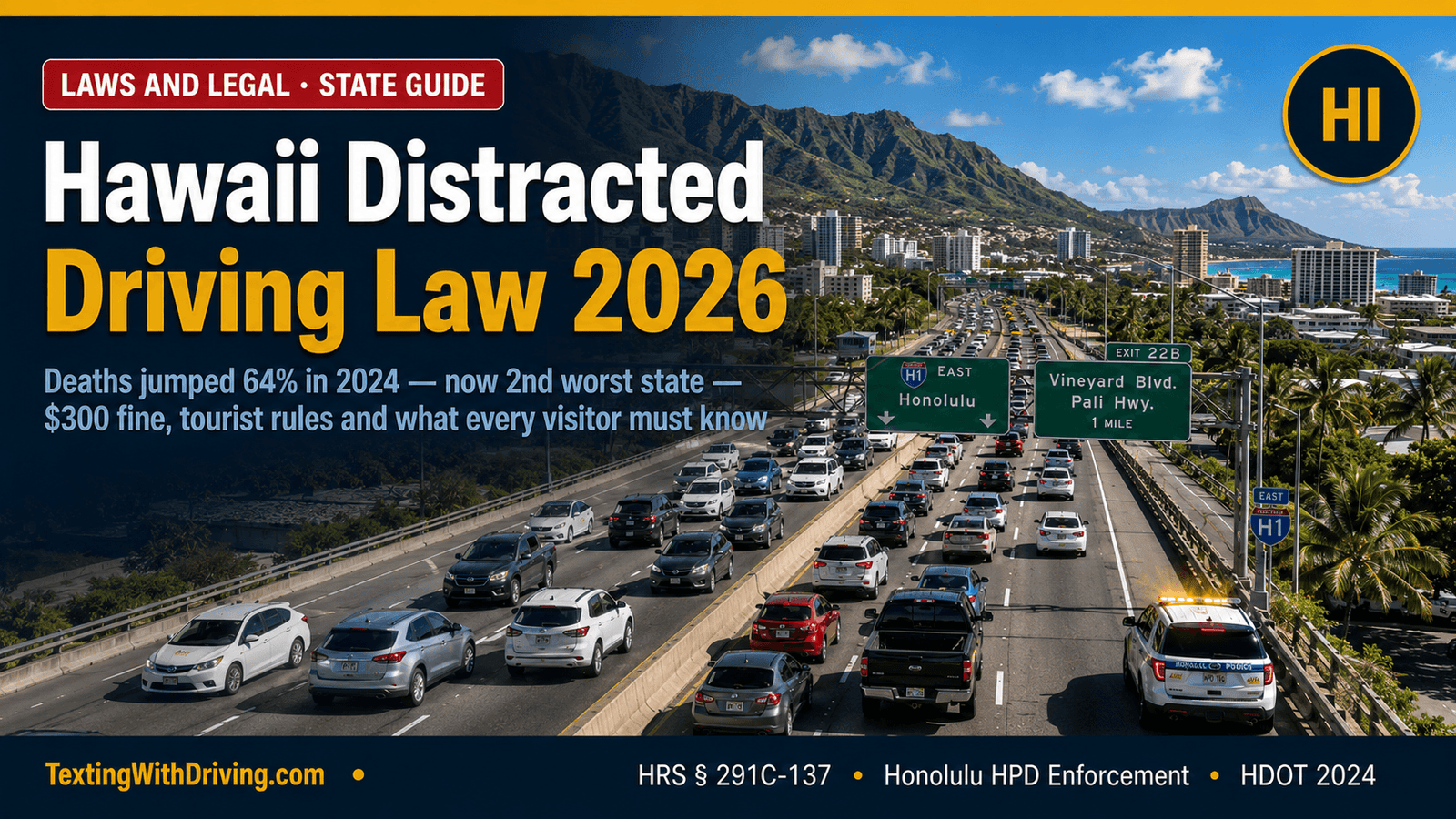
Hawaii Distracted Driving Law 2026: Deaths Jumped 64%, Now 2nd Worst State
The Hawaii distracted driving law has been on the books since 2013 — one of the earlier states to enact a comprehensive mobile electronic device ban. Hawaii Revised Statutes § 291C-137 prohibits all handheld mobile device use while driving, applies primary enforcement, and carries a $300 fine that is among the higher base fines of any state in this series.
And yet: Hawaii recorded the largest single-year deterioration of any state in 2024, with distracted driving deaths jumping from 25 to 41.
From 25 deaths to 41 deaths in a single year. A 64 percent increase in distracted driving fatalities that moved Hawaii from a mid-tier performer to the second worst state in the country — behind only New Mexico, which has held the worst position for five consecutive years as documented in our New Mexico distracted driving law 2026 article.
This is the most alarming single-state deterioration in the complete 2024 NHTSA dataset. No other state experienced a comparable single-year jump in distracted driving deaths — not in absolute terms, not in percentage terms. Hawaii’s 64 percent increase occurred simultaneously with national distracted driving deaths declining 2 percent and multiple states achieving their best-ever crash reduction numbers.
Why did Hawaii deteriorate so dramatically in a year when the national trend moved in the opposite direction? This guide covers the complete Hawaii distracted driving law picture: the specific law provisions under HRS § 291C-137, the $300 standard fine and $400 school zone enhancement, what the Honolulu Police Department’s enforcement data shows, what is known and what is unknown about the 2024 deterioration, and what every resident and the millions of tourists who drive rental cars in Hawaii must know before getting behind the wheel.
What the Hawaii Distracted Driving Law Prohibits
The Hawaii distracted driving law under HRS § 291C-137 is among the most comprehensive handheld device bans of any state. The statute’s prohibition covers all use of a mobile electronic device while operating a motor vehicle.
No person shall operate a motor vehicle while using a mobile electronic device. The use of a mobile electronic device for the sole purpose of making a “911” emergency communication shall be an affirmative defense to this law.
“While using a mobile electronic device” covers the full spectrum of device interaction. In Hawaii, it’s illegal to use a handheld mobile electronic device while operating a vehicle. The restriction applies to talking on the phone, texting, and all other uses of an electronic device.
The prohibited behaviors under the Hawaii distracted driving law cover:
All handheld phone calls. Unlike Kentucky, New Mexico, and the other texting-only ban states we have covered, Hawaii’s § 291C-137 prohibits handheld calls. Holding a phone to your ear for a voice call while driving is illegal in Hawaii regardless of what state you are licensed in and regardless of your home state’s law.
All texting and electronic messaging. Reading, writing, or sending any text, email, instant message, or electronic communication while driving is prohibited.
All other mobile device use. The “all other uses” language is comprehensive. Scrolling social media, watching videos, browsing the internet, taking photos, adjusting music apps — any interaction with a mobile electronic device while the vehicle is moving is a violation.
The only 911 exception. The use of a mobile electronic device is only legal for the sole purpose of “911” emergency communication. This is the narrowest exception of any state in this series. Emergency calls to 911 are permitted in handheld mode. No other handheld device use has any exception for adult drivers under the standard Hawaii law.
Primary Enforcement: No Other Violation Needed
The Hawaii distracted driving law is primary enforcement. A Honolulu Police Department officer, Hawaii County Police officer, or Maui Police Department officer who observes a driver using a handheld device while driving can initiate a stop based solely on that observation.
In 2023, the Honolulu Police Department cited more than 4,700 individuals for operating a vehicle while using a cell phone.
4,700 citations in a single year from HPD alone. Primary enforcement authority actively exercised across Oahu’s road network. The enforcement presence is real and the citation volume demonstrates it.
The HDOT announced increased enforcement: Drivers can expect to see more enforcement of Hawaii’s Mobile Electronic Device Law. This enforcement intensification was active in 2024 — the year Hawaii’s distracted driving deaths jumped 64 percent. The enforcement increase did not prevent the deterioration, raising questions about whether the enforcement intensity reached the level required for sustained behavioral change.
The Fine Structure: $300 Standard, $400 in School Zones
The Hawaii distracted driving law fine structure is specific and tiered:
Every person who violates this section shall be subject to a fine of $300 that shall be deposited into the state highway fund; provided that if a person violates this section while operating a motor vehicle in a school zone or construction area, the fine shall be $400.
Standard violation: $300 fine.
School zone or construction area violation: $400 fine.
Additional surcharge: You can also be subject to a $100 surcharge which will be deposited into the trauma system special fund. This surcharge, added on top of the base fine, brings the effective first-offense cost to $400 standard and $500 in school zones before court fees.
With the inattentive driving charge: If you were caught texting while driving, you could face a fine of $147 as a separate inattentive driving charge under HRS § 291-12, which can be added to the § 291C-137 mobile device violation. Multiple charges from a single stop compound the financial consequence.
Hawaii’s $300 base fine is significantly higher than Kentucky’s $25, New Mexico’s $25, and Alabama’s $50 — making it one of the stronger base financial deterrents in any state we have covered in this series. The $400 school zone fine and $100 trauma fund surcharge add additional layers that make Hawaii’s effective first-offense cost $400 to $500.
The contrast between Hawaii’s relatively high fine level and its second-worst national ranking is instructive. As we documented in our distracted driving vs drunk driving 2026 article, fine severity without consistent perceived catch probability produces limited behavioral change. Hawaii’s $300 fine is not producing the outcomes that Ohio’s $150 fine is producing — because Ohio’s enforcement intensity, sustained public awareness campaign, and primary enforcement context create a higher perceived catch probability than Hawaii’s enforcement environment can maintain across its island-by-island road network.
The Under-18 Complete Ban
No person under eighteen years of age shall operate a motor vehicle while utilizing a hands-free mobile electronic device, except for the sole purpose of making a “911” emergency communication.
For drivers under 18, Hawaii’s law extends beyond the handheld prohibition to cover hands-free use as well. A teen driver in Hawaii cannot use Bluetooth for a call, cannot use voice commands connected to a phone, cannot use any phone function while driving. The only permitted use is a 911 call in a genuine emergency.
This complete ban for drivers under 18 is consistent with the GDL frameworks we have documented across most states in this series. Hawaii’s teen prohibition is among the strictest in the country because it explicitly covers hands-free technology by name — making clear that the teen ban is not merely about physical contact with the device but about any phone engagement while driving.
What Remains Legal Under the Hawaii Distracted Driving Law
For adult drivers (18 and older), the Hawaii distracted driving law permits:
Hands-free calls through Bluetooth earpiece, speakerphone on a mounted device, or vehicle-integrated system where the phone is not physically held. Hawaii’s distracted driving laws prohibit all motorists from using a handheld mobile electronic device while driving. And for certain drivers, even hands-free device use is prohibited. But for most drivers, the ban doesn’t apply to hands-free device use.
Mounted GPS navigation with destination pre-set before driving. The device must not be held while the vehicle is moving, but mounted navigation is permitted.
Voice commands for any function that requires no manual device contact.
911 emergency calls in genuine emergency circumstances, even in handheld mode under the explicit statutory affirmative defense.
The practical difference from a texting-only ban state like New Mexico or Kentucky: in Hawaii, even the handheld voice call is prohibited. An adult driver who picks up their phone to dial a number and hold it to their ear during a call is violating § 291C-137, unlike in Kentucky where that same behavior is entirely legal.
The 2024 Deterioration: What We Know and What We Don’t
The most urgent question about the Hawaii distracted driving law in 2026 is the same one that researchers and advocates have been asking since the April 2026 NHTSA data release: why did Hawaii’s distracted driving deaths jump 64 percent in 2024?
Hawaii recorded the largest single-year deterioration of any state, with distracted driving deaths jumping from 25 to 41.
Hawaii went from 25 distracted driving deaths in 2023 to 41 in 2024 — a 64 percent increase in a year when every national trend moved in the opposite direction.
What is known:
The trend was building. Distracted driving had been a growing concern in Hawaii before the 2024 spike. In 2019, 34.3 percent of fatal crashes in Hawaii were due to distracted driving — already an elevated rate. The 2024 jump to a level that placed Hawaii second nationally represents an acceleration of an existing trajectory, not a sudden reversal from a strong safety position.
Post-COVID tourism volume surge. Hawaii’s tourism industry recovered dramatically from 2020-2023. 2024 represented near-record visitor numbers — millions of tourists driving rental cars on island roads they had never seen before. The specific driver distraction risks associated with tourist driving we documented in our Virginia Beach distracted driving 2026 article — navigation dependency, rental vehicle unfamiliarity, social coordination phone pressure — apply specifically to Hawaii’s tourism-dependent road environment.
The reporting methodology question. As we documented in our Maryland distracted driving statistics 2026 article, NHTSA’s ACRS system underwent changes in 2024 that affected how distracted driving is coded in some states. Hawaii’s data should be examined for potential reporting methodology effects, though NHTSA has not specifically identified Hawaii as a state where the 2024 data change is a primary explanation for the spike.
The enforcement timing effect. The HDOT’s April 2024 announcement of increased enforcement came in the same year as the spike — suggesting that the enforcement increase may have been a response to emerging crash data rather than a prevention of it.
What is unknown:
The specific causal explanation for Hawaii’s 64 percent deterioration in 2024 has not been publicly established. No official state or federal report has identified the primary driver of the increase. The island-by-island distribution of the 41 deaths — whether concentrated on Oahu, the Big Island, Maui, or distributed across all islands — has not been publicly broken down in the available data.
The Tourist Dimension: Why Hawaii’s Law Matters for Visitors
Hawaii receives approximately 10 million tourists annually, most of whom drive rental cars on roads they have never navigated before. The Hawaii distracted driving law applies to every one of those rental cars the moment they leave the airport.
There are nearly 10,000 car accidents every year in Hawaii. And most of these are simple distracted driving mistakes that are completely preventable.
The tourist-specific distracted driving risk factors in Hawaii are both comparable to and different from the mainland tourism contexts we have covered:
Island navigation complexity. Hawaiian roads frequently pass through dramatic terrain changes — coastal highways, mountain switchbacks, one-lane bridges in rural areas — that require navigation attention and create the specific uncertainty that drives phone-checking behavior. A tourist navigating to a Maui waterfall trailhead or a Big Island lava field may be checking their phone every few minutes on roads that require full visual attention.
Rental car unfamiliarity. Tourists arriving from the mainland are often driving vehicles they have not operated before, in right-hand traffic (same as mainland), but on roads with different lane configurations, narrower shoulders, and specific island infrastructure characteristics. The cognitive load of unfamiliar vehicle operation compounds the distraction risk of unfamiliar road navigation.
The $300 fine applies immediately. Unlike in some states where out-of-state drivers may believe their home state’s law applies while traveling, Hawaii’s § 291C-137 applies to every driver on any Hawaii public road from the moment they leave the rental car facility. A tourist from Kentucky — where holding a phone for a call is legal — faces a $300 Hawaii fine for the same behavior the moment they pick up their phone on H-1.
The use of a mobile device is only legal for the sole purpose of “911” emergency communication. No other handheld device use has any exception — not for a quick check of the hotel address, not for a glance at the map, not for a text to the travel companion in the following car. The 911 exception is the only one.
Honolulu’s Enforcement Infrastructure
The Hawaii distracted driving law enforcement is conducted primarily by county police departments — HPD for Oahu, Hawaii County Police for the Big Island, Maui Police for Maui and Molokai, and Kauai Police for Kauai — with support from HDOT enforcement programs.
In 2023, the Honolulu Police Department cited more than 4,700 individuals for operating a vehicle while using a cell phone.
4,700 Honolulu citations in 2023 alone. HPD’s enforcement program on Oahu is one of the more active distracted driving enforcement programs of any city department in the Pacific region. Officers are deployed on the H-1, H-2, and H-3 freeways as well as the surface road network including Nimitz Highway, Ala Moana Boulevard, and Kamehameha Highway.
The Put the Phone Away or Pay campaign that HDOT coordinates with county police departments and NHTSA runs annually in April during Distracted Driving Awareness Month, with enhanced patrol presence specifically targeting the § 291C-137 violation. The campaign’s enforcement data for 2024 — issued during the year of the 64 percent death spike — documents the tension between enforcement intensity and the underlying behavioral and environmental factors that produced the deterioration.
The H-1, H-2, and H-3 Freeways: Hawaii’s Specific High-Risk Corridors
The Hawaii distracted driving law enforcement concentrates on the specific road corridors that produce the highest crash concentration in the state.
Oahu’s freeway network — the H-1 through Honolulu from the Leeward Coast through downtown to Hawaii Kai, the H-2 from Pearl City to Wahiawa, and the H-3 connecting Kaneohe to Halawa — carries the majority of Hawaii’s freeway-level traffic on a set of corridors that are among the most congested per lane mile of any highway network in the United States.
The H-1 specifically through the downtown Honolulu core, the Vineyard Interchange, and the approach to the Airport produces the stop-and-go commuter traffic where phone-checking behavior is most prevalent. The same pattern we documented for Fairfax County’s I-66 and I-495 congestion — where stop periods create the phone-check opportunity that acceleration turns into crash scenarios — applies on H-1 during Honolulu’s morning and evening peak hours.
Oahu has reported that since the distracted driving laws were enacted in Honolulu two years ago, there has been more than $1.6 million in tickets. This citation revenue demonstrates the enforcement scale — and provides the clearest available evidence of the gap between enforcement (4,700+ citations per year) and behavioral change (64 percent death increase in 2024).
Civil Liability in Hawaii: The Parallel Consequence
The Hawaii distracted driving law violation creates civil liability exposure regardless of whether a citation was issued. In a civil lawsuit following a distracted driving crash in Hawaii, a plaintiff’s attorney can pursue phone records showing device activity at the time of the crash as evidence of negligence.
Hawaii follows a modified comparative fault standard. A plaintiff who bears 50 percent or less of the fault can recover damages proportional to the defendant’s fault. For distracted driving victims in Hawaii who were not at fault, establishing the defendant’s phone use through call records, app activity logs, and crash reconstruction provides the foundation for recovery.
The inattentive driving charge under HRS § 291-12 provides an additional civil evidentiary pathway: a conviction for inattentive driving — which can be charged simultaneously with the § 291C-137 mobile device violation — establishes the civil negligence foundation more directly than a moving violation alone.
What Every Hawaii Driver and Tourist Must Know in 2026
The Hawaii distracted driving law requires a complete behavioral standard that is stricter than most mainland states: no phone held for any reason, under any circumstances, for any purpose except calling 911 in a genuine emergency.
For residents: Hawaii’s $300 fine with a $100 surcharge represents a $400 effective first-offense cost before court fees. The enforcement presence documented by HPD’s 4,700 annual citations on Oahu alone reflects a genuine catch probability. The 64 percent jump in distracted driving deaths in 2024 — occurring in a year of increased enforcement — indicates that citation volume alone is insufficient to produce behavioral change. The technology setup that makes phone-free driving automatic is the solution that enforcement intensity has not achieved.
For tourists: Set the navigation before leaving the rental car facility. The Hertz, Dollar, Alamo, and Enterprise rental facilities at Honolulu International Airport all have parking areas where you can complete the GPS setup, Bluetooth pairing, and Driving Focus activation before driving onto the H-1. Those two minutes of setup eliminate the navigation dependency that drives phone-checking behavior on unfamiliar Hawaiian roads. A $300 fine — or $400 if you pass a school zone while checking your phone — is an expensive addition to any vacation budget.
For the under-18 driver in Hawaii: the complete ban including hands-free covers every phone interaction. The 911 exception is the only permitted use. No navigation, no voice commands, no music through a phone connection while the vehicle is moving.
For the complete technology setup that makes Hawaii compliance automatic, our hands-free while driving complete setup guide covers iPhone, Android, Bluetooth, and CarPlay. For the national comparison showing where Hawaii’s second-worst 2024 position sits among all 50 states, our distracted driving deaths by state 2026 covers every state. For the complete 50-state law comparison, our distracted driving laws all 50 states 2026 covers every jurisdiction.
Sources Used in This Article
All links verified working before publication.
Zutobi: States With the Least and Most Distracted Driving Accidents — Hawaii largest single-year deterioration 25 to 41 deaths 64% increase, second worst state 2024, May 2026
Justia: Hawaii Revised Statutes § 291C-137 2025 — Complete statute text, $300 fine, $400 school zone and construction area, under-18 hands-free prohibition, 911 exception
Driving Laws: Hawaii’s Distracted Driving Cell Phone and Texting Laws — Hands-free permitted for adults, under-18 complete ban statutory language, December 2023
HDOT: Put the Phone Away or Pay Distracted Driver Awareness Month April 2024 — 4,700 HPD citations 2023, $400 school zone construction area fine, HDOT Director Sniffen quote, April 2024
Honolulu Police Department: Motor Vehicle Safety 2024 — 56 HPD investigated traffic fatalities 2024, 36 impairment-related, 911 only legal use, 422 racing arrests 2024
Steve Cedillos Law: Inattentive Driving Honolulu — $147 texting fine, $100 surcharge trauma fund, $1.6 million in Honolulu tickets, HRS § 291-12 inattentive driving definition
KHON2: Hawaii Lawmakers Consider Changing Fine for Phone While Driving — 14 fatal crashes 2020 jumped to 27 in 2021, 34.3% of Hawaii fatal crashes 2019, more than 13,000 HPD citations three years, February 2022
Insured Better: Guide to Hawaii Distracted Driving Laws — Nearly 10,000 car accidents per year, prevention focus, December 2025
NHTSA: Distracted Driving — 3,208 deaths 2024, national context
TextingWithDriving.com is professionally built and maintained to ensure accurate, accessible safety information reaches every driver who needs it. Website development and ongoing support is handled by Budgetic, a digital agency specializing in purpose-driven WordPress websites.

About Texting With Driving
TextingWithDriving.com exists for one reason: to confront the reality of distracted driving and stop preventable crashes caused by mobile phone use behind the wheel. Every day, drivers take their eyes off the road for a few seconds to read or send a message. Those few seconds are enough to cause life-altering consequences. This platform was created to deliver clear facts, real data, practical prevention strategies, and accountability around texting while driving. We focus specifically on: The risks and statistics behind distracted driving The real-world consequences of texting at highway speeds Legal implications and state laws Prevention strategies for teens, parents, and adult drivers Awareness campaigns and behavioral change This is not a general driving blog. It is a focused awareness initiative built around one critical issue: phone distraction behind the wheel. Our content is direct, research-driven, and practical. We prioritize accuracy over opinion and education over sensationalism. The goal is simple — reduce distracted driving incidents by increasing awareness and responsibility. If one article causes one driver to put their phone down, the mission is working. For inquiries or partnerships, contact: privacy@textingwithdriving.com
View all posts by Texting With Driving