

Employer Distracted Driving Policy 2026: Fleet Cameras, Zero Tolerance and Legal Liability Guide

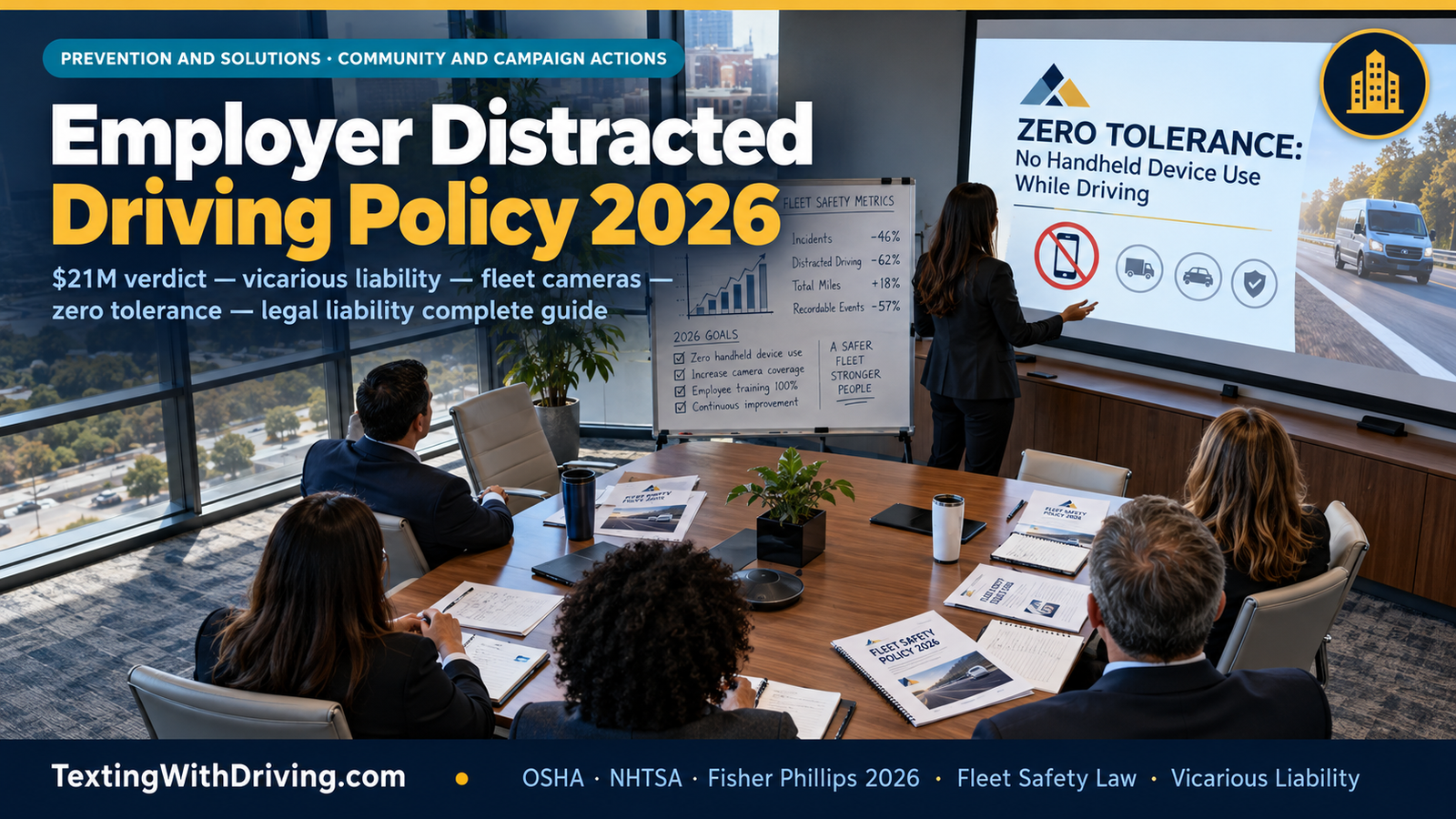
Employer Distracted Driving Policy 2026: Fleet Cameras, Zero Tolerance and Legal Liability Guide
Employer distracted driving policy 2026 is no longer an optional best practice — it is a legal liability management requirement for every business whose employees drive on company time, in company vehicles, or using company-issued devices while behind the wheel.
The $21 million jury verdict against a leading beverage manufacturer whose employee struck a woman pedestrian while driving a company vehicle and using a company-issued portable device sent shockwaves through the trucking and fleet industries about the financial consequences of distracted driving. That verdict is not an outlier. Other vicarious liability crash settlements range from $5 million to $22 million. A lumber salesman using a cell phone while driving caused a crash that left a woman crippled and produced a $16 million settlement. The pattern is consistent: when an employee drives distracted on company time, the employer’s liability exposure is measured in millions.
Distracted driving costs employers $60 billion annually in medical care, legal expenses, and productivity losses. Employment-related distracted driving accidents produce more than 200,000 employee injuries per year. A single on-the-job fatality costs employers over $500,000 in direct and liability costs. An injury crash averages $150,000. A property damage crash averages $24,500.
Fisher Phillips LLP’s 2026 guidance is direct: OSHA considers distracted driving a recognized workplace hazard. Employers must implement distracted driving policies. Failure to do so creates legal exposure across multiple theories of liability simultaneously.
This guide covers the complete employer distracted driving policy 2026 picture: the legal liability theories that create employer exposure, the policy components required for adequate protection, fleet camera systems, zero tolerance enforcement, and what every employer with driving employees must implement.
The Legal Liability Framework: Three Theories Every Employer Faces
Employer distracted driving policy 2026 begins with the legal theories that create employer exposure when an employee drives distracted on company time.
Theory 1: Vicarious Liability
Vicarious liability — also called respondeat superior — holds an employer legally responsible for an employee’s negligent actions when the employee was acting within the scope of their employment at the time of the crash.
The vicarious liability standard for distracted driving cases is straightforward: if an employee is making a work-related call, responding to a work email, or using a company-issued device while driving during work hours, the employer is a named defendant in any resulting lawsuit. The employee’s violation of the law is attributed to the employer because the employee was performing their job function when the crash occurred.
The $21 million Florida verdict established the standard for vicarious liability in distracted driving cases involving company-issued devices. The employee was using a company-issued portable device — not their personal phone. The employer’s choice to provide that device and allow or implicitly expect its use while driving created the liability. Even when the employer has a written policy prohibiting device use while driving, courts have held that employers may still be liable if the policy was inconsistently enforced or if company culture effectively pressured employees to remain reachable while driving.
Theory 2: Negligent Entrustment
Negligent entrustment occurs when an employer negligently provides a company vehicle to an employee who then causes injury or death to a third party with that vehicle. The “negligent” element requires that the employer knew or should have known the employee was unfit to drive — through a history of traffic violations, license suspensions, or prior distracted driving incidents.
Negligent entrustment creates the specific imperative for Motor Vehicle Record (MVR) checks on every employee who drives on company business. An employer who provides a company vehicle to a driver with a documented history of moving violations — including distracted driving citations — without conducting an MVR check has laid the foundation for a negligent entrustment claim when that driver causes an injury crash.
Theory 3: OSHA General Duty Clause
OSHA’s position that distracted driving is a recognized hazard under workplace safety law creates a third liability exposure for employers. The OSHA General Duty Clause requires employers to provide a workplace free from recognized hazards that are causing or likely to cause death or serious physical harm. Distracted driving — which has been publicly documented as causing 3,208 deaths in 2024 and is officially recognized as a hazard by NHTSA, CDC, and OSHA — is a recognized hazard under this standard.
Employers who require employees to be reachable by phone during work hours, who incentivize rapid call response, or whose culture foreseeably results in employees taking calls while driving are creating the recognized hazard that the General Duty Clause requires them to address. An employer’s liability may increase significantly if injured workers prove the company required the use of handheld electronic devices while driving — directly or through the implicit expectation that employees be continuously reachable.
The Policy Architecture: What Every Employer Must Have
Employer distracted driving policy 2026 requires a specific policy architecture that courts and OSHA look for when evaluating employer liability exposure.
Written Zero Tolerance Policy
The foundation is a clear written policy that prohibits all use of personal and company-issued handheld electronic devices for work-related purposes while driving. The policy must specify:
What devices are covered — company-issued phones, personal phones used for work calls, tablets, and any other handheld device.
What driving contexts are covered — company vehicles, personal vehicles used for business purposes, rental vehicles, and any driving during work hours or on the employer’s behalf. The personal vehicle used for work travel is specifically a covered context that many employers omit, creating an exposure gap.
What is prohibited — composing or reading texts or emails, making or receiving handheld calls, using apps for work purposes. The policy must also address hands-free use, because employer liability can extend to hands-free calls if the employer requires employees to remain reachable while driving.
What is permitted — pulling over to a safe location before making or receiving any call, using hands-free only after safely parked, emergency communications.
The policy statement that courts specifically look for: the company does not expect employees to answer calls or read messages while driving. That one sentence eliminates the implicit-expectation liability theory by making explicit that employee unavailability while driving is acceptable and expected.
Signed Employee Acknowledgement
Courts examine whether employees received and understood the policy. A written policy that employees never signed is of limited defensive value. The policy must require a written acknowledgement from every covered employee — confirming they have received, read, and understood the policy and its consequences.
Acknowledgements should be collected at onboarding and re-signed annually or whenever the policy is updated. For companies that have had distracted driving incidents, re-acknowledgement after the incident creates a documented record that the policy was reinforced.
Motor Vehicle Record Checks
MVR checks on every driver at the company are the specific tool that addresses negligent entrustment exposure. MVR checks should occur:
At hiring, for any position that involves driving.
Annually for ongoing employees in driving positions.
After any traffic citation involving an employee driver.
Before assigning a company vehicle to any employee.
The MVR check that identifies a driver with multiple distracted driving citations before they cause a company crash is the specific preventive tool that eliminates the negligent entrustment theory. The MVR check conducted after a crash and prior to vehicle assignment creates the documented record that the employer exercised reasonable care.
Training Program
A policy that employees were never trained on is treated by courts similarly to a policy employees never signed. Training documentation should cover:
The specific legal consequences of distracted driving under applicable state laws.
The company’s zero tolerance policy and its enforcement consequences.
The proper setup and use of hands-free technology.
Procedures for pulling over safely before making or receiving calls.
Training documentation — dates, attendees, materials used — creates the evidence record that the employer took the policy seriously. For construction, logistics, and other industries where Fisher Phillips specifically notes a culture of safety already exists, distracted driving training integrates directly into existing safety program frameworks.
Fleet Camera Systems: The Technology Layer
Employer distracted driving policy 2026 technology component is the fleet camera system — the monitoring infrastructure that creates both deterrence and documentation.
Modern fleet camera systems — from providers including Samsara, Lytx, and Netradyne — combine forward-facing road cameras with driver-facing cabin cameras that use AI to detect phone use events, fatigue indicators, and distracted behavior in real time. These systems:
Generate in-cab alerts: When the AI detects a driver picking up their phone, the system generates an immediate audible or visual in-cab alert. The deterrence effect of knowing the camera will immediately flag the behavior is a primary behavior-change mechanism.
Create behavioral records: Every trip is recorded and stored. A distracted driving incident that results in a crash produces video evidence that shows exactly what the driver was doing in the moments before impact. This evidence cuts both ways — it documents the driver’s violation (supporting company policy enforcement) and the employer’s monitoring effort (demonstrating the company took reasonable steps to prevent the behavior).
Enable coaching opportunities: Supervisors can review flagged events and conduct coaching conversations with drivers about specific incidents. A coachable moment with video evidence is more effective than a generic policy reminder.
Support insurance discount programs: Many commercial auto insurance carriers offer premium discounts for fleets with verified camera monitoring systems. The same LifeSaver and DriveWell behavioral monitoring we documented in our best apps to stop texting while driving 2026 article operate at the fleet scale, and insurer relationships with telematics providers create premium reduction pathways for companies that deploy monitoring.
Others have installed cameras or monitoring systems in vehicles to discourage distracted driving — the Fisher Phillips 2026 guidance noting that camera deployment is a standard component of defensible employer distracted driving programs.
Zero Tolerance: The Enforcement Component
Employer distracted driving policy 2026 zero tolerance standard requires that the policy consequences are enforced consistently — because a policy that is inconsistently enforced provides reduced protection against vicarious liability claims.
Zero tolerance does not necessarily mean immediate termination for every violation. It means that no violation is ignored — that every documented distracted driving incident produces a documented response:
First violation: Documented coaching conversation, policy re-acknowledgement, and a specified monitoring period.
Second violation: Written warning with progressive discipline documentation.
Third violation: Removal from driving duties and potential termination.
Post-crash protocol: Any employee involved in a crash while using a handheld device faces immediate suspension from driving duties pending investigation, regardless of prior violation history.
The zero tolerance framework must be applied consistently across all employees regardless of seniority, role, or business urgency. A company that terminates a junior driver for a phone violation while allowing a senior sales manager to take calls while driving has not implemented a zero tolerance policy — it has created a legally dangerous inconsistency that plaintiff’s counsel will document in discovery.
Courts will also likely consider the existence of such a policy when determining the employer’s potential liability and damages during litigation. The policy is the first item plaintiffs’ attorneys request in any distracted driving lawsuit against an employer. A well-documented, consistently enforced zero tolerance policy with signed acknowledgements, annual MVR checks, and camera monitoring creates the defensive foundation. Its absence creates the foundation for enhanced damages.
The OSHA Dimension: Employer Duty Beyond State Law
Employer distracted driving policy 2026 OSHA obligation is specific and distinct from the civil liability exposure.
OSHA’s position — as articulated through Fisher Phillips’ 2026 fleet safety guidance — is that distracted driving is a recognized hazard that employers who require or incentivize driving on the job must address. This applies to:
Employers who require employees to carry and use company phones during work hours. If the expectation of being reachable extends to driving time, the employer is effectively requiring phone use while driving.
Employers who send calls or messages to employees they know are driving. A supervisor who calls an employee known to be driving, knowing the call will be answered on a handheld phone, is contributing to the recognized hazard.
Employers who do not explicitly address driving safety in their safety programs. An employer with a written chemical handling policy, a forklift safety policy, and a ladder safety policy — but no distracted driving policy — has a documented gap in their OSHA General Duty Clause compliance.
An employer’s liability may increase if injured workers prove the company required the use of handheld electronic devices while driving. The specific way employers create this requirement is through always-reachable culture — the implicit expectation that any call from a manager will be answered immediately, regardless of whether the employee is driving. An explicit policy statement that driving employees are not expected to answer calls while in transit is the specific OSHA compliance action that removes this exposure.
Commercial Vehicle Drivers: The Federal Overlay
Employer distracted driving policy 2026 for employers with commercial vehicle drivers has a specific federal dimension — FMCSA regulations that supersede state law and create federal enforcement exposure independent of state law or company policy.
As documented in our FMCSA commercial driver distracted driving rules article, FMCSA prohibits commercial drivers from:
Using handheld mobile phones while operating a commercial motor vehicle — maximum penalty $2,750 for the driver.
Requiring or allowing a driver to use a handheld mobile phone while driving — maximum penalty $11,000 for the employer.
The employer penalty — $11,000 per incident — applies when the employer knew or should have known the driver was using a handheld device. For a fleet operator who has not established a clear zero tolerance policy and does not have camera monitoring to detect violations, the “should have known” standard is easily met when a violation occurs.
Federal motor carrier safety compliance officers specifically audit company distracted driving policies during compliance reviews. A company without a documented policy that addresses FMCSA handheld device requirements is in compliance violation before any crash occurs.
What Every Employer Must Implement
Employer distracted driving policy 2026 requires the following minimum employer actions:
Written zero tolerance policy — today. The absence of a written policy is the single largest employer liability exposure. The policy should be in place before any employee drives for business purposes.
Signed acknowledgement from every driving employee. Documentation that employees received and understood the policy is the specific evidence that courts and OSHA look for.
Annual MVR checks on all drivers. Identify drivers with distracted driving citation histories before they cause crashes, not after.
Explicit statement that employees are not expected to take calls while driving. This single sentence eliminates the implicit-expectation liability theory that has generated the multi-million-dollar verdicts.
Training program with dated documentation. Policy without training is a policy employees cannot follow. Training documentation demonstrates the employer’s good-faith compliance effort.
Fleet camera deployment for vehicle-equipped operations. The deterrence effect of camera monitoring and the behavioral record it creates are the specific technology tools that reduce crash frequency and provide crash documentation.
Consistent enforcement. A policy that is not enforced is not a policy — it is a document that plaintiff’s attorneys will use to argue the company knew the risk and chose not to address it.
For the legal framework that applies when a Virginia-based employee’s distracted driving crash creates corporate liability, our Virginia distracted driving law covers Va. Code § 46.2-818.2. For the reckless driving upgrade that converts an employee’s distracted driving crash into a criminal charge with specific implications for employer negligent entrustment claims, our Virginia reckless driving and distracted driving 2026 article covers the criminal exposure. For the FMCSA commercial vehicle rules that create the federal employer penalty independent of state law, our FMCSA commercial driver distracted driving rules covers the complete federal framework. And for the technology solutions that implement the phone-free driving standard the policy requires, our best apps to stop texting while driving 2026 covers LifeSaver, DriveWell, and the built-in phone solutions.
Sources Used in This Article
All links verified working before publication.
Fisher Phillips LLP 2026: OSHA Employers Must Implement Distracted Driving Policies — OSHA recognized hazard distracted driving, $60 billion annually employer costs, employers must implement policies, cameras monitoring systems consistent audit enforcement, consistent enforcement consequences, legal counsel developing implementing policies, Fisher Phillips 2026
Smith System Blog: How to Reduce Employer Liability For On-the-Job Crashes — Vicarious responsibility legal theory employee scope of employment, negligent entrustment company vehicle injury death third party, property damage crash $24,500 average, injury crash $150,000 average medical legal property lost productivity, MVR check every driver formal training policy, adopt distracted driver policy
TT News Opinion New Rules of the Road: $21M Verdict — $21 million jury verdict beverage manufacturer employee company-issued portable device woman pedestrian, shockwaves trucking fleet industries, 39 states enacted handheld bans, 200,000+ employee injuries annually workers compensation, on-the-job fatality $500,000+ direct liability costs, uninsurable serious willful misconduct OSHA violations
VSSP / Legal Alert: Employers Should Consider Implementing Distracted Driving Policies — Florida $21 million employer liable company-issued device, written policy prohibit personal and company devices work purposes, written acknowledgement policy, employer does not expect employees answer calls while driving, courts consider policy existence determining liability damages
FindLaw Archive: Employer Fleet Distracted Driving Policy — $16 million settlement lumber salesman cell phone crash woman crippled, $5 million to $22 million vicarious liability range, prohibit all personal electronic devices, employees sign off policy, deadly chain-reaction driver sent received 11 texts 11 minutes before crash
ECMWeb: Distracted Driving Policies Construction Fleets — Zero tolerance policies recommended, written signed contracts training observation reporting post-crash discipline random safety audits, companies yet to experience negative effects, construction safety culture most likely successful zero tolerance
LexisNexis Insights: Increase Distracted Drivers Fleet Risk Managers — On-the-job fatality $500,000 direct liability, fleet safety policy zero tolerance rules consequences, company vehicle rental car personal car all covered, technology applications future liability modest cost obligation
NHTSA: Distracted Driving — 3,208 deaths 2024, 315,167 injuries, national context
TextingWithDriving.com is professionally built and maintained to ensure accurate, accessible safety information reaches every driver who needs it. Website development and ongoing support is handled by Budgetic, a digital agency specializing in purpose-driven WordPress websites.


