
Month in Review: September 2026 Distracted Driving News — From Labor Day to School Year

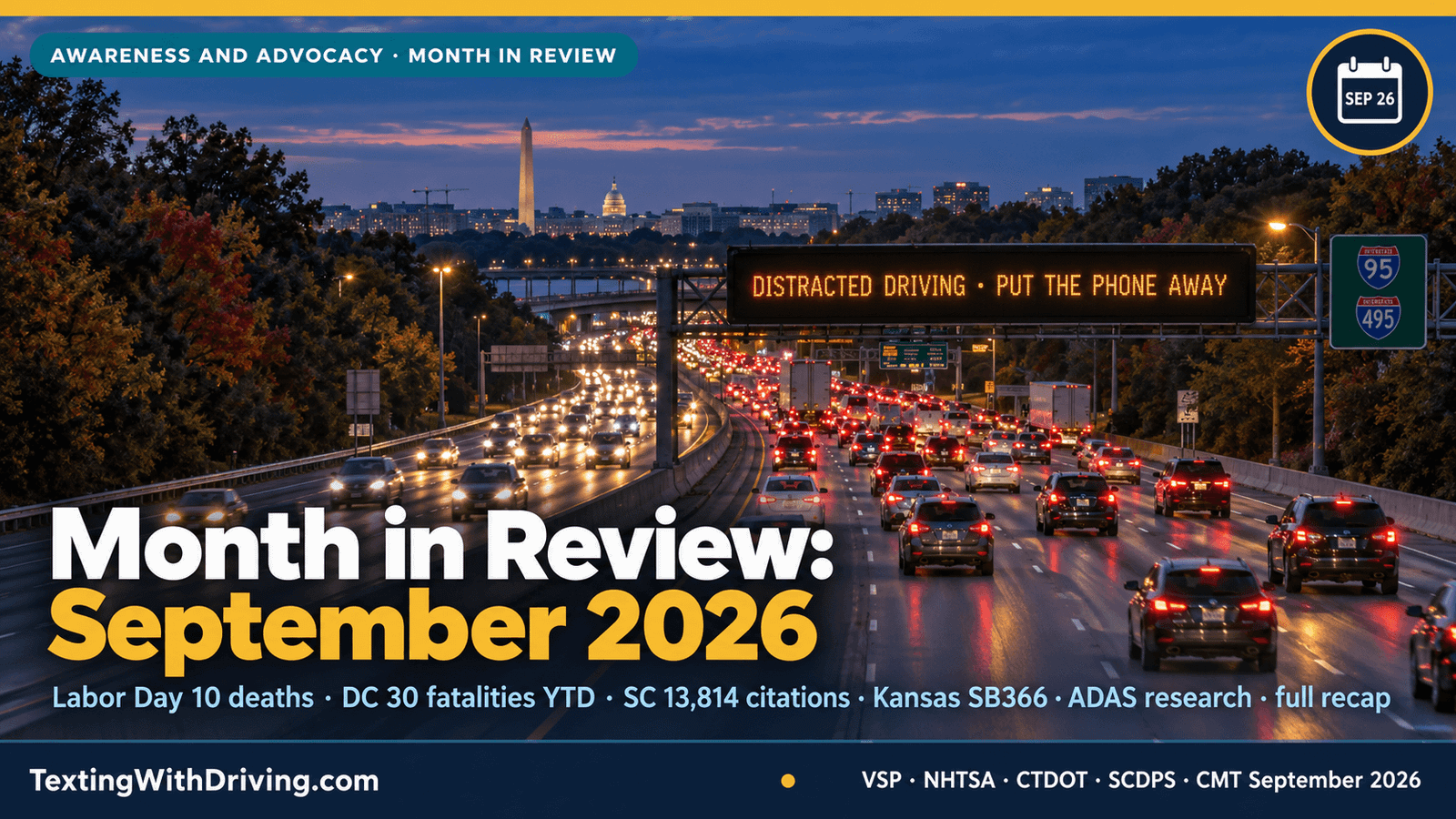
Month in Review: September 2026 Distracted Driving News — From Labor Day to School Year
Distracted driving news September 2026 opens with a Labor Day tragedy and closes the first month of the school year with data, legislation, and research developments across the country that collectively define where the distracted driving safety landscape stands as summer ends and fall begins.
September is the month that concentrates more distinct distracted driving safety narratives than any other month of the year: the Labor Day holiday’s proven fatality spike, the return-to-school enforcement period that activates school zone laws and mandatory fines, the beginning of the fall-darkening cycle that escalates pedestrian risk, the one-year anniversary of multiple state hands-free laws, and the back-to-school demographic shift that brings teen drivers back onto daily commute roads after three months of summer.
This month in review captures the complete distracted driving news September 2026 picture: the Labor Day data from Virginia State Police, the DC traffic death surge that has placed the District in crisis mode, the South Carolina one-year anniversary enforcement results, the Iowa year-one behavioral change results that were released July 1 and remain the September benchmark for what evidence-based legislation achieves, the ADAS research that changed how we understand driver assistance systems, the Kansas SB366 signing and its limitations, and the full September enforcement calendar that stretched from the post-Labor Day return to Operation DISS-RUPT’s August-into-September impact.
The Story of the Month: Labor Day’s 10 Deaths and Three Pedestrians on I-395
Distracted driving news September 2026‘s defining story is Virginia State Police’s September 9 release documenting the Labor Day weekend toll: 10 people dead in eight crashes on Virginia roadways.
Three of those killed were pedestrians — one in Emporia, one in Fairfax along Interstate 395, and one in Alexandria along Interstate 395. Pedestrian deaths on an interstate highway represent the most preventable category of traffic fatality: pedestrians on I-395 are there because their vehicles broke down, because prior crashes have forced them to the shoulder, or because circumstances have placed vulnerable people in the path of highway-speed traffic. The driver who is distracted — by phone, by fatigue, by impairment — and who has reduced attentional capacity to detect a pedestrian on the highway shoulder is the specific behavioral failure that produced two pedestrian deaths on I-395 in a single holiday weekend.
Virginia State Police are reminding drivers and pedestrians of the rules of the road after 10 people died in eight crashes along Virginia roadways over the Labor Day holiday. The September 4 and September 7 dates as the busiest travel days framed the enforcement window where VSP deployed maximum staffing for a weekend that historically produces Virginia’s highest holiday casualty concentration.
The Labor Day context from this article series is essential for the September in-review. As documented in our Virginia distracted driving September 2026 article, Virginia’s year-to-date improvement through August 31 — 480 deaths versus 542 at the same point in 2025, an 11 percent reduction — represented the strongest summer-period improvement in recent memory. Labor Day’s 10 deaths in a single weekend is the sobering counterpoint: sustained systematic improvement and specific holiday concentration tragedy can coexist, because the behavioral choices that produce fatal crashes are made one driver at a time, not in aggregate.
DC’s Alarming 2026 Trajectory: 30 Deaths, 83 Percent Behavioral
Distracted driving news September 2026 in Washington DC is the most dramatic regional story of the month. As documented in our DC distracted driving and pedestrians 2026 article, MPD data as of September 9, 2026 shows 30 traffic deaths in the District — compared to 16 at the same point in 2025 and a full-year 2025 total of only 25.
DC’s 2026 traffic deaths are on pace for approximately 46 by year-end. That would be the most DC traffic deaths since the period before Vision Zero began. And the cause is identified explicitly: DDOT’s preliminary data indicates behavioral factors have contributed to more than 83 percent of this year’s traffic fatalities — compared to 69 percent in 2025.
83 percent behavioral. Not road design failures. Not inadequate infrastructure. Driver behavior — distracted driving, impaired driving, speeding, failure to yield — is behind 83 percent of the District’s 2026 traffic deaths. The reversal from 2025’s celebrated 50-plus percent improvement to 2026’s nearly-doubled death count is the starkest illustration of the fragility of road safety gains when they depend on behavioral compliance rather than engineering permanence.
The August 2026 death of 29-year-old Shanell Holiday — struck by a driver in the crosswalk at North Capitol Street and New York Avenue NE in a hit-and-run — is the named human victim at the center of DC’s September safety reckoning. Hit-and-run drivers who leave crash scenes are the most extreme expression of the behavioral failure category that DDOT’s 83 percent attribution documents. The driver who leaves Shanell Holiday dying in the crosswalk is the behavioral extreme on the same continuum as the driver who glances at their phone and misses the pedestrian who is legally crossing with the green light.
The connection to Vision Zero’s documented 2025 progress — which our Washington DC Vision Zero distracted driving 2026 article covered in detail — is the policy lesson of DC’s 2026 trajectory: infrastructure investment without behavioral enforcement produces gains that are real when behavioral compliance is high and that erode when behavioral compliance falls. The $10 million Vision Zero investment, the leading pedestrian intervals at 80-plus percent of intersections, the 20 mph neighborhood speed limits — all represent meaningful risk reduction. When behavioral compliance deteriorates, the engineering cannot fully compensate.
South Carolina: One Year, 13,814 Citations
Distracted driving news September 2026 marked a milestone for South Carolina on September 1: the one-year anniversary of the Hands-Free and Distracted Driving Act taking effect. As documented in our South Carolina distracted driving law 2026 article, SCDPS released the six-month enforcement data on September 3: 13,814 citations and 11,557 warnings issued since full enforcement began February 28, 2026.
The South Carolina data is the September month’s most directly measurable legislative accomplishment. 13,814 citations in six months — approximately 2,302 per month, 77 per day across all 46 counties — establishes that South Carolina’s law is producing the active enforcement that citation-based behavioral change requires. Charleston County leading with 470 first-month citations, Horry County second in the coastal tourism corridor, Richland and Pickens following — the geographic distribution reflects SC’s specific demographic and road network characteristics operating precisely as the law was designed.
The Kelly Willenberg dimension of the South Carolina anniversary is the September month’s most human-centered moment: the advocate whose husband was killed in 2017 by a driver who admitted checking a text has now seen the law she helped push take effect and produce its first year of enforcement. It’s a way to protect families. Distracted driving is an epidemic. One year of enforcement. 13,814 citations. The data represents the beginning of the behavioral change that Iowa’s CMT/Nationwide research suggests will accelerate from the warning-period baseline as financial enforcement creates the amplified deterrent that citation authority produces.
Iowa’s Year-One Results: The September Benchmark
Distracted driving news September 2026 has an ongoing benchmark from the July 1 data release that remains the most precisely documented behavioral change study of any recently enacted state hands-free law. As documented in our Iowa distracted driving law 2026 article, CMT and Nationwide’s analysis of 140 million Iowa trips found:
Screen-tapping fell 13.6 percent during full enforcement (up from 5.9 percent during the warning period). Handheld calling dropped 9.1 percent. Iowa drivers produced 140,700 fewer phone-motion events than pre-law behavior would project. 85 of Iowa’s 99 counties improved. 470 crashes prevented, 210 injuries avoided, 3 fatalities prevented, $20.3 million in economic damage avoided.
The Iowa benchmark is the September 2026 data point against which South Carolina’s six-month citation data should be understood. South Carolina has the citation count. Iowa has the behavioral change measurement. Together they establish the evidence base that other states considering comprehensive hands-free legislation can reference: South Carolina-style enforcement paired with Iowa-style behavioral monitoring is the most complete measurement framework available for first-year results.
The Minnesota contrast — 26.5 percent increase in distracted driving events during the same period Iowa improved 13.6 percent — remains the September month’s most compelling argument for the comprehensive law standard that distinguishes Iowa and South Carolina from states that retain texting-only bans without a broader handheld prohibition.
Kansas SB366: The Signed Law and Its Limitations
Distracted driving news September 2026 includes the Kansas SB366 signing from April 6 — which took effect immediately and entered its active warning citation period. As documented in our Kansas distracted driving law 2026 article, Governor Kelly signed the school zone and construction zone phone ban that will carry a $60 fine when full enforcement begins July 1, 2027.
The Kansas story’s September 2026 status is the warning citation period: officers are stopping violators in school zones and construction zones and issuing warnings — creating the documented stop record and norm-setting awareness that the pre-enforcement period is designed to produce. The September back-to-school context makes this September particularly relevant: every Kansas school zone with flashing lights active is now a location where an officer observing phone use can initiate a stop and issue a warning citation.
The limitation that the Kansas article documented — Kansas still lacks a comprehensive statewide hands-free law for adult drivers on standard roads — places Kansas in the September 2026 legislative landscape alongside states that are moving toward stronger laws but have not yet achieved the comprehensive standard. For Kansas drivers, September 2026 is the month when every school zone drive with a phone in hand is a potential warning citation. July 1, 2027 is when every school zone drive with a phone in hand becomes a $60 citation.
ADAS Research: The Counterintuitive Finding of September
Distracted driving news September 2026 produced one of this series’ most counterintuitive findings in the ADAS research we documented in our ADAS distracted driving 2026 article. The comprehensive ScienceDirect analysis of 28 ADAS features — published January 2025 — established that adaptive cruise control is associated with an 8 percent increase in crash rates, while lane keeping assist produces a 19.1 percent crash rate reduction.
The September publication context for this finding: as new model year 2027 vehicles begin appearing in showrooms in late September and October 2026, the ADAS feature packages being marketed to consumers increasingly center adaptive cruise control and lane centering as the premium safety differentiation. The ScienceDirect research’s finding that these comfort-enhancing features are associated with worse crash outcomes — through the automation complacency mechanism — is the consumer safety information that should accompany every ADAS feature brochure.
The VTTI-AAA Foundation naturalistic driving research that we documented alongside the ADAS article is the behavioral mechanism: drivers in ADAS-active vehicles engage in more non-driving secondary tasks — including phone use — than the same drivers in manual driving conditions. The feature designed to make driving safer is creating the conditions for the distracted driving that makes driving less safe. September 2026 is the moment when this research becomes practically relevant for the annual model-year vehicle purchase cycle.
The Telematics Landscape: September’s Technology Story
Distracted driving news September 2026 technology dimension is the telematics ecosystem we documented in our telematics distracted driving 2026 article. The LexisNexis 2026 US Auto Insurance Trends Report — showing 57 percent distracted driving violation increase since 2022 and 73 percent increase for drivers over 66 — is the September benchmark for what telematics monitoring is revealing about national driving behavior trends.
The specific September relevance: insurance renewals for millions of American drivers occur in the fall months as calendar-year policies approach renewal. The driver whose telematics program has been monitoring phone-motion events through the summer driving season is receiving their renewal quote in September and October — and the behavioral data from summer trips is feeding the premium calculation that the renewal reflects. CMT’s two-week behavioral score, Progressive’s Snapshot renewal adjustment, State Farm’s Drive Safe and Save analysis — all are producing September renewal impacts from summer driving behavior.
The fleet telematics dimension is equally September-relevant: school buses in Virginia, Maryland, and DC begin their school-year routes in late August and early September, activating the school bus AI camera enforcement systems that Chesterfield County’s program and comparable deployments represent. September is when the school bus camera citation infrastructure that was inactive all summer begins generating citations for the drivers who stop in the bus stop-arm zone with a phone in their hand.
Oregon and Connecticut: The Veteran State Dimension
Distracted driving news September 2026 includes the Oregon and Connecticut coverage from this month’s series that places the newer state law adoptions in the context of what long-established comprehensive laws produce over time.
Oregon’s 62,237 convictions from 2019 to 2023 — documented in our Oregon distracted driving law 2026 article — and the conviction rate rising to 12,829 in 2023 as the highest post-pandemic level, establish the September benchmark for what nine years of primary enforcement under the highest-fine-in-the-nation structure produces. The conviction rate is rising even in Oregon’s mature enforcement environment — consistent with the national LexisNexis trend showing 57 percent violation increases despite expanding law coverage.
Connecticut’s spotter technique — documented in our Connecticut distracted driving law 2026 article — is the September enforcement innovation highlight: officers in elevated positions looking down into vehicles to observe phone holding from angles that ground-level observation cannot achieve. The 6.8 to 3.1 percent handheld phone use reduction from the federal pilot program’s Hartford-area implementation remains one of the most precisely documented enforcement-driven behavioral changes in any state’s history.
Oregon and Connecticut together establish the September lesson: comprehensive primary enforcement laws produce meaningful but incomplete behavioral change, even over decades of consistent enforcement. The Iowa behavioral improvement data (13.6 percent) suggests that new laws combined with modern telematics monitoring can achieve more rapid behavioral change than the pre-telematics enforcement era produced. But even Oregon’s 12,829 convictions in 2023 — in a state that has been enforcing the handheld ban since 2017 — establishes that compliance is not achieved; it is continuously enforced.
The September Brain Science Update
Distracted driving news September 2026 included our most comprehensive brain science coverage in two articles that complement each other: the Virginia-specific VTTI research in our Virginia distracted driving and the brain 2026 article, and the national brain science overview in our distracted driving brain science 2026 article.
The September brain science message — timed to coincide with the return of teen drivers to school-year routes after summer, the back-to-school parent conversations about driving safety, and the ADAS research revealing that automation complacency operates through the same cognitive mechanisms as phone distraction — is the 27-second cognitive recovery window.
The AAA Foundation’s finding that cognitive impairment persists for up to 27 seconds after completing a hands-free voice command interaction is September’s most practically significant brain science data point. At 65 mph on I-66 during the September back-to-school commute, 27 seconds covers more than half a mile of travel during which the driver is nominally compliant with Virginia’s hands-free law but neurologically impaired from the pre-commute voice text they sent while approaching the Springfield interchange.
September’s brain science update reinforces the fundamental insight that runs through every article in this month’s series: legal compliance and behavioral safety are not the same thing. The law establishes the minimum. The brain science establishes what the minimum is minimum for. The phone in the back seat is the standard that eliminates the cognitive impairment that the minimum does not address.
The Alexandria Pedestrian Crisis: A September Snapshot
Distracted driving news September 2026 Alexandria dimension, documented in our Alexandria Virginia distracted driving 2026 article, provides the most specific geographic pedestrian safety snapshot of September’s DMV series.
As of the September 15 near-miss data publication by Northern Virginia Families for Safe Streets — 241 near-miss reports from January 2025 to June 2026 — Alexandria’s pedestrian safety picture is the most quantified civilian safety monitoring dataset of any Northern Virginia jurisdiction. 76 percent failure to yield in near-miss reports. 36 percent speeding. 35 percent red light or stop sign running. These near-miss behavioral frequencies, collected by community volunteers and reported through NOVA FSS’s text-based reporting system, are the September street-level view of what the brain science and the enforcement data describe at the aggregate national level.
The September 15 near-miss push for stop-sign cameras in Alexandria’s high-crash network — as NOVA FSS’s Mike Doyle advocated at the ALXnow article date — is the September policy moment that connects the community-collected near-miss data to the legislative action that the SB84 framework has enabled.
The Back-to-School Enforcement Window: September’s Calendar Context
Distracted driving news September 2026 enforcement calendar for September is defined by the back-to-school window that Virginia State Police Operation DISS-RUPT’s August 22-24 I-66 deployment, the September school zone activation, and the Fairfax County Road Shark campaign’s sustained deployment all contribute to.
Operation DISS-RUPT’s August 22-24 I-66 citation data — expected from VSP in September’s first weeks — will provide the enforcement benchmark for what the most intensive interstate distracted driving campaign in Virginia history produces when deployed in the specific back-to-school timing window that VSP Captain Koushel identified as strategic. The 53 distracted driving citations from February 2026’s I-66 DISS-RUPT serve as the comparison baseline until August’s data is released.
School zone enforcement through September’s full month — with mandatory $250 fines for any CGS § 14-296aa violation in Virginia school zones — is the daily enforcement reality for every commuting parent who passes through a school zone while holding their phone. September is when the school year’s highest-volume citation period begins, when the return-to-school-routine driver who has been passing through an inactive summer school zone must reacquire the active-zone behavioral standard.
The DRIVE SMART Virginia simulator program’s school visit calendar begins in September — reaching the first of the 28-plus Virginia high schools that will receive simulator programming in the 2026-2027 school year. September’s simulator visits complement the enforcement environment: the teen who experiences the distracted driving crash simulation in September is making their school-year driving behavioral choices before the peer passenger dynamics, after-school driving patterns, and social coordination phone pressure that October and November bring are fully normalized.
The Five Most Important Stories From September 2026
Distracted driving news September 2026 month-in-review distills to five stories that carry the most significance for the month and beyond:
1. Virginia’s Labor Day 10 deaths establish the holiday return trip as September’s most urgent safety moment. The 480-deaths-through-August improvement trajectory did not prevent 10 deaths in 8 crashes over a single holiday weekend. Three pedestrians on I-395 — the specific most vulnerable category of highway fatality — are September’s most urgent human cost.
2. DC’s 83 percent behavioral attribution is the month’s most alarming trend. 30 DC traffic deaths through September 9, 2026 — nearly double last year’s pace — with DDOT explicitly attributing 83 percent to behavioral factors including distracted driving, reversing the 2025 success story that made DC a national Vision Zero model.
3. South Carolina’s 13,814 citations at one year is the legislative achievement story. The one-year anniversary of the Hands-Free and Distracted Driving Act produced the most precisely documented six-month citation dataset of any state hands-free law currently in the active enforcement phase.
4. ADAS research’s adaptive cruise control finding is the consumer safety finding of the month. As the 2027 model year vehicles appear in showrooms, the research establishing that adaptive cruise control is associated with an 8 percent crash rate increase while lane keeping assist produces a 19.1 percent reduction should be the first fact in every consumer comparison of ADAS packages.
5. Kansas SB366’s warning period begins September’s school zone enforcement window in the state with the most cited distracted driving problem and no comprehensive law. Every Kansas school zone with flashing lights is now a potential warning citation location — and the path toward the comprehensive law that AAA Kansas, KHP, and KACO all supported in testimony remains the policy gap that 2027’s Kansas legislative session must address.
For the complete Virginia law that governs every September school zone and enforcement scenario, our Virginia distracted driving law covers Va. Code § 46.2-818.2. For the September resource roundup covering every piece of content published in the September 2026 series, our September 2026 Distracted Driving Resource Roundup covers all 30 articles. And for the technology setup that makes behavioral safety the same as legal compliance on every September road, our hands-free while driving complete setup guide covers iPhone, Android, Bluetooth, and CarPlay.
Sources Used in This Article
All links verified working before publication.
VSP News Release: Ten Dead in Eight Crashes Over Labor Day Holiday — 10 deaths 8 crashes Labor Day weekend, three pedestrians one Emporia one Fairfax I-395 one Alexandria I-395, September 9 2026
VSP News Release: Virginia State Police Stressing Safety Over Last Summer Holiday — 480 Virginia deaths through August 31 2026 versus 542 same period 2025, September 3 2026
WUSA9: Traffic Deaths Surge in DC Data Shows — 30 DC traffic deaths through September 9 2026, 83% behavioral factors, Shanell Holiday August 2026 death, September 2026
Live5News: SC Hands-Free Law Results in Nearly 14,000 Citations During First 6 Months — 13,814 citations 11,557 warnings, one year anniversary September 1 2026, September 3 2026
Nationwide/CMT: New Data Shows Reduction in Distracted Driving Iowa — 140 million trips, 13.6% screen-tapping reduction, 140,700 fewer phone events, 470 crashes 210 injuries 3 fatalities $20.3M prevented, July 2026
KCTV5: Put the Phone Down — Kansas Bans Cell Phone Usage in School and Construction Zones — Governor Kelly signed SB366 April 6 2026, $60 fine July 1 2027, warning citations now, April 2026
ScienceDirect: Rethinking ADAS Taxonomies — LKA 19.1% crash rate reduction, ACC +8% increase, comfort-enhancing systems detrimental, January 2025
ALXnow: Hundreds of Near-Misses Prompt Push for Stop Sign Cameras — NOVA FSS 241 near-miss reports January 2025 to June 2026, 76% failure to yield, September 15 2026
LexisNexis 2026 US Auto Insurance Trends Report — 57% violation increase since 2022, 73% senior driver increase, May 2026
DRIVE SMART Virginia: 2025 Annual Report — 28 high schools 6,000 teens simulator program, 825 total Virginia road deaths 2025
NHTSA: Distracted Driving — 3,208 deaths 2024, 315,167 injuries, national context
TextingWithDriving.com is professionally built and maintained to ensure accurate, accessible safety information reaches every driver who needs it. Website development and ongoing support is handled by Budgetic, a digital agency specializing in purpose-driven WordPress websites.

About Texting With Driving
TextingWithDriving.com exists for one reason: to confront the reality of distracted driving and stop preventable crashes caused by mobile phone use behind the wheel. Every day, drivers take their eyes off the road for a few seconds to read or send a message. Those few seconds are enough to cause life-altering consequences. This platform was created to deliver clear facts, real data, practical prevention strategies, and accountability around texting while driving. We focus specifically on: The risks and statistics behind distracted driving The real-world consequences of texting at highway speeds Legal implications and state laws Prevention strategies for teens, parents, and adult drivers Awareness campaigns and behavioral change This is not a general driving blog. It is a focused awareness initiative built around one critical issue: phone distraction behind the wheel. Our content is direct, research-driven, and practical. We prioritize accuracy over opinion and education over sensationalism. The goal is simple — reduce distracted driving incidents by increasing awareness and responsibility. If one article causes one driver to put their phone down, the mission is working. For inquiries or partnerships, contact: privacy@textingwithdriving.com
View all posts by Texting With Driving