

Connecticut Distracted Driving Law 2026: $200 Fine, Spotter Enforcement and What Drivers Must Know

Connecticut Distracted Driving Law 2026: $200 Fine, Spotter Enforcement and What Drivers Must Know
The Connecticut distracted driving law under Connecticut General Statutes Section 14-296aa has been in effect since 2005 — making Connecticut one of the first states in the nation to ban handheld device use while driving. What began as a cell phone ban in 2005 has evolved into one of the most comprehensive mobile electronic device prohibitions in the northeastern United States, supported by a unique spotter enforcement technique that has made Connecticut’s citations among the most difficult in the country to avoid.
Nearly 5,200 crashes were attributed to distracted driving in Connecticut in 2022. Since 2015, nearly 30,000 crashes in Connecticut have involved a distraction — resulting in 41 fatal crashes. Despite these numbers, Connecticut consistently ranks near the lower end of per-capita distracted driving fatalities nationally — the 40th position in the nation in distracted-driving fatalities, which indicates that the state’s crackdown on distracted driving may be making a difference, according to AAA spokesperson Amy Parmenter.
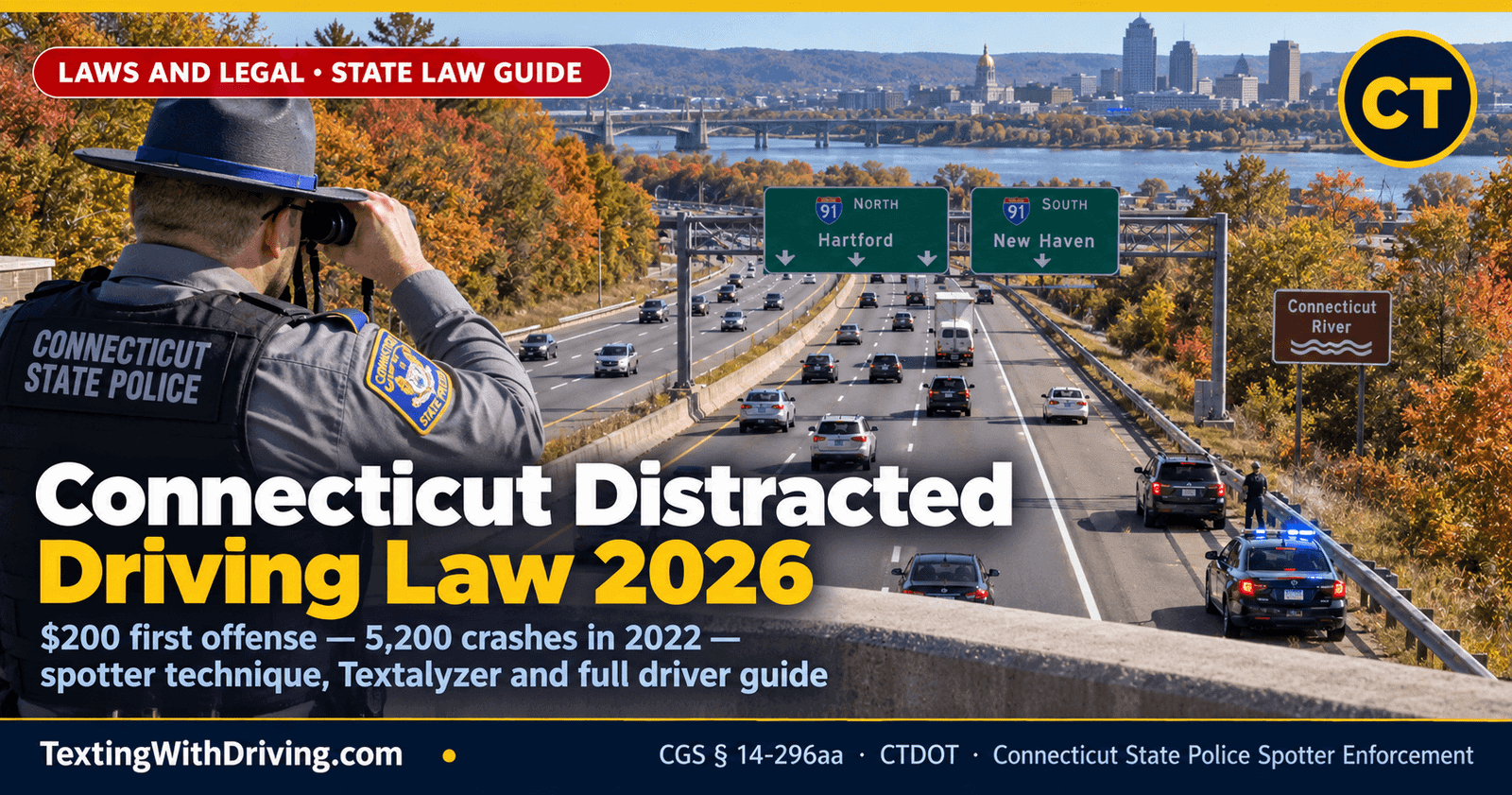
The difference Connecticut’s enforcement makes is built on a distinctive approach: the spotter technique, where law enforcement officers take elevated positions — in tall trucks, on hills, on bridge overpasses — to look down into vehicles and observe phone-holding behavior that drivers often believe is hidden from ground-level observation. A Stamford sergeant once posed as a surveyor to avoid detection. The creative, elevated-position enforcement that Connecticut has developed for distracted driving is one of the most effective officer-observation techniques of any state in the country.
This guide covers the complete Connecticut distracted driving law 2026 picture: what CGS § 14-296aa specifically prohibits, the escalating fine structure, the unique enforcement techniques Connecticut has developed, what the crash data shows about Connecticut’s law effectiveness, the Textalyzer technology that Connecticut has been a national leader in considering, the under-18 complete prohibition, and what every Connecticut driver and visitor to the state must know.
What Connecticut’s Distracted Driving Law Prohibits
The Connecticut distracted driving law under CGS § 14-296aa prohibits all drivers from using any hand-held mobile electronic device while operating a motor vehicle. Connecticut law prohibits the use of any handheld mobile electronic device while driving, including smartphones, tablets, GPS devices, and laptops.
The specific prohibited behaviors under the Connecticut distracted driving law:
Holding a phone or mobile electronic device while operating a vehicle. The possession of a phone in the hand while the vehicle is in motion is the primary violation. Connecticut’s law does not require proof that the driver was actively interacting with the device — holding the phone is the violation.
Sending or reading text messages while driving. The original texting prohibition remains part of the comprehensive handheld device framework.
Accessing email, social media, or apps while driving. CGS § 14-296aa’s comprehensive scope covers all electronic device interactions, not just phone calls and texts.
Using a mobile electronic device at red lights or in stopped traffic. Connecticut’s law applies when the vehicle is stopped at a traffic control device — not just when moving at speed.
What remains permitted under Connecticut’s law:
Hands-free device use for adult drivers (18 and older). Bluetooth calls, voice commands, mounted navigation — all legal for adult Connecticut drivers as long as the device is not held.
Emergency calls to 911 or emergency services.
Using a device when lawfully parked — not stopped at a light, but actually parked.
The under-18 complete prohibition: Drivers who are 16 or 17 years old are prohibited from using a cell phone at any time, even with a hands-free accessory. Connecticut’s complete under-18 ban — including hands-free — mirrors the Virginia and Maryland standards we documented in our Virginia teen distracted driving 2026 and Maryland teen distracted driving 2026 articles. The neurological rationale we documented in our Virginia teen distracted driving brain science 2026 article applies equally in Connecticut: the still-developing prefrontal cortex makes even hands-free cognitive distraction more impairing for teen drivers than for adults.
School bus drivers: Prohibited from using both hand-held and hands-free devices, except in emergencies. School bus drivers are held to the strictest device prohibition of any driver category in Connecticut law — complete prohibition regardless of hands-free mode, reflecting the specific responsibility for child passenger safety that school bus drivers carry.
Primary enforcement. Connecticut State Police and local law enforcement have primary authority to stop any driver observed holding a mobile device, without any concurrent violation.
The Fine Structure: Connecticut’s Escalating Penalties
The Connecticut distracted driving law fine structure has escalated over the years since the 2005 original law, reaching the current levels that reflect Connecticut’s commitment to sustained financial deterrence.
First offense: $200 fine.
Second offense: $375 fine.
Third and subsequent offenses: $625 fine.
The current fine structure was established in the 2023-2026 timeframe following several upward revisions from the original 2005 fines. The escalation from $200 to $375 to $625 creates a meaningful financial deterrent at each tier — with the third-offense $625 fine representing the penalty level that Connecticut lawmakers have determined appropriate for habitual distracted drivers.
Work zone doubling: Violations occurring in work zones carry doubled fines under Connecticut law — $400 for a first work zone offense (doubled from the standard $200), with comparable doubling at higher offense tiers. The work zone doubling reflects the specific vulnerability of highway workers that the construction zone crash scenarios we documented in our distracted driving work zones 2026 article address.
Insurance consequences: Connecticut law allows reporting of distracted driving offenses to insurance companies. Unlike Maryland’s zero-points first-offense structure, Connecticut’s distracted driving citations can be reported to insurers and affect rates — creating an insurance consequence in addition to the courthouse fine that compounds the financial deterrence.
Comparative negligence: Connecticut uses a modified comparative negligence standard — unlike Virginia’s pure contributory negligence rule. Under Connecticut’s framework, a distracted driver who causes a crash bears liability proportional to their fault, and the victim can recover damages reduced by any percentage of fault attributed to them, as long as the victim is not more than 51 percent at fault. Violating CGS § 14-296aa creates strong evidence of negligence in a civil claim — when a driver violates the law and causes a crash, that violation helps establish liability under Connecticut’s comparative negligence rule.
The Spotter Technique: Connecticut’s Unique Enforcement Innovation
Connecticut distracted driving law enforcement is distinguished from most states by a specific observational technique that Connecticut law enforcement has developed and refined over nearly two decades of CGS § 14-296aa enforcement.
Officers, or spotters, get to a higher position — such as by sitting in a tall truck or standing on a hill next to the road. The officers then look down into cars and relay information about violators over police radios. The spotters usually hide so as not to be seen and often are creative: a Stamford sergeant once posed as a surveyor to avoid detection.
The spotter technique directly addresses the fundamental observational challenge of handheld device enforcement: from a ground-level position in a patrol vehicle, an officer may not be able to see whether a driver’s hand is holding a phone when the phone is in the lap, at the steering wheel, or at ear level while the driver’s head position appears normal. A phone call with the device pressed to the ear might be visible from a parallel vehicle, but a driver who lowers the phone slightly as they approach an intersection is less visible to ground-level observation.
From an elevated position — a bridge overpass, a highway overpass, a truck cab, a hillside above the road — the officer’s sight line looks directly down into the vehicle’s interior. The phone in the lap is visible. The phone held at steering wheel level is visible. The driver who lowers the phone at the intersection and raises it again between traffic lights is visible throughout the sequence. The spotter relay — communicating the vehicle description, color, and plate to a ground-level officer waiting ahead — enables the citation to be issued by an officer who has not personally observed the violation, based on the spotter’s primary observation.
The spotter technique’s effectiveness is documented in Connecticut’s enforcement history. During the federal pilot program that used Connecticut as one of two test locations — along with Syracuse, New York — Hartford-area enforcement produced approximately 6,900 citations for talking on cell phones and 348 citations for texting during the first three enforcement waves. Police say the percentage of Hartford-area drivers seen holding phones to their ears dropped from 6.8 to 3.1 after the first two enforcement waves — a 54 percent behavioral reduction from enforcement campaigns using the spotter technique specifically.
The spotter technique has been adopted by other states since Connecticut pioneered it, but Connecticut’s law enforcement agencies have refined the approach over the longest operational period of any state’s enforcement program for distracted driving.
The Textalyzer: Connecticut’s Legislative Innovation
Connecticut distracted driving law has been at the center of a significant national technology debate: the Textalyzer — a device that could analyze a driver’s phone after a crash to determine whether it was in use at the time of the collision, without accessing the content of messages or calls.
As we documented in our Textalyzer technology article in the May 2026 series, the Textalyzer concept addresses the fundamental enforcement challenge of post-crash distraction investigation: without contemporaneous observation or phone records (which require subpoenas and time), it is very difficult to establish that a driver was using their phone at the moment of impact. The phone may be locked, the driver may deny use, and the investigating officer has no real-time evidence.
The Textalyzer — developed by Cellebrite (the Israeli digital forensics company) — was proposed as a field device that could be applied to a crash scene phone immediately, detecting active screen engagement at the time of the crash without accessing the content of messages or calls. The technology parallels the breathalyzer for drunk driving: a standardized field test that provides immediate, admissible evidence of the relevant impairment without requiring laboratory analysis or content disclosure.
Connecticut has been among the states where Textalyzer legislation has been most actively debated. The advocacy connection runs specifically through the Connecticut-based distracted driving community: advocates who pushed for CGS § 14-296aa enhancements have also advocated for Textalyzer legislation as the evidentiary complement to the behavioral prohibition.
The Textalyzer legislative pathway faces specific privacy challenges: the Fourth Amendment and state privacy law frameworks that govern when police can examine personal electronic devices without a warrant apply to the Textalyzer context. Even if the device accesses only metadata (timestamps of active screen engagement) rather than content (the specific messages or calls), the constitutional question of whether an officer can apply the device at a crash scene without a warrant or the driver’s consent remains unresolved in Connecticut and nationally.
As of 2026, no US state has fully enacted a Textalyzer law that authorizes warrantless roadside device analysis for distracted driving investigation. Connecticut’s legislative discussions on the subject continue as the privacy framework that would make Textalyzer use constitutionally defensible is developed by legal scholars, privacy advocates, and law enforcement.
Connecticut’s Enforcement Campaign History: U Drive U Text U Pay
Connecticut distracted driving law enforcement has been organized under a series of campaign names that reflect the national NHTSA framework and Connecticut’s own initiatives.
The “U Drive U Text U Pay” campaign — the national NHTSA campaign name that Connecticut has run under — organizes the high-visibility enforcement periods that Connecticut law enforcement deploys throughout the year. The campaign uses NHTSA grant funding to reimburse participating police departments for extra traffic enforcement shifts during the zero-tolerance enforcement windows.
About 50 police agencies are participating, including the Connecticut State Police — the breadth of participation that reflects Connecticut’s coordinated, statewide enforcement approach rather than leaving distracted driving enforcement to individual departmental discretion.
The “Phone in One Hand, Ticket in the Other” campaign name from Connecticut’s earlier enforcement history reflects the same enforcement philosophy as the current U Drive U Text U Pay framework: the awareness campaign message and the enforcement action are inseparable. The awareness campaign is most effective when it accurately communicates that the enforcement is real, active, and immediate.
Connecticut law enforcement conducts targeted high-visibility enforcement periods that are typically announced publicly — a deliberate decision that makes the announcement itself serve a deterrence function before any enforcement contact occurs. If you have a phone in your hand, expect to be stopped and issued a ticket. That direct message from Connecticut DOT Commissioner Eucalitto is the 2026 campaign’s behavioral instruction delivered without softening.
What Connecticut’s Crash Data Shows
Connecticut distracted driving law effectiveness is reflected in the crash and fatality data that Connecticut DOT tracks and reports.
In 2022, there were nearly 5,200 crashes attributed to distracted driving in Connecticut. Since 2015, nearly 30,000 crashes in Connecticut have involved a distraction — resulting in 41 fatal crashes. The five-year average from the 2015-to-present period produces approximately 4,300 crashes per year with 6 to 7 fatal crashes per year.
The 40th-in-nation ranking for distracted-driving fatalities — meaning Connecticut has the 11th lowest distracted driving fatality rate in the country — reflects the combined effect of Connecticut’s early 2005 law enactment, the 20-plus years of enforcement experience under the law, the spotter technique’s effectiveness in producing behavioral change through perceived enforcement probability, and the fine structure that has been raised from the original 2005 levels to the current $200/$375/$625 escalation.
Connecticut’s ranking as 40th in fatalities (relatively low per-capita) while recording 5,200 crashes (high absolute crash count) reflects the state’s geographic and demographic reality: Connecticut is a small, densely populated state with high vehicle miles traveled per capita in an urban and suburban road network. Crashes are numerous because of road network complexity and traffic density — but fatal crashes are relatively low because the crash speeds in Connecticut’s dense road network are often lower than the highway-speed crashes that produce the highest fatality rates in other states.
The 2019 data showing 6,600 crashes and 11 deaths, followed by 2022’s 5,200 crashes, suggests improvement over the period — though the interpretation requires caution because COVID-19 significantly reduced driving and crashes in 2020 and 2021, making direct year-over-year comparisons across this period complex.
The Greater New York Metro Context: I-95 and the Connecticut Corridor
Connecticut distracted driving law has a specific geographic dimension as the state through which I-95 — the East Coast’s primary north-south artery — passes between New York and Massachusetts.
I-95 through Connecticut connects New York City and the tri-state area to Providence, Boston, and the rest of New England. The daily commuter and commercial traffic on I-95 through Stamford, Bridgeport, New Haven, and New London includes millions of miles of annual travel by New York, New Jersey, Massachusetts, and Rhode Island drivers who may be unfamiliar with Connecticut’s specific fine structure.
A New York driver accustomed to New York’s $200 first-offense fine (comparable to Connecticut’s $200) faces essentially the same financial consequence in Connecticut. But a New Jersey driver entering Connecticut on I-95 — whose home state fine starts at $200 and reaches $400 for third offense — faces a comparable standard. A Massachusetts driver — whose state has a $100 first offense — faces Connecticut’s $200 first offense, which is double the home state baseline.
The I-95 border crossing dynamic creates the same compliance awareness requirement we documented for other state border transitions: the handheld device use that is legally addressed differently (by different fine levels) in New York, New Jersey, or Massachusetts becomes Connecticut’s $200 first offense immediately upon crossing the state line on any I-95 connector road.
The Hartford and New Haven Enforcement Concentration
Connecticut distracted driving law enforcement concentrates in the specific urban environments where crash rates are highest: Hartford and New Haven.
The Hartford urban area — where the federal pilot program’s spotter enforcement produced the 6.8 to 3.1 percent reduction in observed handheld phone use — remains Connecticut’s highest-crash-density environment and the primary deployment zone for Connecticut’s distracted driving enforcement campaigns.
Hartford’s specific urban road network — including I-84, I-91, and the urban arterials connecting West Hartford, East Hartford, and downtown Hartford — produces the traffic complexity, the elevated positions for spotter observation, and the high vehicle volume that makes Hartford enforcement both necessary and effective.
New Haven’s Yale University environment, the I-95/I-91 interchange known as Mixmaster, and the Route 34 and Whalley Avenue corridors create a comparable enforcement environment in southern Connecticut. New Haven’s student population and the commuter traffic from the New York metro area create the specific demographic mix of young adults and commuters that Connecticut’s enforcement campaigns target.
What Every Connecticut Driver and Visitor Must Know in 2026
Connecticut distracted driving law creates specific obligations for every driver on Connecticut’s roads — and specific awareness needs for the millions of travelers who pass through Connecticut on I-95 and I-84 annually.
$200 first offense is real and enforced. Unlike states with warning periods before full enforcement, Connecticut has been issuing real citations under CGS § 14-296aa for over 20 years. There is no warning period, no grace period, no educational window. The first time a Connecticut officer — or their elevated-position spotter — observes a phone in your hand, it is a $200 citation.
The spotter technique means the phone in your lap is visible. Many drivers believe that holding the phone below the dashboard or in the lap creates a sight-line barrier to officer observation. The Connecticut spotter technique specifically addresses this: from an elevated overpass or hillside position, the officer’s sight line directly enters the vehicle interior, making the lap-held phone as visible as the ear-held phone. There is no low-profile phone position that is reliably invisible to Connecticut’s enforcement approach.
Under-18 complete ban applies through age 18. Connecticut’s under-18 prohibition — no device use of any kind including hands-free — applies through the 17th birthday. A 17-year-old driver who is using a mounted Bluetooth system for a call while driving is violating CGS § 14-296aa. Parents of teen Connecticut drivers must communicate this stricter standard explicitly.
School bus drivers face complete prohibition. School bus drivers who are using hands-free devices are violating Connecticut law. The complete prohibition for school bus drivers reflects the specific child passenger safety responsibility of that driver category.
Work zone fines double. Any distracted driving citation received in a Connecticut work zone doubles the standard fine — $400 for a first work zone offense, compared to the standard $200. I-95 through Connecticut, I-84, and I-91 regularly have active construction zones where the doubling provision applies.
The citation can be reported to your insurer. Connecticut allows distracted driving violations to be reported to insurance companies, producing a potential insurance rate impact in addition to the courthouse fine. Unlike Maryland’s zero-points first-offense structure, Connecticut citations carry insurance consequences that compound the direct financial deterrence.
For the complete 50-state law comparison that places Connecticut within the national framework, our distracted driving laws all 50 states 2026 covers every jurisdiction. For the New England regional context showing how Connecticut compares to Massachusetts, Rhode Island, and the neighboring I-95 corridor states, our [distracted driving laws northeast 2026] covers the regional picture. And for the technology setup that makes CGS § 14-296aa compliance automatic on every Connecticut road, our hands-free while driving complete setup guide covers iPhone, Android, Bluetooth, and CarPlay.
Sources Used in This Article
All links verified working before publication.
Barchart/DeFronzo Petroskey Law: Connecticut Distracted Driving CGS 14-296aa — CGS § 14-296aa handheld ban, $200 first offense $375 second $625 third, fines doubled work zones, 5,000+ distracted crashes 2022 eight fatalities 800 injuries, comparative negligence violation establishes liability, 2026
CTDOT: Connecticut Law Enforcement Launches Statewide Campaign to Crack Down on Distracted Driving — Commissioner Eucalitto phone in hand expect stopped ticketed, 5,200 crashes 2022, $200 first offense $375 second $625 third, October 2023
Trucker’s News: Connecticut Steps Up Texting and Distracted Driving Enforcement — Current fine structure confirmed $200/$375/$625, 16-17 no device even hands-free, school bus drivers complete ban except emergencies, October 2023
CTDOT: Driving While Distracted It Will Cost You — 30,000 crashes since 2015 41 fatal crashes, Lt. Gosselin painfully obvious law enforcement sees distracted driving, fine structure then $150/$300/$500 (now updated to $200/$375/$625), 2019
Hartford Courant via PressReader: Police Again Targeting Distracted Driving — 50 police agencies including CT State Police, spotter elevated position technique binoculars relay to ground officer, surveyor disguise Stamford sergeant, 11 deaths 2019 40th nation, AAA Amy Parmenter quote, 6,600 crashes 2019, April 2021
WABC: Connecticut Launches Crackdown on Distracted Driving — U Drive U Text U Pay campaign, second statewide crackdown 2018, state prohibits all handheld, hands-free permitted adult drivers, under-18 no hands-free, novice drivers no electronic devices, school bus drivers hands-free prohibited, makeup eating radio all grounds for stop, August 2018
Claims Journal: Connecticut Police Use New Law to Target Distracted Driving — Law since 2005 handheld ban, legislature enacted 2005, insurance reporting provision added, $150/$300/$500 original structure (later increased), 2013
Insurance Journal: Crackdown on Distracted Drivers Phone in One Hand Ticket in the Other — Federal pilot program Hartford Syracuse, 6,900 citations three waves, 6.8% to 3.1% phone use reduction first two waves, Nina Pezzello Lynnsey Spader student advocates, March 2011
NHTSA: Distracted Driving — 3,208 deaths 2024, national context
TextingWithDriving.com is professionally built and maintained to ensure accurate, accessible safety information reaches every driver who needs it. Website development and ongoing support is handled by Budgetic, a digital agency specializing in purpose-driven WordPress websites.

About Texting With Driving
TextingWithDriving.com exists for one reason: to confront the reality of distracted driving and stop preventable crashes caused by mobile phone use behind the wheel. Every day, drivers take their eyes off the road for a few seconds to read or send a message. Those few seconds are enough to cause life-altering consequences. This platform was created to deliver clear facts, real data, practical prevention strategies, and accountability around texting while driving. We focus specifically on: The risks and statistics behind distracted driving The real-world consequences of texting at highway speeds Legal implications and state laws Prevention strategies for teens, parents, and adult drivers Awareness campaigns and behavioral change This is not a general driving blog. It is a focused awareness initiative built around one critical issue: phone distraction behind the wheel. Our content is direct, research-driven, and practical. We prioritize accuracy over opinion and education over sensationalism. The goal is simple — reduce distracted driving incidents by increasing awareness and responsibility. If one article causes one driver to put their phone down, the mission is working. For inquiries or partnerships, contact: privacy@textingwithdriving.com
View all posts by Texting With Driving