

ADAS and Distracted Driving 2026: Do Driver Assistance Systems Help or Make Things Worse?

ADAS and Distracted Driving 2026: Do Driver Assistance Systems Help or Make Things Worse?
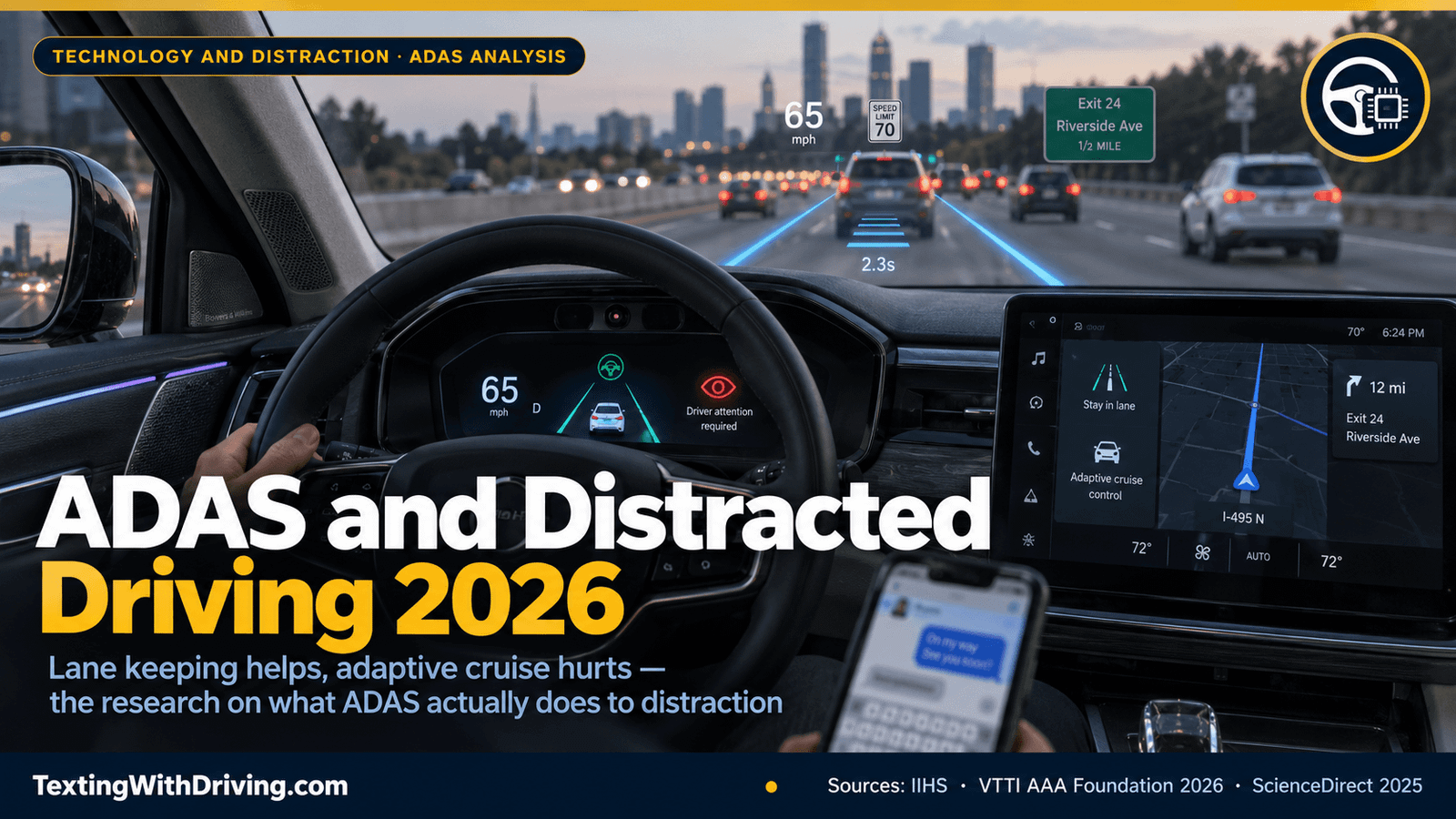
ADAS distracted driving 2026 research has produced a finding that most new car buyers do not know and that most automotive marketing does not emphasize: some of the most popular driver assistance features in current vehicles are not just failing to reduce distracted driving crashes — they are associated with increased crash rates.
Lane Keeping Assist reduces crashes by 19.1 percent. Driver Monitoring Systems reduce crashes by 14 percent. Forward automatic emergency braking reduces rear-end striking crashes by 45 percent. These are the genuinely safety-improving features of the advanced driver assistance technology suite.
Adaptive cruise control is associated with an 8 percent increase in crash rates. Standard cruise control is associated with a 12 percent increase.
These findings, from a comprehensive 2025 review published in ScienceDirect analyzing 28 distinct ADAS features across real-world effectiveness data, are the single most important counter-narrative in automotive safety in 2026: the features that automate the most comfortable driving tasks — maintaining speed, maintaining following distance — appear to produce worse crash outcomes than driving without them. The features that actively intervene in crash-producing moments — lane correction, emergency braking — produce the best outcomes.
The explanation is automation complacency. Partially automated systems may also have unintended consequences, as drivers become disengaged because the vehicle is handling more of the driving. System misuse has already been implicated in fatal crashes per NTSB reporting in 2017, 2019, 2020, and again in 2026.
This guide covers the complete ADAS distracted driving 2026 research picture: what the evidence actually shows about which ADAS features help and which hurt, how automation complacency produces distracted driving rather than preventing it, what the VTTI-AAA Foundation 2026 naturalistic study found about real-world driver behavior with Level 2 ADAS, the specific legal question of whether a legally hands-free driver staring at their phone while the vehicle self-steers is violating Virginia’s hands-free law, and what the research recommends for drivers who want to use ADAS features most safely.
The Contradiction at the Heart of ADAS Safety Claims
ADAS distracted driving 2026 analysis must begin with the fundamental contradiction that the research evidence reveals: the features that marketers and buyers most associate with “semi-autonomous” driving — adaptive cruise control, lane centering — are the features with the worst crash outcome data. The features that are often considered standard safety equipment rather than luxury automation — automatic emergency braking, lane keep assist — have the best crash outcome data.
Lane Keeping Assist (LKA) has a 19.1 percent crash rate reduction and Driver Monitoring Systems (DMS) a 14 percent reduction. These are the strongest crash rate reductions of any studied ADAS features.
However, systems like Adaptive Cruise Control (ACC) and Cruise Control (CC) were associated with increased crash rates of 8 percent and 12 percent respectively. Comfort-enhancing systems appear not to have beneficial effects on safety.
The pattern the research reveals is precise: systems that actively intervene in crash-producing moments produce safety benefits. Systems that make driving more comfortable by automating routine speed and distance management produce safety costs through the mechanism of automation complacency.
The why is straightforward. A lane keep assist system that applies a corrective steering input when the vehicle begins to drift helps even when the driver is fully attentive — it adds a safety margin. When the driver is distracted — looking at their phone — the same LKA reduces the crash probability from the lane departure that the distraction creates. The system actively compensates for the distraction.
Adaptive cruise control does not add a safety margin for distracted drivers the same way. ACC maintains the programmed speed and distance — but it does not prevent the car from drifting, does not prevent the driver from missing stopped traffic beyond the ACC detection range, and critically, does not prevent the driver from checking their phone with the psychological conviction that “the car is driving itself.” The comfort of ACC, not the actual automation level, is the behavior-changing factor that the crash rate increase reflects.
Adaptive cruise control and lane centering can be considered high priority features for tracking because of their significant market penetration and the safety implications of their use — but the tracking purpose is because the evidence on their safety effects is more complex than their marketing suggests.
The Automation Complacency Mechanism
ADAS distracted driving 2026 research has a specific name for the phenomenon that produces worse crash outcomes from comfort-enhancing ADAS features: automation complacency.
A key concern is that drivers may become inattentive due to engagement in non-driving-related tasks or become drowsy while driving using these systems. In these scenarios — Level 2 ADAS where speed control and steering are automated but the driver is still required to monitor traffic and be ready to resume control — the driver’s psychological experience is that less active attention is required. The vehicle is steering. The vehicle is maintaining speed. The driver does not feel the urgency of continuous engagement.
This is the automation complacency mechanism: the feeling that automation provides justifies reduced attention investment. The technology handles it. The driver can check their phone. The driver can look at the passenger. The driver can look at the roadside scenery. The automation handles the routine driving tasks — and the driver extends this confidence incorrectly to the non-routine events that the automation cannot handle: the unexpected vehicle cutting in three car lengths ahead, the deer crossing from the dark tree line, the end of the adaptive cruise control’s detection range.
VTTI’s naturalistic study data, leveraged by the AAA Foundation in its 2026 research, captures this mechanism directly: drivers do engage in more non-driving-related tasks when using Level 2 ADAS features compared to manual driving. The naturalistic camera data shows the behavior — eyes leaving the road more frequently, hands more frequently away from the wheel, phone interaction increasing — precisely when the vehicle has ACC and lane centering active.
72 percent of drivers are unaware of ACC’s limitations. This specific finding establishes the knowledge gap that automation complacency exploits: most drivers using adaptive cruise control do not accurately understand what the system can and cannot do. They overestimate its capability — believing it will handle more crash-prevention scenarios than it actually can — and reduce their attentional investment accordingly.
System misuse has already been implicated in fatal crashes per NTSB reporting in 2017, 2019, 2020, and 2026. The NTSB’s repeated citation of ADAS system misuse in fatal crash investigations across these years reflects the real-world consequence of the automation complacency mechanism: a driver who believed the automation was handling the driving situation when it was not.
The VTTI-AAA Foundation 2026 Study: What the Cameras Found
The most directly relevant ADAS distracted driving 2026 research for the Virginia context comes from the Virginia Tech Transportation Institute — in Blacksburg, Virginia — whose 2026 AAA Foundation-published research applied VTTI’s naturalistic driving study infrastructure to examine Level 2 ADAS user behavior.
This research examines driver behavior when driving vehicles equipped with advanced driver assistance systems (ADAS), such as adaptive cruise control or lane-keep assist. Information regarding driver behaviors was drawn from two naturalistic driving studies. The ultimate goal of advanced driver assistance systems is to increase traffic safety and driving comfort. Despite their potential safety benefits, there are concerns about unintended consequences associated with intermediate levels of automation.
The VTTI-AAA Foundation research leveraged data from two specific naturalistic driving studies: the Virginia Connected Corridors Level 2 study and an additional NDS dataset. The cameras placed inside the instrumented study vehicles captured what drivers actually did — moment by moment, trip by trip — when their vehicles had Level 2 ADAS active versus when they drove in standard manual mode.
The findings documented the automation complacency behavior pattern that the crash rate data implies: drivers using Level 2 ADAS are more likely to engage in secondary tasks — including phone use — during ADAS-active periods compared to manual driving periods. The ADAS did not eliminate the distraction risk. In measurable respects, it increased it by creating the psychological conditions under which drivers concluded that less active attention was required.
The VTTI study’s Virginia geography matters for this article’s regional context. The Virginia Connected Corridors study that the VTTI-AAA research leverages collected its naturalistic data on Virginia roadways — including the I-66 corridor in Northern Virginia and the I-64 corridor through the Charlottesville and Richmond areas. The distracted driving behaviors captured by VTTI’s cameras in ADAS-active vehicles were occurring on the same Virginia roads where Operation DISS-RUPT enforcement campaigns document distracted driving citations, where Road Shark campaigns issue 50,000-plus annual citations, and where Virginia’s 18,688 distracted driving crashes in 2024 occurred.
What Each ADAS Feature Actually Does for Distracted Drivers
ADAS distracted driving 2026 analysis is most practically useful when it evaluates specific ADAS features individually rather than treating ADAS as a monolithic technology category. The evidence on specific features varies dramatically.
Forward Collision Warning (FCW): Issues an audio and visual alert when the system detects an imminent collision risk. The alert can trigger the driver to look up from a phone in the moments before the crash window closes. On-road studies found a 16 percent reduction in rear-end striking crashes for forward collision alerts. The alert is the safety contribution. The alert does not replace the driver’s attention — it provides a last-resort backup when attention has lapsed.
Automatic Emergency Braking (AEB): Applies emergency braking automatically when collision is imminent and the driver has not responded. The real-world safety benefit is substantially larger than FCW alone: a 45 percent reduction in rear-end striking crashes for front automatic braking. AEB is the most safety-effective individual ADAS feature by crash reduction percentage. It provides genuine crash prevention even when the driver is fully distracted — the brake applies regardless of driver input.
Lane Departure Warning (LDW): Alerts the driver when the vehicle crosses lane markers. On-road data showed only a 3 percent reduction in lane departure crashes. Warning-only systems have limited effectiveness because the alert occurs after the unsafe condition has already been reached — the driver must then respond to correct the departure.
Lane Keep Assist (LKA): Applies steering input to keep the vehicle within its lane without driver correction. Real-world data: a 30 percent reduction in lane departure crashes for lane keep assist, and the ScienceDirect review found a 19.1 percent overall crash rate reduction. The active intervention — the system steers, not just warns — is the mechanism that produces the larger benefit compared to LDW.
Adaptive Cruise Control (ACC): Maintains programmed speed while automatically adjusting to maintain safe following distance from the vehicle ahead. Associated with an 8 percent increase in crash rates in the ScienceDirect comprehensive review. The speed and distance maintenance comfort that ACC provides — the primary experiential benefit the driver perceives — is the same comfort that enables the distracted phone checking the naturalistic data captures.
Driver Monitoring System (DMS): The in-cabin camera that watches the driver and alerts when attention lapses, as documented in our distracted driving AI technology 2026 article. The ScienceDirect review found a 14 percent crash rate reduction from DMS. DMS is the only ADAS feature that directly addresses driver attention rather than vehicle dynamics — it reduces crashes by detecting and alerting the human behavior problem rather than compensating for it mechanically.
Blind Spot Detection (BSD): Alerts when a vehicle is in the driver’s blind spot. Could decrease crash incidents by 9 percent per national crash database analysis. BSD provides the specific value of detecting vehicles in the areas that manual mirror scanning can miss — relevant for lane change distracted driving scenarios.
The pattern is clear: ADAS features that actively intervene to prevent crashes (AEB, LKA, DMS) produce safety benefits. ADAS features that make driving more comfortable without preventing crash-producing driver behaviors (ACC) produce safety costs through complacency.
The Level 2 Legal Question: Hands-Free Law and ADAS-Active Driving
ADAS distracted driving 2026 creates a specific legal question that has not been definitively resolved in any state: does a driver who is using a hands-free ADAS-equipped vehicle and looking at their phone while lane centering and adaptive cruise control are active violate Virginia’s hands-free law?
Virginia Code § 46.2-818.2 prohibits holding a personal communications device while operating a motor vehicle. The specific prohibition is on holding the device. A driver who is not holding the phone — whose phone is in their lap, face-up, while they read messages during an ADAS-active highway segment — is not holding the device. Whether the face-up-in-lap phone that requires no manual contact to view constitutes a violation under the specific language of the Virginia statute has not been definitively litigated.
What is unambiguous: the safety research is worse for this scenario than for standard phone-in-hand driving. A driver who is reading a phone in their lap while ADAS maintains speed and lane position is experiencing the full automation complacency effect — reduced attention to the road environment, full cognitive engagement with the phone content, and the false security that the automation is handling the driving. This is precisely the scenario that the NTSB has implicated in fatal crashes involving ADAS misuse.
The legal clarity that currently exists: a driver who picks up the phone and holds it while the vehicle is on a public road is violating § 46.2-818.2 regardless of whether ADAS is active. The ADAS state of the vehicle does not create any exception to the hands-free law. A Virginia State Police trooper who observes a driver holding a phone on I-66 while adaptive cruise control is active can stop and cite the driver exactly as they would cite a driver without ADAS.
The Maximum Potential Reality: What ADAS Cannot Do
ADAS distracted driving 2026 has a specific ceiling on its potential impact that IIHS established through a foundational analysis: even if all interstate miles were logged by vehicles driven entirely by automation that did not crash, the maximum overall benefit would be 17 percent fewer crash deaths and 9 percent fewer crash injuries than when driven by a human without automation assistance.
17 percent. Not because automated driving on interstates is not beneficial — it is. But because approximately 83 percent of crash deaths and 91 percent of crash injuries occur on roads where ADAS like adaptive cruise control and lane centering are not designed to operate: urban surface streets, suburban arterials, intersections, parking lots, and the lower-speed road environments where the majority of pedestrian deaths, intersection crashes, and distracted driving injuries accumulate.
Much of the technology available in current vehicles, such as adaptive cruise control and lane centering, typically works only on higher-speed roadways where crashes are relatively infrequent. The ADAS technologies that Virginia drivers encounter most in their marketing and vehicle purchases — the adaptive cruise and lane centering packages — are most effective on exactly the road type where crashes per mile traveled are lowest. They provide limited benefit on the Alexandria King Street intersections, the Richmond Route 1 crosswalks, and the Fairfax County Battlefield Boulevard commercial corridors where most of Virginia’s distracted driving crashes and pedestrian fatalities occur.
This ceiling does not mean ADAS is without value. AEB’s 45 percent rear-end crash reduction and LKA’s 19 percent overall crash reduction are genuinely meaningful safety improvements on the road types where they operate. But the marketing narrative that implies Level 2 ADAS represents a pathway to substantially reduced crash totals is not supported by the ceiling analysis — or by the complacency data showing that some features produce worse crash outcomes than manual driving.
The Driver Disuse Problem
ADAS distracted driving 2026 has an additional complication that the research has documented: many drivers turn ADAS features off because they find the systems annoying, unpredictable, or uncomfortable.
Many participants reported discomfort with specific tactical and operational behaviors of ADAS, such as frequent overrides, unintended acceleration, or delayed lane changes. Participants described adaptive cruise control as frustrating in urban environments where stop signs require manual braking followed by system reactivation. The frequent cycle of activating and deactivating ACC at each traffic light or intersection not only failed to reduce workload but actually increased it.
Adaptive cruise control doesn’t detect stop signs. So a driver must brake manually at every stop sign, then reactivate the system — a cycle that urban drivers find more cognitively demanding than simply driving manually. The result: ACC is turned off in urban environments, which means the most congested, highest-crash-density road environments that produce the majority of distracted driving crashes are precisely where the system is not being used.
Lane keep assist produces its own discomfort from drivers who experience the system’s steering corrections as intrusive or uncomfortable. In urban environments with frequent crosswalks, drivers note repeated correction conflicts at intersections and crosswalk approaches where the lane detection logic conflicts with the driver’s intentional steering movements.
ADAS dependency: drivers may become overly reliant on assistance systems, which can lead to reduced driving skills and reduced ability to drive without assistance. The skill atrophy concern — that drivers who use ADAS extensively develop degraded manual driving skills — has not been definitively proven but is a genuine research concern as vehicles increasingly automate the routine driving tasks that maintain proficiency.
What This Means for Virginia, Maryland and DC Drivers
ADAS distracted driving 2026 has specific practical implications for the DMV region’s driving population, which is among the most technologically sophisticated in the United States — early adopters of new vehicles with high rates of Level 2 ADAS deployment across the Northern Virginia technology workforce and DC metropolitan professional community.
AEB and LKA are the features worth prioritizing. When purchasing a vehicle, automatic emergency braking — which reduces rear-end striking crashes by 45 percent — and lane keep assist — which reduces overall crashes by 19.1 percent — are the features with the strongest safety evidence. These should be standard rather than optional priorities.
Adaptive cruise control requires extra vigilance about complacency. The comfort that ACC provides is real. The temptation to check the phone that ACC creates — “the car is maintaining distance, I have a moment” — is documented in naturalistic data. Using ACC on Virginia’s I-66 and I-95 corridors requires the explicit conscious decision NOT to interpret ACC’s operation as permission for reduced attention.
DMS alerts are behavioral signals, not suggestions. The driver monitoring system that alerts when gaze leaves the forward zone is providing information about a documented crash risk, not a bureaucratic compliance notification. An alert from the DMS camera is the system telling the driver that they are experiencing the exact attentional lapse that VTTI’s cameras have shown is present in 80 percent of crashes in the three seconds before impact.
The hands-free law applies regardless of ADAS state. Virginia Code § 46.2-818.2 does not have an ADAS exception. No ADAS feature — not adaptive cruise, not lane centering, not any combination of Level 2 features — creates a legal window for holding a phone while driving on a Virginia public road.
The most practical synthesis of all the ADAS research: AEB is the feature most worth having because it provides genuine crash prevention even for distracted drivers. ACC is the feature requiring the most behavioral vigilance because its comfort actively increases distracted driving tendency. And DMS is the feature that closes the loop — detecting when ACC’s complacency-inducing comfort has led the driver to look away from the road and alerting them before the crash that the naturalistic data shows is coming within the next three seconds.
For the AI technology context that places ADAS within the broader technology response to distracted driving, our distracted driving AI technology 2026 article covers roadside cameras, DMS, and fleet AI cameras. For the Virginia-specific camera deployment that is moving AI enforcement from concept to reality, our Virginia distracted driving cameras 2026 covers SB84 and the Obvio deployment. For the brain science explaining why automation complacency exploits the same cognitive vulnerabilities as phone distraction, our Virginia distracted driving and the brain 2026 covers the VTTI attention research. And for the technology that closes the behavioral loop regardless of what ADAS features the vehicle has, our hands-free while driving complete setup guide covers iPhone, Android, Bluetooth, and CarPlay.
Sources Used in This Article
All links verified working before publication.
ScienceDirect: Rethinking ADAS Taxonomies Framework and Inventory of Real-World Safety Performance — LKA 19.1% crash rate reduction, DMS 14% reduction, ACC +8% increase, CC +12% increase, comfort-enhancing systems detrimental effects, warning vs intervening systems analysis, January 2025
IIHS: Advanced Driver Assistance Research Area — Even if all interstates automated zero crashes only 17% fewer crash deaths 9% fewer injuries, ACC lane centering only higher-speed roadways less frequent crashes, system misuse implicated in fatal crashes NTSB 2017 2019 2020 2026, automakers use DMS alert strategies, Mueller et al 2025
AAA Foundation for Traffic Safety: Understanding Impact of Technology ADAS Improper Driving Behavior — VTTI naturalistic driving studies Level 2 Virginia Connected Corridors, key concern drivers inattentive non-driving tasks drowsy while using systems, March 2026
ScienceDirect: Methods to Estimate ADAS Penetration Rates United States — Front AEB 45% reduction rear-end striking crashes, LDW 3% reduction vs LKA 30% reduction lane departure crashes, forward collision alerts 16% reduction, highest priority ADAS features ACC AEB LKA pedestrian AEB
ScienceDirect: Disuse of Advanced Driver Assistance Systems — ACC doesn’t detect stop signs block-by-block deactivation increase workload, aggressive handling discomfort urban environments, 35 participants Level 2 6+ months experience, October 2025
Wikipedia: Advanced Driver Assistance Systems — Forward collision prevention 29% crash reduction potential, LKA 19%, blind zone detection 9%, ADAS features comprehensive list
BTS DOT: Impact of ADAS on Road Safety — 72% of drivers unaware of ACC limitations, proper knowledge limitations usability conditions important
PMC NCBI: Analysis of ADAS for Safe and Comfortable Driving — Reduced stress fatigue cognitive load automated lane keeping ACC AEB, ADAS dependency skill atrophy concern, survey-based effectiveness evaluation
NHTSA: Distracted Driving — 3,208 deaths 2024, national context
TextingWithDriving.com is professionally built and maintained to ensure accurate, accessible safety information reaches every driver who needs it. Website development and ongoing support is handled by Budgetic, a digital agency specializing in purpose-driven WordPress websites.

About Texting With Driving
TextingWithDriving.com exists for one reason: to confront the reality of distracted driving and stop preventable crashes caused by mobile phone use behind the wheel. Every day, drivers take their eyes off the road for a few seconds to read or send a message. Those few seconds are enough to cause life-altering consequences. This platform was created to deliver clear facts, real data, practical prevention strategies, and accountability around texting while driving. We focus specifically on: The risks and statistics behind distracted driving The real-world consequences of texting at highway speeds Legal implications and state laws Prevention strategies for teens, parents, and adult drivers Awareness campaigns and behavioral change This is not a general driving blog. It is a focused awareness initiative built around one critical issue: phone distraction behind the wheel. Our content is direct, research-driven, and practical. We prioritize accuracy over opinion and education over sensationalism. The goal is simple — reduce distracted driving incidents by increasing awareness and responsibility. If one article causes one driver to put their phone down, the mission is working. For inquiries or partnerships, contact: privacy@textingwithdriving.com
View all posts by Texting With Driving