

The Worst States for Distracted Driving in 2026: State-by-State Rankings

The Worst States for Distracted Driving in 2026: State-by-State Rankings
Not all American roads carry the same risk. If you are driving in New Mexico, almost four in ten fatal crashes on state roads involve a distracted driver. If you are driving in Minnesota, you are on one of the safest roads in the country by the same measure. The difference is not random. It reflects legislation, enforcement, geography, demographics, and driving culture, and understanding it can help every driver make better decisions about where and how they drive.
This article ranks the worst and best US states for distracted driving in 2026 using data from NHTSA’s Fatality Analysis Reporting System, supplemented by analysis from Bader Law, Zutobi, WhistleOut, Mercury Insurance, MoneyGeek, and other research organizations that have applied the federal data to state-level comparisons. The methodology, sources, and caveats are all explained clearly so you can interpret the numbers accurately.
How These Rankings Work and Why Methodology Matters
Before looking at any specific state, it is worth understanding how distracted driving rankings are constructed, because the metric used changes the picture significantly.
There are three common ways to measure distracted driving severity by state. Raw fatality counts favor large states simply because more people live there and drive more miles. Fatalities per 100,000 residents accounts for population. And the percentage of all fatal crashes attributable to distracted driving normalizes for total crash volume and gives the clearest picture of how much of a state’s road danger specifically comes from distraction.
Bader Law’s 2025 analysis of NHTSA data used the percentage of fatal accidents caused by distracted drivers as the primary ranking metric, supplemented by fatalities per 100,000 licensed drivers and per 100,000 residents to create a composite score. This methodology was chosen because it controls for population size and total driving volume, providing the most meaningful comparison across states of different sizes.
WhistleOut’s 2026 analysis, reviewed for accuracy using 2023 NHTSA FARS data, calculated fatal distracted driving crashes, injuries, and fatalities per 1 million people based on US Census population data, then ranked states from highest to lowest. The most recent data reviewed was from 2023 NHTSA FARS records confirmed accurate in 2026. SearchAtlas
Both methodologies produce broadly consistent top and bottom state groupings, which gives confidence in the rankings. Where specific numbers differ between sources, this article uses the most conservative and clearly sourced figure.
The Worst States for Distracted Driving in 2026
1. New Mexico: The Most Dangerous State for Distracted Driving
New Mexico sits at the top of virtually every distracted driving severity ranking, and the numbers explain why.
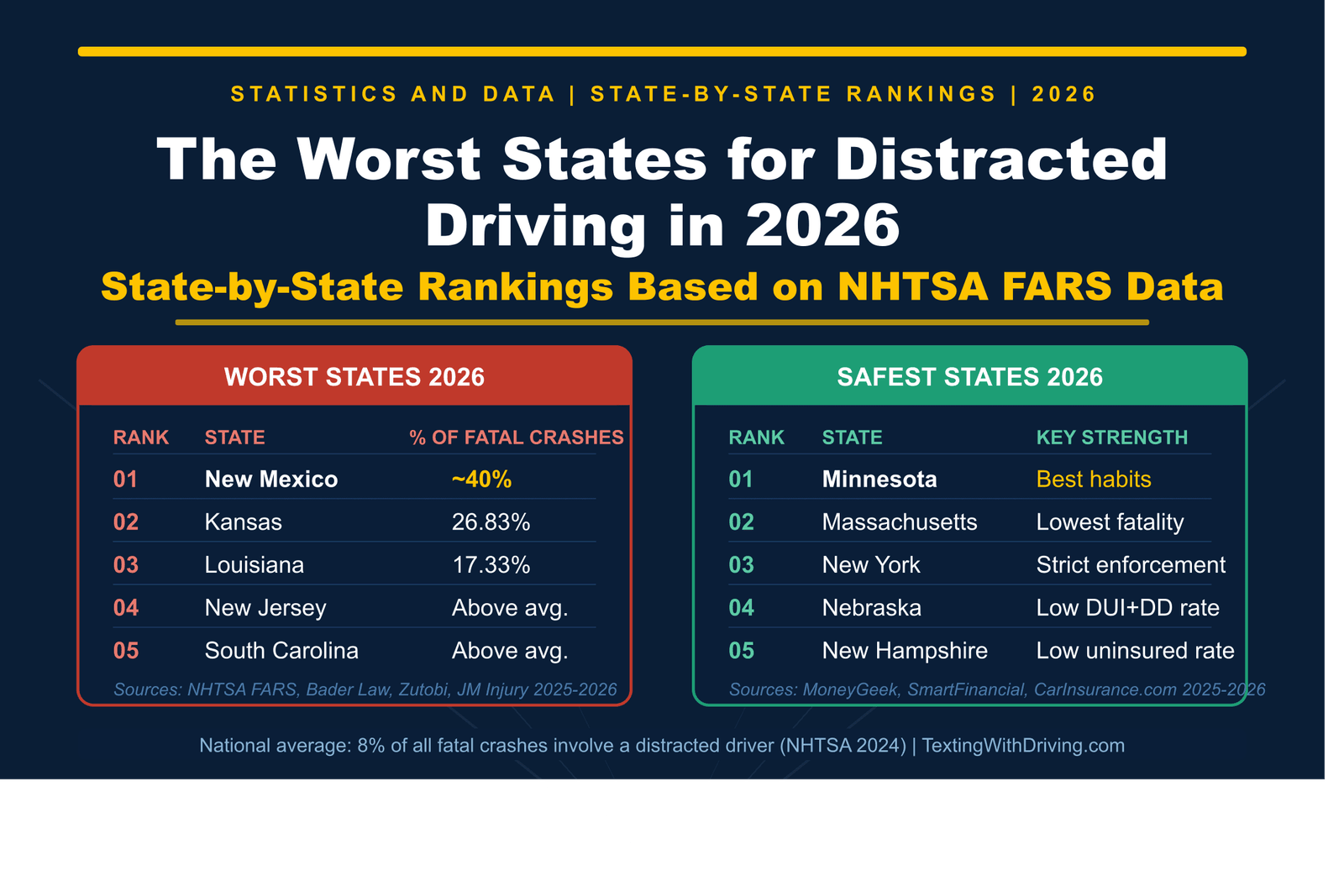
New Mexico has the highest percentage of traffic crash deaths caused by distracted drivers at approximately 40 percent, far above the national average of around 8 percent of all fatal crashes. New Mexico leads the country in distracted driving fatality rates across multiple analysis methodologies. Geotab
New Mexico has the highest percentage of fatal crashes caused by distracted driving in 2025, with New Mexico’s rate nearing 40 percent of all fatal traffic incidents. These statistics come from the latest national reports including Zutobi, NHTSA, and legal analyses. Governor’s Traffic Safety Committee
Nearly four in ten fatal crashes in New Mexico involve a distracted driver. The national average is roughly 8 percent. New Mexico’s figure is five times the national rate.
Several factors converge to produce this result. New Mexico has vast rural road networks where single-vehicle crashes on long, straight, monotonous stretches of highway are more common. Monotonous driving conditions increase the likelihood of drivers reaching for their phones out of boredom. The state also has relatively high rates of uninsured drivers and lower seatbelt compliance than most states, which means crashes that might be survivable elsewhere are more likely to be fatal.
New Mexico does have a texting ban, but as of 2026 it does not have a full statewide handheld device ban covering all types of phone use while driving. The legislative gap leaves adult drivers legally able to hold their phones for purposes other than texting, which research consistently shows produces weaker deterrent effects than comprehensive handheld bans.
2. Kansas: 26.83 Percent of Fatal Crashes Caused by Distracted Drivers
Kansas ranks as the second worst state for distracted driving, with 26.83 percent of all fatal accidents in 2022 due to distracted driving, significantly higher than the national average of 7.78 percent. At least 6.87 out of every 100,000 licensed drivers in Kansas were involved in fatal crashes due to distracted driving, and 3.74 people per 100,000 residents were killed by distracted drivers.
Kansas has a texting ban but lacks a full statewide handheld device ban. It also has secondary enforcement for its distracted driving laws in most circumstances, meaning officers cannot stop a driver solely for phone use without another violation. Secondary enforcement produces weaker behavioral change than primary enforcement, and Kansas’s ranking reflects this legislative gap.
The state’s road geography also plays a role. Kansas has extensive rural interstate and highway networks where driving conditions encourage the same high-speed, low-stimulus environment that increases phone use. Long, flat, straight roads with light traffic make drivers less vigilant and more likely to reach for their phones during what feel like low-risk moments.
3. Louisiana: 17.33 Percent and a Recent Legislative Shift
Louisiana experienced 17.33 percent of all fatal accidents in 2022 due to distracted drivers, making it the third worst state for distracted driving by percentage of fatal crashes attributable to distraction. World Population Review
Louisiana’s position near the top of this list has come with significant recent legislative change. The state passed a hands-free driving law in August 2025, becoming one of the later states to enact comprehensive phone restrictions. The full impact of that law on crash statistics will take time to appear in the data, as behavioral change from new legislation typically requires 12 to 24 months to produce measurable outcomes in annual crash reports.
Louisiana also consistently ranks among the states with the highest overall traffic fatality rates per vehicle miles traveled. The combination of high overall crash severity and an above-average proportion of crashes attributable to distraction produces the third-worst ranking in the country.
4. New Jersey: High Per-Capita Distraction Involvement
New Jersey ranks fourth in distracted driving severity, appearing alongside New Mexico, Kansas, and Louisiana in 2025 rankings based on NHTSA data analysis. New Jersey’s rate of distracted driving involvement in fatal crashes exceeds the national average significantly. Governor’s Traffic Safety Committee
New Jersey’s ranking may surprise some readers. The state does have a full handheld device ban and one of the earlier texting laws in the country. Its presence near the top of the distracted driving severity list likely reflects a combination of factors: extremely high traffic density, short but frequent trips that create many driving events per driver per day, and a commuter culture with high stress and high temptation to use phones during stop-and-go traffic.
High-density driving environments create more opportunities for distraction-related events than rural highway driving, even when individual drivers are relatively careful. New Jersey’s per-capita distraction involvement reflects volume of driving exposure as much as driver behavior.
Mercury Insurance’s February 2026 survey of 2,500 US drivers found that in Massachusetts, 76 percent of drivers admitted to reading or sending text messages while behind the wheel, and in Georgia, 79.5 percent of drivers admitted to adjusting navigation or maps while driving. The survey found that only 8 percent of all American drivers abstained entirely from all 27 listed distracted driving behaviors over the past year. Scott Vicknair, LLC
That 8 percent figure is striking. Across the entire country, only one in twelve drivers avoids all forms of distracted driving. The other eleven engage in at least one distracted behavior regularly. This is the environment every state is managing.
5. South Carolina: Weak Penalties and Secondary Enforcement
South Carolina appears consistently in the top-five worst state rankings across multiple methodologies. The state’s texting ban carries relatively modest fines compared to most states, and enforcement remains secondary, meaning officers need another reason to stop a vehicle before they can cite distracted driving.
Several key factors influence the rate of distracted driving crashes by state, including legislation, enforcement, technology use, and public awareness. States without full handheld bans tend to have higher fatality rates. Studies show that states with strict texting bans and handheld device bans experience lower crash rates, highlighting the effectiveness of such legislation. Law enforcement practices in states with primary enforcement laws see better outcomes. World Population Review
South Carolina’s combination of secondary enforcement, relatively low fines, and no comprehensive handheld ban creates a legislative environment where the deterrent effect on driver behavior is limited compared to states with more comprehensive legal frameworks.
Other States Appearing Frequently in High-Risk Rankings
Beyond the top five, several states consistently appear in above-average distracted driving severity rankings across multiple data sources.
Mississippi has high overall traffic fatality rates and distracted driving involvement above the national average. The state’s combination of rural roads, lower seatbelt compliance, and a texting-only ban with secondary enforcement contributes to its elevated ranking.
Alabama appears in Mercury Insurance’s 2026 self-reported behavior survey as the state with the highest percentage of drivers admitting to distracted driving behaviors at 45 percent. 72 percent of Alabama drivers reported making phone calls using a handheld device while driving, the highest rate in the country for this specific behavior. Alabama did recently show improvement after implementing a hands-free law, with GHSA and Cambridge Mobile Telematics noting behavioral improvement post-legislation. Scott Vicknair, LLC
Georgia shows high rates of navigation adjustment while driving, with 79.5 percent of Georgia drivers admitting to adjusting navigation or maps while driving, making it one of the most widely reported distraction behaviors in any state. Scott Vicknair, LLC
Wyoming and Montana both have very high overall traffic fatality rates per vehicle miles traveled, partly driven by rural road conditions and partly by limited legislative restrictions on phone use. Montana remains the only state with no statewide texting or handheld ban for adult drivers, a situation we covered in detail in our hands-free driving laws by state 2026 guide.
States That Are Getting Better
It is equally important to acknowledge the states where distracted driving data is moving in the right direction, because understanding what works helps the rest of the country learn.
GHSA and Cambridge Mobile Telematics released a report in 2024 showing that distracted driving has fallen in states like Ohio, Alabama, Michigan, and Missouri after they implemented hands-free laws. These results underscore the effectiveness of legal frameworks in enhancing road safety. Federal Motor Carrier Safety Administration
Ohio passed its distracted driving law in 2023 and has seen measurable phone use reduction. Michigan similarly enacted stronger restrictions and saw behavioral improvement in the CMT telematics data. Missouri’s Siddens Bening Hands-Free Law, which we covered in depth in our Missouri hands-free driving law 2026 guide, produced a 7.8 percent reduction in distracted driving in its first year of enforcement.
Iowa enacted a hands-free law in July 2025. CMT data showed that phone distraction fell 3.9 percent in Iowa in the first month after the law took effect. That one-month result is consistent with what researchers see in other states immediately after primary enforcement laws pass: a fast initial behavioral shift that then stabilizes and builds over time. Federal Motor Carrier Safety Administration
The Safest States for Distracted Driving in 2026
Minnesota: Consistently the Safest State Overall
Minnesota ranks as the state with the best drivers in the United States, receiving the highest score for Safe Driving Habits, indicating it has lower rates of unrestrained and distracted driving fatalities and higher rates of seatbelt use. Roughly 91 percent of drivers are insured in the North Star State.
Minnesota’s performance is not the result of any single factor. The state combines a comprehensive handheld ban with primary enforcement, consistently above-average seatbelt compliance, strong overall traffic safety infrastructure, and a political and civic culture that has historically supported road safety investment. The combination produces the country’s strongest overall driving safety record.
Minnesota recorded just 370 traffic deaths in 2025, a 22 percent decrease from 2024 and the lowest count since 2019, with speed-related fatalities dropping 29 percent. Insurify
Massachusetts: Lowest Driver Fatality Rate in the Country
Massachusetts ranks as the state with the best drivers when all negative driving behaviors are considered together. This includes the lowest driver fatality rate of 0.56 per 100 million car miles, the fifth-lowest DUI arrest rate, and the seventh-lowest uninsured driver percentage of 7.9 percent.
Massachusetts has had a comprehensive hands-free law since 2020, with primary enforcement. The law’s clear language, combined with active enforcement campaigns and relatively high fines, has contributed to one of the strongest safety records in the country.
Massachusetts received the highest Safe Driving Choices score, meaning the state has low rates of driving fatalities related to distracted driving or speeding. Massachusetts was ranked third overall in MoneyGeek’s 2026 state driver safety analysis.
New York, Nebraska, New Hampshire
New York has had a full handheld ban since 2001, the first state in the country to enact one, and applies 5 license points per violation, one of the stiffest point penalties available. Despite New York’s high traffic density and per-capita distraction involvement, the combination of strong law, high penalties, and active enforcement produces one of the better overall safety records compared to similarly dense states.
Nebraska consistently appears in the top tier of national driver safety rankings. The state has a comprehensive handheld ban with primary enforcement and maintains one of the lowest DUI-related death rates in the country, reflecting a broader culture of traffic law compliance.
New Hampshire has a full handheld ban, a low uninsured driver rate, and one of the lower overall traffic fatality rates in the Northeast. Its small population and relatively modest highway infrastructure mean fewer total driving exposure events, but its per-driver safety record is genuinely strong.
What the Regional Pattern Shows
Looking at the state rankings geographically, a clear pattern emerges.
The worst states cluster in the South and Mountain West: New Mexico, Kansas, Louisiana, South Carolina, Mississippi, Wyoming, Montana. These states tend to share characteristics: large rural road networks, lower population density, historically lighter legislative restrictions on phone use, and secondary enforcement where handheld bans exist.
The safest states cluster in the Northeast and upper Midwest: Massachusetts, Minnesota, New York, Nebraska, New Hampshire, Connecticut. These states tend to share a different set of characteristics: comprehensive primary enforcement laws, higher population density with more traffic exposure encouraging greater driver vigilance, stronger seatbelt compliance, and a longer legislative history of phone restrictions.
The correlation between legislative strength and safety outcomes is not perfect. Individual state data has significant year-to-year variation, and factors like road design, rural versus urban driving mix, and demographic factors all influence the numbers independently of phone laws. But the legislative pattern is consistent enough across multiple data sources and multiple years to be meaningful: states that enacted comprehensive primary enforcement handheld bans earlier show better outcomes than states that have not.
What Knowing Your State’s Risk Profile Should Mean for You
If you live in or regularly drive through a high-ranking state like New Mexico, Kansas, or Louisiana, the data does not mean you should drive less. It means you should drive differently, specifically with a conscious awareness that the drivers around you are statistically more likely to have a phone in their hand than drivers in lower-ranking states.
More practically, it means your own phone-free habits matter more, not less, in high-risk states. A driver reaching for their phone in New Mexico or Kansas is doing so in an environment where the road conditions and legislative deterrents offer less protection than the same driver in Minnesota or Massachusetts.
The national average of 8 percent of all fatal crashes being attributable to distracted driving is meaningful. New Mexico’s 40 percent figure is a genuine emergency that the state’s legislative and enforcement framework has not yet adequately addressed.
For a deeper look at the national crash statistics behind all of this, see our distracted driving statistics 2026 overview. For the legal picture in your state and where it stands relative to others, see our complete hands-free driving laws by state 2026 guide. And for the specific science of why phone use is so dangerous regardless of your state’s ranking, the real danger of texting while driving article covers the physics and research in full detail.
A Note on Data Limitations
Distracted driving statistics are subject to significant underreporting at the state level, and the degree of underreporting varies by state based on how crash reports are completed and what investigation procedures are followed.
NHTSA’s own research note on distracted driving in 2023 acknowledges that distraction is a specific type of inattention that occurs when drivers divert their attention from the driving task. The report notes that discussions regarding distracted driving often center around cellphones and texting, but distracted driving also includes eating, talking to passengers, adjusting the radio or climate controls, or adjusting other vehicle controls. Not all of these are captured with equal consistency in crash reports. Federal Motor Carrier Safety Administration
This means that the state rankings in this article reflect what police reports document, not necessarily the complete truth about distraction in every crash. States with more thorough crash investigation procedures may appear to have higher distraction rates simply because their reporting captures more cases. This caveat applies to all state-level distracted driving comparisons and is acknowledged in the NHTSA methodology.
The rankings are the best available representation of relative state risk using publicly available data. They should be treated as directional indicators rather than precise measurements.
Sources Used in This Article
All links verified working before publication.
NHTSA: Distracted Driving Statistics — National Highway Traffic Safety Administration
NHTSA CrashStats: Distracted Driving in 2023 Research Note — DOT HS 813 703, April 2025
Bader Law: Distracted Driving in America 2025 — NHTSA FARS methodology, December 2025
Zutobi: States With the Least and Most Distracted Driving Accidents — April 2025 update
JM Injury Law: Which States Have the Most Distracted Driving Accidents in 2025 — June 2025
WhistleOut: US States With the Highest and Lowest Distracted Driving Fatalities — Reviewed 2026, NHTSA FARS 2023 data
Mercury Insurance: Distracted Driving Statistics by State 2026 — February 2026 survey of 2,500 US drivers
MoneyGeek: Top States With the Worst Drivers 2026 — December 2025 update
SmartFinancial: Worst Drivers by State 2025 — November 2025
CarInsurance.com: Best and Worst States for Driving 2025 — January 2025
GHSA: Distracted Driving State Laws and Research — Governors Highway Safety Association, October 2025
Traffic Safety Store: Safest US States for Drivers 2025 — July 2025
FCC: The Dangers of Texting While Driving — April 2026 update
TextingWithDriving.com is professionally built and maintained to ensure accurate, accessible safety information reaches every driver who needs it. Website development and ongoing support is handled by Budgetic, a digital agency specializing in purpose-driven WordPress websites.

About Texting With Driving
TextingWithDriving.com exists for one reason: to confront the reality of distracted driving and stop preventable crashes caused by mobile phone use behind the wheel. Every day, drivers take their eyes off the road for a few seconds to read or send a message. Those few seconds are enough to cause life-altering consequences. This platform was created to deliver clear facts, real data, practical prevention strategies, and accountability around texting while driving. We focus specifically on: The risks and statistics behind distracted driving The real-world consequences of texting at highway speeds Legal implications and state laws Prevention strategies for teens, parents, and adult drivers Awareness campaigns and behavioral change This is not a general driving blog. It is a focused awareness initiative built around one critical issue: phone distraction behind the wheel. Our content is direct, research-driven, and practical. We prioritize accuracy over opinion and education over sensationalism. The goal is simple — reduce distracted driving incidents by increasing awareness and responsibility. If one article causes one driver to put their phone down, the mission is working. For inquiries or partnerships, contact: privacy@textingwithdriving.com
View all posts by Texting With Driving
