

Virginia Rideshare Distracted Driving 2026: Uber, Lyft and DoorDash in Northern Virginia

Virginia Rideshare Distracted Driving 2026: Uber, Lyft and DoorDash in Northern Virginia
Virginia rideshare distracted driving 2026 represents one of the most specific and underaddressed intersections of Virginia’s hands-free law and the specific behavioral demands that gig economy driving places on drivers every moment they are logged into an app.
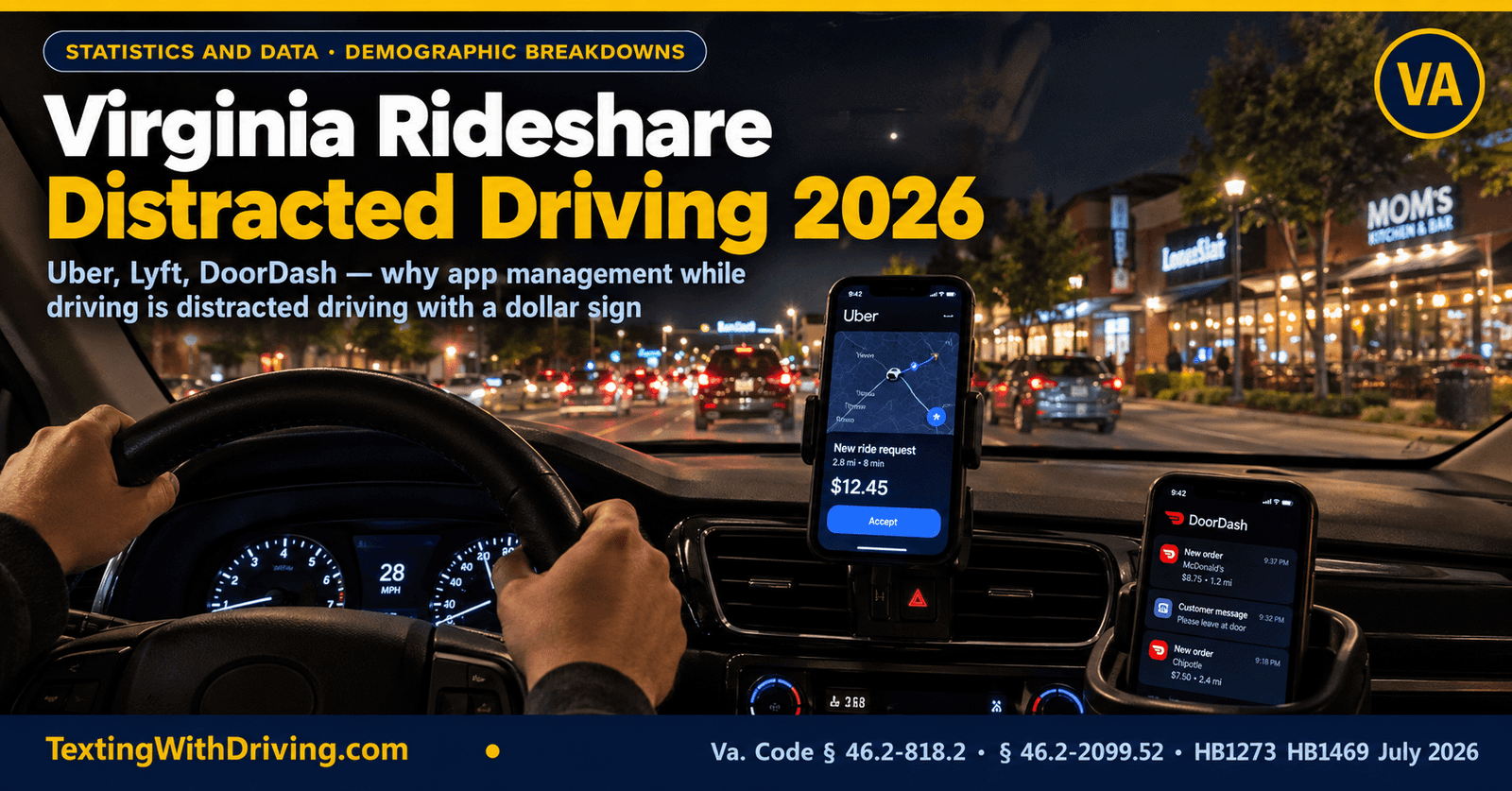
Unlike taxi drivers who use fixed meters and dispatch systems, Uber and Lyft drivers constantly interact with smartphone apps. They check for new ride requests, follow GPS directions, and communicate with passengers. This screen time increases distraction-related crashes. Managing two apps by hand means tabbing between them on your phone, doing mental math on dollars per hour and dollars per mile for each new offer, and deciding in seconds whether to accept — often while driving. It is distracted driving with a dollar figure attached.
That description — from Mystro, one of the leading multi-platform rideshare management apps — is the most honest characterization of what Virginia’s hundreds of thousands of Uber, Lyft, DoorDash, Amazon Flex, and Instacart drivers do every working hour. They are behind the wheel of a moving vehicle on Virginia’s public roads, and their job is to constantly interact with their phone.
Virginia Code § 46.2-818.2 prohibits holding a personal communications device while operating a motor vehicle on any Virginia public road. It does not create an exception for gig economy drivers managing job requests. It does not carve out the specific operational demands of the rideshare business model. And in July 2026, Governor Spanberger signed two new Virginia rideshare safety laws — HB1273 and HB1469 — that demonstrate the Commonwealth’s active engagement with the rideshare safety regulatory environment in ways directly relevant to distracted driving.
This guide covers the complete Virginia rideshare distracted driving 2026 picture: the specific distracted driving risks that rideshare and delivery app management creates, the new 2026 Virginia rideshare safety legislation, the Northern Virginia geographic concentration of rideshare activity, the three-phase insurance framework that governs rideshare driver liability under Virginia Code § 46.2-2099.52, the specific gig driver compliance setup that manages app demands without creating Virginia hands-free violations, and what both riders and other drivers on Virginia roads need to know about rideshare distracted driving risk.
The Specific Distracted Driving Risk of Rideshare App Management
The fundamental Virginia rideshare distracted driving 2026 challenge begins with the structure of the gig economy business model itself — which requires the driver to make real-time decisions while operating a vehicle in ways that create exactly the manual and visual distraction that Virginia’s hands-free law prohibits.
The rideshare app management cycle, repeated dozens of times per working shift:
Ride request notification arrives. The driver’s phone screen lights up with a new ride offer — location, destination, estimated fare, passenger rating. This is a visual distraction: looking at the phone screen while driving.
Acceptance decision required in seconds. Most rideshare platforms require the driver to accept or decline within 10 to 15 seconds. The driver must look at the offer, evaluate it against current location and earnings targets, and tap the response — all while potentially moving at highway speed on Northern Virginia’s I-66 or the Dulles Toll Road. This is simultaneous manual and visual distraction.
Multi-platform switching. Drivers who work multiple platforms simultaneously — Uber and Lyft open at the same time, or Uber plus DoorDash — must manually switch between apps when an offer arrives on one platform and then take the other offline to avoid double-booking. Managing two apps by hand means tabbing between them on your phone — this is distracted driving with a dollar figure attached, as Mystro explicitly characterizes it.
Navigation updates while moving. Rideshare GPS navigation is integrated into the app — but when pickup or drop-off locations change, or when riders request route modifications, the driver must interact with the navigation interface while the vehicle is moving. This is the specific scenario that Virginia’s hands-free law targets: any manual interaction with a device while the vehicle is in motion.
Passenger communication. Riders frequently call or text the driver to identify their pickup location, clarify the destination, or coordinate the approach. Each incoming call or text creates the notification pull — and the specific compliance question of whether the driver can answer while moving or must wait until parked.
Some drivers try to multitask by searching for their next trip while a current fare is still in the car. This multi-tasking — managing the next ride request while a current passenger is present and the vehicle is moving — is the most acute form of rideshare distracted driving and the behavior most directly prohibited by Virginia Code § 46.2-818.2.
Northern Virginia’s Rideshare Density: Where the Risk Concentrates
Virginia rideshare distracted driving 2026 concentrates most intensively in Northern Virginia — for the same structural reasons that Northern Virginia leads Virginia in overall distracted driving crash concentration as documented in our Northern Virginia distracted driving guide and Fairfax County distracted driving 2026 articles.
With the number of people traveling to or through the DC Metro area, Northern Virginia is certainly no exception to the rideshare growth trend. From Richmond to Alexandria, for many people in Virginia, taking a Lyft or Uber is a convenient and affordable way to get around.
The Northern Virginia rideshare market is driven by several specific demand concentrations:
Dulles International Airport. Dulles serves Northern Virginia’s technology and government contractor workforce — and its 26 million annual passengers generate a massive rideshare demand. Uber and Lyft drivers serving Dulles approach through the Dulles Toll Road, park in the designated rideshare pickup area, receive ride requests through the app, and navigate the airport’s complex departure-level and arrival-level pickup infrastructure. The airport rideshare environment combines unfamiliar terminal geography, time-pressure from circling restrictions, and constant app interaction in one of the highest-crash-density transportation environments in the region.
Reagan National Airport. In Arlington County adjacent to the Alexandria, Virginia boundary, Reagan National’s compact urban location — directly on the George Washington Memorial Parkway with no staging area — creates one of the most complex pickup environments for rideshare drivers in the DC region. The Uber and Lyft pickup staging on the lower level creates a specific distracted driving scenario: drivers waiting for ride requests while technically stationary but in an active traffic flow, phone in hand, watching for the request notification.
Amazon HQ2 in Pentagon City. Amazon’s second headquarters in Crystal City/Pentagon City has added a significant new rideshare demand concentration immediately north of Old Town Alexandria and Alexandria’s commuter corridors. Amazon employees who do not own cars — a significant percentage of the young professional workforce attracted to HQ2 — rely on rideshare for daily commuting, creating sustained morning and evening peak demand on the I-395 and Route 1 corridors.
DC government and contracting workforce. Northern Virginia’s federal government workforce — who may commute into DC by Metro but return to their suburban Fairfax, Loudoun, and Prince William County homes by rideshare in the evening — creates the sustained afternoon peak demand that produces maximum driver app-engagement at exactly the highest-traffic-volume time window on Northern Virginia’s highway corridors.
Distracted rideshare driving is particularly dangerous because drivers make many pickups and drop-offs in areas with a lot of pedestrian and bicycle traffic, such as bustling downtowns, airports, bars, restaurants, and college campuses. It is easy for a distracted Uber or Lyft driver to overlook a vulnerable road user, with tragic consequences.
The pedestrian dimension connects Virginia rideshare distracted driving 2026 directly to the pedestrian safety crisis we documented in our Virginia distracted driving and pedestrians 2026 article. Rideshare drivers operating in the exact pedestrian-dense environments — Old Town Alexandria, Clarendon in Arlington, the Virginia Tech Innovation Campus area — where distracted-driver pedestrian crashes concentrate are bringing app-management distraction into the highest-consequence pedestrian vulnerability environments simultaneously.
Virginia’s New 2026 Rideshare Safety Laws: HB1273 and HB1469
Virginia rideshare distracted driving 2026 has a specific new legislative context from the two rideshare safety bills signed by Governor Spanberger in May 2026, effective July 1, 2026.
House Bill 1273, sponsored by Delegate Jackie Glass (D-Norfolk), and House Bill 1469, sponsored by Delegate Lily Franklin (D-Montgomery), together represent Virginia’s most comprehensive rideshare safety regulatory update since the initial Transportation Network Company framework.
Most significantly, companies must offer the option for in-app audio and video recording during rides and implement stronger identity verification for drivers before their accounts are activated and at regular intervals afterward.
The new identity verification and safety technology requirements that became law July 1, 2026 include: in-app audio and video recording options for passengers during rides, enhanced background check procedures under HB1469, and stronger real-time identity verification for drivers throughout their time on the platform.
The in-app recording dimension has a specific distracted driving connection. The in-ride audio and video recording feature that rideshare companies must now offer under HB1273 means that driver behavior during rides — including phone handling and app interaction while the passenger is present — may be captured on video that the passenger and the company can access. This creates a new accountability layer for rideshare driver behavior that complements the hands-free law enforcement framework.
The background check enhancements under HB1469 create a more rigorous vetting process for rideshare drivers entering the Virginia market. While the bills focus primarily on safety screening rather than distracted driving specifically, the broader regulatory tightening of the Virginia rideshare operating environment reflects the Commonwealth’s recognition that rideshare companies operating in Virginia must meet specific safety standards that the app-based business model has historically self-regulated inadequately.
The App Management Compliance Question Under Virginia Law
The core legal question for Virginia rideshare distracted driving 2026 is precise: what app management interactions are permitted by Virginia Code § 46.2-818.2 while the vehicle is moving?
Virginia Code § 46.2-818.2 prohibits any person from holding a personal communications device while operating a motor vehicle on a highway. The prohibition is on physical holding — the device must not be in the hand while the vehicle is in motion.
This creates specific compliance distinctions for rideshare drivers:
Legal with a mounted phone: A ride request that arrives on a mounted phone, and that the driver accepts or declines by a single tap on the mounted device without removing it from the mount, may satisfy the hands-free standard because the device is not being held. The single-touch standard that permits touching the phone to accept or end a call applies here — a single tap on a mounted device to accept a ride request is the rideshare equivalent of accepting a call with one touch.
Illegal: Removing the phone from the mount to read the ride offer details, manually typing a message to a waiting passenger while moving, looking at the phone screen for more than the glance that the mounted device makes available, switching between multiple apps while moving.
Gray area: Multi-app management that requires more than single-touch interaction with a mounted device. The Mystro app — which automates multi-platform management through rule-based auto-acceptance — directly addresses this by removing the manual switching requirement. If the app management is fully automated and requires no manual phone interaction while moving, it eliminates the Virginia hands-free violation risk. If it requires manual interaction, it does not.
The practical guidance for Virginia rideshare and delivery drivers: every interaction that requires removing the phone from the mount, holding the phone, or manually inputting data while the vehicle is moving is a primary offense under Virginia Code § 46.2-818.2. Virginia State Police troopers running Operation DISS-RUPT on I-66 — with both marked and unmarked vehicles — have primary enforcement authority to stop any driver observed holding a phone, including rideshare and delivery drivers managing their apps during active deliveries or rides.
The Three-Phase Insurance Framework and Distracted Driving Liability
Virginia rideshare distracted driving 2026 has a specific liability structure that makes distracted rideshare driving uniquely consequential from an insurance perspective. Virginia Code § 46.2-2099.52 governs the insurance requirements for Transportation Network Companies (rideshare companies) operating in Virginia.
Understanding these phases is critical to recovering full compensation. When you are injured as a passenger in an Uber or Lyft, multiple insurance policies may be in play — and figuring out which one applies depends on what the driver was doing at the exact moment of the crash.
Phase 1 — App Off: The driver is operating their personal vehicle without the rideshare app active. Their personal auto insurance applies. Standard Virginia insurance requirements.
Phase 2 — App On, No Ride Accepted: The driver is logged into the Uber or Lyft app, available for rides, but has not yet accepted a specific ride. Virginia requires rideshare companies to maintain contingent liability coverage during this phase. The rideshare company’s insurance applies when the driver’s personal insurance does not.
Phase 3 — Ride Accepted or Passenger Present: From the moment a driver accepts a ride request through the completion of the ride, the rideshare company’s primary insurance applies. Virginia Code § 46.2-2099.52 and rideshare company policies require substantial coverage — Uber and Lyft carry $1 million liability coverage per incident during active rides.
For Virginia rideshare distracted driving 2026 crash scenarios, the phase matters enormously. A distracted driver who crashes while scrolling through app offers (Phase 2) may leave victims with more limited insurance coverage than a distracted driver who crashes during an active ride (Phase 3 with $1 million coverage).
The defective app design that encourages distracted driving is a specific liability theory being advanced by plaintiffs’ attorneys in rideshare crash cases nationwide — and in Virginia courts as well. The argument is that the rideshare app’s operational design — requiring drivers to accept or decline ride offers within seconds, providing financial incentives for rapid acceptance, and presenting offers on a screen that requires the driver to look at and touch the phone — constitutes an employer-created distraction environment that creates liability for the rideshare company beyond the driver’s individual negligence.
DoorDash, Amazon Flex and Delivery Driver Distraction
Virginia rideshare distracted driving 2026 extends beyond passenger rideshare to the delivery driver category — DoorDash, Instacart, Amazon Flex, and Uber Eats drivers who share Northern Virginia’s roads in increasing numbers.
As documented in our rideshare and delivery driver distracted driving article, parcel delivery driver workload increased 55.5 percent between Q1 2023 and Q4 2024 per Gridwise data. The delivery driver population in Northern Virginia has grown dramatically as the suburban delivery market expanded through the Amazon HQ2 effect and the general growth of on-demand delivery services.
Delivery drivers face the same app-management distracted driving risk as rideshare drivers — with an additional operational challenge: delivery navigation requires constant destination management, building-by-building delivery sequencing, and the specific address lookup behavior that produces the highest frequency of manual phone interaction of any gig driving category.
An Amazon Flex driver making 20 deliveries in a shift in Tysons Corner, Reston, and Herndon is entering 20 different delivery addresses into navigation, receiving 20 pick-up and drop-off confirmation notifications, and managing route sequencing throughout a shift that typically involves 3 to 5 hours of continuous driving. Every one of these interactions creates a Virginia § 46.2-818.2 violation risk if the phone is held or manually operated while moving.
Some delivery drivers noted that they interact with customers in similar ways to rideshare drivers but are often subject to different regulatory standards. This parity gap — highlighted in the HB1469 Virginia legislative discussion — reflects the reality that delivery drivers face comparable distraction risks to passenger rideshare drivers without always being subject to the same TNC regulatory framework.
The Technology Solution: App Management Without Hands-On-Phone Violations
Virginia rideshare distracted driving 2026 has a technology solution specifically built for the gig driver problem: automation tools that eliminate manual app interaction while driving.
Mystro is one of the few US apps, and the leading option on iPhone, that lets drivers run multiple rideshare and delivery platforms hands-free. It keeps Uber and Lyft (plus DoorDash if you deliver) online at the same time, surfaces incoming offers from all of them in one place, prominently displays dollars per hour and dollars per mile for every offer, and auto-accepts or auto-rejects based on rules you set up once.
The safety angle matters: every second you spend looking at your phone to compare ride offers is a second you are not watching the road. Mystro eliminates that distraction entirely through hands-free ride management.
Mystro’s automation approach converts the hands-on manual rideshare app management cycle — the pick up, review, tap, switch, tap cycle that Mystro describes as “distracted driving with a dollar figure attached” — into a set-once rule that the app executes automatically without any driver interaction while moving.
For a Virginia rideshare driver, Mystro or comparable automation tools address the § 46.2-818.2 compliance question directly: if the app management requires no manual phone interaction while moving because it is fully automated, the hands-free law violation risk is eliminated. The driver remains logged in and available, the app accepts qualifying rides automatically, and the driver’s hands stay on the wheel throughout.
For delivery drivers, Google Maps and Waze’s route optimization features — combined with pre-loaded delivery sequence lists — can similarly reduce the per-stop manual navigation interaction. Entering the first delivery address before moving and allowing the navigation system to sequence subsequent deliveries reduces the manual address-entry frequency that produces § 46.2-818.2 violations during delivery driver shifts.
What Virginia Rideshare and Delivery Drivers Must Know in 2026
Virginia rideshare distracted driving 2026 creates specific compliance requirements for every gig economy driver in the Commonwealth:
Virginia Code § 46.2-818.2 applies to you regardless of your gig driver status. There is no rideshare driver exception to Virginia’s hands-free law. The app notification that arrives while you are moving at 65 mph on I-66 en route to a pickup must be handled through a mounted device with single-touch interaction — not through a phone in your hand.
HB1273 and HB1469 effective July 1, 2026 create new in-app recording and identity verification requirements. The in-ride audio and video recording that companies must now offer creates a behavioral accountability layer that extends beyond law enforcement observation. In-ride recording of driver behavior during active rides may capture phone-handling behavior that was previously observable only to law enforcement.
The three-phase insurance framework matters for your liability exposure. Understanding which phase you are in — and what insurance coverage applies in each phase — is critical for managing the financial risk of a distracted driving crash during a working shift.
Multi-platform app management while moving is the highest Virginia § 46.2-818.2 violation risk in gig driving. Switching between Uber and Lyft apps, accepting DoorDash deliveries while a Lyft ride is in progress, or manually inputting delivery addresses while moving — all create primary offense violation risk that applies identically whether you are a gig driver or a private motorist.
Use automation tools to eliminate hands-on app management. Mystro for multi-platform rideshare management, Google Maps route optimization for delivery drivers, and the OnMyWay app’s cash rewards for phone-free driving all provide technology solutions that address the gig driver distracted driving problem without requiring the gig driver to choose between income and compliance.
For the complete Virginia hands-free law that applies to every gig driver on every Virginia road, our Virginia distracted driving law covers Va. Code § 46.2-818.2. For the financial consequences of a Virginia distracted driving citation including the insurance impact, our Virginia distracted driving fines 2026 and Virginia distracted driving and insurance 2026 articles cover every cost component. For the technology setup that makes phone-free driving automatic, our hands-free while driving complete setup guide covers iPhone, Android, Bluetooth, and CarPlay.
Sources Used in This Article
All links verified working before publication.
Martin Wren PC: Rideshare Accidents in Virginia — Virginia Code § 46.2-2099.52 rideshare insurance requirements, three-phase insurance structure, defective app design liability theory, constant app interaction distraction, January and May 2026
Law.com: How Uber and Lyft Accident Claims Work in Virginia — Rideshare drivers distracted by app GPS passenger communication, searching next trip while current fare in car, pedestrian areas particularly dangerous, DC Metro area Northern Virginia rideshare density, October 2024
Virginia Mercury: Spanberger Signs Rideshare Safety Bills — HB1273 Jackie Glass D-Norfolk, HB1469 Lily Franklin D-Montgomery, identity verification July 1 2026 effective, in-app audio video recording requirement, May 2026
Route Fifty: Virginia Governor Signs Rideshare Safety Bills — Uber flagged 2,717 serious sexual assault incidents, Lyft 23 fatal physical assaults 2020-2022, HB1273 HB1469 package, May 2026
Roanoke Rambler: HB1469 Background Checks Rideshare Virginia — Delivery drivers DoorDash interact with customers similarly different regulatory standards, balance overcorrection concern, May 2026
Mystro: Best Rideshare Apps for Drivers 2026 — Managing two apps distracted driving with dollar figure, tabbing between platforms mental math seconds, Mystro hands-free automation, April 2026
Chex.AI: Top 5 Best Apps for Rideshare Drivers 2026 — Gridwise earnings tracking multi-platform, Mystro auto-accept rules safety angle seconds looking at phone not watching road, July 2026
DRIVE SMART Virginia: 2025 Annual Report — 80% crashes attributed to distraction VTTI, 825 total Virginia road deaths 2025 down 11%
NHTSA: Distracted Driving — 3,208 deaths 2024, national context
TextingWithDriving.com is professionally built and maintained to ensure accurate, accessible safety information reaches every driver who needs it. Website development and ongoing support is handled by Budgetic, a digital agency specializing in purpose-driven WordPress websites.

About Texting With Driving
TextingWithDriving.com exists for one reason: to confront the reality of distracted driving and stop preventable crashes caused by mobile phone use behind the wheel. Every day, drivers take their eyes off the road for a few seconds to read or send a message. Those few seconds are enough to cause life-altering consequences. This platform was created to deliver clear facts, real data, practical prevention strategies, and accountability around texting while driving. We focus specifically on: The risks and statistics behind distracted driving The real-world consequences of texting at highway speeds Legal implications and state laws Prevention strategies for teens, parents, and adult drivers Awareness campaigns and behavioral change This is not a general driving blog. It is a focused awareness initiative built around one critical issue: phone distraction behind the wheel. Our content is direct, research-driven, and practical. We prioritize accuracy over opinion and education over sensationalism. The goal is simple — reduce distracted driving incidents by increasing awareness and responsibility. If one article causes one driver to put their phone down, the mission is working. For inquiries or partnerships, contact: privacy@textingwithdriving.com
View all posts by Texting With Driving