

Distracted Driving and Motorcycles 2026: Why Riders Face Deadly Risk From Other Drivers

Distracted Driving Motorcycles 2026: Why Riders Face Deadly Risk From Other Drivers
Distracted driving and motorcycles 2026 exist in the most dangerous intersection of behaviors and vehicle characteristics in American road safety. A distracted driver in a 4,000-pound SUV who misses a motorcycle in their field of view creates a crash where the motorcyclist has no protective cage, no airbags, and no crumple zones between their body and the impact.
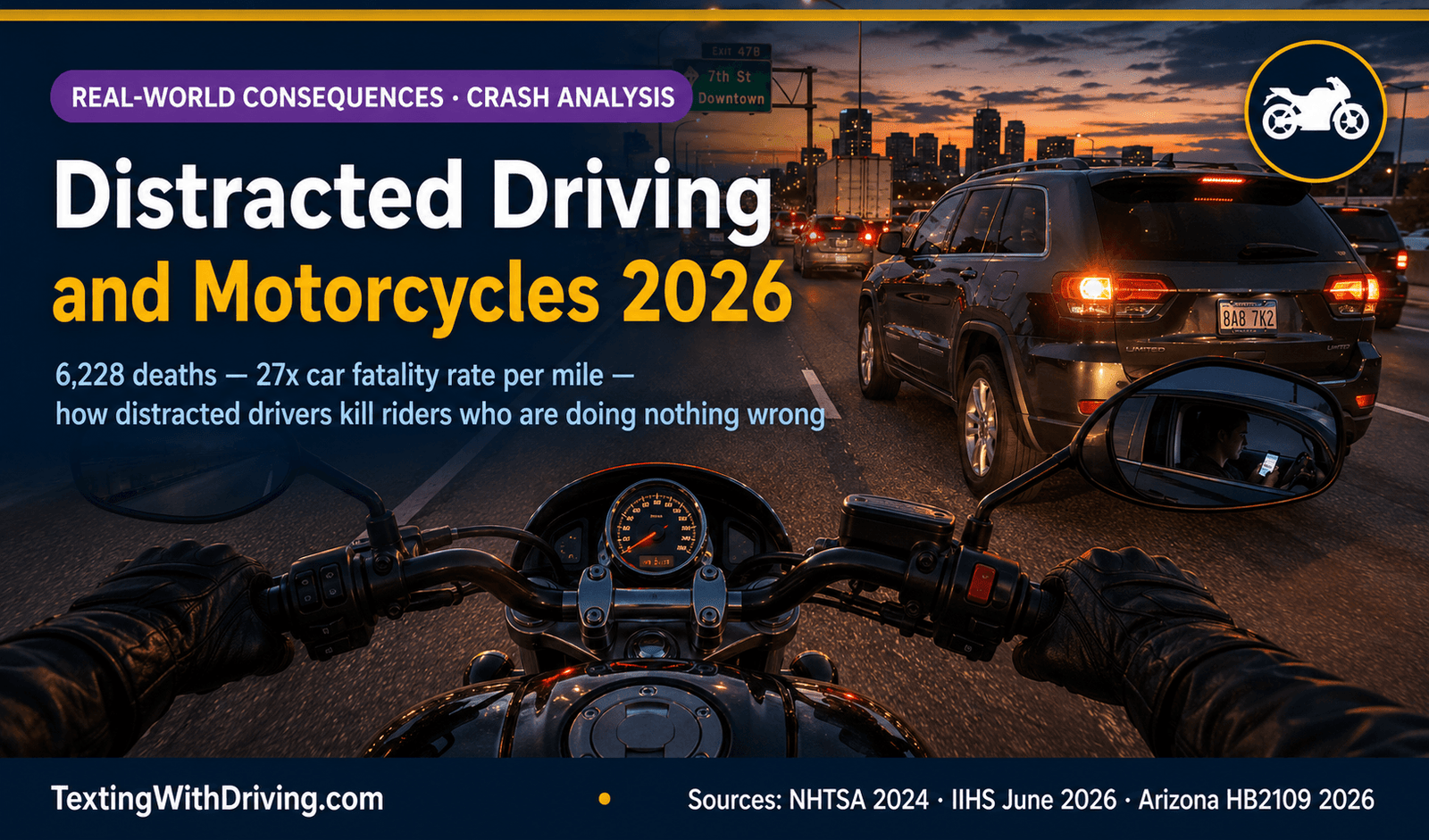
The numbers document this reality without ambiguity. A total of 6,228 motorcyclists were killed in crashes in 2024, about triple the number in 1997. Motorcyclists accounted for 16 percent of all crash deaths in 2024. The federal government estimates that per mile traveled in 2024, the number of deaths on motorcycles was almost 27 times the number in cars.
27 times. Per mile traveled. A motorcyclist covering the same road miles as a car driver faces 27 times the per-mile fatality risk. And a meaningful, documented share of that risk comes not from anything the rider does, but from what the other driver fails to do — specifically, fails to see.
Many motorcycle accidents occur because drivers of other vehicles fail to detect the presence of a motorcycle, particularly when turning or changing lanes. The most common statement from car and truck drivers after a crash that kills or injures a motorcyclist is “I didn’t see the motorcycle.” Distracted driving — the behavior that takes a driver’s attention off the road and specifically reduces the likelihood that a smaller, narrower vehicle will register in their visual field — is the behavior that most directly produces these failure-to-detect crashes.
This guide covers the complete distracted driving and motorcycles 2026 picture: the death and injury data, the specific crash types where distraction-caused visibility failures kill riders, why motorcycles are specifically vulnerable to the cognitive and visual impairment that phone use produces, what Arizona’s first legislative response specifically targeting motorcycle-distraction crashes means, and what both riders and drivers need to do to reduce the deadly risk this combination creates.
The 2024 Death Count: The Most Alarming Numbers in This Series
The distracted driving and motorcycles 2026 death data is the most alarming of any category covered in this article series.
A total of 6,228 motorcyclists were killed in crashes in 2024, about triple the number in 1997 and 23 percent higher than in 2019. This is a slight decline from the 2023 figure, the highest number of motorcyclist crash deaths in a single year since the National Highway Traffic Safety Administration began collecting fatal motor vehicle crash data in 1975. IIHS-HLDI
6,228 deaths in a single year. Triple the 1997 count. The trajectory of motorcyclist fatalities has moved consistently upward over the past quarter century, driven by the combination of increasing motorcycle registrations, aging infrastructure, and the specific distracted driving crisis that has intensified since the smartphone era began.
The federal government estimates that per mile traveled in 2024, the number of deaths on motorcycles was almost 27 times the number in cars. IIHS-HLDI
27 times. This is not 27 percent more dangerous. It is 27 times more likely to produce a death per mile traveled. A motorcyclist who covers 10,000 miles in a year faces the same statistical fatality exposure as a car driver who covers 270,000 miles. The gap between motorcycle and car safety is categorical, not marginal.
In 2024, there were 6,228 motorcyclists killed — 16 percent of all traffic fatalities. NHTSA data show that this is one of the highest number of motorcyclists killed since at least 1975. NHTSA
16 percent of all traffic fatalities from a mode of transportation that represents a small fraction of registered vehicles and vehicle miles traveled. Motorcyclists are disproportionately over-represented in traffic deaths by every available metric.
Why Distracted Drivers Kill Motorcyclists: The Visibility Science
The connection between distracted driving and motorcycles 2026 is not simply that distracted crashes are bad for all road users. It is that the specific impairment produced by phone distraction — the reduction of attentional capacity, the narrowing of the visual field, the slowing of hazard detection — is disproportionately lethal for motorcyclists compared to any other road user category.
Many motorcycle accidents occur because drivers of other vehicles fail to detect the presence of a motorcycle, particularly when turning or changing lanes. Auto Insurance
The failure-to-detect crash is the most common and most deadly crash type involving a motorcyclist and another vehicle. It occurs when a car or truck driver looks at the traffic environment and does not register the presence of a motorcycle that is objectively within their visual field.
Research in attention and visual processing explains this phenomenon through two mechanisms that distracted driving specifically compounds.
The inattentional blindness mechanism. Inattentional blindness is the documented phenomenon where a driver who is cognitively loaded — focused on a task other than driving — fails to consciously register objects that are visually present but not the focus of attention. The gorilla experiment — where subjects counting basketball passes fail to see a person in a gorilla costume walking through the frame — demonstrates inattentional blindness under cognitive load. A driver who is cognitively loaded by a phone conversation, a text message, or an app interaction while driving is experiencing exactly this phenomenon. The motorcycle is in their visual field. They do not see it. Not because it is invisible but because their cognitive system is prioritizing the phone task over environmental monitoring.
The size-based attention allocation mechanism. The human visual system allocates attention proportionally to the size of objects in the visual field under conditions of limited attentional capacity. A car, a truck, a bus — large objects — compete effectively for attentional resources even in a cognitively loaded driver. A motorcycle — a narrow, compact object that occupies a small fraction of the visual field — competes poorly for the same limited attentional resources. A driver with full attentional capacity will see the motorcycle. A driver whose attentional capacity is reduced by phone distraction will see the cars and trucks that compete successfully for their remaining attention while the motorcycle goes unregistered.
The combination of these two mechanisms means that exactly when a driver’s attentional capacity is most reduced — during active phone use — the road user most dependent on attentional surplus for detection is the motorcyclist. Distracted driving is not equally dangerous for all road users. It is disproportionately lethal for the road users who require the most attentional capacity to detect.
The Left-Turn Crash: The Most Lethal Specific Scenario
The specific crash type where distracted driving and motorcycles 2026 produces the most deaths is the left-turn crash — the scenario where a vehicle turns left across the path of an oncoming motorcycle.
The left-turn crash is the most common and deadliest type of motorcycle accident involving another vehicle. It often occurs when cars make left turns at intersections. In these crashes, the car or truck driver is typically at fault. They either do not see the motorcycle or misjudge its speed.
The left-turn crash scenario unfolds in a specific sequence: the car driver approaches an intersection with a left turn to make, scans traffic for an adequate gap, begins the turn, and strikes the oncoming motorcycle that was in the lane they turned across.
Every element of this sequence is compromised by phone distraction:
The traffic scan. A distracted driver’s traffic scan at the intersection is less thorough, covers a narrower field of view, and processes fewer objects than a fully attentive driver’s scan. The motorcycle in the oncoming lane — which a fully attentive driver would see and register as a reason not to initiate the turn — may not be detected in the distracted driver’s compromised scan.
The gap judgment. Even when a distracted driver does detect the motorcycle, their impaired reaction time and processing speed may produce a gap judgment that underestimates the motorcycle’s closing speed. A motorcycle that appears to be four seconds away under attentive assessment may be two seconds away in the distracted driver’s compromised perception — leading to an initiated turn that the motorcycle cannot avoid.
The reaction to an initiated collision. Once a distracted driver has begun a left turn and the motorcycle enters their visual field at close range, the reaction time available for evasive action is measured in fractions of a second. The reaction time impairment that phone use creates — documented at 35 percent in the Transport Research Laboratory study we cover in our distracted driving vs drunk driving 2026 article — may mean the difference between a successful evasive steer and a collision.
The left-turn crash at intersections is precisely the scenario that Arizona HB2109’s motorcycle surcharge targets. Arizona’s year-round riding environment, its high intersection complexity in Phoenix and Tucson, and the state’s documented motorcycle crash data all contributed to the legislature’s decision to add a specific financial consequence for distracted driving violations that involve motorcycle collisions.
Arizona HB2109: The First State to Specifically Target Motorcycle-Distraction Crashes
The most significant recent legislative development in distracted driving and motorcycles 2026 is Arizona’s House Bill 2109, signed by Governor Katie Hobbs on June 4, 2026, which established the first state-specific financial surcharge for distracted driving violations involving motorcycle collisions.
As we documented in our Arizona distracted driving law article, HB2109 raised the maximum civil penalty for repeat distracted driving violations from $250 to $400 and established a new $150 surcharge specifically for violations involving motorcycle collisions.
The $150 motorcycle surcharge is a direct legislative acknowledgment that distracted driving’s interaction with motorcycle safety creates a specific harm category that deserves specific financial deterrence beyond the standard distracted driving penalty. When a distracted driver’s phone use causes or contributes to a crash that injures or kills a motorcyclist, Arizona’s law now assigns an additional $150 financial consequence that does not apply to crashes involving only enclosed vehicle occupants.
The motorcycle surcharge provision was driven by Arizona’s specific road safety data showing the intersection of distracted driving violations and motorcycle crash incidents on Arizona’s year-round riding corridors. Arizona’s warm climate keeps motorcyclists on the road throughout the year — unlike northern states where riding season is limited — creating a persistent year-round intersection of distracted drivers and motorcycle riders that the standard distracted driving penalty structure was not specifically addressing.
The Weekend Concentration: When Motorcycle Deaths Peak
The distracted driving and motorcycles 2026 risk is not uniformly distributed across the week or the day. According to IIHS data from 2023, 47 percent of motorcycle fatalities occurred on the weekends, defined as the hours between 6 PM on Friday and 6 AM on Monday.
47 percent of motorcycle deaths in the 60-hour weekend window. The weekend motorcycle fatality concentration reflects several converging factors:
Recreational riding versus commuting. Weekend riding is primarily recreational — longer distances, unfamiliar roads, higher speeds on rural highways and scenic routes. Recreational riding involves less habitual route familiarity and potentially higher speeds than weekday commute riding.
Alcohol involvement. In 2023, 41 percent of motorcycle riders who died in single-vehicle crashes had a blood alcohol concentration of 0.08 or higher, meaning they were alcohol-impaired. Weekend social events produce the same alcohol-driving risk pattern for motorcyclists as for car drivers — but with a dramatically higher per-mile fatality rate that makes alcohol impairment especially lethal on a motorcycle.
Distraction from other drivers. Weekend road traffic includes a higher proportion of recreational drivers — vacationers, day-trippers, families on outings — who may be using phones for navigation, social coordination, and photography at higher rates than weekday commuters. The weekend concentration of recreational distracted driving intersects with the weekend concentration of recreational motorcycle riding.
Nighttime riding. The weekend window (6 PM Friday to 6 AM Monday) specifically captures evening and nighttime hours. While only 39 percent of motorcycle fatalities occurred in the dark overall, nighttime riding creates reduced visibility conditions that amplify the failure-to-detect risk that distraction creates during daylight.
Florida and Texas: The Highest Motorcycle Death States
The distracted driving and motorcycles 2026 state-level picture shows specific concentration in the two largest states without comprehensive statewide hands-free laws.
Florida had the largest number of motorcycle fatalities in 2023, with 668 deaths. This number accounted for 11 percent of all motorcycle fatalities in the US that year. Texas had the second-most motorcycle fatalities — 598 — in 2023, accounting for 9 percent of motorcycle fatalities nationwide.
Florida and Texas together produce approximately 20 percent of all US motorcycle fatalities while having two of the least restrictive distracted driving laws in the country. Florida prohibits handheld phone use only in school zones and work zones under its Statute § 316.306, leaving the majority of Florida road miles in a legally permissive environment for handheld calling. Texas prohibits texting but not handheld calls on most roads outside city ordinances.
The correlation between permissive distracted driving law and high motorcycle fatality counts in Florida and Texas reflects the general pattern we have documented throughout this series — but it is amplified by the motorcycle context because motorcyclists are the road users most vulnerable to the specific type of distraction-caused failure-to-detect crash that permissive phone-use laws enable.
As we documented in our Florida distracted driving law and Texas hands-free driving law articles, both states’ legislative failures to pass comprehensive statewide handheld bans are directly relevant to the motorcycle fatality counts their roads produce.
The Urban Concentration: Most Motorcycle Deaths Happen in Cities
The distracted driving and motorcycles 2026 geographic pattern shows that most motorcycle crashes do not happen on the rural highways where riders might expect the highest risk.
In 2023, most motorcycle deaths — 65 percent — occurred in urban settings. Only 35 percent occurred in rural settings.
65 percent of motorcycle deaths in urban settings. The urban concentration of motorcycle fatalities reflects the specific crash scenario most associated with distracted driving: the intersection-based crash. Urban environments have higher intersection density, higher traffic complexity, more vehicles per road mile, and more left-turn opportunities — all the conditions that create maximum exposure to the left-turn and intersection-based failure-to-detect crashes that distracted drivers produce.
The same dense urban environments where distracted drivers are most likely to be on their phones — navigating unfamiliar routes, coordinating parking locations, responding to work notifications during commutes — are the same environments where motorcyclists are most likely to encounter the intersection-based crash scenarios that kill them.
This urban concentration is directly relevant to the specific city-level crash data we have documented throughout this series. In Fairfax County’s Tysons corridor, Richmond’s downtown intersections, Virginia Beach’s resort strip, and every other high-density urban environment covered in our Virginia city guide articles, motorcyclists share the road with the same distracted drivers whose behavior we have documented in the crash data.
The Rider’s Perspective: What Motorcyclists Can Do
The distracted driving and motorcycles 2026 risk is not symmetric — motorcyclists bear the consequences of other drivers’ phone use without causing it. But there are specific riding strategies that reduce the exposure to distraction-caused crashes.
Ride conspicuously. Bright-colored riding gear, headlight modulators that produce a visible pulsing effect, and lane positioning that maximizes the rider’s presence in other drivers’ forward visual field all address the visibility deficit that makes motorcyclists vulnerable to inattentional blindness in distracted drivers. Riders should make themselves visible by wearing brightly colored and reflective gear and using their high beams during the day.
Intersection approach strategy. Approaching every intersection with the assumption that an oncoming vehicle may turn left without yielding is the most effective defensive strategy for the left-turn crash scenario. Covering the front brake, reducing speed at intersections, and positioning in the lane to maximize sightlines gives the rider the maximum available reaction time if a vehicle initiates an unexpected turn.
Lane positioning for driver attention. A motorcyclist who positions themselves in the center of their lane is visible in the car ahead’s rearview mirror and in the mirrors of vehicles in adjacent lanes. Riding in other vehicles’ blind spots — particularly next to the rear quarter of vehicles that are positioned to make lane changes — creates maximum failure-to-detect exposure.
Avoiding distracted driver indicators. The observable signs of a distracted driver — the gradual lane drift without signaling, the delayed response at signal changes, the erratic speed variation — are detectable before a crash occurs. A motorcyclist who observes these behaviors in surrounding traffic and creates distance between themselves and the suspected distracted vehicle is exercising the defensive riding that the imbalance of vulnerability requires.
The Driver’s Responsibility: What Car and Truck Drivers Must Do
The distracted driving and motorcycles 2026 risk reduction requires action primarily from car and truck drivers — because the failure-to-detect crash is primarily a consequence of driver inattention that has lethal consequences for the motorcyclist who did nothing wrong.
It’s especially important for drivers to understand the safety challenges faced by motorcyclists such as size and visibility, and motorcycle riding practices like downshifting and weaving to know how to anticipate and respond to them.
The specific driver behaviors that reduce motorcycle crash risk:
Phone-free driving eliminates the primary attention mechanism. A fully attentive driver will see a motorcycle in their visual field because motorcycles are objectively visible objects. The failure-to-detect crash happens when driver attention is reduced — primarily by phone use. Eliminating phone use while driving is the single most effective action a car or truck driver can take to protect motorcyclists sharing their road.
Mirror checks before every lane change. The standard mirror check before a lane change is effective for detecting cars and trucks. Motorcycles require an additional over-the-shoulder head check because they occupy a smaller visual signature in mirrors. Drivers who routinely add the head check to their lane-change sequence reduce the blind-spot failure-to-detect risk for motorcyclists.
Left-turn yielding with motorcycle attention. When making a left turn, actively scan specifically for motorcycles in the oncoming lane — not just for cars. The size-based attention allocation means that scanning for traffic will naturally register cars and trucks first. A specific secondary scan for motorcycles — checking whether the oncoming lane contains any smaller, narrower vehicles — addresses the specific gap in automatic traffic scanning that produces left-turn motorcycle crashes.
The Arizona HB2109 message. The $150 motorcycle collision surcharge for distracted driving violations in Arizona is the legislative expression of what the data establishes: when a distracted driver crashes into a motorcyclist, the consequence should be more severe than when they crash into an enclosed vehicle. The financial deterrent for the specific crash type that kills motorcyclists most frequently — the distraction-caused failure-to-detect — is now quantified in Arizona law. Other states are watching this provision’s effect on motorcycle crash rates.
What the Data Means for Every Driver on Every Road
The distracted driving and motorcycles 2026 risk picture asks every driver who touches their phone while driving to consider not just what happens to them if they crash, but what happens to the person they crash into.
A distracted driver who drifts into an adjacent lane and side-swipes another car produces a property damage crash and potentially a minor injury. The same distracted driver who drifts into an adjacent lane and strikes a motorcyclist produces a fatality — a person who was riding legally, safely, and in their own lane.
The 27-times-per-mile fatality risk for motorcyclists compared to car occupants is not primarily a motorcycle problem. It is a problem created by the 4,000-pound vehicles surrounding motorcyclists on every road — specifically by the decisions the drivers of those vehicles make about whether to put their phone down before they drive.
The 6,228 motorcyclists killed in 2024 are not statistics. They are riders who left for a commute, a weekend ride, or a trip to the store and did not come home. Many of them died because a driver of another vehicle chose to check their phone at exactly the wrong moment.
The phone in the back seat before every drive is worth more than any article in this series. For the motorcyclist sharing the road with that driver, it may be worth everything.
For the complete Virginia distracted driving law that applies on every Virginia road where motorcyclists ride, our Virginia distracted driving law covers Va. Code § 46.2-818.2 in full. For the Arizona law that now specifically addresses motorcycle-distraction crashes, our Arizona distracted driving law covers HB2109. For the technology setup that makes phone-free driving automatic, our hands-free while driving complete setup guide covers iPhone, Android, Bluetooth, and CarPlay.
Sources Used in This Article
All links verified working before publication.
IIHS: Motorcycles Research Area — 6,228 motorcyclists killed 2024, triple 1997 figure, 23% higher than 2019, 16% of all crash deaths, slight decline from 2023 record, August 2026
IIHS Fatality Facts 2024: Motorcycles and ATVs — 27 times car fatality rate per mile 2024, NHTSA 2026 citation, helmet effectiveness, June 2026
NHTSA: Motorcycle Safety — 6,228 motorcyclists killed 2024, 16% of all fatalities, share the road messaging, visibility guidance, August 2026
AutoInsurance.com: Motorcycle Accident Statistics 2026 — 47% weekend fatalities, 65% urban, 97% clear weather, Florida 668 deaths Texas 598 deaths 2023, 41% alcohol single-vehicle, lane splitting, failure to detect, August 2026
Easton Law Offices: Worst States for Motorcyclists 2026 — Distracted driver involvement in fatal motorcycle crashes tracked, 56% drivers don’t survive, 81,000 annual injuries, 25% fatality surge decade, January 2025
NHTSA: Distracted Driving in 2024 DOT HS 813 790 — 80% of distraction-affected fatalities were vehicle occupants including motorcyclists, 3,208 deaths 2024
The Zebra: Distracted Driving Statistics 2026 — 10% of driving time distracted, Transport Research Laboratory 35% reaction time reduction texting, January 2026
CMT: Distracted Driving Fell 8.6% in 2024 — Handheld call increases crash speeds 31%, behavioral data, telematics context
NHTSA: Distracted Driving — 3,208 deaths 2024, 537,000 distracted drivers at any daylight moment, national context
TextingWithDriving.com is professionally built and maintained to ensure accurate, accessible safety information reaches every driver who needs it. Website development and ongoing support is handled by Budgetic, a digital agency specializing in purpose-driven WordPress websites.

About Texting With Driving
TextingWithDriving.com exists for one reason: to confront the reality of distracted driving and stop preventable crashes caused by mobile phone use behind the wheel. Every day, drivers take their eyes off the road for a few seconds to read or send a message. Those few seconds are enough to cause life-altering consequences. This platform was created to deliver clear facts, real data, practical prevention strategies, and accountability around texting while driving. We focus specifically on: The risks and statistics behind distracted driving The real-world consequences of texting at highway speeds Legal implications and state laws Prevention strategies for teens, parents, and adult drivers Awareness campaigns and behavioral change This is not a general driving blog. It is a focused awareness initiative built around one critical issue: phone distraction behind the wheel. Our content is direct, research-driven, and practical. We prioritize accuracy over opinion and education over sensationalism. The goal is simple — reduce distracted driving incidents by increasing awareness and responsibility. If one article causes one driver to put their phone down, the mission is working. For inquiries or partnerships, contact: privacy@textingwithdriving.com
View all posts by Texting With Driving