

How Many People Die From Texting While Driving Each Year?

How Many People Die From Texting While Driving Each Year?
It is a question most people ask with a general sense of the answer already in mind. They know it is a lot. They know it is serious. But when you see the actual number, something shifts.
This article gives you the real data, from the sources that actually track it, verified and broken down so you understand not just how many people die but exactly who they are, what role phones play specifically, and why these numbers are almost certainly lower than the true death toll.
The Official Death Toll for 2024
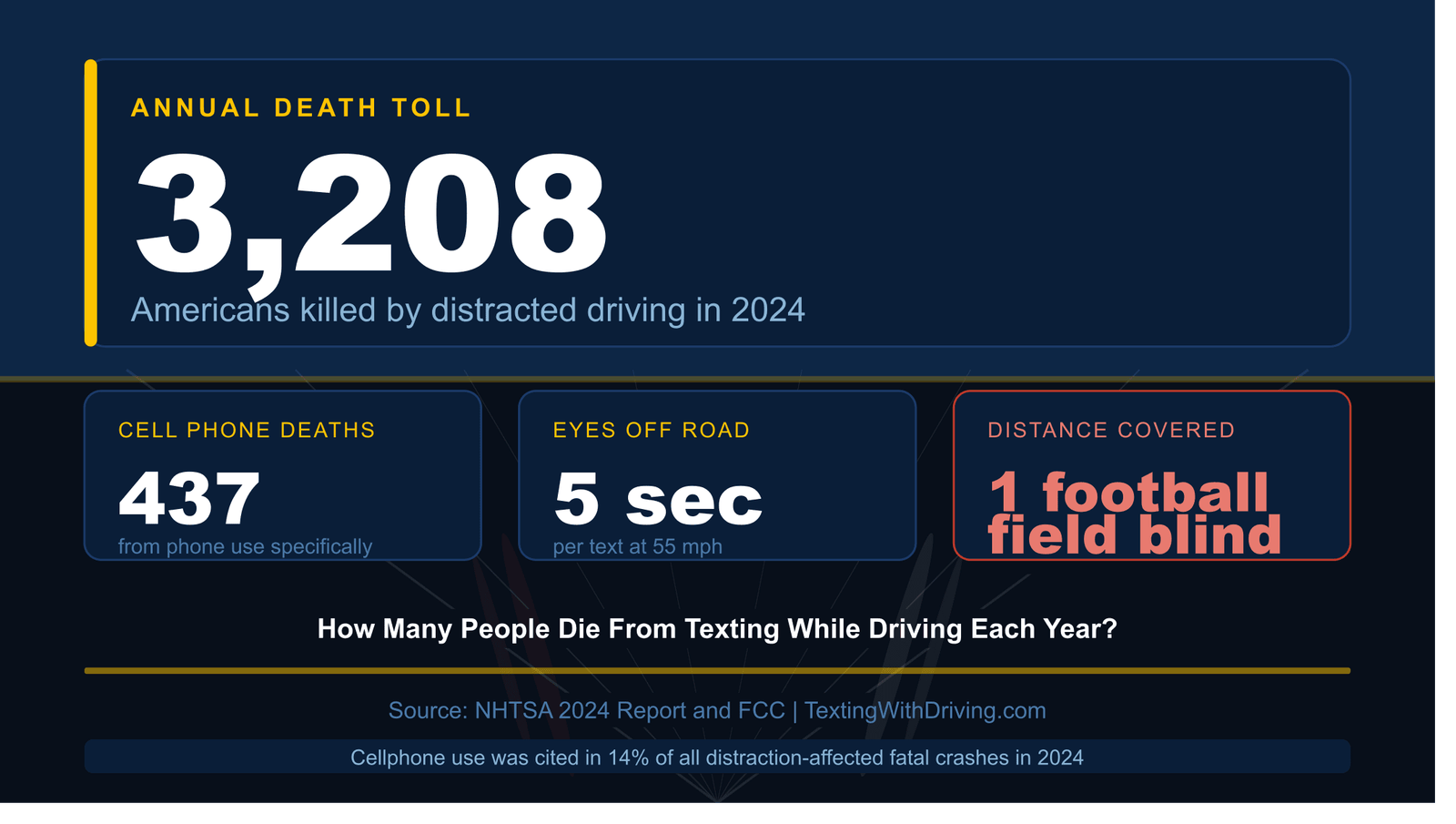
Distracted driving is dangerous, claiming 3,208 lives in 2024, according to the National Highway Traffic Safety Administration. Federal Motor Carrier Safety Administration
That is roughly nine people every single day. Every week of the year. Every holiday included.
But here is where the data gets more specific, and where many people are surprised. That 3,208 figure covers all distracted driving, which includes eating, adjusting the radio, talking to passengers, looking at billboards, and dozens of other activities behind the wheel. The number tied specifically to cell phone use is different.
In 2024, a total of 437 people died in crashes involving at least one driver who was engaged in cell phone-related activity, according to the FCC citing NHTSA data. Cell phone use was cited as the distraction in 14 percent of all distraction-affected fatal traffic crashes in 2024. World Population Review
So the direct cell phone death figure is 437. The broader distracted driving figure is 3,208. Both numbers are real, both matter, and understanding what each one actually measures will help you interpret any statistic you see on this topic.
Why 437 Is Almost Certainly Too Low
Here is where researchers and road safety advocates get frustrated with the official data.
The 437 figure for cell phone-specific deaths depends on what police officers write in crash reports at the scene. If a surviving driver denies phone use, if there are no witnesses, if the phone is not retrieved and analyzed, then cell phone distraction goes unrecorded. The crash still happened. The person still died. But the cause attributed to the data is something else.
NHTSA’s own economic and societal impact report suggested that rather than roughly 3,100 deaths per year, distracted driving fatalities were likely in excess of 10,000 per year when underreporting is accounted for. Accordingly, the percentage of traffic fatalities caused by distracted driving was likely closer to 29 percent rather than the reported 10 percent. GHSA
That is a striking gap. The reported figure and the likely actual figure could differ by a factor of three. This is not a claim that the NHTSA data is wrong. It is an acknowledgment of how difficult distraction is to document at a crash scene compared to something like blood alcohol, which can be measured directly.
The bottom line: every figure you read about texting while driving deaths is a minimum, not a complete count.
The Football Field Stat: What 5 Seconds Actually Means
Texting is the most alarming distraction. Sending or reading a text takes your eyes off the road for 5 seconds. At 55 mph, that is like driving the length of an entire football field with your eyes closed.
This is the statistic that road safety researchers cite most often, and for good reason. It converts an abstract danger into something physically imaginable.
Picture a full-size football field. End zone to end zone, 100 yards. Now imagine driving that entire distance at highway speed with your eyes shut. No braking. No steering adjustments. No awareness of what changed ahead of you in those five seconds.
That is what reading one text message does. Not a long distraction. Not scrolling through social media. Just reading one message.
At 65 mph, which is the posted limit on many US interstate highways, the distance covered in five seconds increases to approximately 477 feet. That is more than one and a half football fields of blind driving from a single glance at your phone.
Most crashes do not require five seconds of inattention to happen. A vehicle stopping suddenly ahead, a child stepping into the road, a tire blowing out on the car in front of you: these events unfold in a fraction of a second. Five seconds of blindness is more than enough time to have no chance of reacting.
Who Is Dying: The Age Breakdown
The data on who is most affected by distracted driving fatalities reveals patterns that matter for how we approach prevention.
The highest percentage of drivers using cell phones in fatal crashes were in the 25 to 34 age group. Twenty-seven percent of drivers involved in these crashes were using cell phones in some way. World Population Review
That finding surprises a lot of people. Teenagers are the most discussed demographic in distracted driving conversations, but young adults in their mid-twenties and early thirties are responsible for the largest share of cell phone-related fatal crashes. This is partly because there are more drivers in this age group on the road than in the teen cohort, but it also reflects something important about behavior: the phone habits formed in young adulthood do not automatically improve with age.
Thirteen percent of 15 to 20-year-olds involved in fatal crashes in 2024 were reportedly driving while distracted, and 10 percent of the total fatalities in that age group involved drivers using cell phones. World Population Review
Teen drivers carry a different kind of risk profile. They have less experience reading road conditions, less practiced reaction to emergencies, and less developed impulse control around the phone. The combination of inexperience and phone distraction makes teen crashes particularly severe when they happen.
Drivers aged 21 to 24 represent 10 percent of all distracted drivers and 12 percent of those using cell phones at the time of a fatal crash. Drivers between 25 and 34 are responsible for 28 percent of distraction-related accidents, the highest of any age group. AgencyAnalytics
The Crash Count Beyond Deaths
Deaths are the most visible measurement but they represent only the sharpest edge of a much larger problem.
Using a phone while driving causes 1.6 million crashes every year, according to the National Safety Council.
Of those 1.6 million crashes, the vast majority do not result in death. But they result in injuries, in permanent disability, in property damage, in trauma, and in financial consequences that can follow families for years. The death toll is the number that makes headlines. The crash count is what tells you how often this actually happens on the roads you drive every day.
From 2011 to 2021, crashes involving cell phone use on average accounted for about 13 percent of fatal crashes involving distractions yearly, according to the National Safety Council.
That percentage has remained stubbornly consistent across more than a decade, which tells researchers something important. Awareness campaigns, legislation, and technology improvements have not meaningfully reduced the share of distraction crashes attributable to phones. The phone remains the dominant source of fatal distraction despite everything that has been done to address it.
What Drivers Actually Admit To
The death statistics measure outcomes. Survey data measures behavior. And the behavior data is genuinely alarming.
In early 2024, The Zebra conducted a national survey and found that 47 percent of drivers admitted to sending or reading a text message while driving. This was a sharp 31 percent increase from a similar survey three years earlier.
Nearly half of US drivers admitting to texting while driving. Not occasionally. Not once. As a behavior they engage in. And that number went up significantly between 2021 and 2024, not down.
Generational differences play a role. In 2024, 55 percent of younger drivers including Gen Z and Millennials reported texting while driving, compared to 33 percent of Baby Boomers.
But even 33 percent of Boomers is a striking figure. This is not a problem concentrated in any one generation. It is a behavior pattern that spans every age group of American drivers, which is part of why the death toll remains so consistent year after year despite widespread awareness of the risk.
The Underreported Demographic: Pedestrians and Cyclists
One aspect of texting while driving deaths that rarely gets discussed is what happens to people who are not in vehicles.
Distracted driving significantly affects vulnerable road users, with 621 pedestrians, cyclists, and other non-occupants killed in 2022. This highlights the broader impact of distracted driving beyond just vehicle occupants.
When a driver looks down at their phone, it is not only the people in their vehicle at risk. It is the person crossing at the crosswalk. It is the cyclist in the bike lane. It is the runner on the shoulder of the road. Distracted driving deaths are not an internal-to-vehicle problem. They affect every person who shares the road with distracted drivers.
How Much Has Awareness Actually Helped?
This is the honest question. Distracted driving has been a public health priority for more than fifteen years. There have been campaigns, laws, technology changes, and constant media attention. What has that actually produced?
The short answer is that the raw death toll has improved from its peak but has not declined anywhere near the pace researchers hoped for.
Between 2014 and 2023, approximately 32,000 people lost their lives in distracted driving accidents in the United States.
That is more than the total US combat deaths in the Vietnam War, spread across a single decade, caused entirely by preventable behavior on public roads. And unlike many categories of traffic death, the behavior driving it is becoming more common, not less, as the survey data above shows.
The NHTSA’s most recent public campaign, “Put the Phone Away or Pay,” launched in April 2025, reflects a shift in strategy toward enforcement-focused messaging rather than purely awareness-based approaches. The research increasingly shows that perceived risk of being caught matters more than knowledge of danger when it comes to actual behavior change.
For the current campaign resources and how to get involved, you can visit the NHTSA distracted driving campaign page.
What the Data Should Change About How You Drive
The statistics in this article represent a problem that is entirely traceable to a single repeated decision: reaching for a phone while operating a vehicle.
The FCC puts it plainly on their distracted driving resource page: no call, text, or notification is worth a life.
The research on what actually changes behavior points to a few things that work.
Putting your phone physically in the back seat before you start driving removes the temptation before it arrives rather than requiring willpower in the moment. Activating the built-in driving mode on your phone, whether that is Driving Focus on iPhone or a similar feature on Android, silences notifications automatically so there is nothing arriving to tempt you in the first place. And having a direct, specific conversation with teen drivers in your household about exactly what to do when a notification arrives while driving, not a general warning but a specific plan, is one of the highest-impact things a parent can do according to AAA Foundation research.
None of these are complicated. All of them are free. The data makes it very clear that the alternative is not worth it.
For a full breakdown of all the distracted driving numbers including injuries, state-by-state data, and economic costs, see our distracted driving statistics 2026 overview. For the legal picture of what is and is not allowed in your state, see our guide to texting while driving laws by state 2026.
Sources Used in This Article
All links verified working before publication.
NHTSA Distracted Driving — National Highway Traffic Safety Administration
FCC: The Dangers of Distracted Driving — Federal Communications Commission
End Distracted Driving: Research and Statistics — EndDD.org
The Zebra: Texting and Driving Statistics 2026
AAA Foundation: Distracted Driving Among Newly Licensed Teen Drivers
GHSA Distracted Driving Laws and Data — Governors Highway Safety Association
NSC Injury Facts: Distracted Driving — National Safety Council
TextingWithDriving.com is professionally built and maintained to ensure accurate, accessible safety information reaches every driver who needs it. Website development and ongoing support is handled by Budgetic, a digital agency specializing in purpose-driven WordPress websites.

About Texting With Driving
TextingWithDriving.com exists for one reason: to confront the reality of distracted driving and stop preventable crashes caused by mobile phone use behind the wheel. Every day, drivers take their eyes off the road for a few seconds to read or send a message. Those few seconds are enough to cause life-altering consequences. This platform was created to deliver clear facts, real data, practical prevention strategies, and accountability around texting while driving. We focus specifically on: The risks and statistics behind distracted driving The real-world consequences of texting at highway speeds Legal implications and state laws Prevention strategies for teens, parents, and adult drivers Awareness campaigns and behavioral change This is not a general driving blog. It is a focused awareness initiative built around one critical issue: phone distraction behind the wheel. Our content is direct, research-driven, and practical. We prioritize accuracy over opinion and education over sensationalism. The goal is simple — reduce distracted driving incidents by increasing awareness and responsibility. If one article causes one driver to put their phone down, the mission is working. For inquiries or partnerships, contact: privacy@textingwithdriving.com
View all posts by Texting With Driving