

Nevada Distracted Driving Law 2026: Las Vegas Strip Rules and What Tourists Must Know

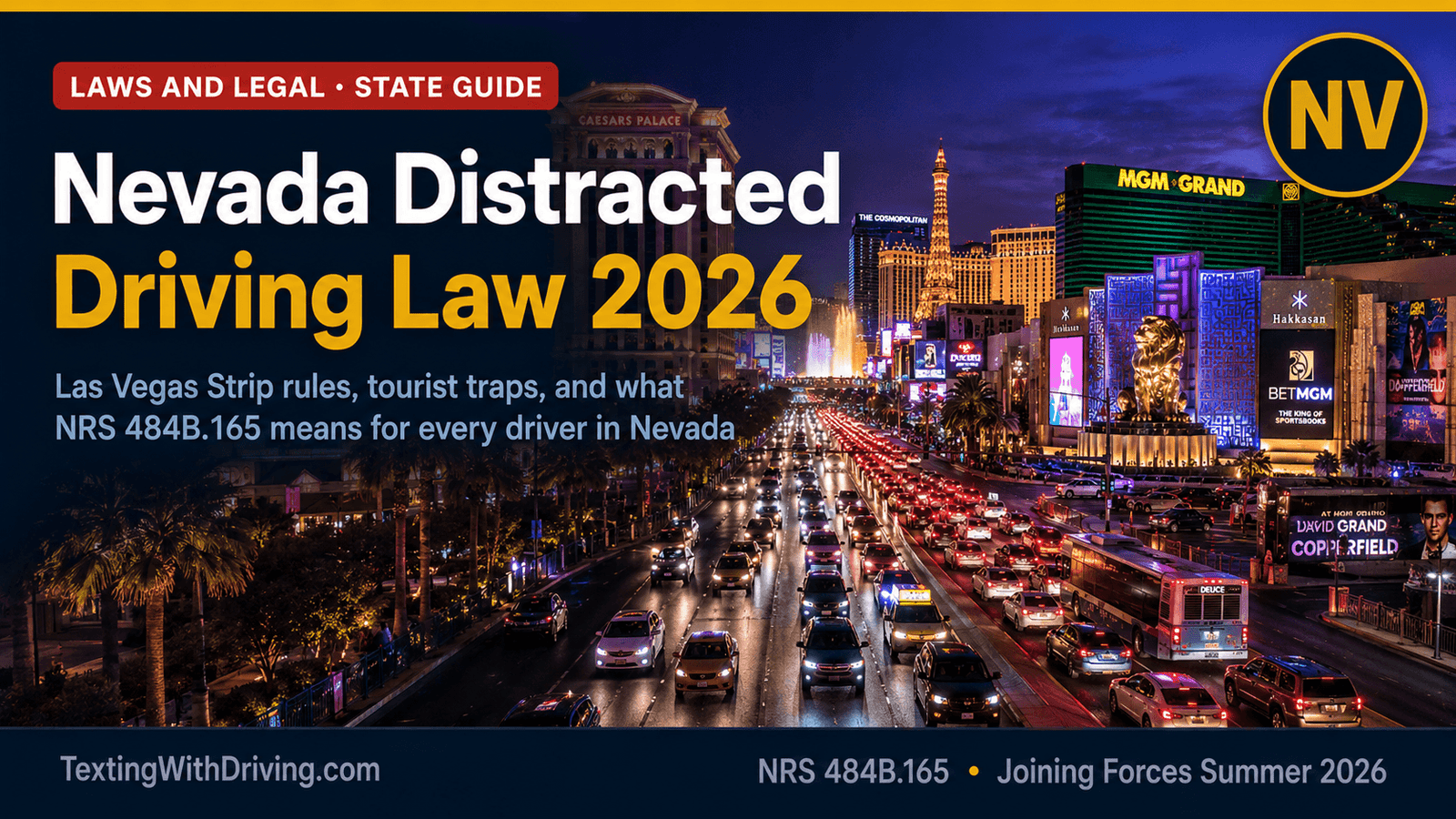
Nevada Distracted Driving Law 2026: Las Vegas Strip Rules and What Tourists Must Know
The Nevada distracted driving law operates through a single comprehensive statute — Nevada Revised Statutes § 484B.165 — that has been in effect for years and yet continues to surprise visitors who arrive in Las Vegas expecting that what is legal in their home state is legal on Nevada roads. It is not always. And in summer 2026, the annual Joining Forces enforcement campaign means increased patrols specifically targeting distracted driving across the Las Vegas metro area and statewide.
The Nevada distracted driving law under NRS 484B.165 prohibits holding any handheld wireless communication device while operating a motor vehicle on a Nevada public road — including while stopped at a red light. This last point directly contradicts a persistent myth that red lights create a legal window for phone use in Nevada. They do not. The Nevada Globe confirmed in May 2026: the viral claim that you can be fined for holding a phone at a red light is 100% accurate under current Nevada law. In Nevada, you are operating a motor vehicle as long as you are on a public roadway — this includes being stopped at a red light, a stop sign, or even in traffic.
This guide covers everything every driver in Nevada needs to know in 2026: what NRS 484B.165 prohibits and permits, the fine structure including the seven-year lookback window, how enforcement works on the Strip and beyond, what happened with the viral June 2026 new-law claim, and the specific tourist considerations that make Nevada’s law different from most out-of-state visitors’ expectations.
What the Nevada Distracted Driving Law Prohibits
The Nevada distracted driving law under NRS 484B.165 makes it illegal for a driver to physically handle any electronic device while driving, including while stopped at a red light.
The statute covers the full range of handheld device interactions:
Holding a phone to make or receive a voice call. Drivers also cannot hold the phone to their ear during a voice call unless they’re using a hands-free setup, such as a Bluetooth earpiece or mounted speaker. This is one of the most important distinctions for tourists from states like Texas or Florida, where holding a phone for a voice call on standard roads is currently legal. In Nevada it is not.
Manually entering text of any kind. The law prohibits anyone from manually entering text into a cell phone. Texting, emailing, messaging, social media typing — any manual text entry while driving is prohibited.
Sending data, searching the internet, or engaging in any non-voice communication. Beyond voice calls and texts, the statute covers internet browsing, social media scrolling, email access, and any other data use while the device is being physically held or manipulated.
Scrolling social media. Whether you’re checking Facebook, Instagram, or TikTok while the car is moving or stopped at a light, the Nevada distracted driving law applies.
Recording video while driving. Recording or broadcasting video while operating a vehicle is prohibited under the broader scope of the statute’s device manipulation prohibition.
The body-support standard applies in Nevada as in most comprehensive hands-free states: any use of any part of the body to hold or support the device while driving creates a violation.
The Red Light Rule: The Fact That Surprises Most Drivers
The most consistently misunderstood element of the Nevada distracted driving law is the red light provision. A significant number of drivers — including many Las Vegas residents — believe that a stopped vehicle at a red light creates a legal window for phone use. This belief is incorrect.
In Nevada, you are operating a motor vehicle as long as you are on a public roadway — this includes being stopped at a red light, a stop sign, or in traffic. Officers are specifically trained to watch for the tell-tale signs of phone use at intersections: the downward head tilt, the glow of a screen in a lap, the delayed response when the light turns green.
This rule applies equally on the Las Vegas Strip, at suburban Clark County intersections, at rural Nevada highway stops, and at any other public road in the state. The only exception to the operating standard is when the vehicle is lawfully parked completely off the roadway, not merely stopped in a traffic queue.
A viral claim circulated in Nevada in May and June 2026 about a new cell phone law taking effect on June 5, 2026. The Nevada Globe investigated and confirmed there is no new statewide traffic law taking effect on June 5, 2026. The existing NRS 484B.165 has been in effect for years. The confusion arose from the anniversary of an unrelated school phone ban signed on June 5, 2025. What the fact-check did confirm: the red light rule under existing Nevada law is real and actively enforced.
The Fine Structure and Seven-Year Lookback
The Nevada distracted driving law fine structure uses a seven-year lookback window rather than the shorter two or three-year windows used in most other states, making the escalation pathway more consequential for repeat offenders.
First offense: $50 civil penalty. This first offense is not considered a moving violation under Nevada law, which means it generally does not add demerit points to the license and may not trigger an insurance rate increase at the same level as a moving violation citation.
Second offense within seven years: $100 fine and 4 demerit points on the driver’s license.
Third offense within seven years: $250 fine and 4 demerit points per violation.
Work zone or school zone violations: Fines may be doubled in work zones and school zones, meaning a first offense in an active work zone could reach $100 instead of $50.
The seven-year lookback is the critical compliance detail that most Nevada drivers underestimate. A driver who receives a first offense in 2023 and a second in 2028 is still within the seven-year window — the second offense costs $100 and adds 4 license points rather than resetting to first-offense treatment. In most other states with two or three-year lookback windows, the same 5-year gap would result in the 2028 offense being treated as a first offense. In Nevada it is not.
Nevada uses a point system to track driving violations. If you collect 12 or more points within a 12-month period, the DMV may suspend your license for 6 months. The 4 demerit points added on a second or subsequent Nevada distracted driving law violation are meaningful within this framework — three subsequent violations within a 12-month period would produce 12 points from the distracted driving violations alone.
Court costs: Court costs can double the effective cost of the ticket. A $50 base fine may become $100 to $120 with court costs. A $250 fine may become $400 to $500 with full court costs applied.
What Remains Legal Under the Nevada Distracted Driving Law
The Nevada distracted driving law permits the following:
Hands-free voice calls. It is legal to use voice-activated technology such as Bluetooth to operate a cell phone’s text-messaging, internet and GPS capabilities hands-free. Bluetooth earpieces, speakerphone on a mounted device, and vehicle-integrated systems are all fully legal.
Single-touch call activation. The law does not prohibit touching the phone to activate or deactivate a feature, such as accepting a call, but the device must be hands-free while the driver is talking. A single tap to accept or end a call on a mounted device falls within the permitted single-touch standard.
GPS navigation pre-set before driving. Using GPS navigation on your cell phone is ok as long as the directions were programmed into your phone before you began driving. In order for this to be considered legal, the driver would have to enter all information regarding the address while the car is parked. A phone mounted and displaying navigation with the destination entered before the car moved is fully compliant. Entering a destination or adjusting the route while moving is not.
Voice-activated text and internet. If you are driving and using your Bluetooth to utilize your phone’s text messaging capability, then you are ok. The same goes for the internet and GPS via Bluetooth. Voice commands that operate messaging or internet functions without manual device contact are permitted.
Emergency calls. Communication with emergency services during a genuine emergency is permitted regardless of hands-free status.
Emergency responders on duty. Law enforcement officers, firefighters, EMTs, and emergency management personnel are exempt while acting in their official emergency response capacity.
The Las Vegas Strip: Why Nevada’s Law Has Specific Relevance for Tourists
The Las Vegas Strip is the most-visited tourist driving corridor in the United States, with millions of out-of-state visitors driving rental cars on Las Vegas Boulevard and the surrounding Clark County road network every year. The combination of unfamiliar roads, casino resort entrance complexity, GPS navigation demands, and social coordination pressure from group travel creates the exact conditions that produce maximum phone-while-driving temptation.
Las Vegas is a high-risk environment. Our roads are a mix of local commuters, distracted tourists, and rideshare drivers navigating complex resort entrances, according to legal professionals who work with Las Vegas crash cases.
The specific challenge for Strip tourists:
Rental car unfamiliarity. A driver who does not know the Bluetooth pairing process for their rental car’s audio system may default to holding their phone for navigation, which is a violation the moment the car is on a Nevada public road.
Resort entrance complexity. Many Strip resort entrances require specific turns, lane choices, and navigation decisions that are not obvious to first-time visitors. The temptation to reach for the phone at exactly the moment the navigation is needed is highest in these complex entrance environments.
Rideshare pickup confusion. Las Vegas is one of the highest-rideshare-volume cities in the country, with Uber and Lyft pickup zones that vary by resort and change regularly. Riders who text their driver, check the app, or photograph the pickup location while the vehicle is moving are within the Nevada distracted driving law‘s scope regardless of whether they are in a rental car or their own vehicle.
Social coordination pressure. Group travel in Las Vegas involves constant social coordination — where to meet, what show, which restaurant, which casino floor. The group texts and coordination messages arrive continuously throughout the trip. Every message that arrives while a driver is on the road creates exactly the notification pull that the law exists to address.
Out-of-state law assumptions. Visitors from Texas, Florida, Tennessee, and other states without comprehensive statewide handheld bans may assume that the driving rules from home apply in Nevada. They do not. A Texas driver who legally holds their phone for a call on an Austin highway is violating NRS 484B.165 the moment they pick up the phone in a moving rental car on Las Vegas Boulevard.
The practical guidance for every tourist driving in Las Vegas: set the navigation before leaving the hotel or resort, pair Bluetooth before leaving the parking garage, put the phone in the center console or back seat rather than the cupholder where it creates temptation at every intersection, and use the hotel concierge or Uber app before getting in the car rather than navigating with the phone in hand.
The Joining Forces Summer 2026 Enforcement Campaign
Nevada law enforcement agencies conduct their annual Joining Forces campaign each summer, with extra patrols funded specifically to ticket distracted drivers. The Nevada Globe confirmed in May 2026 that early June typically marks the start of a zero-tolerance wave where extra patrols are funded specifically to ticket distracted drivers, and that this campaign was active for summer 2026.
The Joining Forces enforcement model deploys funded overtime patrol resources specifically directed at distracted driving detection. Officers are trained to spot the tells of a distracted driver during the campaign: the glow and the glance (repeatedly looking down at a lap or center console), lane deviation (drifting across markers without signaling), and delayed kinetic response (failing to brake when traffic slows, leading to high-impact rear-end collisions).
The Las Vegas metro area, which includes the Strip corridor, Henderson, North Las Vegas, and the broader Clark County road network, is one of the primary Joining Forces deployment zones because of the concentration of rental vehicle traffic and the documented pedestrian crash risk around the high-density resort corridor.
The summer timing of the Joining Forces campaign coincides with the highest tourist traffic volume of the year and with AAA’s 100 Deadliest Days window that runs from Memorial Day through Labor Day. As we documented in our summer road trip safety guide, the summer period carries elevated crash risk nationally, and the enforcement intensity of campaigns like Joining Forces directly addresses the behavioral challenge that the elevated risk environment creates.
Nevada’s Crash Data: The Context for 2026 Enforcement
Nevada’s traffic safety situation in 2026 reflects both its best-state performance in distraction-as-percentage-of-crashes and its continuing absolute crash toll.
In 2025, Nevada saw over 380 traffic fatalities, with distracted driving remaining a top contributing factor, according to Lasso Injury Law’s Las Vegas enforcement analysis.
As we documented in our distracted driving statistics by state 2026 article, Nevada ranks among the best-performing states nationally in the percentage of fatal crashes involving distraction — placing third in the national best-states ranking. This performance stands in sharp contrast to Nevada’s appearance in our Juneteenth weekend driving safety article as one of six states where Juneteenth is the most dangerous holiday of the entire year.
This apparent contradiction resolves the same way Minnesota’s best-state ranking coexists with its 5,426 April citations: Nevada’s low percentage of distraction-affected fatal crashes as a share of total crashes reflects the effectiveness of the handheld law and its enforcement. But the absolute toll — 380-plus fatalities in 2025 — reflects a large driving population with millions of additional tourist miles that are not present in less-visited states.
CDL Driver Rules: The Federal Layer in Nevada
Commercial drivers operating commercial vehicles in Nevada face the FMCSA federal framework on top of the state law provisions. Federal authorities consider it a serious offense to text while driving for CDL holders. If a CDL commits two of these types of offenses within three years, their commercial license could be suspended for sixty days. A 120-day suspension would occur if a third violation happens. CDL holders must also report their violation to their employer within thirty days of being ticketed.
The commercial driver rules apply to the significant truck and commercial vehicle traffic on I-15, US-95, and US-93 that serves as Nevada’s major freight corridors. As we covered in our FMCSA commercial driver distracted driving rules article, the federal framework applies in Nevada simultaneously with NRS 484B.165, and the stricter standard governs in any overlap.
Civil Liability: Phone Records as Evidence in Las Vegas Crash Cases
The Nevada distracted driving law violation carries significant civil litigation consequences beyond the traffic citation, particularly in the Las Vegas metro area where crash-related personal injury claims are frequent.
If a driver causes a crash while texting, they may face charges beyond a simple ticket. In serious cases, texting while driving may lead to charges like reckless driving or even vehicular manslaughter. Evidence of distracted driving can significantly strengthen a victim’s case and demonstrate that the at-fault driver was not exercising reasonable care.
Las Vegas law firms specifically note that digital forensics matching cellphone timestamps with the exact moment of impact has become a standard practice in distracted driving crash cases in Nevada. Phone records can show not just message delivery timestamps but app activity, data usage spikes, and location data that places the driver’s attention on the device at the precise moment relevant to the crash.
What Every Nevada Driver and Visitor Should Do Right Now
The Nevada distracted driving law requires a simple behavioral standard that eliminates both the legal risk and the safety risk simultaneously: no phone in hand, no typing, no scrolling, no video, for any reason, on any Nevada public road, including at red lights.
For residents: The seven-year lookback window makes repeat violations significantly more expensive than the first offense’s $50 fine suggests. The path from first offense to 4-point second offense to license suspension risk is shorter in Nevada’s seven-year framework than in states with two or three-year lookback windows.
For tourists: Set the navigation before leaving the hotel. Pair Bluetooth in the parking garage. Put the phone in the back seat before pulling onto the street. The Las Vegas Boulevard environment — complex traffic, heavy pedestrian presence, rideshare density, unfamiliar roads — is precisely the environment where maximum phone-free attention is needed, not reduced.
The Joining Forces summer 2026 campaign is active now. Officers are deploying specifically to detect distracted driving in the Clark County and Las Vegas metro road network during the highest-volume tourist season of the year.
For the complete technology setup that makes Nevada compliance automatic, our Do Not Disturb while driving setup guide covers both iPhone and Android from scratch. For the national comparison showing where Nevada sits among all 50 states, our hands-free driving laws by state 2026 covers every state’s specific provisions.
Sources Used in This Article
All links verified working before publication.
Nevada Globe: Fact Check Is a New Cell Phone Law Hitting Nevada on June 5 — Red light rule confirmed, no new June 2026 law, Joining Forces campaign reference, May 2026
Lasso Injury Law: Las Vegas Distracted Driving Lawyer LVMPD Enforcement 2026 — 380 Nevada fatalities 2025, enforcement tell signs, tourism risk context, April 2026
Blake Friedman Law: Nevada’s Texting and Driving Law NRS 484B.165 — First offense $50, second $100 4 points, third $250 4 points, seven-year lookback, emergency exceptions
Adam Kutner Law: Nevada Revised Statutes 484B.165 Cell Phone While Driving — $50 first offense, court costs doubling, seven-year lookback, vehicular manslaughter escalation
Lerner and Rowe: Nevada Distracted Driving Laws — Single-touch exception, GPS pre-set requirement, misdemeanor classification
Ticket Busters: NRS 484B.165 Nevada State Law Regarding Texting While Driving — Bluetooth text exception, CDL 30-day employer report, CDL suspension schedule
Shouse Law Group: NRS 484B.165 Texting While Driving Nevada Law — GPS pre-set legal standard, voice-activated internet permitted
Cameron Law: Cell Phone Use While Driving in Nevada — Civil liability, insurance impact, distracted driving thousands of accidents annually
NHTSA: Distracted Driving — 3,208 deaths 2024, national context
TextingWithDriving.com is professionally built and maintained to ensure accurate, accessible safety information reaches every driver who needs it. Website development and ongoing support is handled by Budgetic, a digital agency specializing in purpose-driven WordPress websites.

About Texting With Driving
TextingWithDriving.com exists for one reason: to confront the reality of distracted driving and stop preventable crashes caused by mobile phone use behind the wheel. Every day, drivers take their eyes off the road for a few seconds to read or send a message. Those few seconds are enough to cause life-altering consequences. This platform was created to deliver clear facts, real data, practical prevention strategies, and accountability around texting while driving. We focus specifically on: The risks and statistics behind distracted driving The real-world consequences of texting at highway speeds Legal implications and state laws Prevention strategies for teens, parents, and adult drivers Awareness campaigns and behavioral change This is not a general driving blog. It is a focused awareness initiative built around one critical issue: phone distraction behind the wheel. Our content is direct, research-driven, and practical. We prioritize accuracy over opinion and education over sensationalism. The goal is simple — reduce distracted driving incidents by increasing awareness and responsibility. If one article causes one driver to put their phone down, the mission is working. For inquiries or partnerships, contact: privacy@textingwithdriving.com
View all posts by Texting With Driving