

Distracted Driving and Senior Citizens: Facts, Risks and Family Resources 2026

Distracted Driving and Senior Citizens: Facts, Risks and Family Resources 2026
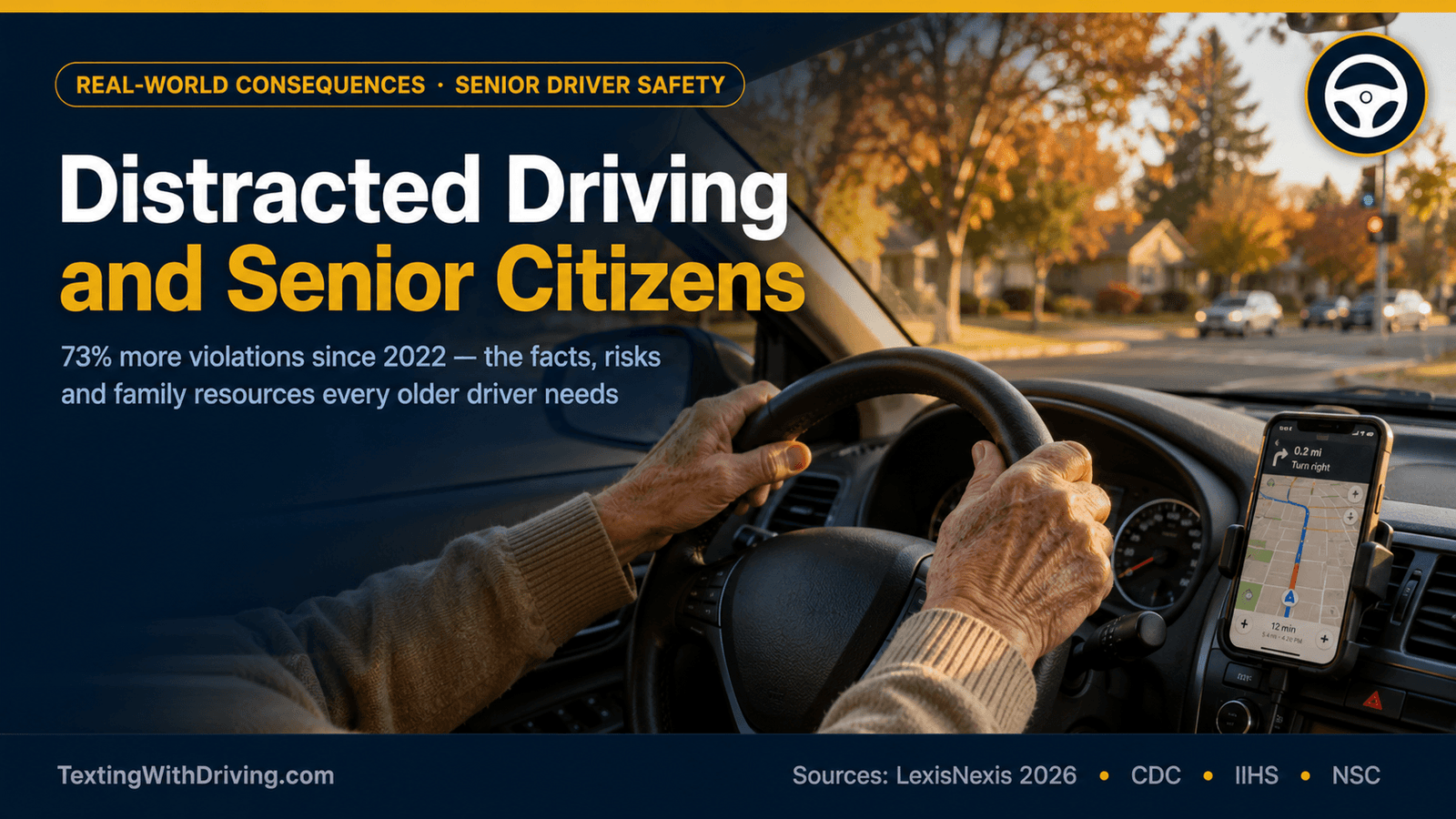
Distracted driving and senior citizens is one of the most underreported and most rapidly changing safety stories in American traffic data in 2026. The LexisNexis 2026 US Auto Insurance Trends Report released May 19, 2026 contained a finding that most mainstream coverage overlooked entirely: drivers aged 66 and older saw a 73 percent increase in distracted driving violations since 2022 — the largest proportional increase of any age group in the entire national dataset.
Repairer Driven News analysis of the same LexisNexis data showed that Silent Generation drivers aged 66 to 90 have seen an 80.3 percent increase in distracted driving violations compared to baseline data. This is not the teenage driver narrative that dominates public awareness of distracted driving and senior citizens. It is a category of driver — experienced, careful, law-abiding by historical standards — whose engagement with smartphones while driving has grown faster than any other demographic group in the country.
This article covers the complete data picture on distracted driving and senior citizens: the violation and crash statistics, the specific reasons why older drivers face distinct risk factors when distracted, what the NHTSA observation data shows about actual senior driver phone use, the resources that families and older drivers themselves can access, and the conversation framework that works when a family member needs to address this issue.
The Violation Data: 73 Percent and Rising
The LexisNexis finding on senior driver distracted driving violations is the most important new data point in the distracted driving and senior citizens landscape in 2026.
Taking 2022 as the baseline, numbers from a recent LexisNexis Risk Solutions study show that distracted driving violations increased in all age groups through Q3 2025: 48 percent increase among drivers aged 16 to 25, 55 percent among drivers aged 26 to 35, 70 percent among drivers aged 36 to 45, 55 percent among drivers aged 45 to 55, 52 percent among drivers aged 56 to 65, and 73 percent among drivers aged 66 and older, who represent 5 percent of total violations.
73 percent. The largest proportional increase of any age group. Senior drivers aged 66 and older are accumulating distracted driving violations at a faster rate than teenagers, faster than young adults, faster than middle-aged drivers with demanding professional schedules. The increase is across all age groups, confirming that distracted driving and senior citizens is not an isolated phenomenon but part of a multi-generational escalation — but the senior rate is the steepest.
Why? The explanation is not recklessness. It is smartphone adoption trajectory. Older Americans adopted smartphones significantly later than younger generations. The habitualization of constant phone checking developed in older adults’ driving lives more recently than in younger drivers. What took younger drivers a decade to develop as a driving habit, older drivers have adopted in a compressed period, arriving at the same compulsive notification-checking behavior without the earlier years of adjustment or the earlier formation of phone-free driving habits before that behavior developed.
Educational, usage-based mileage programs and incentivized safe-driving tools originally designed for young drivers may need to be expanded to a broader audience, according to LexisNexis’s own analysis of this finding.
The Crash Statistics: 25 Killed and 740 Injured Every Day
The distracted driving and senior citizens conversation exists within the broader context of older adult traffic safety statistics that are stark regardless of distraction specifically.
Each day, 25 older adults are killed and over 740 are injured in crashes, according to the CDC. In 2024, 8,019 people aged 65 and older were killed in traffic crashes in the United States, accounting for 20 percent of all traffic fatalities. The number of motor-vehicle deaths involving drivers and other road users age 65 and older increased 1.5 percent in 2024, from 9,587 in 2023 to 9,727. Over the last decade, the number of deaths has increased 33 percent.
A total of 5,679 people ages 70 and older died in motor vehicle crashes in 2024. This is a 50 percent increase since 1975, according to the IIHS June 2026 fatality statistics.
The older adult driving population has grown rapidly. In 2024 there were 61.2 million people — 18 percent of the total US population — who were 65 and older. In 2022, there were almost 52 million licensed drivers ages 65 and older in the United States, a 77 percent increase since 2004.
More older drivers on the road, more miles driven collectively, and a 73 percent increase in distracted driving violations since 2022. These three trends interact to produce an elevated and growing crash risk for the senior driving population that requires specific, targeted attention from families, healthcare providers, and traffic safety organizations.
Why Older Drivers Face Distinct Risk Factors From Distraction
The risk profile of distracted driving and senior citizens differs from the risk profile of younger distracted drivers in several important ways.
Slower reaction time to post-distraction hazards. Research consistently documents that reaction time increases with age, particularly in unexpected or urgent situations. A 25-year-old driver who looks at their phone for five seconds and then looks up to find a vehicle braking ahead has a shorter gap between perception and response than a 72-year-old driver in the same scenario. The five-second distraction window is equally blind for both. The response capability upon looking up differs.
Intersection crash concentration. Among passenger vehicle drivers involved in fatal crashes in 2024, the proportion in multiple-vehicle crashes at intersections increases steadily with age starting at 65 to 69. Multiple-vehicle crashes at intersections accounted for 43 percent of fatal crash involvements among drivers 80 and older, compared with about 24 percent for drivers ages 20 to 64.
As we documented in our distracted driving on highways versus city streets article, intersections are the specific road environment where distracted driving produces the most catastrophic outcomes because of the multi-directional conflict they create. Older drivers who are already statistically more likely to be involved in intersection crashes face compounded risk if they are additionally distracted at exactly these highest-risk locations.
Higher injury severity per crash. The increased fatal crash risk among older drivers is largely due to their increased susceptibility to injuries, particularly to the chest, and medical complications, rather than an increased tendency to get into crashes. A crash that would produce minor injuries in a 35-year-old may produce fatal injuries in a 78-year-old. This means that the consequence per distraction event is more severe for an older driver even if the likelihood of the event itself is not greater than for younger drivers.
Visual processing changes. Age-related changes to vision — reduced peripheral vision, slower dark adaptation, increased sensitivity to glare, and reduced contrast sensitivity — are well-documented and directly relevant to distracted driving recovery. A driver who has been looking at their phone and returns their gaze to the road relies on their visual processing system to rapidly re-acquire the road environment. The same visual processing changes that make older adults more vulnerable to intersection crashes make the post-distraction re-acquisition of the road environment more demanding.
Medication interactions. Many medications commonly taken by older adults affect driving ability in ways that compound with distraction. Medications that cause drowsiness, reduce reaction time, affect concentration, or produce light sensitivity are among the most commonly prescribed for age-related conditions. A driver who is managing medication side effects and simultaneously handling a phone creates a compound impairment that is more serious than either factor alone.
What the NHTSA Observation Data Shows
The NHTSA National Occupant Protection Use Survey, which conducts systematic direct observation of driver phone use behavior, provides a counterintuitive finding about distracted driving and senior citizens that contextualizes the LexisNexis violation data.
Driver hand-held cell phone use also varied by age group and is generally highest among 16- to 24-year-old drivers and lowest among drivers 70 and older. The percent of younger drivers observed to be manipulating hand-held devices in 2024 was 8.7 percent, compared to 4.4 percent among drivers aged 25 to 69 and 1.2 percent among drivers age 70 and older.
1.2 percent of drivers aged 70 and older observed to be visibly manipulating a handheld device at any given observed moment. This is the lowest rate of any age group — significantly below the 8.7 percent rate for 16- to 24-year-olds and even the 4.4 percent for the broad middle-age category.
How does the lowest observed phone manipulation rate coexist with the highest violation increase? Several explanations reconcile the data. The NHTSA observation is a snapshot of moment-in-time visible manipulation. The LexisNexis violation data captures actual citation events, which may reflect different driving environments (more rural, lower-density roads where enforcement patterns differ), different types of phone interaction (voice calls rather than screen manipulation, which is harder to observe), or different compliance responses to being observed (older drivers may be more aware of observation). Additionally, because the observed rate for the 70-plus group starts from a lower absolute baseline, a smaller absolute increase in violations produces a larger percentage change.
The 73 percent violation increase and the 1.2 percent observed manipulation rate are both true and not contradictory. They measure different things about the same underlying behavioral pattern.
The Smartphone Adoption Explanation
The most important structural explanation for the distracted driving and senior citizens violation increase is the timing of smartphone adoption across generations.
Millennials adopted smartphones in their early adulthood, between approximately 2007 and 2015. During that same period, most were still forming their adult driving habits. The development of compulsive phone checking and the development of driving habits occurred simultaneously, creating a difficult but at least unified habit formation context.
Older Baby Boomers and the Silent Generation adopted smartphones significantly later — many after their driving habits were already firmly established for decades. The integration of a compelling, addictive technology into a habitual behavior that was previously phone-free creates a specific behavioral challenge: the phone impulse is new and has not been integrated into the established driving routine, which means it disrupts the routine rather than becoming part of it.
A 70-year-old who drove for 40 years without any phone interaction is adopting smartphone behavior in the context of a driving routine that was formed entirely before smartphones existed. The notification-checking impulse competes with established driving habits rather than being incorporated into them. The result is exactly what the LexisNexis data shows: a rapid increase in violation rates as the technology behavior catches up to the driving population.
Family Resources: What Adult Children Can Access
For adult children and caregivers of older drivers who have concerns about distracted driving and senior citizens in their families, the national resource landscape is more extensive than most people realize.
AAA Driver Safety Foundation. AAA’s older driver resources, which we covered in detail in our how to talk to an older parent about distracted driving article, include the Driver Planning Agreement framework, the older driver assessment programs, and the CarFit educational program that checks whether older drivers are properly fitted to their vehicles. AAA’s CarFit events are held at thousands of locations annually and are available to any driver 55 and older.
AARP Smart Driver Course. The AARP Smart Driver Course is the largest driver safety program in the country for adults 50 and older. The online course covers defensive driving, changes in vision, hearing and reaction time with age, how to adjust driving habits to continue driving safely, and — critically — how to use in-vehicle technology safely to reduce distraction while staying connected. The course is available online at aarp.org/auto/driver-safety/course/ and typically qualifies for an auto insurance discount.
NHTSA Older Driver Safety Resources. NHTSA’s Traffic Safety Marketing division maintains specific older driver safety resources at trafficsafetymarketing.gov/safety-topics/older-driver-safety, including talking points for families of older drivers, sample social media content, and educational materials that can be shared directly with older drivers.
Certified Driver Rehabilitation Specialists. For older drivers with specific medical concerns, vision changes, or questions about their fitness to drive, a Certified Driver Rehabilitation Specialist (CDRS) provides professional on-road assessment and recommendations. CDRS professionals can be found through the Association for Driver Rehabilitation Specialists at aded.net. These specialists provide an objective professional assessment that removes the family dynamics from the evaluation and gives older drivers a credible third-party assessment of their driving capabilities.
ITNAmerica. ITNAmerica (Independent Transportation Network) is a nonprofit that provides car rides for seniors and specifically addresses the transportation independence that driving provides. Rather than framing the driving safety conversation as a removal of independence, ITNAmerica offers a concrete alternative that preserves mobility without requiring the older driver to continue driving in conditions that may be unsafe. Their network is available in many US communities.
The Specific Conversation About Phone Use
As we covered in detail in our how to talk to an older parent about distracted driving article, the conversation about distracted driving and senior citizens within a family requires specific framing to be effective.
The most effective approach addresses phone use specifically rather than driving generally. A conversation that starts with “I’m worried about your driving” carries the implicit threat of the full independence-loss conversation. A conversation that starts with “I read that drivers your age are seeing the biggest increase in distracted driving violations in the country and I wanted to talk about your phone setup when you drive” is specific, data-grounded, and not threatening to driving independence itself.
The technology solution framing is particularly effective with older drivers because it positions the conversation as helping them stay legally compliant and safe rather than asking them to give something up. Setting up iPhone Driving Focus or Android driving mode takes under two minutes and addresses the phone distraction concern without requiring any behavioral willpower from the driver during the drive itself. As we covered in our Do Not Disturb while driving setup guide, the auto-reply feature specifically addresses the social communication anxiety that drives many older drivers to check their phones: every sender receives an automatic response explaining that the driver is in the car and will respond when they arrive.
The auto-reply eliminates the feeling that unanswered messages are creating social obligation during the drive — the feeling that is, in many cases, the specific psychological driver of the phone-checking impulse in older drivers who did not grow up with smartphone norms around immediate response.
Self-Assessment Resources for Older Drivers Themselves
Many older drivers who are concerned about their own driving safety or who want to evaluate whether their phone use while driving is creating risk have access to self-assessment tools.
AAA Roadwise Driver: An online tool at aaafoundation.org that allows older drivers to self-assess capabilities in areas including visualization, working memory, speed of processing, and attention — all relevant to the cognitive demands of driving with any distraction.
NHTSA MyMobility Plan: A planning tool specifically designed for older adults who want to prepare for potential changes in their driving capabilities before those changes become a crisis, available at nhtsa.gov.
The MIT AgeLab Older Driver’s License Renewal: A research-based assessment framework from MIT’s AgeLab that addresses the full range of driving capabilities and produces a personalized recommendation about whether any driving modifications are appropriate.
These self-assessment tools do not replace professional evaluation but provide older drivers with a way to proactively monitor their own capabilities and make informed decisions about how and when they drive — including whether their phone use while driving has increased in ways that represent a safety concern.
What Every Older Driver Should Do Right Now
The distracted driving and senior citizens data tells a clear story: the 73 percent violation increase since 2022 reflects a rapid adoption of smartphone-while-driving behavior in a population whose driving habits were formed before smartphones existed. The solution is not to tell older drivers that they are bad drivers. It is to help them extend the excellent driving habits they spent decades developing to include the same phone-free standard in those habits.
Every experienced driver who drove safely for 40 years without looking at a phone can continue driving safely without looking at a phone. The phone-in-back-seat pre-drive ritual eliminates the distraction before it can disrupt the established driving routine. Driving Focus eliminates the notification pull before it creates the impulse. The auto-reply manages the social communication obligation that drives the check.
For older drivers specifically, the additional motivation of preserving driving independence is the most powerful argument. A distracted driving citation adds to the driving record. A distracted driving crash raises insurance rates, potentially triggers a family conversation about driving capability, and in the worst case produces injury that ends driving entirely. The two minutes invested in the pre-drive phone-free setup is the most direct available protection for exactly the independence that driving provides.
For the complete technology setup, our Do Not Disturb while driving setup guide covers both iPhone and Android from scratch. For the family conversation about this topic, our how to talk to an older parent about distracted driving article covers the five conversation principles in detail. And for the national data context showing how the senior driver violation increase fits into the complete distracted driving picture, our distracted driving statistics 2026 overview has everything in one place.
Sources Used in This Article
All links verified working before publication.
LexisNexis Risk Solutions: Distracted Driving Violations Rise Among All Drivers — 73% increase ages 66+, all age group breakdown, April 2026
PR Newswire: 2026 LexisNexis US Auto Insurance Trends Report — 57% all-ages increase, May 2026
Repairer Driven News: New Data Shows Distracted Driving Up 68.8% — Silent Generation 80.3% increase, LexisNexis generational breakdown, August 2025
CDC: Older Adult Drivers — 25 killed and 740 injured daily, 52 million licensed drivers 65+, 77% increase since 2004, January 2026
NSC Injury Facts: Older Drivers — 9,727 motor-vehicle deaths 65+ in 2024, 33% decade increase, April 2026
NHTSA Traffic Safety Marketing: Older Driver Safety — 8,019 NHTSA estimate, 20% of all traffic fatalities, 29% fatal crash increase
IIHS Fatality Facts 2024: Older People — 5,679 deaths 70+ in 2024, 50% increase since 1975, intersection crash concentration, June 2026
NSC Injury Facts Distracted Driving Data Details — NHTSA NOPUS 1.2% 70+ observed manipulation rate, 8.7% 16-24 rate, May 2026
SafeTREC Berkeley: 2024 Traffic Safety Facts Older Adult Road Users — Improper turning 18.2% primary crash factor, intersection crash analysis
NHTSA: Distracted Driving — 3,208 deaths 2024, national context
TextingWithDriving.com is professionally built and maintained to ensure accurate, accessible safety information reaches every driver who needs it. Website development and ongoing support is handled by Budgetic, a digital agency specializing in purpose-driven WordPress websites.

About Texting With Driving
TextingWithDriving.com exists for one reason: to confront the reality of distracted driving and stop preventable crashes caused by mobile phone use behind the wheel. Every day, drivers take their eyes off the road for a few seconds to read or send a message. Those few seconds are enough to cause life-altering consequences. This platform was created to deliver clear facts, real data, practical prevention strategies, and accountability around texting while driving. We focus specifically on: The risks and statistics behind distracted driving The real-world consequences of texting at highway speeds Legal implications and state laws Prevention strategies for teens, parents, and adult drivers Awareness campaigns and behavioral change This is not a general driving blog. It is a focused awareness initiative built around one critical issue: phone distraction behind the wheel. Our content is direct, research-driven, and practical. We prioritize accuracy over opinion and education over sensationalism. The goal is simple — reduce distracted driving incidents by increasing awareness and responsibility. If one article causes one driver to put their phone down, the mission is working. For inquiries or partnerships, contact: privacy@textingwithdriving.com
View all posts by Texting With Driving