

Michigan Distracted Driving Law 2026: 18.7% Crash Reduction and What Every Driver Must Know

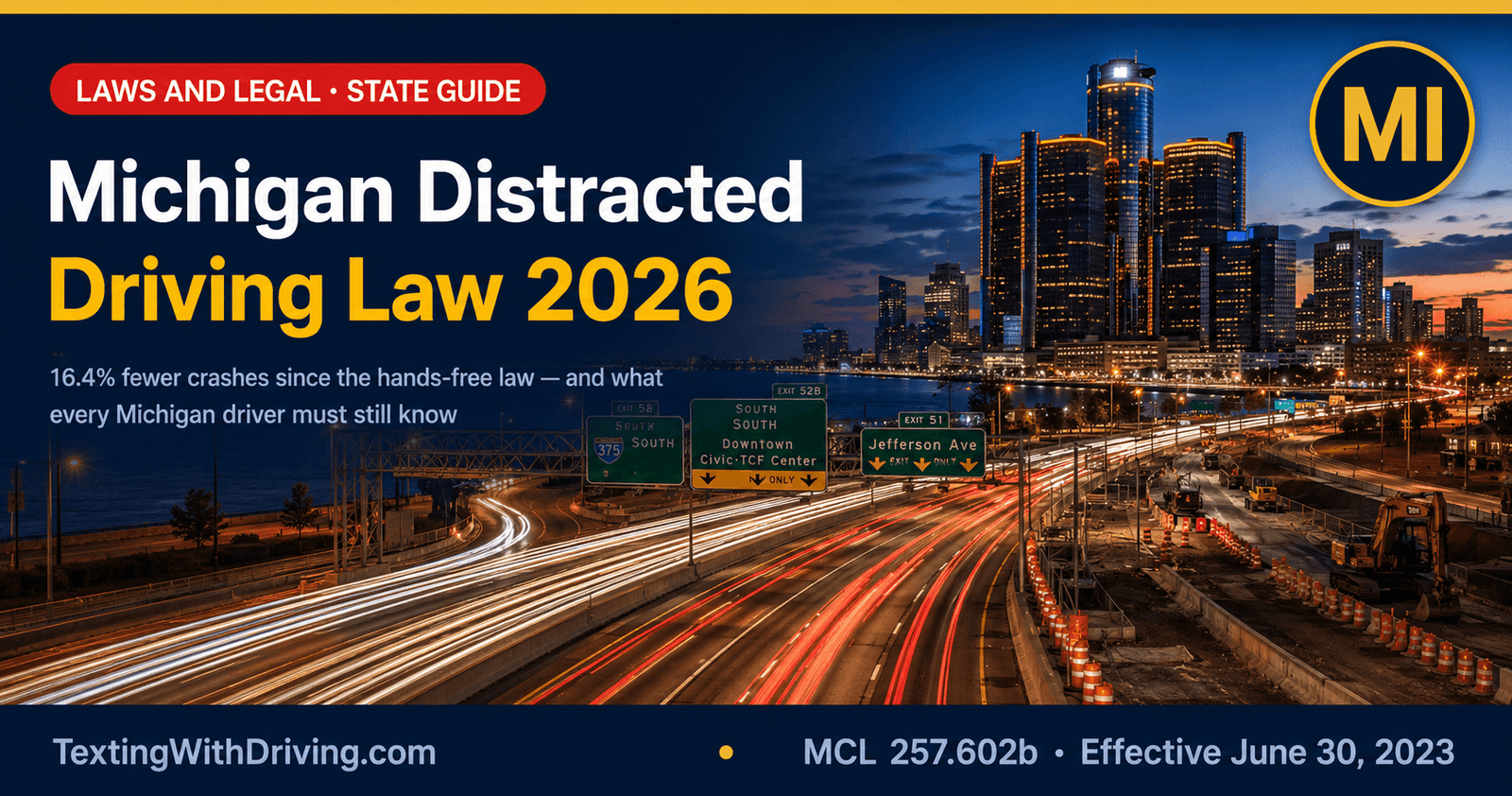
Michigan Distracted Driving Law 2026: 18.7% Crash Reduction and What Every Driver Must Know
The Michigan distracted driving law has now been in primary enforcement for three years and the results are among the most clearly documented outcomes of any hands-free law in the country. Since the law took effect on June 30, 2023, distracted driving crashes involving electronic devices have fallen 19.1 percent statewide, and overall distracted driver crashes are down 16.4 percent from the pre-law baseline.
Those are significant numbers. But the April 2026 enforcement data from the Michigan Office of Highway Safety Planning introduces a complication that every Michigan driver needs to understand: mobile device use on Michigan roads actually increased from 5.2 percent to 5.7 percent of observed drivers in 2025 despite the law, and distracted driving fatalities rose 10 percent from 59 to 65 in 2024 even as crash counts fell.
The Michigan distracted driving law is working. And it faces specific challenges that the data reveals clearly. This guide covers what the law requires, what the documented outcomes show, the unique community service provision that distinguishes Michigan from every other state, the controversial loophole that critics say undermines the law’s effectiveness, and what every Michigan driver needs to know in 2026.
What the Michigan Distracted Driving Law Prohibits
In 2023, Governor Gretchen Whitmer signed into law a bill making it illegal to manually use a cell phone or other mobile electronic device while operating a vehicle on Michigan roads. Under the law, a driver cannot hold or support a phone or other device with any part of their hands, arms, or shoulders. Injury Facts
The Michigan distracted driving laws prohibit drivers from using a hand-held cell phone or mobile electronic device to: talk on the phone, text, watch or record videos, and post to and engage on social media. EndDD
The body-support prohibition is broad and specific. Even if a cell phone or other device is mounted on your dashboard or connected to your vehicle’s built-in system, you cannot use your hands to operate it beyond a single touch. Injury Facts
The single-touch rule is the defining operational standard of the Michigan distracted driving law. A driver can touch their mounted phone once to answer or end a call, accept or decline a navigation prompt, or activate a hands-free function. Any interaction beyond that single touch, scrolling, typing, swiping between apps, entering a GPS destination while moving, is a violation regardless of how the device is physically positioned.
The law applies even when a vehicle is stopped at a red light or in traffic. You cannot use your phone while driving unless you park your car legally. It is illegal in Michigan to use your hands-free car technology, including a Bluetooth system, for anything more than a one-touch operation. NHTSA
Is the Michigan Distracted Driving Law Primary Enforcement?
Yes. Michigan’s distracted driving law is a primary enforcement law, meaning police officers can stop a driver solely for a violation — no other traffic offense is required. ConsumerAffairs
Primary enforcement is the most important structural feature of the Michigan distracted driving law. An officer who observes a driver holding a phone can initiate a traffic stop based solely on that observation, without needing speeding, a lane departure, or any other violation as justification. This is the same enforcement standard that we documented producing Ohio’s 15,400-crash reduction in year one and Georgia’s 23.7 percent phone distraction reduction in two weeks, as covered in our Ohio distracted driving law results and Georgia hands-free driving law articles.
The Fines — Plus the Unique Community Service Option
The Michigan distracted driving law fine structure is notable for one provision that no other state’s distracted driving law includes: community service as an alternative to the fine.
The penalties for violation of Michigan’s distracted driving laws may include: a fine of $100 to $250, 16 to 24 hours of community service, repeat offenders get points on the driving records, and driving school for three or more distracted-driving violations in a three-year period. EndDD
Breaking this down precisely:
First offense: $100 fine or 16 hours of community service, or both. No automatic points on the first violation.
Second or subsequent offense: $250 fine or 24 hours of community service, or both. Points begin applying on repeat violations.
Three or more offenses within three years: Driver must complete a basic driver improvement course in addition to fines.
A driver who violates the law and is at-fault for causing a crash is subject to double the fines that would normally be imposed for the violation. Mylegalneeds
Double fines apply when a crash is involved. A driver whose first offense produces a crash faces a $200 civil penalty rather than $100. A repeat offender who causes a crash faces a $500 penalty rather than $250.
The community service alternative is unusual among US distracted driving laws and reflects a legislative philosophy of rehabilitation alongside deterrence. A driver who completes 16 hours of community service instead of paying the $100 fine has made a tangible contribution to their community as a consequence of the violation. Whether this alternative reduces the deterrent effect of the fine or produces better long-term behavioral change than a fine alone is an open question in the research literature.
The Crash Data: What Three Years of Enforcement Has Produced
The documented outcomes of the Michigan distracted driving law since June 30, 2023 provide the clearest picture of what primary enforcement hands-free legislation produces in practice.
Michigan’s hands-free law shows clear effectiveness: distracted driving crashes dropped 16.4% from 18,096 in 2019 to 15,136 in 2023, while electronic device-related crashes fell 19.1%. Kidslox
The baseline comparison uses 2019 as the pre-law reference year, which is the last full year of data before the pandemic distorted traffic patterns. The comparison is meaningful: 18,096 total distracted driver crashes in 2019 fell to 15,136 by 2023, and crashes specifically attributed to electronic device use fell from 4,826 to 3,902 — a 19.1 percent reduction in the category the law most directly targets.
According to Michigan Traffic Crash Facts, motor vehicle crashes involving a distracted driver decreased by 4.6 percent from 15,136 in 2023 to 14,439 in 2024. However, the number of fatalities in distraction-involved crashes increased 10 percent from 59 fatalities in 2023 to 65 in 2024. harvard
The 2024 data introduces the complication that makes the Michigan distracted driving law picture more nuanced than a simple success story. Crashes continued falling — 4.6 percent more in 2024. But fatalities rose 10 percent. Fewer crashes but more deaths within the crash category. This pattern suggests that while the law has reduced the frequency of distraction-involved crashes, the severity of those that do occur may be increasing, possibly because the crashes that do happen involve higher speeds or more dangerous circumstances than the lower-stakes crashes the law has successfully eliminated.
While fewer distracted-driving crashes is encouraging news, the increase in mobile device use and distracted-driving-related fatalities is alarming, said Alicia Sledge, OHSP director. Nearly 300 people have died in distraction-involved crashes in Michigan from 2020 to 2024. harvard
The 2025 Observational Study: Device Use Is Rising Despite the Law
The April 2026 enforcement announcement from Michigan OHSP included a finding that should concern every Michigan driver and traffic safety advocate.
A recent observational study from Michigan State University found that mobile device use by drivers increased from 5.2 percent in 2024 to 5.7 percent in 2025. harvard
Mobile device use rose in 2025 despite the law being in its second full year of enforcement. This is the Michigan-specific version of the paradox we documented nationally in our adult distracted driving prevention programs article: awareness of a law does not automatically translate into sustained compliance, and without consistent high-visibility enforcement, observed phone use rates can creep back up after an initial post-enactment decline.
The MSU observational study methodology, which counts actual observed phone handling events by real drivers on real roads, provides independent verification of behavioral trends that crash statistics alone cannot capture. A driver who handles their phone without causing a crash does not appear in the crash database. The observational study captures their behavior regardless.
The 5.7 percent observed rate in 2025 means that on any given stretch of Michigan road, approximately 1 in 18 drivers is actively handling a mobile device in a way that violates the Michigan distracted driving law at any observed moment. That rate, multiplied across Michigan’s approximately 7.5 million licensed drivers and the millions of miles driven on Michigan roads annually, produces the crash count that the statistics document.
The Loophole Critics Say Undermines the Law
The Michigan distracted driving law contains a provision that prominent Michigan car accident attorneys have publicly identified as a significant weakness.
Because of the way the hands-free driving law in Michigan is written, it also allows drivers to watch and record videos and read and post to social media while they are driving so long as the cell phone or device they are using is in hands-free or voice-operated mode or is placed in a mount. I recognize most people and likely most lawmakers may not fully appreciate how increasingly common this is, but I do. I have now had several truck accident cases where long-haul drivers were streaming movies, and more cases than I can count of drivers creating TikTok videos and other social media while driving — and of course then causing car wrecks because they were driving distracted. These loopholes in the Michigan 2026 cell phone law will allow drivers to continue to drive dangerously distracted while the phone is mounted. DOT
This is a genuine and significant loophole. The Michigan distracted driving law prohibits handheld use but permits mounted use even for video and social media, on the theory that a mounted device does not require the driver to physically hold a phone. But a driver watching a video on a mounted phone is cognitively distracted by the video content regardless of whether the device is in their hand. A driver recording a TikTok on a mounted phone is visually distracted by the camera framing regardless of whether they are holding the device.
Compare this to Illinois, where the 2024 expansion explicitly banned social media access regardless of how the device is positioned, as we covered in our Illinois distracted driving law article. The Illinois framework closes the mounted-device social media loophole that Michigan’s law leaves open.
Kelsey’s Law: The Teen Driver Standard
Teen drivers in Michigan are subject to a separate and stricter standard under Kelsey’s Law, named after Kelsey Raffaele, a 17-year-old Michigan teenager who died in a car crash in 2010 that authorities attributed to cell phone use.
Notably, for Michigan’s teen drivers with a license restriction through Michigan’s Graduated Driver Licensing, any kind of cell phone use is unlawful. nhtsa
Teen drivers remain subject to Michigan’s additional distracted driving restrictions under Kelsey’s Law. Driving Tests
Under Kelsey’s Law, teen drivers with GDL restrictions cannot use any wireless communication device while driving, including hands-free devices, with the exception of emergency calls. This mirrors the under-19 prohibition in Illinois and the under-18 prohibition in New York and most other states with comprehensive novice driver bans, as we documented in our distracted driving laws for teen drivers state guide.
The combination of Kelsey’s Law restrictions for teens and the general hands-free law for adult drivers creates a two-tier system where teens face a complete device ban and adult drivers face a one-touch mounted-device standard.
Commercial Driver Penalties Under Michigan Law
Commercial drivers face stricter penalties under the hands-free law: a first violation brings a $200 fine or 32 hours of community service, while repeats cost $500 or 48 hours, and three offenses in three years require a driving-improvement course. Kidslox
Commercial driver penalties are exactly double the standard driver penalties: $200 versus $100 for a first offense, $500 versus $250 for subsequent offenses. The community service alternative scales proportionally as well. These penalties layer on top of the FMCSA federal commercial driver penalty structure of up to $2,750 per violation that we covered in our FMCSA commercial driver distracted driving rules article.
The April 2026 Enforcement Campaign and SAFER by 2030
Michigan’s enforcement of the Michigan distracted driving law operates within a broader statewide safety initiative called SAFER by 2030.
SAFER by Statewide Action to Reduce Fatalities Encountered on our Roadways by 2030 is a collaborative effort by state agencies and traffic safety partners to reduce traffic fatalities on Michigan roadways by 30 percent by the year 2030. Educational efforts by SAFER by 2030 partner agencies include the posting of Hands-Free Law signs at rest stops and Welcome Centers by the Michigan Department of Transportation, the OHSP’s distracted-driving paid media campaign, and the Kiefer Foundation’s Just Drive Simulator for high schools. harvard
The 30 percent fatality reduction by 2030 goal is ambitious. The rising fatality count in 2024 despite falling crash counts means the SAFER by 2030 initiative faces a specific challenge: the crashes that are occurring are more likely to be fatal than they were before the law took effect. Addressing severity rather than just frequency will require enforcement strategies that go beyond citation volume.
Throughout April 2026, police agencies throughout Michigan teamed up with OHSP for a high-visibility enforcement effort specifically targeting handheld device violations. The April campaign is the primary annual enforcement window, coordinated with NHTSA’s national Put the Phone Away or Pay campaign that we covered in our how police enforce distracted driving laws article.
What Every Michigan Driver Should Do in 2026
The documented outcomes of the Michigan distracted driving law tell a clear story: the law is reducing crash counts, but device use is rising and fatalities are climbing within the remaining crashes. Every Michigan driver who wants to stay both legal and safe in 2026 needs to apply the same pre-drive discipline regardless of how their device is positioned.
Phone in a mount is not automatically safe. Phone in a mount playing a video or social media feed while the driver watches is a cognitive and visual distraction regardless of the legality. The law sets the minimum standard. Safety requires exceeding it.
The minimum legal standard: phone mounted, no handheld contact except a single touch to activate hands-free, GPS pre-set before moving, all calls through Bluetooth or vehicle system.
The safety standard that the crash data supports: GPS pre-set before moving, Driving Focus or Android driving mode active, no video or social media even on a mount, phone interaction reserved for stops completely off the roadway.
For the technology setup that makes the safety standard automatic, our Do Not Disturb while driving setup guide covers both iPhone and Android from scratch. For the national comparison showing how Michigan’s law and outcomes compare to all 50 states, our hands-free driving laws by state 2026 guide covers every state.
Sources Used in This Article
All links verified working before publication.
Michigan Auto Law: Michigan Distracted Driving Law 2026 — MCL 257.602b text, fine structure, 16.4% and 19.1% crash reductions, April 2026
Michigan OHSP: Distracted Driving Awareness Month 2026 — 4.6% crash drop to 14,439, 10% fatality rise to 65, MSU 5.7% device use, April 2026
Michigan.gov: Distracted Driving Safety Program — Official prohibited activities list, single-touch standard
Cars Counsel: Michigan Distracted Driving Laws 2026 — Community service alternative, CDL penalties, May 2026
Michigan Auto Law: Michigan Cell Phone Law 2026 — Mounted device loophole analysis, April 2026
Falzon Law: Michigan Distracted Driving Laws 2026 — 287,953 total accidents 2023, 15,136 distracted, 2,405 cell phone crashes
Falzon Law: Distracted Driving and Michigan Law — Primary enforcement, civil liability, crash-caused fine doubling, May 2026
Michigan Auto Law: Michigan Texting and Driving Law 2026 — Double fine on crash, 23x more likely crash texting, April 2026
David Christensen Law: Are Distracted Driving Laws Effective — Michigan fatality stability vs national trend, March 2026
NHTSA: Distracted Driving — 3,208 deaths 2024, national context
TextingWithDriving.com is professionally built and maintained to ensure accurate, accessible safety information reaches every driver who needs it. Website development and ongoing support is handled by Budgetic, a digital agency specializing in purpose-driven WordPress websites.

About Texting With Driving
TextingWithDriving.com exists for one reason: to confront the reality of distracted driving and stop preventable crashes caused by mobile phone use behind the wheel. Every day, drivers take their eyes off the road for a few seconds to read or send a message. Those few seconds are enough to cause life-altering consequences. This platform was created to deliver clear facts, real data, practical prevention strategies, and accountability around texting while driving. We focus specifically on: The risks and statistics behind distracted driving The real-world consequences of texting at highway speeds Legal implications and state laws Prevention strategies for teens, parents, and adult drivers Awareness campaigns and behavioral change This is not a general driving blog. It is a focused awareness initiative built around one critical issue: phone distraction behind the wheel. Our content is direct, research-driven, and practical. We prioritize accuracy over opinion and education over sensationalism. The goal is simple — reduce distracted driving incidents by increasing awareness and responsibility. If one article causes one driver to put their phone down, the mission is working. For inquiries or partnerships, contact: privacy@textingwithdriving.com
View all posts by Texting With Driving