

Maryland Work Zone Distracted Driving 2026: AI Cameras, Tiered Fines and What Every Driver Must Know

Maryland Work Zone Distracted Driving 2026: AI Cameras, Tiered Fines and What Every Driver Must Know
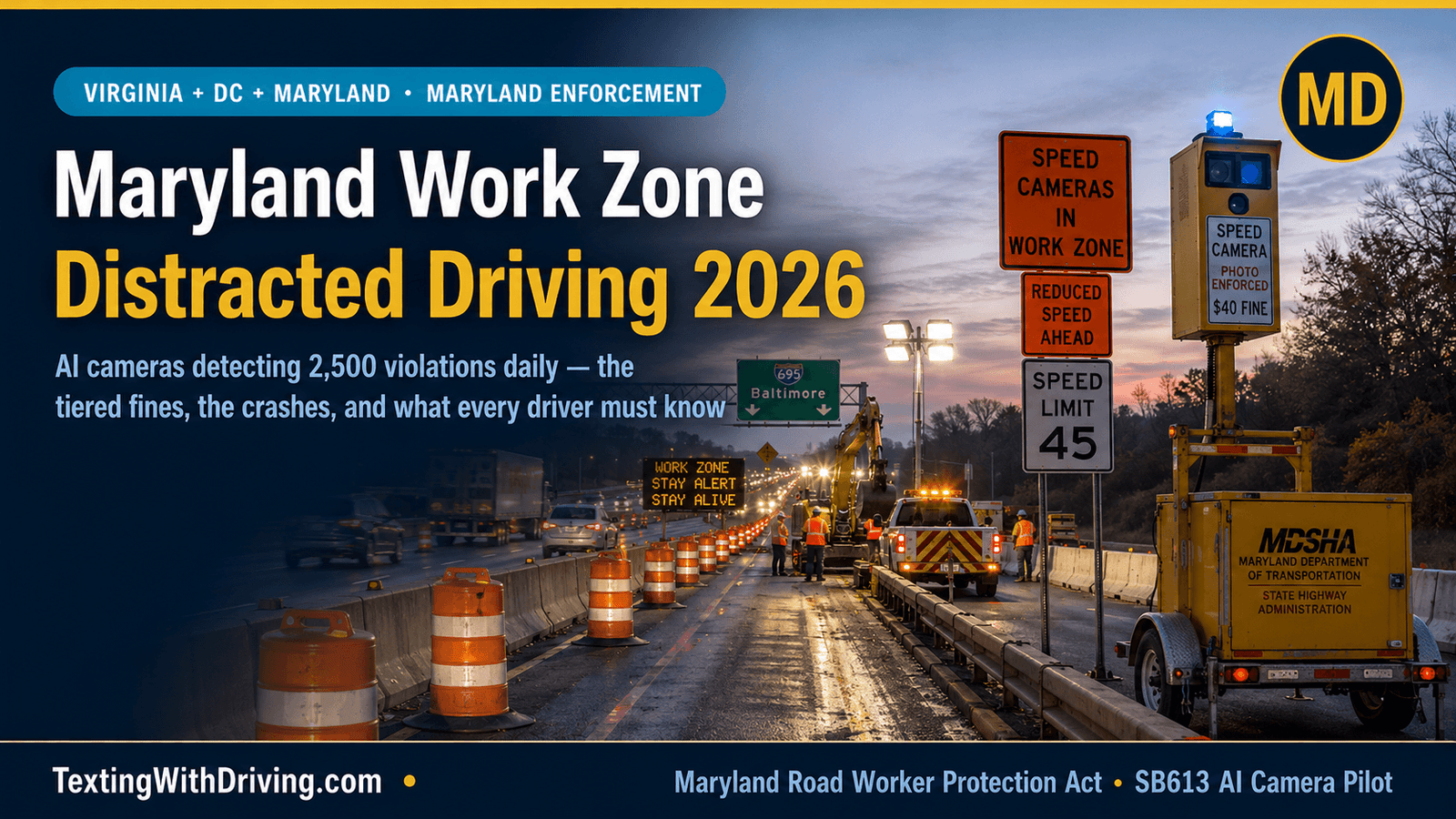
Maryland work zone distracted driving 2026 is being confronted with two of the most aggressive enforcement tools of any state in the DMV region: an AI-powered camera pilot that detected 2,500 distracted driving violations per day in initial testing before any fines were issued, and a tiered speed enforcement system that can reach $1,000 per citation when workers are present and a driver is traveling 40 mph or more over the posted limit.
The enforcement escalation responds to a documented crisis on Maryland’s construction corridors. Between 2019 and 2023, there were 7,110 work zone crashes in Maryland — roughly 1,400 each year. Forty-five people were killed. Two thousand five hundred and eighty-seven were injured. In March 2023, six workers including a father and son were killed when two cars crashed and careened into a work zone on I-695 near the I-70 interchange. In March 2024, six more workers died in the Francis Scott Key Bridge collapse. A dozen people lost their lives each year in work zone crashes in 2022, 2023, and 2024.
The Maryland Road Worker Protection Act of 2024, signed by Governor Wes Moore on April 9, 2024, and the SB613/HB908 AI camera pilot bills introduced in 2025 are Maryland’s legislative response to this toll. They represent the most significant expansion of automated enforcement targeting distracted and speeding drivers in Maryland work zones in the state’s history — and every driver who uses Maryland’s highway network needs to understand exactly what these systems do, where they operate, and what the financial consequences of a violation look like.
The Human Story Behind the Enforcement: The I-695 Crash and What Changed Everything
The specific event that catalyzed Maryland’s Maryland work zone distracted driving 2026 enforcement expansion was the March 22, 2023 crash on Interstate 695 near the I-70 interchange in western Baltimore County.
Six workers including a father and son lost their lives while working on a stretch of Interstate 695. The deaths — half of the total number of people who died in Maryland work zones in all of 2023 — prompted immediate legislative action. Lt. Governor Aruna Miller, a former transportation engineer, chaired a multi-disciplinary work group that drew on technical experts and public input to produce regulatory and operational recommendations in education, engineering, and enforcement.
The I-695 crash was not the end of Maryland’s work zone tragedy. One year later, March 26, 2024 brought the Francis Scott Key Bridge collapse — an event that claimed six highway workers, all immigrant construction workers from Latin America, in a different but related infrastructure tragedy. The men and women in the construction industry place themselves in harm’s way every day on the frontline of service. We saw it happen on March 22, 2023. And we saw it happen again on March 26, 2024. It’s a moral imperative that we protect workers who provide critical service, public service for all of us.
This human context shapes everything about Maryland’s Maryland work zone distracted driving 2026 enforcement approach. The tiered fines, the AI cameras, the expanded camera deployment, and the Montgomery County Cybertruck-style Vitronic cameras are not abstract enforcement mechanisms. They are legislative and operational responses to specific names, families, and deaths that Maryland’s road safety community knows and remembers.
The Tiered Work Zone Speed Fine Structure: What It Means for Every Driver
The tiered fine structure that took full effect in Maryland work zones on January 1, 2025 is the financial foundation of the Maryland work zone distracted driving 2026 enforcement landscape. Every driver on any Maryland highway work zone corridor needs to know this structure before entering a construction zone.
The tiered fines for speed violations detected by automated speed enforcement cameras in Maryland work zones are:
12 to 15 mph above the speed limit: $60 base fine. If workers are present: $120.
16 to 19 mph above the speed limit: $80. Workers present: $160.
20 to 29 mph above the speed limit: $140. Workers present: $280.
30 to 39 mph above the speed limit: $270. Workers present: $540.
40 mph or more above the speed limit: $500. Workers present: $1,000.
The doubling provision when workers are present is the most consequential element for many Maryland work zone scenarios. Maryland work zones are frequently active — with workers present — during daylight hours on major corridors like I-270 in Montgomery County, I-695 around Baltimore, and I-95 between the DC border and Baltimore. A driver who passes through an active work zone at 40 mph over the posted limit while workers are within the zone faces a $1,000 citation that arrives by mail with no officer stop required.
The comparison to Maryland’s previous fine is instructive. The previous penalty in Maryland was $40, among the lowest in the country. The new system starts at $60 for the lowest tier and reaches $1,000 at the highest. From $40 flat to $1,000 maximum — a 25-fold increase in the maximum financial consequence from a single camera citation.
Fines can run even higher than that in work zones — up to $1,000. These new cameras are built to last.
The work zone speed limit in many Maryland construction zones is reduced below the normal highway speed limit. A highway that normally posts 65 mph may have a work zone speed limit of 45 mph. A driver doing 85 mph in a 45 mph work zone — maintaining the same absolute speed they would use on the open highway — is traveling 40 mph over the work zone limit, triggering the $500 base fine or the $1,000 workers-present fine. This is not a rare or extreme scenario. It is the normal behavior of drivers who fail to reduce speed through work zones.
The 2025 Results: Is the Tiered Fine System Working?
The first full year of Maryland’s tiered fine system produced documented results that the state released in April 2026 as part of National Work Zone Awareness Week.
In Maryland, overall traffic deaths dropped 18 percent between 2024 and 2025, and crashes in work zones came down 12 percent over that same time period.
1,148 work zone crashes in 2025 — a 12 percent decrease from 2024. Nine deaths in 2025 — down from 12 in each of the three prior years. Cameras issued fewer citations per day for excessive speeding in 2025 than in the previous two years.
As of early April 2026, there were 222 work zone crashes, with two fatalities and 53 injuries — a continued gradual downward trend in crash frequency.
We are encouraged that the numbers are declining, but frankly it’s not enough and it’s not acceptable that anyone should lose their life doing their job, said State Highway Administrator Will Pines.
The continued concern despite measurable improvement reflects the scale of the remaining problem. 1,148 work zone crashes in 2025 means approximately three crashes every single day in Maryland construction zones — an ongoing reality that injures workers, injures drivers, and creates the recurring traffic disruptions that Maryland highway users experience throughout the year. The behavioral change the tiered fine system and camera deployment has produced is real. It has not been sufficient to protect every worker.
The 19 citations issued in 2025 for drivers traveling in excess of 130 mph in work zones is the most startling single data point in the 2025 work zone data. Not 30 mph over. Not 50 mph over. Drivers doing 130-plus mph on roads with posted work zone speed limits as low as 45 or 55 mph — a behavioral extreme that no fine structure, however graduated, has fully deterred.
The Montgomery County Camera Expansion: 140 New Cameras Including Cybertruck-Style Vitronic Units
Independent of the statewide work zone camera program, Montgomery County is implementing one of the most ambitious automated traffic enforcement expansions of any Maryland county in 2026.
Among the 140 new speed cameras that Montgomery County Police Department announced are six large, unusually shaped ones made by Germany-based company Vitronic that have grabbed significant attention — compared in online chats to Tesla Cybertrucks or something out of Star Wars.
Some are fixed in place, while others are mobile, moving between high-risk areas. Officials say the goal is more than issuing tickets — it’s about preventing accidents and saving lives. The glass in the front of them is actually ballistic grade glass because we had situations where previously people had vandalized cameras.
The vandalism resistance reflects a practical reality of automated enforcement expansion: some drivers respond to camera enforcement by attacking the cameras. The Vitronic units’ ballistic-grade glass is a design response to documented vandalism events that disabled earlier camera deployments. Montgomery County’s $1,000 maximum work zone fine combined with 140 new cameras — including mobile units that rotate between high-risk locations — creates a county-level automated enforcement infrastructure that significantly exceeds what was in place even two years ago.
SB613 and HB908: The AI Distracted Driving Camera Pilot
The most significant new enforcement development in Maryland’s Maryland work zone distracted driving 2026 and broader distracted driving landscape is Senate Bill 613 and House Bill 908, which together establish the framework for AI-powered distracted driving cameras.
Bill MD SB613 was introduced on January 28, 2025 by Senator Jeff Waldstreicher (D-Montgomery County, District 18) and Senator Michael Jackson (D-Prince George’s County, District 27) to establish a pilot program that permits the use of video cameras in Montgomery County and Prince George’s County to enforce specific prohibitions related to the use of mobile devices while operating a vehicle.
The technology is already being tested. Nine cameras in Montgomery County captured 2,500 violations per day, with no fines being issued during the testing period. Preliminary testing in Montgomery County shows alarming results: nearly 30 percent of drivers observed at certain intersections were on their phones.
2,500 violations per day from nine cameras. 30 percent of observed drivers on their phones at certain intersections. These figures from the testing period — before any enforcement consequences existed — provide the most direct behavioral measurement of actual driver phone use in Maryland in the DMV region. The 30 percent observed rate at specific high-traffic intersections is significantly higher than the 1.9 percent NHTSA observational study figure for all US drivers at all times, reflecting that intersection-specific observation — where slower speeds and stop-start patterns create peak phone-checking conditions — captures higher rates than driving-speed observation.
The AI system behind SB613 works through the Obvio system — the world’s first AI-powered traffic monitor that automatically detects and deters traffic violations like stop sign violations, phone use, and close-following. According to SB613, an in-camera feature enables focus on mobile devices and does not capture facial recognition. The image would have to capture at least two time-stamped pictures and at least one clear picture of the registration plate number, along with the driver acting illegally, though their face would be blurred.
The bill requires that each citation include: the date, time, location, and images of the violation. Citations are civil — not criminal — and are addressed to the vehicle owner rather than requiring identification of the driver from facial features. The maximum civil fine is $40.
Both counties would need to get the green light from their governing bodies, hold public hearings, and put up warning signs to keep everyone in the loop before the systems can issue fines. Initially the program would run until September 2028, with participating counties required to report on effectiveness by December 1, 2027.
Why Work Zones and Distracted Driving Are Specifically Dangerous Together
The specific intersection of Maryland work zone distracted driving 2026 enforcement and the underlying road safety problem it addresses reflects a documented pattern that road safety researchers have consistently identified: work zones are the environment where distraction is most dangerous and where drivers are most likely to be distracted.
Work zones are where the specific demands of distracted driving risk compound with the specific hazards of construction environments. Speed limits are reduced but not all drivers comply — creating unpredictable speed differentials. Lane widths are narrowed, often significantly. Barriers are close to the travel lane. Workers are present at the road edge or within the travel lane. Traffic patterns change frequently as construction progresses. And the same navigation uncertainty that produces phone-checking behavior in unfamiliar intersections produces phone-checking in work zones — drivers looking for lane assignment signs, speed limit changes, or exit availability that shifts as the work zone configuration evolves.
Among citations issued for work zone speed violations in 2025, 19 involved drivers traveling in excess of 130 mph. These are the extreme cases. The typical dangerous work zone driver is not going 130 mph. They are going 70 mph in a 55 mph work zone while checking their phone because they did not notice the speed limit sign had changed.
The I-95 corridor through Maryland — from the DC border to Baltimore, including the Maryland/DC line at the Wilson Bridge, the I-95/I-695 interchange, and the I-95/I-295 Baltimore Washington Parkway area — contains some of Maryland’s most active and longest-running work zones. The I-270 corridor in Montgomery County, the I-695 Beltway around Baltimore, and US-50 toward Annapolis all have documented active construction periods that create the specific work zone enforcement environment that Maryland’s tiered fine and camera systems target.
Distracted driving in a work zone — whether the distraction is looking at a phone or failing to notice the reduced speed limit — is not just illegal under Maryland’s general handheld ban. When it produces a speed violation captured by an automated camera, it adds a camera citation to the existing legal exposure. When workers are present, it doubles the fine.
The Maryland DMV Commuter Perspective: What I-270 and I-695 Drivers Need to Know
For the hundreds of thousands of DMV region commuters who use I-270, I-695, I-95, and US-50 as their daily routes to DC or Baltimore employment centers, the Maryland work zone distracted driving 2026 enforcement landscape has specific practical implications.
I-270 in Montgomery County has had extended work zone periods as part of Maryland’s managed lane expansion project. The same corridor where Montgomery County is deploying 140 new speed cameras — including the mobile Vitronic units that move between high-risk areas — is also one of the highest-volume commuter corridors in the state. A commuter who has driven I-270 daily for years and treats it as a familiar route should be aware that: the camera deployment means speed enforcement density is significantly higher than it was even 12 months ago, the work zone speed limits that reduce the posted limit are actively enforced with cameras that issue citations by mail, and the AI camera pilot targeting phone use adds a second citation category to the work zone enforcement environment.
I-695 around Baltimore — where the March 2023 crash killed six workers — has been a specific enforcement focus since that event. The Unity Ride procession of state and contractor vehicles around the west side of I-695 on April 22, 2026 passed by the site of the March 2023 crash to honor the workers killed there. The political and institutional attention on I-695 work zone safety makes it one of the highest-enforcement-priority corridors in all of Maryland for 2026.
Virginia drivers who commute into Maryland via the American Legion Bridge (I-495) and then use I-270 northward, or who cross the Woodrow Wilson Bridge (I-495) and travel north on I-95, enter the Maryland work zone enforcement environment within minutes of crossing the state line. The legal standard that applies is Maryland’s — not Virginia’s — the moment they enter Maryland jurisdiction.
The Connection Between Speed Violations and Distracted Driving in Work Zones
The Maryland work zone distracted driving 2026 enforcement framework addresses two behaviors that are legally distinct but practically related in work zone environments. The tiered speed fine system targets speeding. The SB613 AI camera system targets phone use. But the two behaviors share a common root cause: driver inattention to the specific conditions of the active work zone.
A driver who fails to reduce speed to the work zone limit is typically failing to notice the reduced speed limit sign — which requires visual attention to roadside signage that a phone-distracted driver is not providing. A driver who is using their phone while passing through a work zone is simultaneously creating the conditions that produce both distracted driving violations and unintentional speeding violations.
Maryland’s two-track enforcement approach — speed cameras for speeding and AI cameras for phone use — creates a work zone environment where a driver who enters a work zone while on their phone faces potential citations from both systems simultaneously. The speed camera captures the speed violation. The AI camera captures the phone use. Both arrive by mail. Both are civil penalties. Both apply regardless of whether an officer was present to observe the conduct.
What Every Maryland Driver and DMV Commuter Should Do in 2026
The Maryland work zone distracted driving 2026 enforcement landscape requires a specific behavioral standard from every driver who enters any Maryland construction zone:
Reduce speed before the work zone begins. The reduced speed limit sign marks the beginning of the enforcement zone. Reducing speed to comply before entering the zone is the only way to avoid camera-based speed citations, because the cameras capture speed continuously throughout the zone regardless of where exactly the speed reduction occurred.
Phone in mount or back seat before any Maryland highway entry. For commuters entering Maryland from Virginia via the American Legion Bridge or Wilson Bridge, the phone should be secured before the Virginia-Maryland state line. Maryland’s handheld ban (covered in our Maryland distracted driving law 2026 article) applies on every Maryland public road — work zone or not — and the SB613 AI camera pilot adds automated detection in Montgomery and Prince George’s Counties.
No phone interaction in any active work zone. Even for drivers who use phones hands-free under Maryland’s law, any manual phone interaction — checking navigation, adjusting music, accepting a notification — in an active work zone creates AI camera citation risk if the SB613 pilot is active at that location and the driver’s hand is observed moving toward or holding the device.
Assume cameras are present in every work zone. The mobile camera units that move between high-risk areas create uncertainty about which specific work zone has camera coverage at any given moment. The safest behavioral assumption is that every Maryland work zone has active camera enforcement — because after the 140-camera expansion in Montgomery County alone, that assumption is increasingly close to the literal truth.
For the complete Maryland hands-free driving law that applies on all Maryland roads including work zones, our Maryland distracted driving law 2026 article covers Maryland Transportation Code § 21-1124 in full. For the DMV cross-border commuter guide covering Virginia, DC, and Maryland law together, our DC to Virginia Maryland commuter guide covers each jurisdiction. And for the complete technology setup that makes all three DMV jurisdictions’ compliance automatic, our hands-free while driving complete setup guide covers iPhone, Android, Bluetooth, and CarPlay.
Sources Used in This Article
All links verified working before publication.
Governor Maryland: Lt Gov Miller Urges Renewed Commitment National Work Zone Awareness Week — 1,148 work zone crashes 2025 down 12%, 9 deaths 2025, 222 crashes early April 2026 2 fatalities 53 injuries, State Highway Administrator Pines quotes, April 2026
The Baltimore Banner: Maryland Work Zones Less Deadly But Still Too Dangerous — 18% overall traffic deaths drop 2024-2025, 12% work zone crash reduction, cameras issued fewer citations per day 2025, April 2026
ENR: Maryland Touts Work Zone Safety Improvements But Challenges Remain — 19 citations for 130+ mph 2025, cultural perceptions of speed, I-695 Unity Ride, May 2026
Maryland Matters: Union Demands Beefed-Up Safety After Worker Deaths — 7,800 work zone crashes 2020-2025, 253 crashes through April 2026, I-695 father and son, May 2026
MDOT: Stay Safe New Work Zone Fines 2025 — Complete tiered fine chart $60-$500, doubling with workers present $120-$1,000, 7,110 crashes 2019-2023, 45 killed 2,587 injured, January 2025
MDOT SHA: Enhanced Work Zone Safety Laws June 1 — HB513 signed April 9 2024, multiple cameras per work zone permitted, $40 original fine among lowest in country, June 2024
WJLA: Maryland Lawmakers Propose AI Cameras for Distracted Driving — 9 cameras 2,500 violations per day, SB613 Senator Jackson privacy quote blurred faces, 34% of Maryland road deaths from distracted driving, February 2025
Goldberg Finnegan: Maryland Considers Distracted Driving Cameras — 30% of drivers on phones at certain intersections, $40 civil fine, Obvio technology, 23x crash risk from texting, April 2025
MoCo Show: New Bill Aims to Combat Distracted Driving with Video Cameras — SB613 January 28 2025 introduction, $40 maximum penalty civil citation, two time-stamped pictures required, February 2025
WJLA: Montgomery County Cybertruck-Style Speed Cameras — 140 new cameras Montgomery County, 6 Vitronic Cybertruck-style cameras, ballistic glass, mobile units, $1,000 work zone maximum, April 2026
Maryland General Assembly: SB0613 Official Legislation — Official bill text, pilot program scope, December 1 2027 reporting deadline
NHTSA: Distracted Driving — 3,208 deaths 2024, national context
TextingWithDriving.com is professionally built and maintained to ensure accurate, accessible safety information reaches every driver who needs it. Website development and ongoing support is handled by Budgetic, a digital agency specializing in purpose-driven WordPress websites.

About Texting With Driving
TextingWithDriving.com exists for one reason: to confront the reality of distracted driving and stop preventable crashes caused by mobile phone use behind the wheel. Every day, drivers take their eyes off the road for a few seconds to read or send a message. Those few seconds are enough to cause life-altering consequences. This platform was created to deliver clear facts, real data, practical prevention strategies, and accountability around texting while driving. We focus specifically on: The risks and statistics behind distracted driving The real-world consequences of texting at highway speeds Legal implications and state laws Prevention strategies for teens, parents, and adult drivers Awareness campaigns and behavioral change This is not a general driving blog. It is a focused awareness initiative built around one critical issue: phone distraction behind the wheel. Our content is direct, research-driven, and practical. We prioritize accuracy over opinion and education over sensationalism. The goal is simple — reduce distracted driving incidents by increasing awareness and responsibility. If one article causes one driver to put their phone down, the mission is working. For inquiries or partnerships, contact: privacy@textingwithdriving.com
View all posts by Texting With Driving