

Fourth of July Driving Safety 2026: Holiday Statistics and What to Expect

Fourth of July Driving Safety 2026: Holiday Statistics and What to Expect
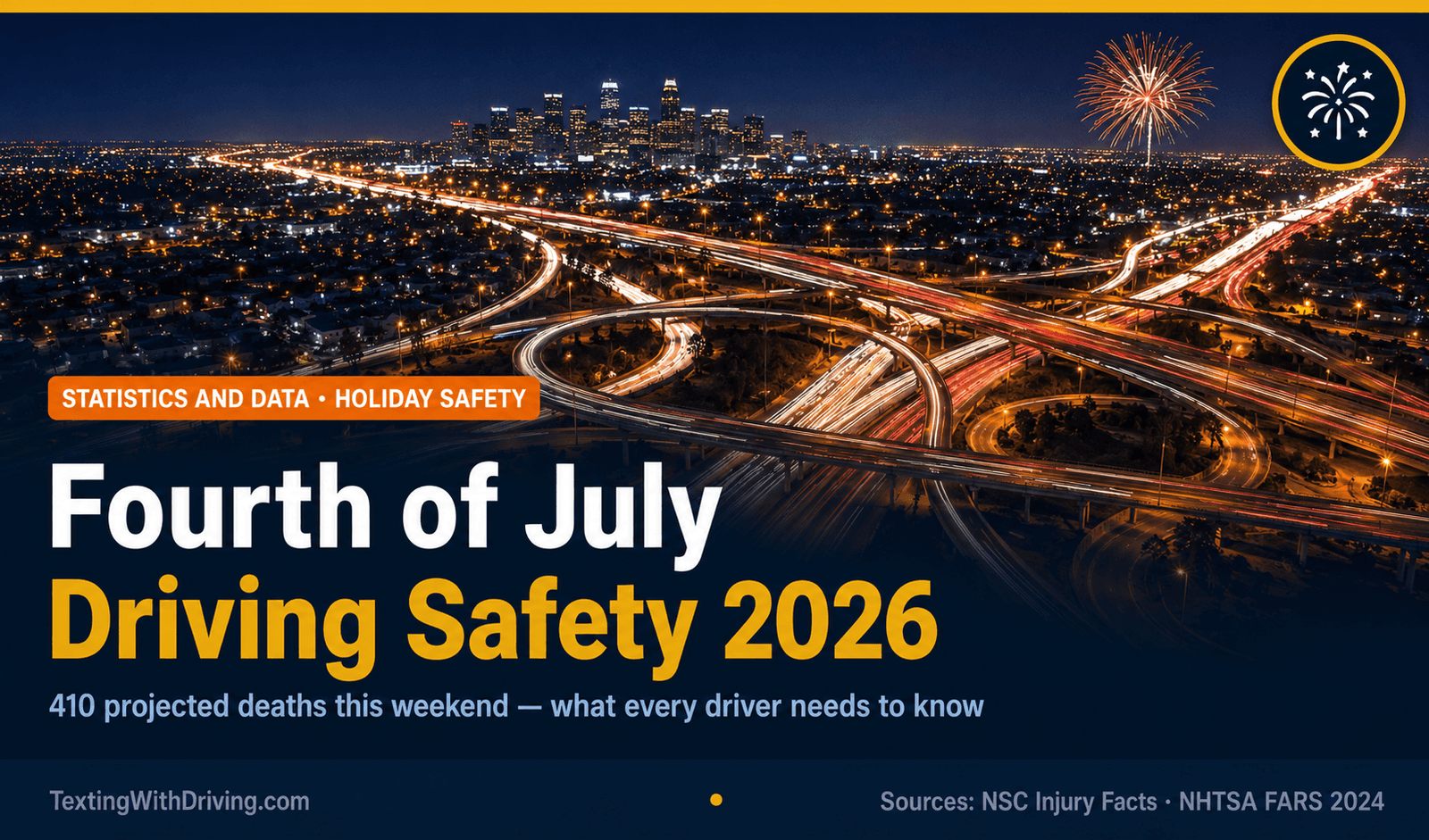
Fourth of July driving safety 2026 is not a topic that can wait until after the holiday. The National Safety Council estimates 410 people may die on US roads this Independence Day holiday period — and the window has already begun. In 2026, July 4 falls on a Saturday, making the official holiday period 3.25 days running from 6 PM Thursday July 2 through 11:59 PM Sunday July 5.
410 projected deaths in 3.25 days. That is approximately 126 people per day on American roads during this specific holiday window. Understanding why the Fourth of July produces this level of carnage every year, and what the specific role of distracted driving plays in it, gives every driver a clearer picture of the road environment they are entering this weekend.
Fourth of July Driving Safety by the Numbers
The most authoritative source for holiday traffic fatality data is the National Safety Council, which uses NHTSA FARS data to calculate both historical trends and forward-looking estimates. The 2026 numbers are alarming and specific.
National Safety Council estimates 410 people may die on U.S. roads this Independence Day holiday period. The last 3.25-day long Independence Day holiday period occurred in 2025, resulting in an estimated 437 deaths. AAA Newsroom
The comparison with 2025 is important context. The 2025 estimate was 437 deaths over an identical 3.25-day window. The 2026 projection of 410 reflects the broader national improvement trend we documented in our distracted driving statistics 2026 article — 36,640 total traffic deaths in 2025 was the second-lowest rate in recorded US history. But 410 projected deaths in a single holiday weekend is still a humanitarian catastrophe measured in preventable losses.
In 2024 alone, there were 579 people killed in traffic crashes during the Fourth of July holiday period. The 2026 projection of 410 is a significant improvement over 2024’s actual count of 579, reflecting the national improvement trend. Even so, every single projected death this weekend represents a preventable outcome. Aaa
Based on the current medically consulted injury-to-death ratio of 114:1, the estimate of nonfatal medically consulted injuries that will result from crashes during the holiday period is 46,700. AAA Newsroom
46,700 additional people are projected to be injured seriously enough to seek medical attention during this same 3.25-day window. Injuries that will produce emergency room visits, hospitalizations, surgeries, lost income, and in many cases permanent disability. All from crashes that did not have to happen.
Why the Fourth of July Is Specifically Dangerous
The Fourth of July does not produce elevated fatality counts simply because more people are driving, though that is a contributing factor. It produces elevated counts because of the specific convergence of behavioral risk factors that no other holiday combines in quite the same way.
Alcohol. Of the 2,719 total traffic fatalities during the Fourth of July holiday period from 2020 to 2024, 38% of those drivers were drunk. Of the 1,724 drivers killed, the 21-34 age group had the highest percentage at 47% of drunk drivers. During the Independence Day period specifically, 38% of fatalities involved an alcohol-impaired driver, compared to 30% of total traffic fatalities nationwide in 2024. The holiday’s alcohol involvement rate is 8 percentage points above the national annual average — a significant elevation produced by the celebration culture of the holiday. AaaAAA Newsroom
Volume. The Fourth of July weekend is one of the highest-travel periods of the summer, sitting squarely within AAA’s 100 Deadliest Days window between Memorial Day and Labor Day. More vehicles on the road means more conflict points, more congestion, more unfamiliar routes, and more opportunities for the behavioral failures that produce crashes to intersect with other vehicles.
Night driving. On the most dangerous nights of the year — New Year’s Eve, Independence Day and Labor Day weekend — drunk drivers are most active in the hours after midnight. The fireworks tradition extends July 4 evening activities significantly later than a typical summer evening, pushing return-trip driving into the late-night window when impairment risk, fatigue, and phone use all peak simultaneously. Upstate Today
Day of week. In 2026, July 4 falls on a Saturday. About one-third of all distracted driving fatalities happen on a Friday or Saturday, according to 2023 NHTSA data. Saturday is already the highest-risk day of the week for fatal crashes year-round. When Saturday coincides with the Fourth of July, the weekend’s natural risk elevation compounds the holiday’s specific risk factors. Berkeley
The Distracted Driving Dimension on July 4
Alcohol-impaired driving gets most of the attention in Fourth of July safety messaging, and rightfully so given its 38% fatality involvement rate. But distracted driving is a parallel and compounding risk factor that operates independently of impairment and deserves specific attention.
The Fourth of July weekend creates every condition that makes distracted driving more dangerous than on an ordinary day.
Social coordination pressure. July 4 celebrations involve the most intense social coordination demands of the summer: group texts about parade locations, fireworks viewing spots, barbecue timing, and gathering logistics all peak on and around July 4. Every one of those messages arrives while many recipients are in a moving vehicle, creating the notification pressure that drives phone interaction during drives. As we documented in our article on the anxiety, stress and FOMO connection to distracted driving, the social pressure to respond to group messages creates a specific psychological pull toward phone use while driving that is stronger on high-social-activity days.
Navigation to unfamiliar locations. July 4 travel frequently involves driving to locations that are not part of the normal routine: fireworks venues, lakeside gatherings, friends’ homes in unfamiliar neighborhoods. Navigation app interaction while moving produces the visual and manual distraction that the California court confirmed is a violation even for mounted devices. As we covered in our summer road trip safety guide, the solution is pre-setting the destination before the car moves, not managing navigation mid-drive.
Late-night return trip phone use. Distracted driving spikes at night between 6:00 PM and 11:00 PM. The return trip from fireworks events falls squarely in this window, often extending past midnight. Cambridge Mobile Telematics data consistently shows this evening period as peak phone interaction time behind the wheel. A driver returning from a July 4 fireworks event at 10:30 PM is navigating the highest-risk period for distracted driving on the highest-risk holiday night of the summer simultaneously. Berkeley
Passenger distraction. July 4 is quintessentially a family holiday. Vehicles are full: children tired after a long holiday day, excitement from the fireworks, multiple conversations, food and drink in the car. As documented in our distracted driving and children article, children in the back seat create more than 3 minutes of driver distraction per 16-minute trip on average. A 45-minute return trip home from a fireworks show with tired children in the car produces a sustained distraction environment that makes phone-free driving more important, not less.
The Week Context: The Most Dangerous Week of the Year
The Fourth of July does not exist in isolation. It anchors the most dangerous week of the year for American road travel.
The first week of July was the most dangerous week for drunk driving from 2019 to 2023, with 1,439 DUI fatalities during the Independence Day period. It narrowly edged out the first week of September, which includes Labor Day, at 1,424 fatalities, a margin of about 1%. Eight of the 10 deadliest weeks fall between June and early September. Upstate Today
The entire week surrounding July 4, not just the holiday itself, carries elevated crash risk because of increased travel volume, extended celebration activity across multiple days, and the behavioral patterns that persist throughout a holiday week rather than concentrating on a single day.
For drivers who are making any road trip between July 1 and July 7, 2026, the same precautions that apply to the holiday itself apply to every drive during this window.
Seatbelt Data: The Most Direct Life-Saving Action
The NSC’s Fourth of July safety analysis includes a specific calculation about seatbelt use that puts the stakes of this single behavioral choice in clear terms.
Studies show seat belts, when used, are 45% effective in preventing fatalities among front-seat passenger car occupants. Based on the projected number of vehicle occupants who will wear seat belts, an estimated 154 lives may be saved this Independence Day holiday period. An additional 100 lives could be saved if all vehicle occupants wear seat belts. AAA Newsroom
154 lives saved by current seatbelt usage rates. 100 additional lives that could be saved if everyone buckled up. 254 total preventable deaths from seatbelt non-compliance during a single holiday weekend. The combination of seatbelt use and phone-free driving addresses the two most individually controllable crash risk factors that every driver has direct power over regardless of what other drivers do.
What Enforcement Looks Like This Weekend
Law enforcement agencies across the country intensify Fourth of July weekend patrol presence specifically because of the documented elevated crash risk. The Drive Sober or Get Pulled Over campaign, coordinated by NHTSA, deploys targeted enforcement resources during the holiday period in states that activate the campaign.
Distracted driving enforcement runs parallel to drunk driving enforcement during the holiday weekend. In primary enforcement states, including the 33 states plus DC with comprehensive hands-free laws, officers can stop any driver observed holding a phone without any other violation. As we covered in our how police enforce distracted driving laws article, high-visibility enforcement during holiday periods elevates the perceived risk of being caught, which produces real behavioral change even among drivers who would not change behavior based on awareness alone.
The Defensive Driving Standard for July 4 Weekend
The presence of 38% alcohol-impaired driver involvement in July 4 fatalities means that the danger this weekend does not only come from your own choices. It also comes from the choices other drivers make. A fully sober, fully attentive, phone-free driver can still be affected by an impaired driver’s error.
Whether you’re sober or not, stay off the phone and keep your eyes on the road, especially at night. Distracted driving is a leading cause of fatal crashes according to NHTSA. You can’t always tell when an impaired driver is nearby, so staying alert gives you more time to react. Upstate Today
Staying alert gives you more time to react to an impaired driver’s behavior. That reaction time is only available to you if your attention is fully on the road environment. The five-second phone glance that covers a football field blind eliminates the reaction window that could allow you to avoid a crash caused by someone else’s impairment.
The practical Fourth of July driving standard is therefore more strict, not less, than on an ordinary day. Not because the law changes. Because the road environment has materially more risk in it, and the margin for any inattention event to produce a crash is smaller when the surrounding traffic includes a statistically elevated proportion of impaired drivers.
The Complete July 4 Weekend Driving Checklist
Before every drive this weekend, regardless of distance:
Before the car moves: Phone in the back seat. Driving Focus or Android driving mode activated. GPS destination entered. Every passenger briefed that the driver is not answering their phone during the drive.
Timing: Where possible, avoid driving between 10 PM and 2 AM on the nights of July 3, 4, and 5. This window represents the peak convergence of late-night impaired driving, peak phone use hours, and fireworks-related pedestrian activity near roadways.
Seatbelts: Every occupant, every seat, before the car moves. The NSC data shows 100 additional lives per July 4 weekend could be saved by universal seatbelt compliance.
Return trip planning: Arrange the return trip timing before leaving for the event. A driver who knows they will be leaving at 9 PM rather than after midnight is avoiding the highest-risk window entirely. Plan it before the evening starts.
For the full context of summer driving risk that surrounds this holiday, our summer road trip phone-free driving guide 2026 covers everything from AAA’s 100 Deadliest Days data to multi-day trip fatigue management. For the technology setup that makes phone-free driving automatic regardless of what the holiday brings, our Do Not Disturb while driving setup guide covers both iPhone and Android from scratch.
Sources Used in This Article
All links verified working before publication.
NSC Injury Facts: Independence Day 2026 Motor Vehicle Fatality Estimates — 410 projected deaths, 3.25-day window, 46,700 projected injuries, 154 lives saved by seatbelts
NHTSA Traffic Safety Marketing: Fourth of July Stats — 579 killed in 2024, 2,719 total 2020-2024, 38% alcohol involvement
NSC Injury Facts: Holiday Motor Vehicle Introduction — Holiday period definition, 2026 Independence Day window
MoneyGeek: 2026’s Most Dangerous Days for DUIs — First week of July most dangerous for drunk driving 2019-2023, 1,439 DUI fatalities
Insurify: Distracted Driving Statistics 2026 — Friday/Saturday distraction peak, 6 PM-11 PM distraction spike
NHTSA: Distracted Driving — 3,208 deaths 2024, national statistics
NSC Injury Facts: Distracted Driving — 2% decrease in fatal distraction crashes 2024, 14% cell phone involvement
Allen and Allen: Holiday Driving Statistics — Holiday phone use increases 33%, speed increases during holidays
TextingWithDriving.com is professionally built and maintained to ensure accurate, accessible safety information reaches every driver who needs it. Website development and ongoing support is handled by Budgetic, a digital agency specializing in purpose-driven WordPress websites.

About Texting With Driving
TextingWithDriving.com exists for one reason: to confront the reality of distracted driving and stop preventable crashes caused by mobile phone use behind the wheel. Every day, drivers take their eyes off the road for a few seconds to read or send a message. Those few seconds are enough to cause life-altering consequences. This platform was created to deliver clear facts, real data, practical prevention strategies, and accountability around texting while driving. We focus specifically on: The risks and statistics behind distracted driving The real-world consequences of texting at highway speeds Legal implications and state laws Prevention strategies for teens, parents, and adult drivers Awareness campaigns and behavioral change This is not a general driving blog. It is a focused awareness initiative built around one critical issue: phone distraction behind the wheel. Our content is direct, research-driven, and practical. We prioritize accuracy over opinion and education over sensationalism. The goal is simple — reduce distracted driving incidents by increasing awareness and responsibility. If one article causes one driver to put their phone down, the mission is working. For inquiries or partnerships, contact: privacy@textingwithdriving.com
View all posts by Texting With Driving