

Distracted Driving and Drowsy Driving 2026: The Compounding Risk Every Driver Must Know

Distracted Driving and Drowsy Driving 2026: The Compounding Risk Every Driver Must Know
Distracted driving drowsy driving 2026 is the combination that traffic safety researchers have identified as one of the most dangerous and most underaddressed convergences in American road safety — and one that occurs with alarming frequency on the specific roads and at the specific times when most drivers believe they are handling the situation.
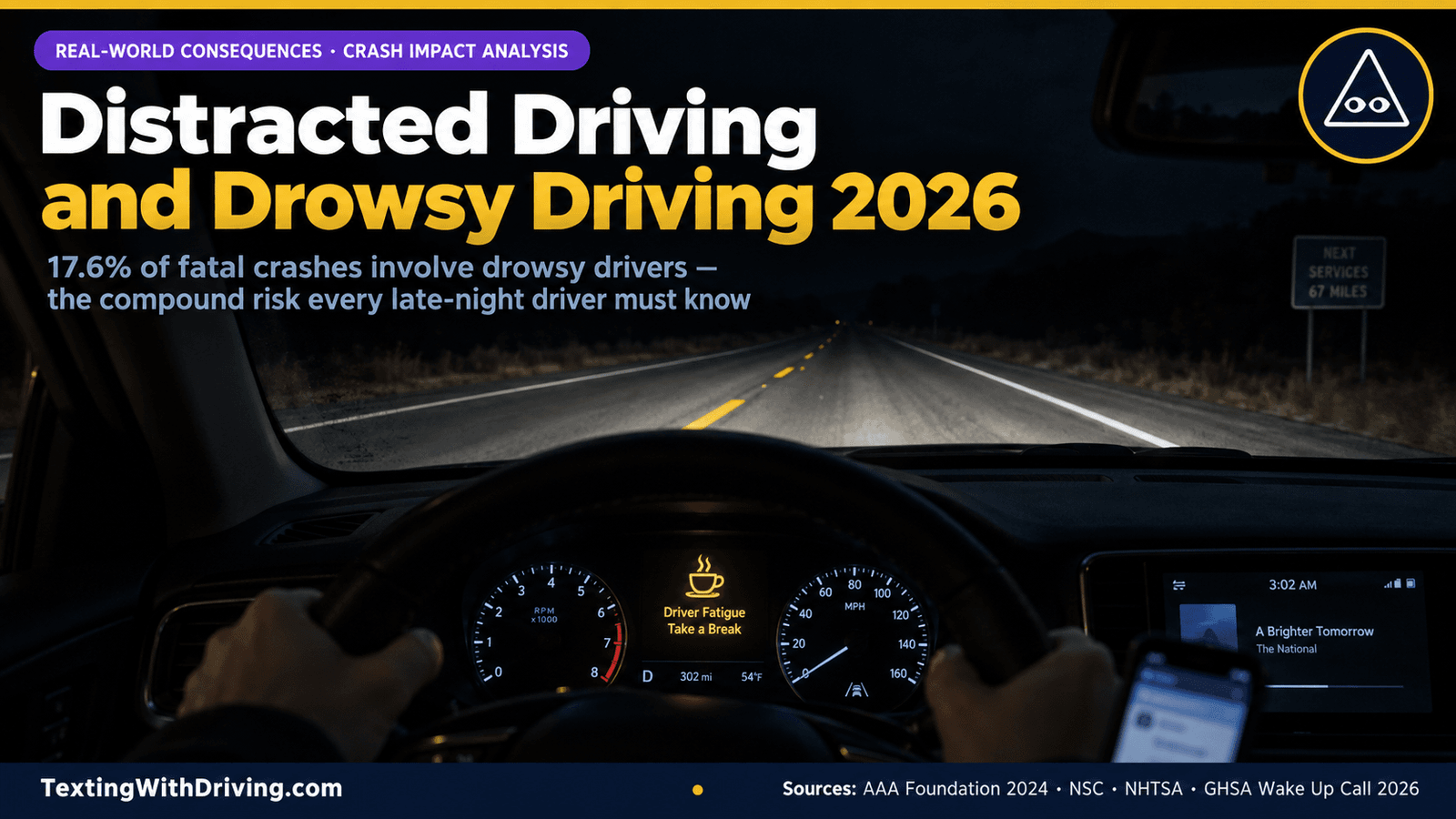
The scale of each individual problem is significant: distracted driving killed 3,208 people in 2024 per NHTSA. But drowsy driving’s scale is far larger than most drivers know, because it is dramatically underreported. A 2024 study by the AAA Foundation for Traffic Safety estimated that 17.6 percent of all fatal crashes from 2017 to 2021 — 30,000 fatalities over the five-year period — involved a drowsy driver. That is 10 times higher than the reported number.
10 times higher than the reported number. NHTSA officially reports approximately 633 drowsy driving deaths per year in its FARS data. The AAA Foundation’s naturalistic research methodology — which captures driver state in the seconds before a crash rather than relying on post-crash reporting where the driver’s drowsiness must be documented by an investigating officer — estimates the actual drowsy driving fatality count is approximately 6,000 per year. The gap between what gets coded in crash reports and what actually caused crashes is larger for drowsy driving than for any other behavioral risk factor.
The convergence of these two behaviors — distracted driving and drowsy driving — creates a compounding impairment that is more dangerous than either behavior individually. This is not additive: a slightly distracted and slightly drowsy driver is not simply the sum of two mild impairments. Both behaviors reduce the same limited pool of attentional resources that safe driving requires. They compound — creating a level of impairment that exceeds what either behavior alone produces.
This guide covers the complete distracted driving drowsy driving 2026 picture: the drowsy driving statistics that most drivers have never seen (because the official numbers dramatically understate the problem), the neurological mechanism that makes the two behaviors compound rather than add, the specific time windows and road scenarios where the combination is most dangerous, what the fall season does to the compound risk, and what every driver can do to recognize and respond to the combined impairment before it kills someone.
The Real Scale of Drowsy Driving: 10 Times Worse Than Reported
Distracted driving drowsy driving 2026 analysis must begin with the drowsy driving statistics that explain why the compound risk has been underaddressed: the official data dramatically understates drowsy driving’s contribution to crashes.
NHTSA reports approximately 100,000 police-reported crashes and over 1,500 deaths as the results of drowsy driving each year. But the same research community that produces this number acknowledges the fundamental limitation: NHTSA and NSF have stated that the reported number of drowsy drivers is artificially low due to underreporting because sleepiness before and after a crash can be challenging to ascertain.
The investigative challenge is specific. An officer who arrives at a crash scene observes the physical evidence — vehicle positions, skid marks, road conditions — and interviews the surviving parties. A driver who fell asleep at the wheel and crashed may not accurately self-report drowsiness, either because they did not recognize their own fatigue level before the crash or because they wish to avoid the legal and insurance consequences of admitting impaired driving. Unlike alcohol impairment — which produces a measurable, objective blood alcohol concentration from a blood or breath test — drowsiness leaves no toxicological record.
The AAA Foundation’s 2024 study resolved this methodological limitation by using naturalistic driving data — cameras that were recording the driver in the seconds before crashes, providing objective behavioral evidence of drowsiness that does not depend on post-crash self-reporting. From July 2025 through May 2026, the AAA Foundation analyzed this naturalistic data across thousands of crashes and near-crashes, establishing that 17.6 percent of all fatal crashes involved a drowsy driver.
17.6 percent of fatal crashes. Applied to the approximately 39,000 total US traffic fatalities in 2023, the AAA Foundation’s 17.6 percent figure projects to approximately 6,864 drowsy driving deaths — versus NHTSA’s reported 633. The ten-fold gap between these estimates is the largest systematic undercount of any behavioral crash factor in NHTSA’s data.
NHTSA estimates fatigue-related crashes resulting in injury or death cost society $109 billion annually, not including property damage. $109 billion. Against the $120.32 billion economic cost of distracted driving documented in our economic cost of distracted driving 2026 article, drowsy driving’s $109 billion societal cost positions it as an equally large national road safety crisis — but one that receives far less public attention, campaign infrastructure, and legislative response than distracted driving.
The Neurological Connection: Why Both Draw From the Same Resource Pool
Distracted driving drowsy driving 2026 compound impairment operates through a neurological mechanism that makes the combination categorically more dangerous than either behavior alone.
Both distracted driving and drowsy driving reduce the same finite cognitive resource: attentional capacity. The prefrontal cortex’s executive function — including sustained attention, hazard detection, and response inhibition — is the specific cognitive resource that both sleep deprivation and phone distraction reduce.
As we documented in our distracted driving brain science 2026 article, a phone conversation reduces driving-related brain activity by 37 percent (Carnegie Mellon University fMRI research) and causes drivers to miss up to 50 percent of hazards in their visual field (NSC inattentional blindness research). As we documented in our Virginia distracted driving and the brain 2026 article, the attentional resource that phone distraction depletes is managed by the prefrontal cortex — the brain region whose activity decreases by 37 percent during phone use.
Sleep deprivation reduces the prefrontal cortex’s function through a different mechanism but with the same effect: reduced attentional capacity, impaired working memory, and degraded hazard detection and response. After 17 to 19 hours without sleep, cognitive performance impairment from sleep deprivation is equivalent to a blood alcohol concentration of 0.05 percent — below the legal limit but meaningfully impairing. After 20 to 25 hours awake, the impairment reaches 0.10 percent BAC equivalent — above the legal limit.
Drowsy driving mirrors so many symptoms of drunk driving: blurred vision, slowed reaction time, and poor decision making. The physiological mechanism behind this BAC-equivalence is the prefrontal cortex’s role in both alcohol impairment and sleep deprivation. Alcohol impairs prefrontal function by disrupting GABA and glutamate neurotransmission. Sleep deprivation impairs prefrontal function by disrupting the adenosine signaling that normally restores neural function during sleep. Different mechanism, same region, same functional outcome.
When a driver who is mildly sleep-deprived — six hours of sleep instead of eight, combined with early morning drive time — also makes a hands-free phone call, both impairments operate on the prefrontal cortex’s attentional capacity simultaneously. The phone call’s 37 percent brain activity reduction applies to an attentional capacity that is already below baseline from the sleep deficit. The combined reduction is not 37 percent plus sleep deficit — it is 37 percent of a reduced baseline, producing a total impairment that exceeds either behavior alone.
Driving drowsy has been shown to increase the risk of accidents and potentially fatal crashes. The BAC equivalence data — 0.05 to 0.10 percent — combined with the 37 percent phone-related brain activity reduction produces the combined impairment of a driver who is both sleep-impaired and phone-distracted at a level that exceeds the crash risk of either impairment alone.
The Peak Windows: When Combined Risk Is Highest
Distracted driving drowsy driving 2026 peaks at specific, predictable time windows that every driver should know.
Midnight to 6 AM: The majority of drowsy-driving crashes happen between midnight and 6 AM. This window coincides with the circadian nadir — the lowest point of human alertness in the 24-hour biological cycle — when drowsiness is greatest regardless of how long the driver has been awake. The driver who starts a midnight return trip from a holiday celebration is in both the peak drowsiness window and the peak impaired driving window documented in our Labor Day driving safety 2026 article.
The midnight-to-6-AM window is also the period when the specific social coordination phone use that holiday returns generate is most active: texting about arrivals, calling about ETA, checking in with people who stayed behind. The highest-distraction phone use demand coincides precisely with the highest-drowsiness biological window.
Late afternoon (2 to 4 PM): NHTSA identifies a secondary drowsy driving peak in the late afternoon hours — the post-lunch circadian dip that affects alertness during the 2 to 4 PM window even for drivers who are adequately rested. For drivers who did not sleep adequately the night before, the afternoon dip compounds the already-reduced baseline — and the afternoon commute phone use that CMT’s behavioral data consistently documents as a peak phone-interaction period creates the specific afternoon compound risk.
The school year morning commute: September’s return to school creates a specific compound risk window that the Virginia September 2026 article addresses: parents who are managing school-start-time logistics, who may have reduced sleep from the school year schedule transition, who are coordinating school drop-off by phone during the morning commute. The combination of schedule transition sleep disruption and morning coordination phone use creates the compound impairment in the most traffic-dense commute window of the day.
Post-shift driving for shift workers: Nurses, factory workers, first responders, and other shift workers who commute home after 12-hour overnight shifts are among the highest-risk drowsy driving populations. The post-shift driver who is simultaneously exhausted from the overnight shift and managing phone coordination with family members about their arrival is in the compound impairment scenario at its most acute.
The Fall Season Connection: Daylight Saving and Sleep Disruption
Distracted driving drowsy driving 2026 has a specific fall seasonal component that makes the September-November period particularly important for compound risk awareness.
The transition out of Daylight Saving Time in early November — and the gradual shortening of daylight through September and October that precedes it — creates specific drowsy driving risk escalation:
Circadian rhythm disruption. The abrupt one-hour shift when clocks fall back — typically the first Sunday of November — disrupts the circadian rhythm comparably to a one-time zone westward travel. The body clock’s adjustment period, typically one to two weeks, produces reduced sleep quality and daytime alertness during the transition period.
Reduced daylight during commutes. As September progresses, the afternoon school dismissal window and evening commute window shift progressively into lower-light conditions. By late October, the 3 PM to 4 PM child pedestrian death peak we documented in our back to school driving safety 2026 article occurs in near-dark conditions. Driving in reduced-light conditions increases cognitive load — requiring more attentional resources for adequate hazard detection — at exactly the time when the same drivers may also be experiencing the early fall circadian adjustment.
New school year sleep disruption. The return to school in September creates sleep disruption for both students and parents — earlier wake times, new scheduling demands, and the social and academic pressures that the school year reactivates after summer. Research consistently shows that school-year sleep quantity decreases compared to summer for both teens and their parents, creating the mild chronic sleep debt that compounds with phone distraction during commutes.
Interventions focusing on this age group can help move the needle to reduce drowsy driving. The CDC’s recommendation that teens get 8 to 10 hours of sleep per night — typically not achieved during the school year — reflects the specific teen population vulnerability that the fall season creates for the same teen drivers whose phone distraction risk we documented in our teen distracted driving behavior change 2026 article.
The Holiday Return Trip: The Most Dangerous Compound Scenario
Distracted driving drowsy driving 2026 produces its most dangerous conditions during the specific scenario documented in both our Labor Day driving safety 2026 article and the Virginia distracted driving September 2026 article: the holiday weekend return trip.
Virginia State Police documented 10 deaths in 8 crashes over the Labor Day 2026 holiday weekend. Three of those killed were pedestrians on I-395. The midnight-to-6-AM return trip window, the post-celebration sleep deficit, the social coordination phone use, and the alcohol-adjacent driving environment documented in our Labor Day article all converge in the specific compound risk scenario that holiday return trips produce.
The Labor Day return trip is the prototypical distracted driving drowsy driving 2026 compound scenario:
Sleep deficit. A Labor Day celebrant who attended a Saturday night party and returned to the campground or friend’s house at midnight has had reduced sleep by at least four to six hours below their normal baseline before the Sunday return trip begins.
Alcohol proximity impairment. Even a driver who did not personally drink — the designated driver, the driver who stopped drinking hours before departure — may have been around alcohol consumers, managing the logistics of a social situation, and dealing with the stress of coordinating return transportation. The elevated cortisol from social stress and logistical management degrades sleep quality even when the driver does sleep before the return trip.
Social coordination phone use. The return trip generates the highest volume of phone coordination messaging of any comparable driving period: who is in which car, who needs to be picked up where, which route avoids the traffic, when to stop for gas or food. Every one of these messages creates a phone-check impulse during exactly the midnight-to-6-AM drowsy driving peak window.
The specific physiological warning signs that appear: The driver who is both drowsy and distracted may not recognize their own impairment level. More than 40 percent of drivers admit they have fallen asleep behind the wheel — yet most of them did not recognize they were impaired enough to stop before falling asleep. The progressive drowsiness that produces microsleeps — two-to-four-second lapses of consciousness — can feel like normal attention variation rather than dangerous impairment.
Microsleeps: The Specific Drowsy Driving Crash Mechanism
Distracted driving drowsy driving 2026 reaches its most acute danger level through the specific mechanism of microsleeps — brief, involuntary episodes of sleep that last from two to four seconds and produce complete loss of consciousness and control during that period.
At 60 mph, a two-second microsleep covers 176 feet of travel during which the driver has zero awareness of their environment — no visual processing, no hazard detection, no ability to respond. A four-second microsleep covers 352 feet — more than the length of a football field — while the driver is essentially unconscious.
The critical distinction from phone distraction is that microsleeps produce complete attentional absence rather than reduced attentional capacity. A distracted driver misses up to 50 percent of hazards. A driver experiencing a microsleep misses 100 percent of hazards for its duration — because they are briefly unconscious.
When drowsy driving and phone distraction occur simultaneously, the phone distraction reduces the attentional capacity that would normally provide the driver with the awareness signals of approaching drowsiness — the heavy eyelids, the wandering focus, the need to blink rapidly to clear vision. A driver who is cognitively engaged with a phone conversation has reduced capacity to monitor their own physiological state, including the drowsiness signals that would normally prompt them to pull over or take a break.
The result: the drowsy phone-distracted driver may not recognize the pre-microsleep warning signs because their cognitive resources are allocated to the phone interaction rather than to self-monitoring. They proceed past the warning signs into the microsleep itself, with no awareness of the danger until the vehicle has already departed its lane or struck an obstacle.
The Legislative Gap: Only Two States Have Drowsy Driving Laws
Distracted driving drowsy driving 2026 has a specific policy gap that the distracted driving legislative wave has not addressed: only two states — Arkansas and New Jersey — have laws directly classifying drowsy driving as a punishable offense.
The legislative gap reflects the same enforcement challenge that makes drowsy driving chronically underreported: drowsiness cannot be tested objectively at a crash scene the way alcohol can. Without a breathalyzer equivalent for drowsiness, primary enforcement of a drowsy driving prohibition faces the same evidentiary challenges as the old texting-only bans that permitted drivers to claim GPS use.
The absence of primary drowsy driving laws in 48 states creates a specific asymmetry in the distracted driving drowsy driving 2026 policy framework: the phone use that contributes to the compound impairment is addressed by primary enforcement hands-free laws in 33-plus states, while the drowsiness that compounds with the phone use is addressed by almost no state law. A Virginia driver who is both drowsy and making a hands-free call can be cited for neither behavior under Virginia’s current law — only if they are caught holding the phone is any primary enforcement available.
California, Connecticut, Florida, Iowa, and Maine have adopted driver’s license restrictions for motorists with untreated sleep disorders — a targeted approach that addresses the chronic sleep disorder population without requiring the general drowsiness enforcement that primary drowsy driving laws would need.
The Signs Every Driver Must Recognize
Distracted driving drowsy driving 2026 requires every driver to recognize the specific warning signs that indicate the compound impairment is reaching dangerous levels — before the microsleep event that the signs are warning of.
Physical warning signs of drowsy driving:
Excessive blinking or heavy eyelids that require effort to keep open. Frequent yawning that interrupts focus. Head nodding or snapping upright from brief dozing. Difficulty maintaining a consistent speed or lane position. Missing exits or turns that were in the driving plan. Inability to recall the last few miles of road traveled.
Behavioral warning signs of compound impairment:
The phone that is providing the stimulation of a conversation feels necessary to stay awake — not just as communication but as cognitive stimulation that counteracts drowsiness. This is the dangerous inversion where phone use is being used as an alertness tool: the driver who keeps talking on the phone precisely because they are drowsy and the conversation is keeping them awake is experiencing the compound impairment at its most acute. The conversation is reducing their hazard detection capacity at exactly the moment when their drowsiness is also reducing it — and the driver is choosing to maintain the reducing factor because it is providing the stimulation that masks the warning signs.
The coffee misconception: Caffeine can delay the onset of sleep for one to two hours but cannot substitute for actual sleep. A driver who is 18 hours awake — the BAC-equivalent of 0.05 percent — who drinks coffee will feel more alert for 30 to 60 minutes but will not have their attentional capacity restored to baseline. The compound impairment with phone distraction continues regardless of caffeine consumption.
The only effective intervention for drowsy driving: Stopping and sleeping. A 20-minute nap — not longer, to avoid entering deep sleep that produces grogginess upon waking — has documented research support for restoring short-term alertness for one to two hours. Pulling off the highway at a rest stop, locking the doors, and taking a 20-minute nap is the most effective available intervention when the drowsy driving warning signs appear.
What Every Driver Must Do
Distracted driving drowsy driving 2026 requires three specific actions that address the compound risk directly.
Never drive drowsy. Recognize that 40 percent of drivers have fallen asleep at the wheel — and that drowsiness reaches dangerous levels before the driver recognizes it. If the warning signs appear, stop. A 20-minute rest area stop is not a schedule inconvenience. It is the specific intervention that prevents the microsleep that would convert a late return trip into a crash.
No phone during drowsy driving windows. The midnight-to-6-AM window and the late-afternoon 2-to-4-PM window are when both drowsy and distracted driving risk peak. Phone in back seat during these windows eliminates the compound impairment that makes these windows specifically more dangerous than the same behavior during midday driving.
Recognize the holiday return trip as the compound risk scenario it is. Labor Day, Thanksgiving, New Year’s, Memorial Day — every major holiday return trip combines the sleep deficit of the celebration weekend, the social coordination phone use of the return logistics, and the late-night driving window that peaks drowsy driving risk. The combination is not coincidental. It is systematic. And it is preventable with planning: leave before midnight, sleep before driving, phone in back seat for the return trip.
For the full distracted driving statistics context including the NHTSA 2024 baseline, our distracted driving statistics 2026 article covers the complete data. For the Labor Day specific compound risk scenario with the Virginia and national death data, our Labor Day driving safety 2026 article covers the holiday return trip context. For the brain science explaining why both behaviors reduce the same attentional resource, our distracted driving brain science 2026 article covers the cognitive load mechanism. And for the technology setup that removes the phone from the compound impairment equation, our hands-free while driving complete setup guide covers iPhone, Android, Bluetooth, and CarPlay.
Sources Used in This Article
All links verified working before publication.
NSC: Fatigued Driving — AAA Foundation 2024 study 17.6% of all fatal crashes 2017-2021 involved drowsy driver = 30,000 fatalities, 10 times higher than reported, $109 billion annually societal costs fatigue crashes, teen sleep recommendation CDC 8-10 hours
The Zebra: Drowsy Driving Statistics 2026 — NHTSA 100,000 police-reported crashes 1,500+ deaths 71,000 injuries $12.5 billion monetary losses, 40%+ drivers admitted falling asleep at wheel AAA, 2.1% fatal crashes drowsy asleep fatigued 2022, midnight-6AM late afternoon peaks, only Arkansas New Jersey specific drowsy driving laws, January 2026
Bankrate: Drowsy Driving Statistics — AAA Foundation 29,834 traffic fatalities 2017-2021 from drowsy driving 6,726 in 2021 alone, 17.6% fatal crashes, 1 in 25 drivers admit falling asleep last 30 days CDC, mirrors drunk driving blurred vision slowed reaction, California Connecticut Florida Iowa Maine license restrictions untreated sleep disorders
GHSA: Wake Up Call 2026 Update — NHTSA 633 people killed drowsy 2023 FARS data, AAA Foundation naturalistic driving naturalistic study methodology for drowsy crash identification, February 2026
NHTSA: Drowsy Driving — Drowsy driving kills but is preventable, three factors commonly associated with drowsy-driving crashes, tips for prevention
The Zebra: Distracted Driving Statistics 2026 — 3,308 deaths 2022 distraction, distracted driving spikes 6PM-11PM CMT, $836 billion societal cost traffic crashes, January 2026
NSC Injury Facts: Distracted Driving — NSC inattentional blindness 50% hazards missed, three distraction categories, national context
NHTSA: Distracted Driving — 3,208 deaths 2024, 537,000 distracted drivers any daylight moment, national context
TextingWithDriving.com is professionally built and maintained to ensure accurate, accessible safety information reaches every driver who needs it. Website development and ongoing support is handled by Budgetic, a digital agency specializing in purpose-driven WordPress websites.

About Texting With Driving
TextingWithDriving.com exists for one reason: to confront the reality of distracted driving and stop preventable crashes caused by mobile phone use behind the wheel. Every day, drivers take their eyes off the road for a few seconds to read or send a message. Those few seconds are enough to cause life-altering consequences. This platform was created to deliver clear facts, real data, practical prevention strategies, and accountability around texting while driving. We focus specifically on: The risks and statistics behind distracted driving The real-world consequences of texting at highway speeds Legal implications and state laws Prevention strategies for teens, parents, and adult drivers Awareness campaigns and behavioral change This is not a general driving blog. It is a focused awareness initiative built around one critical issue: phone distraction behind the wheel. Our content is direct, research-driven, and practical. We prioritize accuracy over opinion and education over sensationalism. The goal is simple — reduce distracted driving incidents by increasing awareness and responsibility. If one article causes one driver to put their phone down, the mission is working. For inquiries or partnerships, contact: privacy@textingwithdriving.com
View all posts by Texting With Driving