

Teen Passengers and Distracted Driving 2026: The 3x Crash Risk and What Every Parent Must Know

Teen Passengers and Distracted Driving 2026: The 3x Crash Risk and What Every Parent Must Know
Teen passengers distracted driving 2026 research has documented one of the most consistent and alarming findings in the entire teen driver safety literature: the presence of peer passengers in a newly licensed teen driver’s vehicle dramatically increases crash risk — and the mechanism is not primarily deliberate peer pressure to drive recklessly, but the specific distractions that the social environment of peers creates.
The crash risk doubles when teens drive one peer passenger and triples with two or more teen passengers. These figures, from the Children’s Hospital of Philadelphia’s TeenDriverSource — one of the most authoritative teen driver research institutions in the country — reflect the consolidated evidence from multiple NHTSA studies, IIHS research, and naturalistic driving data collected from instrumented vehicles.
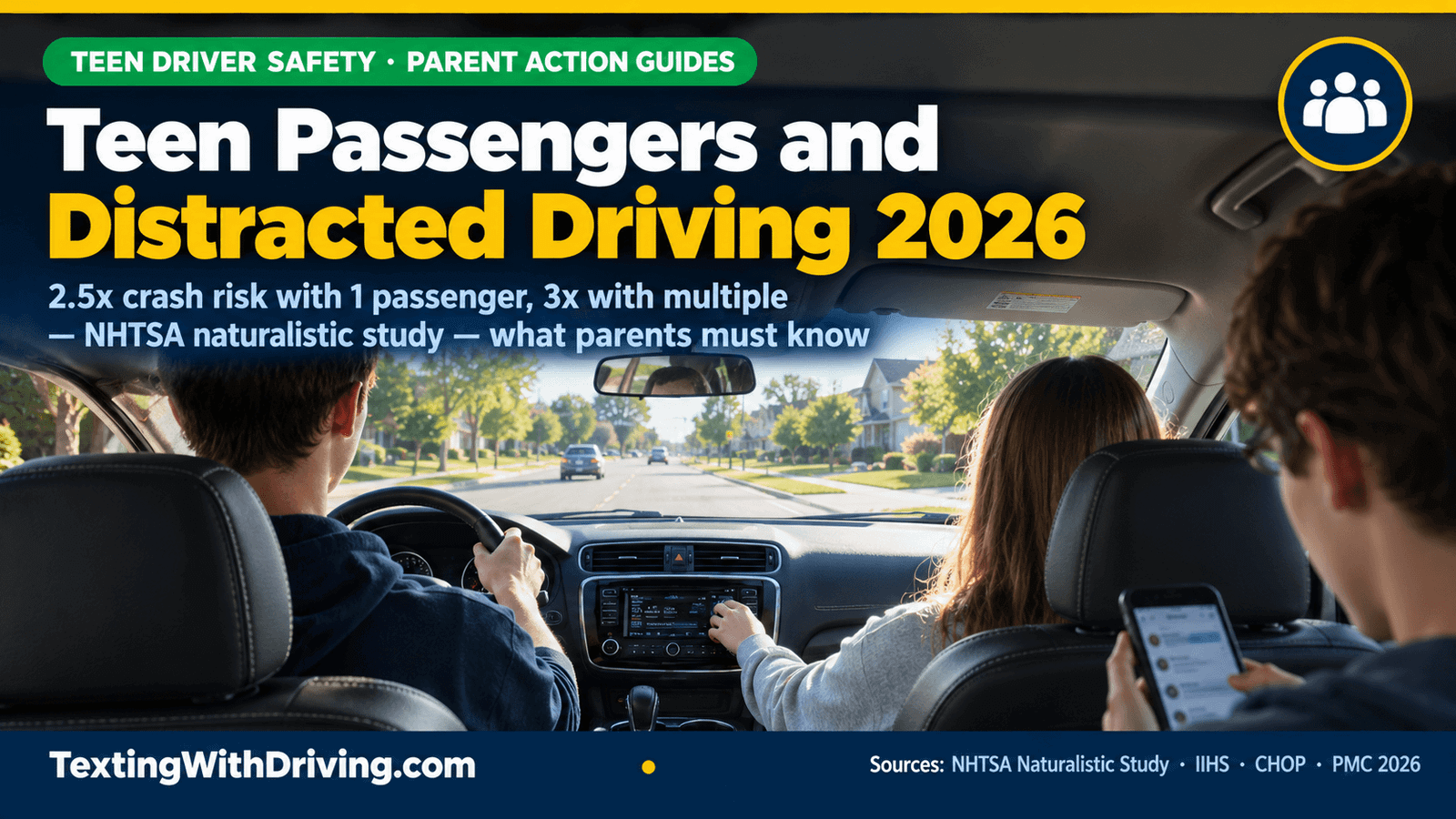
The NHTSA naturalistic study is even more precise: teenage drivers were two-and-a-half times more likely to engage in one or more potentially risky behaviors when driving with one teenage peer compared to when driving alone. When driving with multiple teenage peers, the likelihood increased to three times. And the most acute risk scenario — three or more peer passengers — produces a fatal crash relative risk of 4.39 compared to driving alone.
4.39 times more likely to die in a fatal crash with three or more peer passengers. Not 10 percent more likely. Not twice as likely. 4.39 times more likely. This is the number that every parent of a newly licensed teen driver needs to internalize before making any decision about the passenger restriction provisions of their state’s Graduated Driver Licensing law.
This guide covers the complete teen passengers distracted driving 2026 picture: the specific mechanisms through which peer passengers increase crash risk, what the naturalistic driving camera data revealed about what actually happens when peers are in the car, the gender-differentiated research findings, the specific GDL passenger restriction provisions in Virginia and Maryland, what the research shows about passenger behaviors that reduce versus increase crash risk, and what parents can do in 2026 that is supported by the evidence.
The NHTSA Naturalistic Study: Cameras Inside the Car
The most direct evidence in teen passengers distracted driving 2026 research comes from NHTSA’s naturalistic driving study that placed event-based data recorders inside the vehicles of newly licensed teen drivers and captured what actually happened during 24,085 driving clips over a six-month study period.
Risky driving behaviors by teenage drivers were more common while they were driving in the presence of teenage peers. The naturalistic data captured what surveys and self-reports cannot: actual in-car behavior, in real-time, without the modification that observed behavior and self-reported behavior both involve.
What the cameras found when teen peer passengers were present:
Loud conversation was 5 times more likely. The specific social behavior of loud conversation — which diverts the driver’s auditory attention, creates the social pressure to respond, and physically orients the driver’s head toward the passenger — was five times more frequent when teen passengers were present than when the driver was alone.
Horseplay was 9 times more likely. Physical horseplay between driver and passenger — reaching across the center console, playful contact, the physical social behaviors of peer interaction — was nine times more frequent with passengers present. Horseplay creates manual distraction (hands leaving the wheel), visual distraction (eyes leaving the road toward the passenger), and cognitive distraction simultaneously.
Deliberate encouragement to take risks was rare. This finding is the most counterintuitive in the entire passenger research literature: some of the mechanisms commonly thought to explain the increased crash risk when carrying passengers were rare, such as instances of deliberate encouragement for the drivers to take risks. Rather, helpful statements on the part of passengers were 10 times more common than statements encouraging risk-taking behavior. These findings suggest the mere presence of peers may have influenced risky driving behaviors more than deliberate encouragement.
The mere presence of peers. Not peer pressure to speed. Not passengers saying “go faster” or “run the light.” Just having peers in the car — even peers who are not doing anything overtly risky — is the mechanism that produces the 2.5x to 3x crash risk increase. The social brain of the adolescent that is still developing its prefrontal cortex-based impulse regulation, as we documented in our Virginia teen distracted driving brain science 2026 article, is more activated by the social context of peer presence than by an empty car — and that social activation diverts attentional resources from the driving task.
The Escalating Risk Gradient: One Passenger, Two, Three
Teen passengers distracted driving 2026 research documents a specific escalating risk gradient that makes the number of passengers the critical variable — not just their presence or absence.
The research from Tefft, Williams, and Grabowski cited in the PMC peer-reviewed literature shows:
One peer passenger: Relative risk of fatal crash 1.44 (44 percent higher than driving alone)
Two peer passengers: Relative risk 2.02 (more than double the risk of driving alone)
Three or more peer passengers: Relative risk 4.39 (more than four times the risk of driving alone)
These are fatal crash relative risks — not all-crash risks, but the specific risk of dying in a crash. The escalation from 1.44 to 4.39 across three tiers of passenger count is non-linear: each additional passenger adds proportionally more risk than the previous one. Three passengers is not three times the risk of one passenger — it is more than three times, reflecting the compounding social complexity that each additional peer creates.
In fatal speeding-related crashes with teen drivers, the risk increases exponentially with each additional peer in the vehicle. The exponential nature of the escalation — cited by IIHS and confirmed in the CHOP research — is the mechanism that explains why the GDL passenger restriction is the most evidence-based element of any state’s graduated driver licensing framework. If the risk escalation were linear, a restriction limiting passengers might reduce risk proportionally. Because the escalation is exponential, restricting to zero or one non-family passenger prevents the highest-risk scenarios while permitting the lower-risk scenarios.
The Gender Dimension: Different Mechanisms for Male and Female Teen Drivers
Teen passengers distracted driving 2026 research reveals an important gender-differentiated pattern in how peer passengers increase crash risk for male versus female teen drivers.
The study analyzing 677 drivers aged 16-18 from the National Motor Vehicle Crash Causation Survey found:
Male teen drivers with passengers:
More likely to perform an aggressive act (risk ratio 2.36 compared to male drivers alone). More likely to perform an illegal maneuver (risk ratio 5.88 — nearly six times more likely). More likely to be distracted by an exterior factor (risk ratio 1.70). Risk taking increased regardless of whether the passengers were male or female.
Female teen drivers with passengers:
More often engaged in at least one interior non-driving activity other than conversing with passengers (risk ratio 3.87 — nearly four times more likely), particularly when driving with opposite-gender passengers. Female drivers, both with and without passengers, rarely drove aggressively or performed an illegal maneuver before crashing.
The conclusion: passengers may affect male teen driver crashes through both distraction and risk-promoting pathways, and female involvement primarily through internal distraction.
This gender differentiation has practical implications for parent conversations. A conversation with a son about the passenger restriction should emphasize the risk-promotion pathway — the aggressive acts, the illegal maneuvers, the externally directed distraction that male teens show in crash data. A conversation with a daughter should emphasize the internal distraction pathway — the non-driving activities (phone use, music, social coordination) that are significantly more frequent when passengers are present.
Both conversations lead to the same conclusion — fewer passengers equals lower crash risk — but the specific mechanism that makes the restriction safety-relevant differs by gender and should be communicated accordingly.
The Social Distraction Mechanism: Why Mere Presence Is Enough
Teen passengers distracted driving 2026 is most accurately understood not as peer pressure to drive dangerously but as the specific cognitive and social distraction that peer presence activates in the adolescent brain.
We conducted focus groups with 30 teens ages 16-18 licensed for one year or less to examine attitudes, perceived behavioral control, and norms related to driving inattention and peer passengers. Three themes emerged in this research: good and not good passengers, passengers and technology as harmful and helpful, and the driver is in charge.
The first theme — good and not good passengers — is the teen driver’s own categorization of the peer passenger risk. Teens themselves recognize that some passengers increase their crash risk (the loud, distracting, phone-using passenger who creates the social engagement demand) and some reduce it (the calm, helpful passenger who assists with navigation and reduces technology demand).
The second theme — passengers and technology as harmful and helpful — reveals a specific interaction dynamic that the naturalistic data also captures: passengers who help the driver manage their phone (handling navigation queries, responding to messages on the driver’s behalf, managing music selection) can actually reduce the driver’s direct phone interaction. But passengers who are themselves engaged with their own phones, generating social media content of the shared ride, requesting music changes, or creating the social media environment that generates peer attention — increase the driver’s technology interaction demand.
The third theme — the driver is in charge — is the teen driver’s expressed norm of asserting control over the vehicle environment. Teens reported feeling that it was their responsibility to manage the passenger environment, set expectations about noise and behavior, and maintain focus. But the gap between the expressed norm and the naturalistic data is exactly where the mere presence mechanism operates: the driver who intends to be in charge of their vehicle environment is still subject to the automatic social monitoring that peer presence activates, without any conscious decision to prioritize peers over driving.
What GDL Passenger Restrictions Provide — and What They Don’t
Teen passengers distracted driving 2026 research is the evidence foundation for GDL passenger restrictions in every state — and the passenger restriction is among the most evidence-supported elements of any GDL framework.
Although most states now have restrictions limiting the number of passengers newly licensed teens may drive as part of Graduated Driver Licensing programs, most allow them to carry family members. The family member exception — universal across state GDL frameworks — reflects the practical reality that teen drivers must transport siblings and family members, and that family member passengers may produce less of the social activation and risk-promotion that peer passengers produce.
Virginia’s GDL passenger restriction: One non-family passenger under 21 permitted in the first year of provisional license holding. As we documented in our Virginia teen distracted driving 2026 article, this restriction limits the teen to one peer passenger during the first year — capturing the 1-passenger relative risk (1.44, the lowest peer passenger risk tier) while prohibiting the 2-passenger and 3-plus-passenger scenarios that produce the 2.02 and 4.39 relative risks.
Maryland’s GDL passenger restriction: No passengers under 18 during the first 151 days of provisional license holding, except immediate family members. As we documented in our Maryland teen distracted driving 2026 article, Maryland’s restriction is more comprehensive than Virginia’s — prohibiting all under-18 peer passengers for the first five months rather than limiting to one. The 151-day restriction encompasses the highest-risk driving period when the teen’s experience is most limited and their vulnerability to the peer presence effect is highest.
What GDL restrictions don’t address:
GDL passenger restrictions limit the number of passengers — they do not address the behaviors of those passengers who are permitted. A Virginia provisional driver with one permitted non-family passenger still faces the 1.44 relative risk increase from that permitted passenger’s mere presence. The passenger restriction reduces the highest-risk scenarios but does not eliminate the peer passenger effect for permitted passengers.
This is where parent coaching of passenger behavior supplements the GDL structure: agreeing with the teen’s passengers on specific car rules (seatbelts always, no horseplay, music at low volume, no pressuring the driver) converts the permitted passengers from unmanaged risk factors into managed ones.
The Phone Compounding Factor: Passengers and Devices Together
Teen passengers distracted driving 2026 has a specific compounding dimension when peer passengers bring their own phone-based social demands into the vehicle alongside the teen driver’s own phone use.
A teen driver who is subject to Virginia’s or Maryland’s GDL complete phone ban — as documented in our Virginia teen distracted driving 2026 article — faces the specific social pressure of being with peer passengers who are themselves using their phones actively. The passenger who is texting a friend while in the car may generate an expectation that the driver respond to the same social group. The passenger who is recording a social media video of the car ride creates visual and social demands on the driver. The passenger who reads a funny message aloud creates the auditory distraction that makes the driver want to look at the phone.
The driver’s phone may be in the back seat with Driving Focus active. But the passengers’ phones are not. The social technology environment of a car full of peer passengers who are all actively using their own devices creates the specific peer technology distraction that the mere physical separation of the driver’s phone does not address.
This passenger technology dynamic explains why the car rules conversation — what passengers are expected to do or not do during the ride — is as important as the technology setup conversation we documented in our teen distracted driving behavior change 2026 article. A teen driver who has Driving Focus active and their phone in the back seat still needs the passenger agreement: no phone-based social demands on the driver during the ride. No reading messages aloud. No expecting the driver to see the funny video on your screen while driving.
The research documents the positive side of this dynamic: passengers can be genuinely helpful. Passengers can handle navigation queries, screen calls that would otherwise ring through, change music tracks, and alert the driver to road hazards the driver may have missed. The same passengers who create the highest distraction risk also have the capacity to be active safety partners if the car culture establishes that expectation before the first ride.
The 38% Fatality Figure: What It Means for Every Passenger Decision
Teen passengers distracted driving 2026 fatality data establishes that the passenger risk is not just about crash probability — it is about who dies when crashes happen.
In 1999, the Insurance Institute for Highway Safety estimated that 38 percent of teen driver fatalities involved passengers in the vehicle. More recent data shows: from 2021 to 2022, fatalities among passengers of young drivers decreased by 4 percent — and from 2013 to 2022, such fatalities decreased by 3 percent overall.
38 percent of teen driver fatalities involving passengers means that the teen who crashes with friends in the car is not only risking their own life — they are risking the lives of their passengers at the same time. The peer passengers who increase the crash risk are also among the people who die in the crash they help cause. The moral dimension of this dynamic — that the teen driver’s responsibility includes the lives of the friends they carry — is the passenger restriction’s most direct ethical foundation.
As passengers, teens should respect the responsibility their friends are taking to drive them. The ethical reciprocity of the driver-passenger relationship — the driver takes responsibility for the passengers’ safety, and the passengers take responsibility for not compromising the driver’s ability to fulfill that responsibility — is the framework that the most effective teen passenger education builds on.
It’s also important to not accept rides from newly licensed teen drivers. This guidance from TeenDriverSource addresses the passenger side of the equation directly: teens who are passengers in newly licensed teen driver vehicles are also making a risk decision. Understanding that a peer’s GDL provisional license means the driver has limited experience and is at elevated crash risk with multiple passengers creates the informed consent that the passenger decision requires.
What Parents Can Do: The Evidence-Ranked Action Guide
Teen passengers distracted driving 2026 research points to specific, evidence-ranked actions for parents — not general awareness about the passenger risk, but the specific interventions that produce behavioral change.
Action 1: Enforce the GDL passenger restriction without exception. The specific passenger restriction in your state’s GDL is the most directly evidence-based teen driving safety provision in your legal framework. Virginia’s one-non-family-passenger limit and Maryland’s 151-day complete non-family restriction are not arbitrary bureaucratic rules — they are the specific legal expression of the 2.5x-to-4.39x crash risk gradient that passenger research documents. Enforcing the restriction without exception in the first year or first 151 days prevents the highest-risk crash scenarios.
Action 2: Have the “passengers’ responsibilities” conversation before the first car with friends. Agree with your teen and their expected passengers on specific car rules: seatbelts always, no horseplay, music at low volume, no pressuring the driver, no technology demands on the driver during the ride. Write the rules down. Make it the family’s explicit expectation, not a suggestion.
Action 3: Use the “parents as scapegoat” strategy. Research specifically endorses this approach: together devise a plan to say “my parent is expecting to pick me up.” This gives the teen driver (or the teen passenger considering getting in a peer’s car) a social face-saving exit from a high-pressure decision. The teen who can say “my mom is coming to get me” rather than appearing to refuse a peer’s ride has a dignity-preserving option that the research shows teens will actually use.
Action 4: Model the passenger behavior you expect from your teen’s passengers. A parent who is a calm, quiet, minimally distracting passenger while a teen driver is at the wheel is modeling the passenger behavior standard for every teenager who has been in the car. The parent who is loud, distracting, and phone-using while the teen drives is modeling the opposite.
Action 5: Explain the 4.39 relative risk number explicitly. As we documented in our teen distracted driving behavior change 2026 article, explicit consequence conversations are more effective than general awareness. A teen who knows that three passengers in their car makes them 4.39 times more likely to die in a fatal crash — compared to driving alone — has a specific risk number that is more motivating than “it’s more dangerous to drive with friends.”
For the complete Virginia and Maryland GDL frameworks that govern the legal passenger restrictions, our Virginia teen distracted driving 2026 and Maryland teen distracted driving 2026 articles cover every restriction. For the behavioral change research showing what combination of interventions produces the 85 percent fewer unsafe events outcome, our teen distracted driving behavior change 2026 article covers the full evidence base. For the brain science explaining why the developing teen prefrontal cortex amplifies the peer passenger social distraction effect, our Virginia teen distracted driving brain science 2026 article covers the neurological mechanism. And for the technology setup that makes the driver’s own phone non-distracting regardless of what passengers do, our hands-free while driving complete setup guide covers iPhone, Android, Bluetooth, and CarPlay.
Sources Used in This Article
All links verified working before publication.
NHTSA: Effect of Passengers on Teen Crash Risk Naturalistic Driving Study — 24,085 driving clips 4,466 analyzed, 52 drivers 38 newly licensed teens 14 siblings, 2.5x risky behaviors one peer, 3x multiple peers, loud conversation 5x more likely, horseplay 9x more likely, deliberate encouragement rare helpful statements 10x more common, mere presence mechanism
CHOP TeenDriverSource: Teen Passenger Risks — Crash risk doubles one peer triples two or more, IIHS 38% teen driver fatalities passengers, fatal speeding crashes exponential risk increase each additional peer, GDL passenger limits most states allow family members, passengers should respect driver responsibility, parent scapegoat strategy
PMC NCBI: Driving Inattention and Peer Passengers Qualitative Study — Tefft Williams Grabowski RR one passenger 1.44 two passengers 2.02 three or more 4.39, good and not good passengers theme, passengers technology harmful and helpful, driver is in charge theme, 30 teens 7 focus groups 16-18 licensed one year or less
SWOV: Peer Passengers How Do They Affect Teen Crashes — National Motor Vehicle Crash Causation Survey 677 drivers 16-18, males aggressive act RR 2.36 illegal maneuver RR 5.88 exterior distraction RR 1.70, females interior non-driving activity RR 3.87 opposite gender passengers, male both distraction and risk promotion female primarily internal distraction
Fahsenbeck Fund: Peer Passengers Research — Same study Curry Mirman Kallan Winston Durbin, conclusions distraction and risk-promoting pathways gender differentiated
Alaska DOT: Young Driver Policy Brief — Crash risk 3 to 5 times greater teens driving with teenage passengers, teens admit dangerous behaviors more likely when passengers present, 1999 IIHS 38% teen driver fatalities passengers
T-Driver: Helping Your Teen Manage Distractions Passenger Pressure — CDC 1 in 10 fatal teen crashes distraction, texting 23x VTTI, passengers distraction peer influence, five seconds 55mph football field blind
Coastline Academy: Teen Driving Laws Passenger Restrictions GDL — NHTSA 2.5x one peer 3x multiple peers, peer pressure exists more likely do something with others
NHTSA: Distracted Driving — 3,208 deaths 2024, national context
TextingWithDriving.com is professionally built and maintained to ensure accurate, accessible safety information reaches every driver who needs it. Website development and ongoing support is handled by Budgetic, a digital agency specializing in purpose-driven WordPress websites.

About Texting With Driving
TextingWithDriving.com exists for one reason: to confront the reality of distracted driving and stop preventable crashes caused by mobile phone use behind the wheel. Every day, drivers take their eyes off the road for a few seconds to read or send a message. Those few seconds are enough to cause life-altering consequences. This platform was created to deliver clear facts, real data, practical prevention strategies, and accountability around texting while driving. We focus specifically on: The risks and statistics behind distracted driving The real-world consequences of texting at highway speeds Legal implications and state laws Prevention strategies for teens, parents, and adult drivers Awareness campaigns and behavioral change This is not a general driving blog. It is a focused awareness initiative built around one critical issue: phone distraction behind the wheel. Our content is direct, research-driven, and practical. We prioritize accuracy over opinion and education over sensationalism. The goal is simple — reduce distracted driving incidents by increasing awareness and responsibility. If one article causes one driver to put their phone down, the mission is working. For inquiries or partnerships, contact: privacy@textingwithdriving.com
View all posts by Texting With Driving