

Minnesota Distracted Driving Law 2026: 5,426 Citations in April and What Every Driver Must Know

Minnesota Distracted Driving Law 2026: 5,426 Citations in April and What Every Driver Must Know
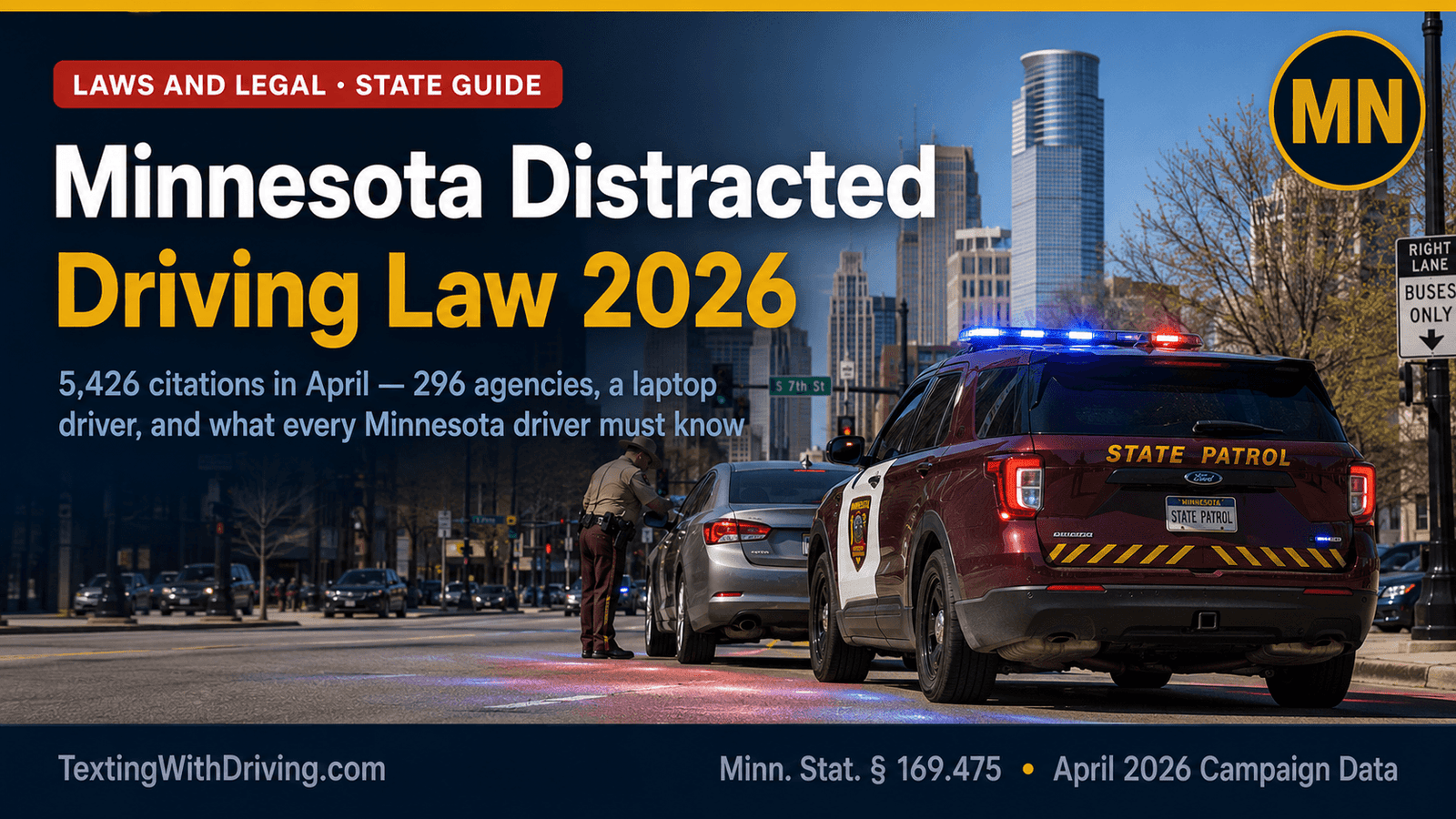
The Minnesota distracted driving law produced one of the most extensively documented enforcement campaigns of any state in 2026. During April — National Distracted Driving Awareness Month — 296 Minnesota law enforcement agencies participated in a monthlong statewide enforcement effort that resulted in 5,426 citations for hands-free cellphone violations, including a driver typing on a laptop while simultaneously holding a phone in heavy St. Cloud traffic, a driver in Elk River cited while holding two phones simultaneously, and a semi driver in Fillmore County so distracted that he did not notice a deputy attempting to pull him over until the vehicle crossed into a neighboring county.
The April 2026 campaign data is striking in what it reveals about the persistence of the distracted driving problem in Minnesota. State Troopers issued more than 15,500 citations for distracted driving in all of 2025 — a 13.6 percent increase over the prior year. Minnesota’s hands-free law has been in effect since 2019. After seven years of primary enforcement, the citation numbers are going up, not down.
This guide covers exactly what the Minnesota distracted driving law requires, the fine and misdemeanor structure, the April 2026 campaign results in full, the human story behind the law, the crash data that makes the enforcement urgency clear, and what every Minnesota driver must know to stay legal and safe on the state’s roads.
What the Minnesota Distracted Driving Law Prohibits
The Minnesota distracted driving law is codified at Minnesota Statutes § 169.475. Since 2019, Minnesota has prohibited drivers from using a hand-held wireless communications device or electronic device while operating a motor vehicle.
The prohibition covers the full range of handheld device interactions:
Holding a phone for a call. Making or receiving a voice call while holding the phone in any hand or supporting it with any part of the body is prohibited.
Texting and any text-based communication. Reading, writing, or sending text messages, emails, instant messages, or any other text-based electronic communication while driving is prohibited.
Social media access. Using social media platforms of any kind while operating a motor vehicle is prohibited.
Video watching. Watching videos, streaming content, or any other video consumption while driving is prohibited.
Internet browsing. Accessing the internet for any purpose while operating a motor vehicle is prohibited.
Device manipulation while moving. Voice-activated or hands-free mode does not include typing or scrolling on a device. The statute explicitly distinguishes between true voice-activated hands-free use (legal) and typing or scrolling even within a hands-free interface (illegal). A driver who uses voice activation to open a navigation app and then types a destination while moving is in violation of the Minnesota distracted driving law even though they initiated the action through voice.
The red light question. Minnesota’s prohibition applies while operating a motor vehicle. The enforcement community in Minnesota has consistently treated red light and stop sign stops as within the prohibition’s scope because the vehicle is still being operated by the driver. The only clear exceptions involve being completely stopped and parked off the roadway.
Primary Enforcement: What It Means in Minnesota
The Minnesota distracted driving law is a primary offense — law enforcement can pull over a driver for a hands-free violation without any other traffic offense present. Since you hear it from drivers constantly — they are frustrated by selfish and entitled behavior behind the wheel, according to Mike Hanson, director of the Minnesota Department of Public Safety’s Office of Traffic Safety — the primary enforcement authority gives officers the tool to act on what they observe directly.
An officer who sees a driver holding a phone, typing on a device, or otherwise using a handheld electronic device has immediate authority to initiate a traffic stop based solely on that observation. This primary enforcement authority has been in place since the original 2019 law took effect and was what enabled the 296-agency April 2026 campaign to issue more than 5,400 citations in a single month.
The Fine Structure and Criminal Classification
The Minnesota distracted driving law violation is classified as a petty misdemeanor with a specific fine escalation structure.
Fines for distracted driving start at $100 for the first offense and can rise to more than $125 with court fees tacked on. Subsequent violations start at $300, according to the Minnesota Department of Public Safety.
Breaking this down precisely:
First offense: $100 base fine, approximately $125 to $135 with court fees applied.
Second and subsequent offenses: $300 base fine, significantly higher with court fees. One driver during the April 2026 campaign was cited for their sixth hands-free violation, indicating that the financial escalation has not deterred every repeat offender.
If injury or death results: If you injure or kill someone while violating the hands-free law, it is considered reckless and careless driving — a criminal escalation that removes the petty misdemeanor classification and applies criminal recklessness or careless driving charges with substantially more severe consequences.
The petty misdemeanor classification for the standard hands-free violation means the offense appears on the driver’s record and affects insurance rates but does not produce a criminal conviction in the way that a Class C or Class A misdemeanor does in other states. Minnesota’s classification is thus financially consequential but less legally severe than Virginia’s Class 1 misdemeanor reckless driving pathway or Illinois’s Class 4 felony for fatal distracted driving crashes.
The April 2026 Campaign: Every Data Point
The April 2026 monthlong enforcement campaign is the most significant recent development in Minnesota distracted driving law enforcement. The Minnesota Department of Public Safety’s Office of Traffic Safety coordinated the campaign from April 1 through April 30 with funding from the National Highway Traffic Safety Administration.
Total citations issued: 5,426
Total participating agencies: 296
Metro area leaders:
- St. Paul Police Department: 912 citations
- Minnesota State Patrol West Metro: 311
- Minnesota State Patrol East Metro: 205
- St. Anthony Police Department: 98
Greater Minnesota leaders:
- Mankato Department of Public Safety: 383
- Minnesota State Patrol Virginia District: 285
- Minnesota State Patrol St. Cloud District: 141
- Olmsted County Sheriff’s Office: 132
- Minnesota State Patrol Duluth District: 111
The geographic spread of citations across metro and Greater Minnesota agencies confirms that the distracted driving problem is not concentrated in the urban Twin Cities corridor. Mankato’s 383 citations and the State Patrol’s Virginia District’s 285 show enforcement producing significant citation volumes in smaller cities and rural corridors statewide.
The Notable Enforcement Incidents: What Officers Actually Saw
The April 2026 campaign produced several specific enforcement incidents that the Minnesota DPS highlighted in its official press release because they illustrate the breadth of the distraction problem beyond the simple phone-in-hand scenario.
The laptop-and-phone driver. In St. Cloud, police stopped a driver for typing on a laptop while also holding a cell phone in heavy traffic. This incident represents the most extreme documented device multitasking case in any state’s 2026 enforcement reporting — not one device but two, one of which was a laptop requiring sustained screen attention, in active heavy traffic conditions.
The two-phone driver. In Elk River, a driver was holding two phones while driving. No further detail is provided in the official reports, but the scenario raises obvious questions about what simultaneous two-phone use in a moving vehicle looks like from an attention management perspective.
The photo-of-police driver. Also in Elk River, police cited another driver for taking a photo of a squad car while stopped in traffic. The vehicle was stopped, not moving — but the stop was a traffic stop rather than a legal parking situation off the roadway, placing the driver within the violation’s scope.
The semi driver who missed a county. In Fillmore County in southeastern Minnesota, a semi driver was so distracted they did not notice a Fillmore County Sheriff’s Office deputy trying to pull them over until the vehicle crossed into a neighboring county. The deputy had to coordinate with the neighboring county’s law enforcement to complete the stop. This incident is documented in the official DPS press release and represents a real-world case of total environmental awareness loss from device distraction.
The sixth-violation driver. At least one driver during the campaign was cited for their sixth hands-free violation. The $300-plus repeat offense fine has not deterred every repeat offender, suggesting that enforcement alone without higher-consequence behavioral intervention may be insufficient for a specific subset of drivers.
These incidents are not statistical outliers invented for press release impact — they are all confirmed in the official Minnesota DPS press release published May 14, 2026, and independently reported by Fox 9, the Star Tribune, KVRR, WJON, and Roads and Bridges.
The Human Story: Mayor Lehman and His Daughter-in-Law
The Minnesota distracted driving law enforcement campaign in 2026 has a human face that gives the citation data its emotional and political weight.
Shakopee Mayor Matt Lehman has been a prominent advocate for distracted driving enforcement in Minnesota following the death of his daughter-in-law in a distracted driving crash. He spoke at the April 2026 campaign launch event alongside Minnesota DPS officials, connecting the enforcement statistics to the human consequences that motivate the enforcement investment.
The personal loss advocacy pattern — where someone who has directly lost a family member to distracted driving becomes a public voice for enforcement and legislation — is one of the most consistent and powerful advocacy mechanisms in traffic safety history. The Hands-Free Georgia Act was named in memory of Hannah Smith, a 17-year-old killed by a distracted driver. The Minnesota Hands Free law’s ongoing enforcement advocacy benefits from this same human dimension in Mayor Lehman’s involvement.
As we documented in our how to talk to an older parent about distracted driving article, the personal story is consistently the most persuasive communication tool available for changing driver attitudes about phone use. The specific death of a specific person connected to a specific law enforcement official produces a different quality of engagement from drivers than an abstract statistic about annual fatalities.
Minnesota’s Crash Data: What the Numbers Show
The enforcement campaign results are contextualized by Minnesota’s crash data, which shows the scale of the problem that 296 agencies and 5,426 April citations are responding to.
At least 21 people died on Minnesota roads in 2025 in crashes attributed to distracted driving, and 159 others were seriously injured, according to DPS data.
Between 2019 and 2023, distracted driving was a factor in 30,000 crashes in Minnesota, which led to an average of 29 deaths per year and 146 life-changing injuries.
Minnesota is the best-performing state in the national distracted driving statistics by state 2026 rankings. As we documented in our distracted driving statistics by state 2026 article, Minnesota leads all 50 states with the lowest observed distracted driving rate among all states measured — 11.3 percent of distracted driving crash involvement — while New Mexico’s worst-state figure is 37 percent.
This apparent contradiction — Minnesota leads the country in best distracted driving statistics while simultaneously issuing 5,426 citations in one month — resolves when the metrics are understood separately. Minnesota’s low percentage of distraction-affected fatal crashes as a share of total crashes reflects its strong enforcement history and hands-free law compliance. The absolute number of citations reflects a large state with millions of licensed drivers where even a low violation rate produces a large absolute citation count.
Minnesota’s best-state performance is not an accident. It is the product of exactly the enforcement infrastructure that the April 2026 campaign demonstrates: 296 agencies coordinated, NHTSA-funded, with a monthlong sustained campaign rather than a single-week event.
The 15,500 Annual Citation Trend: Why Minnesota’s Law Is Not Winning Easily
Despite its best-state performance, the Minnesota distracted driving law enforcement data reveals a persistent and growing compliance challenge.
State Troopers last year issued more than 15,500 citations for distracted driving — a 13.6 percent increase over the previous year. The 57 percent increase in April campaign citations in 2025 versus the prior year’s campaign was described by DPS Director Hanson as disturbing, unacceptable and extremely frustrating.
A 13.6 percent year-over-year increase in citation counts could reflect either more violations or more enforcement. Given that OTS coordinated funding and extra patrol for the April campaign specifically to increase detection capacity, a portion of the increase reflects the enforcement intensity rather than a pure behavioral increase. But the absolute scale — 15,500 annual citations plus the 5,426 in April alone — confirms that the Minnesota distracted driving law is encountering persistent non-compliance seven years after enactment.
The Star Tribune’s May 2026 coverage noted that the campaign title — Not Getting the Message — was an editorial characterization of drivers who continue to violate a seven-year-old law. The phrase captures the fundamental challenge documented across multiple states in this series: primary enforcement laws work to reduce violations, but they do not eliminate them, and without continued high-visibility enforcement campaigns, compliance tends to erode as the law’s novelty fades.
What Remains Legal Under the Minnesota Distracted Driving Law
The Minnesota distracted driving law permits the following for all drivers:
Hands-free calls. Bluetooth calls through any system — earpiece, speakerphone on a mounted device, or vehicle-integrated system — where no physical holding of the device occurs are fully legal.
Voice commands. Using Siri, Google Assistant, or any other voice command system for calls, messages, navigation, or music control with no manual device contact is legal.
Mounted GPS navigation. A phone in a secure mount displaying navigation with a destination pre-set before the vehicle moves is legal. Any typing or scrolling of the navigation app while moving crosses into the prohibited manipulation category.
Single-touch activation. A single touch to accept an incoming call or activate a voice command on a mounted device falls within the hands-free standard. Multiple touches, typing, or scrolling do not.
Emergency calls. Contacting emergency services in a genuine emergency is permitted.
Lawful parking. Device use when the vehicle is legally parked off the roadway is permitted without restriction.
The statute’s explicit clarification — voice-activated or hands-free mode does not include typing or scrolling on a device — is the most important compliance detail for Minnesota drivers who believe that activating a function through voice and then interacting with it manually is within the hands-free standard. It is not.
Commercial Drivers and the Federal Layer
Minnesota commercial drivers face the FMCSA federal framework we covered in our FMCSA commercial driver distracted driving rules article — up to $2,750 per violation for drivers and $11,000 for employers — on top of the state petty misdemeanor classification. The Fillmore County semi driver incident from the April campaign illustrates the specific commercial driver risk: a professional driver in a large vehicle with a prolonged distraction event that produced a multi-county pursuit situation.
What Every Minnesota Driver Should Know in 2026
The Minnesota distracted driving law has produced 5,426 April citations, 15,500-plus annual State Patrol citations, and documented enforcement across 296 agencies from the Twin Cities metro through rural Greater Minnesota corridors. The enforcement infrastructure is real, active, and expanding.
The compliance standard is specific: no phone in hand, no typing, no scrolling, no video, no social media, for any purpose, while operating a motor vehicle on any Minnesota road. At red lights. In heavy traffic. On rural highways. In all conditions.
The $100 first offense fine plus court fees becomes significantly more expensive over three to five years in insurance rate increases, as we documented in our how distracted driving affects car insurance article. The sixth-violation driver from the April campaign illustrates where the escalation ultimately leads: $300-plus repeat offense fines and a driving record that no insurer treats favorably.
For the complete technology setup that makes full compliance with the Minnesota distracted driving law automatic, our Do Not Disturb while driving setup guide covers both iPhone and Android. For the national comparison showing where Minnesota’s law sits among all 50 states, our hands-free driving laws by state 2026 guide covers every state.
Sources Used in This Article
All links verified working before publication.
Minnesota DPS Official Press Release: Nearly 5,500 Drivers Cited During April Campaign — 5,426 citations, 296 agencies, all city-level data, Mike Hanson quotes, May 2026
Fox 9 Minneapolis: Nearly 5,500 MN Drivers Cited During Hands-Free Cell Phone Crackdown — April campaign detail, Mayor Lehman reference, May 2026
Star Tribune: Not Getting the Message — Nearly 5,500 Drivers Ticketed Last Month — 15,500 annual 2025 citations, 13.6% increase, $100 fine, 21 deaths 159 injuries 2025, May 2026
Roads and Bridges: From Laptops to Multiple Phones Minnesota’s Distracted Driving Stops Raise Concerns — Notable incidents detail, April 20 DWI campaign, June 2026
WJON: Minnesota Distracted Driving Campaign 5,426 Violations — Sixth violation driver, all incident details, May 2026
KVRR/KFGO: Minnesota Releases Results of Latest Distracted Driving Crackdown — 912 St. Paul citations, Mankato 383, May 2026
KEYC: More Than 5,000 Drivers Cited During Statewide April Campaign — Southern Minnesota detail, statewide campaign dates
GovTech: Minnesota Sees 75 Percent Rise in Distracted Driving Citations — 57% prior-year campaign increase, 30,000 crashes 2019-2023, 29 annual deaths average
Minnesota Statutes § 169.475 Official Statute Text — Complete statute language, typing/scrolling not hands-free clarification
NHTSA: Distracted Driving — 3,208 deaths 2024, national context
TextingWithDriving.com is professionally built and maintained to ensure accurate, accessible safety information reaches every driver who needs it. Website development and ongoing support is handled by Budgetic, a digital agency specializing in purpose-driven WordPress websites.

About Texting With Driving
TextingWithDriving.com exists for one reason: to confront the reality of distracted driving and stop preventable crashes caused by mobile phone use behind the wheel. Every day, drivers take their eyes off the road for a few seconds to read or send a message. Those few seconds are enough to cause life-altering consequences. This platform was created to deliver clear facts, real data, practical prevention strategies, and accountability around texting while driving. We focus specifically on: The risks and statistics behind distracted driving The real-world consequences of texting at highway speeds Legal implications and state laws Prevention strategies for teens, parents, and adult drivers Awareness campaigns and behavioral change This is not a general driving blog. It is a focused awareness initiative built around one critical issue: phone distraction behind the wheel. Our content is direct, research-driven, and practical. We prioritize accuracy over opinion and education over sensationalism. The goal is simple — reduce distracted driving incidents by increasing awareness and responsibility. If one article causes one driver to put their phone down, the mission is working. For inquiries or partnerships, contact: privacy@textingwithdriving.com
View all posts by Texting With Driving