

Tennessee Distracted Driving Law 2026: What Every Driver Must Know

Tennessee Distracted Driving Law 2026: What Every Driver Must Know
The Tennessee distracted driving law presents one of the most striking paradoxes in American road safety. Tennessee has had a comprehensive hands-free law since July 1, 2019 — for seven years, holding a phone while driving has been a primary offense on any Tennessee road. Yet Tennessee has been named the worst state for distracted driving fatalities, and the state’s distracted driving death toll continues to claim lives at a rate that places it near the top of the national worst-state rankings year after year.
Understanding this paradox is the key to understanding the Tennessee distracted driving law in 2026: the law is real, the enforcement is primary, and the newest campaign (Operation Hands Free, launched April 2026) is deploying bus-mounted spotters to catch distracted drivers from elevated positions. But the fine structure — $50 for a first offense, one of the lowest in the country — has not produced the behavioral change that states with higher penalties and more intensive enforcement have achieved.
This guide covers exactly what the Tennessee distracted driving law requires, the complete fine and points structure, what Operation Hands Free is doing on Tennessee roads right now, the Eddie Conrad Act points increase, the specific rules for teen drivers and school bus operators, and the crash data that explains why Tennessee’s law has not yet matched the outcomes documented in Ohio, Michigan, or Colorado.
What the Tennessee Distracted Driving Law Prohibits
The Tennessee distracted driving law is codified at Tennessee Code Annotated § 55-8-199, enacted as Public Chapter No. 412 on July 1, 2019. The law is comprehensive in its scope.
Tennessee’s hands-free statute T.C.A. § 55-8-199 makes it illegal to hold a cellphone while driving. Specifically, the following are prohibited while operating a motor vehicle on any Tennessee public road:
Holding a phone or mobile device with any part of your body. The body-support prohibition is broad — holding the device with the hand, wedging it against the shoulder, supporting it on a knee, or any other body-part contact while driving is a violation. Using any part of your body to support a cellphone or other wireless telecommunication device is prohibited while driving.
Reading, writing, or sending any written messages. Text messages, emails, instant messages — any text-based communication reading or writing while the vehicle is moving is prohibited.
Reaching for a device in a manner requiring the driver to no longer be in a seated driving position or properly restrained by a seat belt. This provision addresses the specific behavior of leaning or reaching into a bag, the back seat, or the passenger seat to retrieve a phone, which takes the driver physically out of a proper driving position.
Watching a video or movie on a phone or mobile device. Video consumption of any kind on a handheld device while driving is prohibited.
Recording or broadcasting video on a phone or mobile device. Recording video while driving — including the TikTok-style video recording that has become a documented cause of crashes particularly among younger drivers — is explicitly prohibited.
The red light question. The Tennessee distracted driving law applies explicitly when the car is under the driver’s physical control. The hands-free law applies explicitly when the car is under the driver’s physical control — this standard applies even when stopped at red lights.
Primary Enforcement: Officers Can Stop You for This Alone
The Tennessee distracted driving law is a primary offense, classified as a Class C misdemeanor. Distracted driving is a primary offense, meaning that even if you are obeying all traffic laws and believe you are in total control of your vehicle while doing so, if a police officer witnesses you using a handheld device while driving, you can be pulled over and given a citation.
The Class C misdemeanor classification is the same criminal category as the violation itself in Tennessee — the law treats phone use while driving as a misdemeanor offense, not merely a traffic infraction as in many other states. The criminal classification matters for how the violation appears on a driver’s record and how prosecutors can use it in civil litigation following a crash.
Tennessee’s law enforcement has the additional investigative tool of phone records. The DA’s office can also check phone records against the citation’s timing to prove the offense. During an investigation of a distracted driving crash in Tennessee, prosecutors can subpoena phone records to establish that the driver was actively using their device at the moment of the collision.
Operation Hands Free: The April 2026 Enforcement Campaign
The most significant recent development in Tennessee distracted driving law enforcement is Operation Hands Free, launched on April 1, 2026 by the Tennessee Highway Safety Office and Tennessee Highway Patrol as part of National Distracted Driving Awareness Month.
The Tennessee Highway Safety Office and Tennessee Highway Patrol launched Operation Hands Free on April 1, targeting violators of Tennessee’s Hands-Free Law during National Distracted Driving Awareness Month.
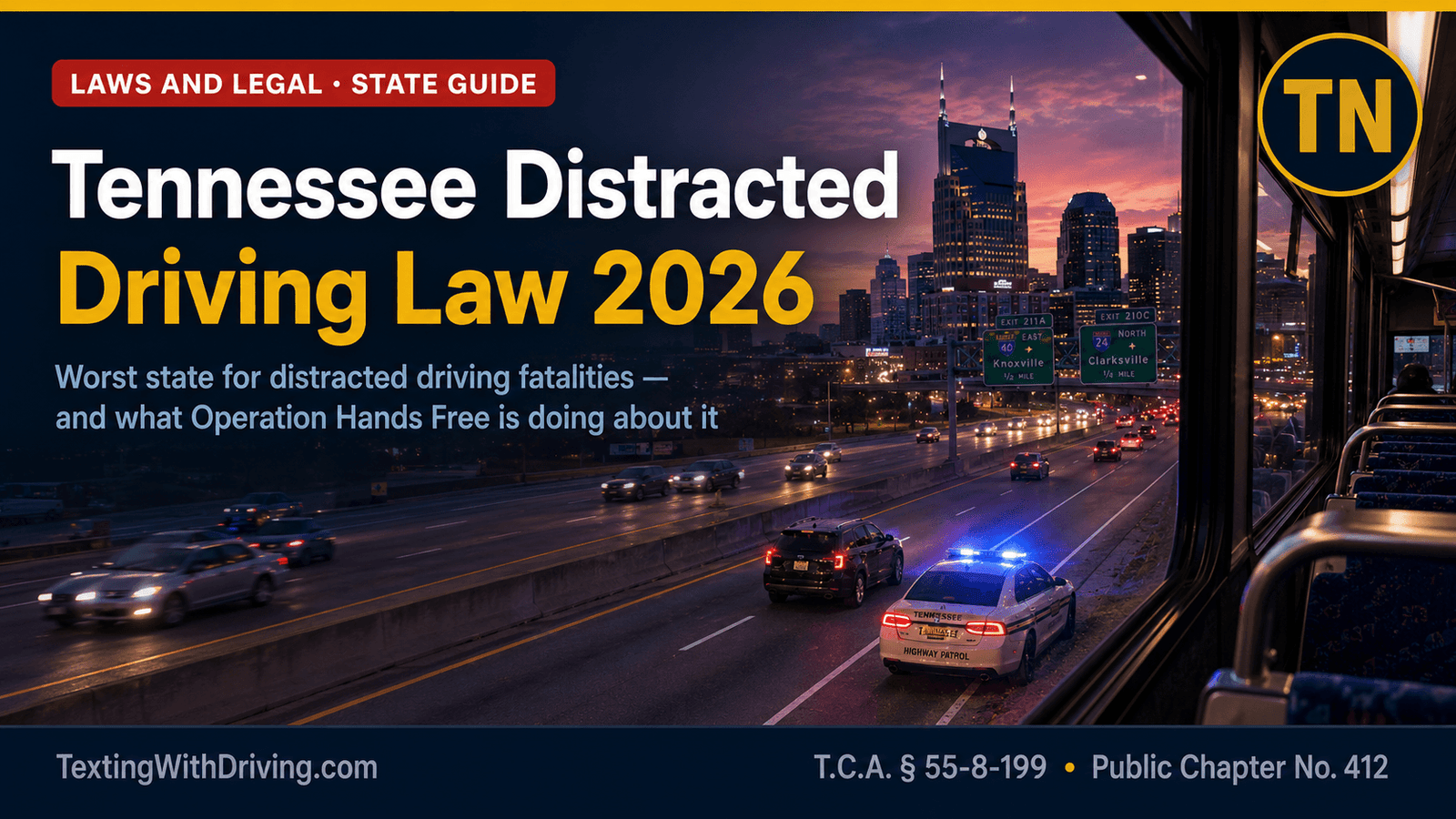
The campaign’s most distinctive enforcement innovation is bus-based spotting. Troopers ride inside transit buses, looking down into passing cars to spot drivers fiddling with phones, then radio nearby patrol units to pull them over. This elevated observation technique addresses the primary challenge of handheld device enforcement: officers in standard patrol cars at road level have difficulty seeing into vehicles to confirm whether a driver is holding a phone, particularly in modern vehicles with higher door lines and tinted windows.
A transit bus positions officers significantly above the roof line of standard passenger vehicles, giving them a clear downward view into cars passing below. A trooper on a bus can observe driver behavior that would be invisible to an officer in a street-level patrol car. The spotter then radios patrol units positioned downstream to initiate the stop.
Operation Hands Free events launched in Nashville, Memphis, Chattanooga, and Knoxville, with heavier enforcement and public-education pushes continuing through April and beyond.
Campaign materials stress that a few simple habits can sharply cut both crash risk and the odds of a ticket: stash your phone where you cannot reach it, set navigation and playlists before you shift into drive, and turn on Do Not Disturb While Driving so texts are handled automatically.
The Fine Structure: Why Critics Say It Is Not Enough
The Tennessee distracted driving law fine structure is among the lowest of any comprehensive hands-free law in the country, and this is widely cited by safety advocates as a primary reason why Tennessee remains at or near the top of worst-state distracted driving rankings despite having a seven-year-old law.
Fines for violations of the law include: $50 for a first or second offense, $100 for a third or subsequent offense, $200 for a violation in a construction, work, or school zone where workers or children are present.
$50. For a first offense of a hands-free law that has been in effect since July 2019. Compare this to the states covered earlier in this series: New York’s maximum third offense fine of $450, New Jersey’s fine of $600 to $800 for a third offense, Virginia’s $125 first offense and $250 repeat offense, Ohio’s $150 first offense. Tennessee’s $50 first offense fine is at the absolute low end of the national spectrum.
The research connection between fine level and behavioral deterrence is not simple — Ohio’s $150 first offense produced 15,400 fewer crashes in year one, but Ohio also paired its law with sustained high-visibility enforcement campaigns. Colorado’s $75 first offense produced documented 4.7 percent improvement. But the consistent finding across states is that fine level, enforcement intensity, and perceived catch probability work together to produce behavioral change. Tennessee’s $50 fine combined with lower-than-average enforcement intensity has not produced the crash reduction that higher-fine, higher-enforcement states have documented.
A first-time distracted driving offender in Tennessee can attend a driver education course instead of paying the fine. This alternative applies at the court’s discretion and requires an approved provider, with course fees between $50 and $175. This mirrors the first-offense course alternative we have documented in Ohio, Georgia (device purchase option), and Colorado.
The Eddie Conrad Act: How Points Are Assessed
The Hands Free Tennessee campaign notes that the Eddie Conrad Act increases the number of points added to driving records for using a cell phone while driving.
Under the current Tennessee points system as modified by the Eddie Conrad Act, distracted driving violations add 3 demerit points to the driver’s license record for a standard violation. For underage drivers who receive a second or subsequent violation, the penalty escalates to 7 points.
Tennessee’s license suspension threshold is 12 points in 12 months. For adult drivers, three distracted driving violations within a year would produce 9 points — close to but not reaching the suspension threshold. Combined with other violations, the path to 12 points is shorter.
For minor drivers under 18, the 7-point escalation on a second violation is particularly consequential. Tennessee law provides that drivers less than 18 years of age who accumulate 6 or more points on their driving record within any 12-month period are sent a notice of proposed suspension from the Department of Safety and are placed in the Driver Improvement Program.
A second distracted driving violation for a Tennessee teen driver produces 7 points — already above the 6-point threshold that triggers the Driver Improvement Program and proposed suspension process. This means a Tennessee teen driver who receives two distracted driving citations within a 12-month period faces an immediate license action regardless of any other violations on their record.
Teen Driver Rules Under the Tennessee Distracted Driving Law
The Tennessee distracted driving law applies a complete device prohibition to teen drivers that goes beyond the adult hands-free standard.
Drivers with learner’s permits or intermediate driver’s licenses, and all drivers under the age of 18, are prohibited from any type of cell phone use, even hands-free.
This complete prohibition — including hands-free — for all under-18 drivers mirrors the standard we have documented in Illinois, Ohio, Michigan, and most other states with comprehensive GDL frameworks. The distinction is particularly important in Tennessee because the statewide adult law already bans handheld use. For teens, the additional prohibition on hands-free means there is no permissible phone interaction while driving except emergency calls, making Tennessee’s under-18 standard an absolute prohibition.
As we covered in our distracted driving laws for teen drivers state guide, the combination of the complete under-18 ban and the 7-point second-offense escalation makes Tennessee one of the more consequential states for teen drivers who violate distracted driving law.
School Bus Operator Rules: The Strictest Consequences in Tennessee
The Tennessee distracted driving law reserves its most severe penalties for school bus operators.
Tennessee has strict distracted driving regulations that apply to school bus operators. Bus drivers within the state are prohibited — with few exceptions — from using any portable electronic device while operating a school bus with at least one passenger on board.
Bus drivers who violate Tennessee’s portable electronics ban can be charged with a Class A misdemeanor. A conviction carries a minimum of 30 days in jail and at least $1,000 in fines. Thereafter, the driver will be permanently prohibited from operating a school bus within the state.
The school bus driver consequences under the Tennessee distracted driving law are categorically more severe than the standard driver Class C misdemeanor: Class A misdemeanor versus Class C, minimum 30 days in jail versus a fine only, $1,000 minimum fine versus $50 maximum, and permanent prohibition from operating school buses. The severity reflects the specific duty of care that bus drivers owe to the children in their charge.
Exceptions for bus drivers include 911 calls, two-way radio communication with dispatch or the school transportation department, GPS units, and hands-free wireless communications for the purpose of accurately accounting for children at pick-ups and drop-offs.
What Remains Legal Under the Tennessee Distracted Driving Law
The Tennessee distracted driving law permits the following for drivers 18 and older:
Hands-free calls through Bluetooth, earpiece, speakerphone on a mounted device, or vehicle-integrated system. Motorists over 18 may use hands-free technology, such as Bluetooth or voice commands, while driving, provided they can access the function with a single press or swipe.
Single-swipe activation. A single swipe or tap to accept a call, end a call, or activate a voice command function on a mounted phone is within the law. Typing on a smartphone is not okay.
GPS navigation on a mounted device pre-set before driving, with no manual interaction required while moving.
Voice commands for any function — calls, messages, navigation, music — that requires no physical holding of the device.
Emergency calls. A driver is permitted to use a cellphone to communicate with law enforcement agencies, medical providers, fire departments, or other emergency service agencies while driving if the use is necessitated by a bona fide emergency.
Lawful parking. Drivers can use their handheld cell phones in their cars if they are parked and the engine is turned off.
The Crash Data: Why Tennessee Remains at the Bottom
Despite seven years of a comprehensive hands-free law, the Tennessee distracted driving law has not moved Tennessee off the worst-state lists for distracted driving fatalities. Damage from distracted driving costs the state over $300 million per year, and distracted driving accidents can maim and kill.
Tennessee has been named the worst state for distracted driving fatalities. The distracted driving statistics by state 2026 data we covered in our dedicated distracted driving statistics by state 2026 article confirms Tennessee consistently appears in the bottom tier nationally.
The crash data from the early law years provided some initial optimism. In the first month after the new law was enacted, police in this state issued 424 citations to drivers who continued to use handheld devices. Initial data indicates a decrease in traffic accidents related to distracted driving.
But the sustained improvement required to escape the worst-state designation has not materialized. The factors that safety researchers point to in explaining Tennessee’s persistent worst-state status include: the $50 first-offense fine that provides minimal financial deterrent, enforcement intensity that has been lower than in states achieving documented crash reductions, a road network with extensive rural highway miles where enforcement is sparse, and Nashville’s rapid population growth creating dense urban driving conditions with high phone use rates.
The connection to Juneteenth is also relevant data for Tennessee. As we documented in our Juneteenth weekend driving safety article, Tennessee is one of six states where Juneteenth is the single most dangerous holiday of the entire year. The specific behavioral risk patterns around that holiday weekend compound with the state’s general distracted driving challenge.
What Every Tennessee Driver Should Do in 2026
The Tennessee distracted driving law has been in primary enforcement since July 1, 2019. Seven years. For seven years, a Tennessee officer has been legally authorized to stop any driver they observe holding a phone without needing any other violation. For seven years, the violation has been a Class C misdemeanor on the driver’s record. For seven years, the $50 fine has been the financial consequence of that misdemeanor.
Operation Hands Free’s bus-mounted spotter deployment in April 2026 represents a meaningful escalation of enforcement intensity specifically designed to catch the behavior that road-level patrol cannot easily see. A driver who has relied on the road-level detection gap to continue holding their phone now faces troopers with elevated visibility who can see directly into the vehicle’s interior.
The practical pre-drive standard for every Tennessee driver: phone mounted or in back seat before the engine starts, GPS pre-set before moving, Bluetooth connected for all calls, Driving Focus or Android driving mode active, no manual device interaction while moving.
For the complete technology setup that makes this standard automatic, our Do Not Disturb while driving setup guide covers both iPhone and Android from scratch in under two minutes. For the national comparison showing where Tennessee’s fine structure and outcomes sit among all 50 states, our hands-free driving laws by state 2026 guide covers every state’s specific provisions. And for the complete crash data showing why Tennessee’s combination of low fines and high crash rates creates the policy challenge it does, our distracted driving statistics by state 2026 covers the full picture.
Sources Used in This Article
All links verified working before publication.
HandsFreeTN.com: Official Hands Free Tennessee Campaign — Official prohibition list, emergency exception language, Eddie Conrad Act reference, points to suspension threshold
WVLT Knoxville: Tennessee Launches Operation Hands Free — April 1 2026 launch announcement, THP and THSO partnership, March 2026
Hoodline: Operation Hands Free Targets Distracted Drivers Across Tennessee — Bus-based spotters, Nashville Memphis Chattanooga Knoxville events, April 2026
GKBM Law: Understanding Distracted Driving Law Tennessee — TCA 55-8-199 statute, Class C misdemeanor, 3 points adult 7 points minor, December 2025
Insured Better: Tennessee Distracted Driving Laws — 424 first-month citations, worst state designation, primary enforcement explanation, December 2025
UltraCar Insurance: Tennessee Hands-Free Driving Law — Single-swipe standard, SR22 requirement, May 2026
Meyers Personal Injury Law: What Is the Tennessee Hands-Free Law — Public Chapter No. 412, bus driver restrictions, March 2026
Tennessee Injury Lawyers: Is Tennessee a Hands-Free State — TCA 55-8-199 prohibition detail, Class A misdemeanor bus drivers
DrivingLaws.org: Tennessee — $200 work zone fine, 7-point minor second offense, bus driver $1,000 minimum fine, permanent prohibition
Road Law Guide: Distracted Driving Laws by State 2026 — Tennessee confirmed in 30-state-plus-DC hands-free list, February 2026
NHTSA: Distracted Driving — 3,208 deaths 2024, national context
TextingWithDriving.com is professionally built and maintained to ensure accurate, accessible safety information reaches every driver who needs it. Website development and ongoing support is handled by Budgetic, a digital agency specializing in purpose-driven WordPress websites.

About Texting With Driving
TextingWithDriving.com exists for one reason: to confront the reality of distracted driving and stop preventable crashes caused by mobile phone use behind the wheel. Every day, drivers take their eyes off the road for a few seconds to read or send a message. Those few seconds are enough to cause life-altering consequences. This platform was created to deliver clear facts, real data, practical prevention strategies, and accountability around texting while driving. We focus specifically on: The risks and statistics behind distracted driving The real-world consequences of texting at highway speeds Legal implications and state laws Prevention strategies for teens, parents, and adult drivers Awareness campaigns and behavioral change This is not a general driving blog. It is a focused awareness initiative built around one critical issue: phone distraction behind the wheel. Our content is direct, research-driven, and practical. We prioritize accuracy over opinion and education over sensationalism. The goal is simple — reduce distracted driving incidents by increasing awareness and responsibility. If one article causes one driver to put their phone down, the mission is working. For inquiries or partnerships, contact: privacy@textingwithdriving.com
View all posts by Texting With Driving