
Norfolk Virginia Distracted Driving 2026: Hampton Roads Navy City Guide

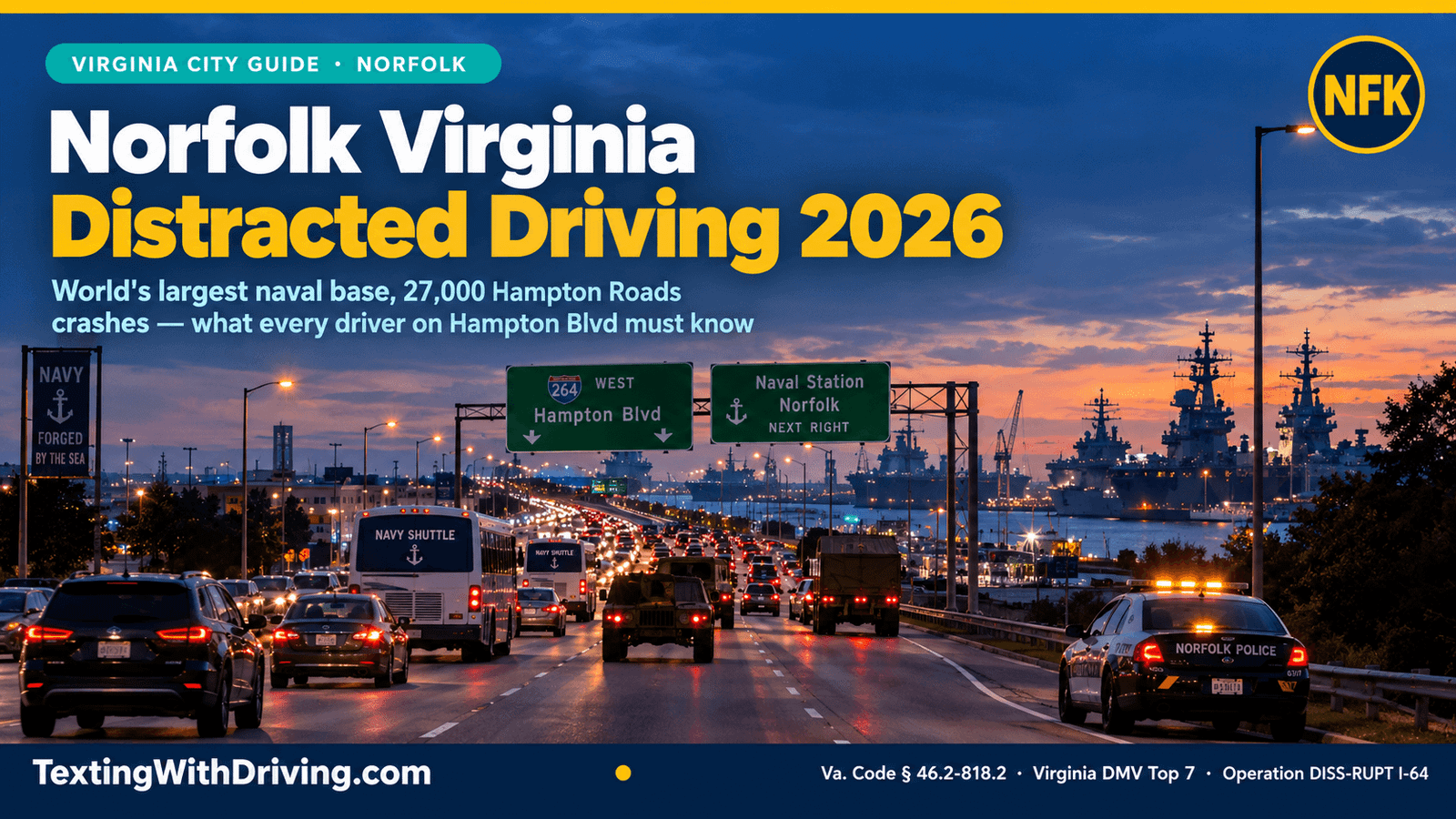
Norfolk Virginia Distracted Driving 2026: Hampton Roads Navy City Guide
Norfolk Virginia distracted driving 2026 carries the official designation of one of the seven highest distracted driving crash jurisdictions in all of Virginia — a distinction the city shares with Fairfax County, Loudoun County, Henrico County, Richmond City, Prince William County, and Virginia Beach City according to the Virginia DMV’s own Highway Safety Office data.
Virginia DMV’s research into distraction-related crash data reveals that these occurrences are most prevalent in Fairfax County, Loudoun County, Henrico County, Richmond City, Prince William County, Norfolk City and Virginia Beach City.
For a city of approximately 238,000 residents — Virginia’s third most populous — Norfolk’s presence in this list alongside Fairfax County’s 1.2 million residents and Prince William County’s 500,000-plus residents reflects a disproportionate crash concentration relative to population. Norfolk’s distracted driving crash density is not just a function of city size. It reflects specific road network characteristics that the world’s largest naval base, a record-breaking international airport, the Downtown and Midtown Tunnel bottlenecks, and the peninsula geography that creates forced traffic concentration on specific corridors all compound into one of the most crash-intensive urban road environments in the Commonwealth.
This guide covers the complete Norfolk Virginia distracted driving 2026 picture: the specific corridors where crashes concentrate, the unique military driver population that adds a specific distracted driving risk dimension, the tunnel bottlenecks that make distraction specifically dangerous, the Operation DISS-RUPT expansion to all 299 miles of I-64 that brought Hampton Roads into Virginia’s most intensive enforcement initiative, what Norfolk Police data shows about distracted driving enforcement, and what every driver navigating Norfolk’s roads must know to stay safe and legal in 2026.
Why Norfolk Is in Virginia’s Top 7 Distracted Driving Cities
Norfolk Virginia distracted driving 2026 concentrates in the city’s top-7 position for several specific structural reasons that differ from Northern Virginia’s concentration factors.
Naval Station Norfolk: the world’s largest naval base. Naval Station Norfolk houses the largest concentration of naval power in the world — approximately 75 warships, 134 aircraft, and more than 80,000 military personnel and civilian employees report to the installation daily. The Hampton Boulevard corridor serving the naval station’s primary access routes creates one of the highest-volume military-civilian traffic mixing zones of any urban road network in Virginia. Traffic from the Naval Station Norfolk, the world’s largest naval base, also increases the likelihood of crashes.
The military population dimension is directly relevant to Norfolk Virginia distracted driving 2026. Military personnel posted to Naval Station Norfolk arrive from across the United States — and in many cases from states with different or less restrictive distracted driving laws than Virginia’s comprehensive hands-free ban. A sailor who has driven their personal vehicle in Texas (texting ban only, no handheld ban outside city ordinances), Alabama (secondary enforcement hands-free law), or Kentucky (texting ban, handheld calls legal) arrives at Naval Station Norfolk accustomed to a legal environment where holding a phone for a call while driving is either legal or only secondarily enforceable. Virginia Code § 46.2-818.2 applies the moment their vehicle enters Virginia roads — but the behavioral habits formed in a different legal environment do not automatically change with the state line.
Norfolk International Airport traffic. Traffic from the Norfolk International Airport often leads to crashes in the city because millions of passengers take off or land at the airport each year. In 2024 alone, the airport saw 4.86 million passengers, marking the airport’s third consecutive year of record-breaking passenger traffic.
4.86 million passengers in 2024 — nearly 13,300 per day arriving or departing. A significant share of these passengers rent vehicles or are picked up by drivers who are simultaneously navigating an unfamiliar road network, managing arrival logistics by phone, and operating rental cars they have never driven before. The specific tourist and travel distraction risk we documented for Virginia Beach in our Virginia Beach distracted driving 2026 article applies at the Norfolk airport corridor as well — arriving passengers reaching for their phones the moment they exit the terminal, pickup drivers circling while calling to coordinate location, rental car drivers entering navigation destinations while leaving the garage.
The peninsula geography. Norfolk occupies a peninsula bounded by the Elizabeth River to the south and west, Hampton Roads harbor to the north, and the confluence of the James River and Chesapeake Bay to the east. This geography forces traffic onto a limited number of crossing corridors — the Downtown Tunnel, the Midtown Tunnel, the High Rise Bridge, and the Hampton Roads Bridge-Tunnel (HRBT) — creating bottleneck conditions where high-volume traffic compressed into limited lanes at complex interchange approaches produces maximum distraction crash risk.
Hampton Boulevard: The Military City’s Most Dangerous Corridor
The specific corridor most directly associated with Norfolk Virginia distracted driving 2026 is Hampton Boulevard — the primary north-south arterial connecting downtown Norfolk to Naval Station Norfolk and Norfolk International Airport.
One of the busiest corridors in Norfolk, Hampton Boulevard sees significant military, commuter, and commercial traffic. Crashes often occur near entrances to Naval Station Norfolk and surrounding intersections.
Hampton Boulevard’s crash concentration near Naval Station Norfolk entrances reflects the specific traffic pattern that a large military installation creates: the morning and afternoon rush of 80,000-plus personnel entering and exiting the base creates stop-and-go congestion at access points that is comparable in volume to a major suburban employment center. The phone-checking behavior during stop-and-go congestion that we documented for Northern Virginia’s I-66 and I-495 commuter corridors in our Northern Virginia distracted driving guide applies on Hampton Boulevard during Naval Station traffic peaks with comparable intensity.
The Hampton Boulevard Safety Study completed by the City of Norfolk in December 2024 specifically examined crash patterns along the Hampton Boulevard corridor from Magnolia Avenue to south of the Lafayette River Bridge, documenting crash frequency at specific intersections and recommending traffic signal installation and other improvements. The study’s acceptance and the planned implementation of its recommendations reflects Norfolk’s recognition that Hampton Boulevard’s crash concentration requires engineering intervention beyond enforcement alone.
The corridor’s specific intersection challenges include the Hampton Boulevard and Jamestown Crescent intersection, the Hampton Boulevard and Richmond Crescent intersection, and the approach roads near the Naval Station Norfolk main gate where civilian and military vehicles must negotiate complex access control procedures while managing the distraction pressures of phone-based coordination.
Military Highway: Hampton Roads’ Most Notoriously Complex Intersection
Beyond Hampton Boulevard, Norfolk Virginia distracted driving 2026 has another specific corridor concentration at the convergence of Military Highway, Northampton Boulevard, and Princess Anne Road.
The Norfolk intersection of Military Highway, Northampton Boulevard, and Princess Anne Road was ranked as the most annoying in Hampton Roads. Despite upgraded traffic signals and recently widened roads, this intersection garners poor ratings for its unintuitive design and bad light timing, resulting in several Norfolk car accidents each year.
“Annoying” is a consumer-sentiment description of an intersection’s frustration level. But frustration at poorly designed intersections is the specific psychological condition that drives phone-checking behavior most directly — the driver who has been delayed at this intersection multiple times in a single week, who knows they are approaching it again, who feels the irritation of a design they cannot navigate efficiently, is exactly the driver who checks their phone while waiting through its poorly timed signals.
The Military Highway and Northampton Boulevard corridor through the central Norfolk area is also a primary commercial corridor — dense with retail, service businesses, and the turn-generating traffic patterns of commercial strip development. High intersection density, high turning movement frequency, and the commercial activity that brings shoppers, delivery vehicles, and pedestrians into the roadway simultaneously create the compounding distraction conditions that produce Norfolk’s crash concentration on this corridor.
The Tunnel Bottlenecks: Where Distraction Is Most Dangerous
Norfolk Virginia distracted driving 2026 has a specific geographic crash concentration related to the tunnel crossings that Norfolk’s peninsula geography makes unavoidable for anyone traveling between Norfolk and Portsmouth or between Norfolk and the wider Hampton Roads region.
Sudden slowdowns, merging traffic, and stop-and-go congestion near the Downtown and Midtown Tunnels regularly lead to rear-end accidents and chain-reaction collisions.
The Downtown Tunnel (US-58/US-460) and Midtown Tunnel (US-58) connect Norfolk and Portsmouth across the Elizabeth River. Both tunnels create specific traffic dynamics: high approach speeds on the Norfolk side, dramatic speed reduction at the tunnel entrance, limited sight lines inside the tunnel, and the merge-and-slow pattern at exits that produces rear-end collision concentration when drivers are not paying full attention.
A driver approaching the Downtown Tunnel entrance from the Norfolk side while checking their phone has reduced the reaction time available for the speed reduction that every tunnel approach requires. The same driver whose phone glance at 55 mph on I-64 covers a football field blind covers a shorter distance at the reduced approach speed — but the tunnel entrance environment requires immediate and precise speed adjustment that the distracted driver may not make until the vehicle in front of them has already braked.
The HRBT (Hampton Roads Bridge-Tunnel) connecting Norfolk to Hampton creates the highest-volume crossing point in the region — and one of the most delay-prone. HRBT delays that can stretch to 30-45 minutes during peak hours create exactly the phone-checking pressure that stop-and-go traffic produces everywhere: the long wait makes the phone feel accessible, the phone check begins, and the abrupt forward movement when traffic clears produces the rear-end scenario at the point of motion resumption.
Tidewater Drive and Granby Street: The Downtown Distraction Corridors
Norfolk Virginia distracted driving 2026 extends beyond Hampton Boulevard and Military Highway into the downtown and midtown corridors that serve Norfolk’s densest residential and commercial activity.
Tidewater Drive experiences frequent intersection accidents, turning collisions, and crashes involving distracted drivers traveling between Norfolk and Virginia Beach. The Tidewater Drive corridor — running north-south through central Norfolk from the Ocean View waterfront through downtown toward Norfolk State University — creates the intersection-dense urban arterial environment where the failure-to-detect pedestrian crash and the distracted-driver intersection collision are most likely.
Granby Street — Norfolk’s primary north-south downtown corridor — appears in Norfolk’s intersection crash data as a specific high-concentration location. Norfolk’s road network, shaped by its peninsulas, waterfront access routes, and heavy port traffic, creates conditions that make intersection accidents particularly common and particularly dangerous. When a driver runs a red light on Granby Street, blows through a stop sign near the naval station, or turns without yielding at one of the Hampton Roads area’s countless signalized intersections, the person in the other vehicle pays the price.
The Old Dominion University campus area in the Larchmont-Edgewater neighborhood creates a specific pedestrian and cyclist crash concentration — the Downtown-Old Dominion University-Naval Station Connector corridor recorded 24 bicycle crashes between 2020 and 2024, the highest of any Norfolk cycling corridor in the city’s own data dashboard. The combination of university-area pedestrian density, student cyclists, and military commuter traffic on the connector corridor creates the vulnerability pattern that distracted driving exploits most directly.
Operation DISS-RUPT Covers All 299 Miles of I-64 Through Hampton Roads
The most significant enforcement development in Norfolk Virginia distracted driving 2026 is the expansion of Operation DISS-RUPT to cover the full length of Interstate 64 through Hampton Roads.
From Covington to Hampton Roads, the next phase of Operation DISS-RUPT will span the entire 299 miles of Interstate 64. The traffic enforcement and educational safety initiative will focus on distracted driving, impaired driving, speed compliance, and seat belt safety. Virginia State Police conducted Operation DISS-RUPT on I-64 on August 20-21, 2026.
The 299-mile I-64 DISS-RUPT operation covers the entire I-64 corridor from the West Virginia border through the Shenandoah Valley, across the Alleghany Highlands, through Richmond and down the Peninsula through Hampton, Newport News, and into Hampton Roads. For Norfolk specifically, the I-64 through Hampton Roads — the primary access route to the Hampton Roads Bridge-Tunnel, the connection to Virginia Beach, and the main artery connecting Norfolk to the Portsmouth-Suffolk corridor — was within the 48-hour enforcement window.
According to data, 433 people have died in a crash on a Virginia roadway so far this year as of August 12, 2026, which is a 13 percent decrease when compared to the prior year. Virginia State Police will be working towards the goal of zero fatal crashes during the 48-hour enforcement period. The August 20-21 Operation DISS-RUPT on I-64 followed the August back-to-school enforcement on all 76 miles of I-66 — extending Virginia’s most intensive enforcement campaign to the second major interstate corridor through the Commonwealth’s second and third most populous metro areas simultaneously.
Distracted driving is a primary target of the operation. Ditch distractions: Virginia is hands-free, which prohibits drivers from holding personal communications devices while driving. The use of GPS and phone calls are legal, as long as the device is not in your hands.
This messaging — articulated in the official Operation DISS-RUPT communications from Virginia State Police — is the compliance standard that every Norfolk driver, Virginia Beach commuter, and Hampton Roads tunnel crossing driver needs to internalize: GPS and calls are legal if the phone is not held. No exceptions for the tunnel approach, no exceptions for Hampton Boulevard near the base, no exceptions for Military Highway’s complex intersection.
Norfolk Police Enforcement: What the Data Shows
Norfolk Virginia distracted driving 2026 enforcement includes both Virginia State Police operations on interstates and Norfolk Police Department enforcement on city streets.
Throughout October 2025, Norfolk Police engaged in targeted enforcement efforts to encourage safe driving and pedestrian habits. As part of these efforts, Traffic Officers issued 10 citations to drivers who were observed operating their vehicles while holding a cell phone — an action that endangers both drivers and pedestrians.
Norfolk Police partnered with NHTSA to encourage safe driving practices and increased pedestrian safety, recognizing October as National Pedestrian Safety Month. The 10 citations from Norfolk’s October 2025 targeted campaign represent the visible tip of the city’s distracted driving enforcement activity — officers who are not running targeted campaigns still have primary enforcement authority to cite distracted drivers as part of routine patrol.
The Norfolk city data is explicit about the city’s specific challenges: while drivers in Norfolk are pretty good at buckling up according to the data, there are clear issues with speeding, alcohol impairment and distracted driving that impact roadway safety. Tackling impaired and distracted driving is challenging as it hinges more on individual choices. Targeted awareness campaigns or stronger accountability policies could help shift behavior.
Norfolk’s own city government acknowledges that the engineering solutions — which work more automatically — are limited by the behavioral factors that require individual decision changes. The 10 Hampton Police citations in October 2025 represent enforcement capacity at a level that is meaningful but not at the Road Shark volumes that Fairfax County achieves. The difference reflects the resource differential between Virginia’s most populous county (Fairfax) and its third most populous city (Norfolk) in dedicated traffic enforcement investment.
The Virginia Law That Applies on Every Norfolk Road
Norfolk Virginia distracted driving 2026 is governed by Virginia Code § 46.2-818.2 — the same law that applies on I-66 in Fairfax County, on Broad Street in Richmond, and on Atlantic Avenue in Virginia Beach. The hands-free law is statewide, comprehensive, and primary enforcement.
The full provisions of Virginia’s hands-free law are covered in detail in our Virginia distracted driving law article. The core standard for every Norfolk driver:
No phone in hand while moving. On Hampton Boulevard, Military Highway, Tidewater Drive, Granby Street, the I-64 Hampton Roads approach, or any other Norfolk public road. The prohibition covers every moment the vehicle is moving — at speed on I-64, in tunnel approach stop-and-go, at a red light waiting to turn left from Hampton Boulevard.
$125 first offense. $250 second offense. $250 mandatory in school zones and work zones. 3 DMV demerit points. As we documented in our Virginia distracted driving fines 2026 article, the total real cost including insurance impact over three years ranges from approximately $1,000 to $1,600 for a first offense.
The reckless driving upgrade applies. Virginia Code § 46.2-868(C) — documented in full in our Virginia reckless driving and distracted driving criminal guide — creates a mandatory additional $250 fine when reckless driving and phone use coincide. In Norfolk’s tunnel approach and Hampton Boulevard high-speed sections, phone use at elevated speeds creates simultaneous reckless-driving exposure.
The Military Driver’s Specific Compliance Responsibility
Norfolk Virginia distracted driving 2026 has a specific message for the military community that constitutes a substantial share of Norfolk’s driving population.
Virginia Code § 46.2-818.2 applies identically to every driver on every Virginia road regardless of the driver’s state of origin, military status, or home state’s law. A Navy officer who holds their phone for a call on Hampton Boulevard is committing a primary offense citation regardless of what Texas, Alabama, or Kentucky permits.
The military community also faces specific additional consequences for traffic violations. Depending on the command, a traffic citation — even a civil infraction — may be reportable to the service member’s chain of command. A security clearance holder who accumulates a reckless driving conviction through the § 46.2-868(C) upgrade pathway faces the security clearance implications we documented in our Virginia reckless driving and distracted driving criminal guide — a consideration that is especially acute in Norfolk’s concentrated federal workforce environment.
The Drive Safe Hampton Roads initiative — which has announced discounted rides for safe travel during enforcement periods and partnered with DRIVE SMART Virginia — provides the rideshare alternative for Norfolk’s military and civilian community for impaired driving situations. The same safe-ride principle applies to distracted driving: a driver who anticipates heavy phone use during a drive has the option of using a rideshare service that places the distraction management in someone else’s hands.
What Every Norfolk Driver Must Do
The Norfolk Virginia distracted driving 2026 compliance standard is the same Virginia law that applies across the Commonwealth — but the specific Norfolk road environment makes the pre-drive setup more important than most Virginia drivers realize.
For Hampton Boulevard drivers approaching Naval Station Norfolk: Set navigation before leaving the parking space. The base access routes and surrounding intersections require precise navigation decisions at exactly the approach points where other drivers are also making navigation decisions. A mounted, pre-set GPS handles every decision without any phone contact.
For tunnel crossing drivers: Driving Focus or Android DND eliminates the notification pull during the tunnel approach delay that stop-and-go traffic creates. The tunnel delay that makes the phone feel accessible is the same delay that makes a phone check during the vehicle-ahead’s sudden braking particularly dangerous.
For airport pickup drivers: Activate Driving Focus before entering the airport access road. The coordination phone calls that airport pickup requires — “I’m at Terminal Departure Level at the second pillar” — should be completed before the vehicle moves from the pickup zone, not while circling.
For military personnel new to Virginia: The hands-free law applies to you immediately and completely regardless of your home state’s law. Phone in back seat, Bluetooth connected, navigation pre-set. The $125 first-offense fine is the minimum consequence. The security clearance disclosure obligation for a reckless driving upgrade through § 46.2-868(C) is the more significant concern for clearance holders in Norfolk’s federal workforce.
For the complete Virginia law that governs every road in Norfolk, our Virginia distracted driving law covers Va. Code § 46.2-818.2 in full. For the Hampton Roads regional crash data that places Norfolk in its broader context, our Virginia distracted driving statistics 2026 covers the complete Virginia picture. And for the technology setup that makes compliance automatic, our hands-free while driving complete setup guide covers iPhone, Android, Bluetooth, and CarPlay.
Sources Used in This Article
All links verified working before publication.
Virginia DMV: Distracted Driving Toolkit — Norfolk City named in top 7 highest distracted driving crash jurisdictions Virginia, ages 21-35 most frequent demographic
WAVY: Virginia State Police Crack Down During Operation DISS-RUPT on Hampton Roads Highways — Operation DISS-RUPT all 299 miles of I-64 August 20-21 2026, 433 Virginia deaths through August 12 down 13%, hands-free messaging, February I-64 57 reckless 87 speeding citations, August 2026
Cooper Hurley Injury Lawyers: Most Dangerous Intersections in Hampton Roads — Norfolk 238,000 residents third most populous Virginia, Naval Station Norfolk world’s largest naval base crash factor, Norfolk Airport 4.86 million passengers 2024 record third consecutive year, Hampton Roads 27,000 crashes 160 deaths nearly 10,000 injuries 2024, May 2025
City of Norfolk: Data How Are We Doing — Norfolk city crash data speeding alcohol impaired distracted driving clear issues, individual choices behavioral challenge, Downtown-ODU-Naval Station Connector 24 bike crashes highest corridor, Norfolk commuters 2019-2023 data
Norfolk City: Hampton Boulevard Safety Study — Hampton Boulevard corridor safety study December 2024 Final Report accepted, Larchmont-Edgewater resident requests, Jamestown Crescent and Richmond Crescent intersection improvements planned
Merrick Brock PLLC: Norfolk Car Accident Lawyers — Hampton Boulevard military commuter commercial crashes near Naval Station entrances, Downtown Midtown Tunnel sudden slowdowns rear-end chain-reaction, Tidewater Drive distracted driver intersection crashes Norfolk to Virginia Beach, June 2026
Rutter Mills: Driver Complaints Worst Intersections in Hampton Roads — Military Highway Northampton Boulevard Princess Anne Road most annoying Hampton Roads, upgraded signals recently widened still poor ratings unintuitive design, Little Creek Road Tidewater Drive Five Points intersections, August 2025
Shapiro Washburn and Sharp: Ten Most Dangerous Intersections in Hampton Roads — Hampton Roads 160 fatalities 10,000 injuries 2024, Norfolk complex layout heavy traffic convergence, October 2025
Montagna Law: Norfolk Intersection Accident Lawyer — Peninsula waterfront port traffic intersection crashes particularly common dangerous, Granby Street red light runs stop sign near naval station, May 2026
Breit Law: Virginia Distracted Driving Accidents Injury Claims — Hampton Roads I-64 Virginia Beach Boulevard Military Highway distracted driving daily crashes, three distraction categories visual manual cognitive, August 2026
DRIVE SMART Virginia: News Archive — Norfolk Police October 2025 targeted enforcement 10 cell phone citations, NHTSA National Pedestrian Safety Month partnership, Drive Safe Hampton Roads discounted rides
NHTSA: Distracted Driving — 3,208 deaths 2024, national context
TextingWithDriving.com is professionally built and maintained to ensure accurate, accessible safety information reaches every driver who needs it. Website development and ongoing support is handled by Budgetic, a digital agency specializing in purpose-driven WordPress websites.

About Texting With Driving
TextingWithDriving.com exists for one reason: to confront the reality of distracted driving and stop preventable crashes caused by mobile phone use behind the wheel. Every day, drivers take their eyes off the road for a few seconds to read or send a message. Those few seconds are enough to cause life-altering consequences. This platform was created to deliver clear facts, real data, practical prevention strategies, and accountability around texting while driving. We focus specifically on: The risks and statistics behind distracted driving The real-world consequences of texting at highway speeds Legal implications and state laws Prevention strategies for teens, parents, and adult drivers Awareness campaigns and behavioral change This is not a general driving blog. It is a focused awareness initiative built around one critical issue: phone distraction behind the wheel. Our content is direct, research-driven, and practical. We prioritize accuracy over opinion and education over sensationalism. The goal is simple — reduce distracted driving incidents by increasing awareness and responsibility. If one article causes one driver to put their phone down, the mission is working. For inquiries or partnerships, contact: privacy@textingwithdriving.com
View all posts by Texting With Driving