
Virginia Back to School Driving Safety 2026: School Zones, Bus Rules and Complete Parent Guide

Virginia Back to School Driving Safety 2026: School Zones, Bus Rules and Complete Parent Guide
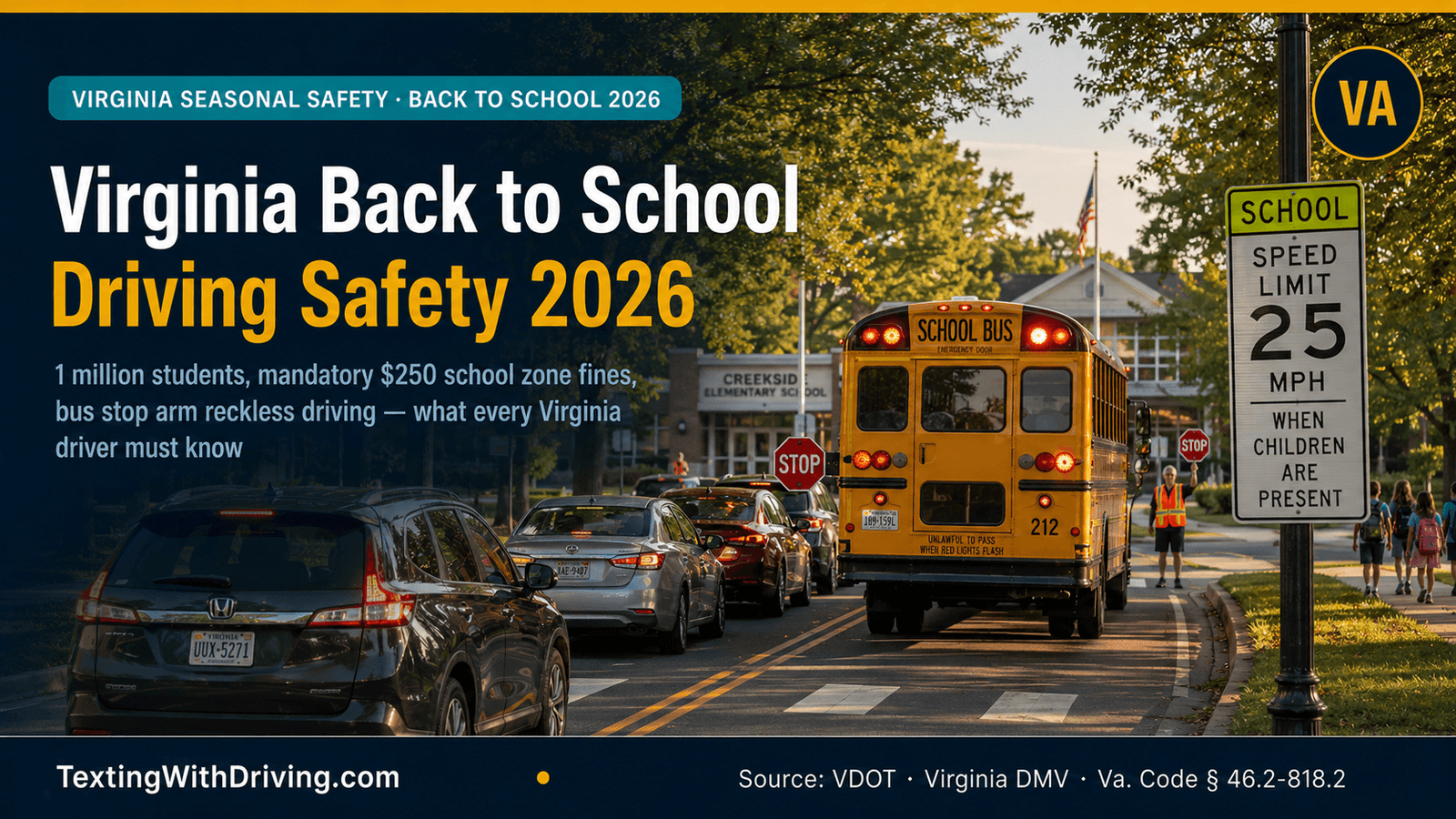
Virginia back to school driving safety 2026 begins with a number that puts the stakes of every driving decision near a school in immediate perspective: more than one million Virginia students are headed back to school this month, and nearly one million of them are transported daily in Virginia school buses. Every car that passes through a school zone, every driver who approaches a stopped school bus, and every teen who gets behind the wheel for the first time in a new school year is part of a road safety environment that the Virginia Department of Transportation, Virginia State Police, and every local law enforcement agency in the Commonwealth takes more seriously in August than at any other time of year.
The Virginia back to school driving safety 2026 legal framework is one of the strictest in the country. School zone distracted driving violations carry a mandatory $250 fine — not a $125 standard first offense, but the same mandatory amount normally reserved for second offenses and work zone violations. Passing a stopped school bus with red lights flashing is reckless driving — the Class 1 misdemeanor we documented in our Virginia reckless driving and distracted driving criminal guide — with a minimum $250 fine and a maximum $2,500 fine. And every Virginia teen driver who returns to school driving for the first time this August faces a complete device ban that is stricter than the adult hands-free law: no phones, no hands-free, nothing — as we covered in our Virginia teen distracted driving 2026 article.
This guide covers everything every Virginia driver and parent needs to know for Virginia back to school driving safety 2026: the school zone law and mandatory fine structure, the school bus stop-arm law and criminal consequence, the speed zone enforcement expansion including local government cameras, the specific high-risk locations where back-to-school enforcement is most intensive, and the complete pre-drive protocol for both adult drivers navigating school zones and teen drivers returning to school year driving.
Why August Is Virginia’s Highest-Risk Month for School-Zone Distracted Driving
Virginia back to school driving safety 2026 is not just an awareness campaign. It reflects documented patterns in crash data that make August and the first weeks of September among the most dangerous periods on Virginia roads for a specific reason: the abrupt return of approximately one million students to a daily commute creates a sudden, dramatic change in the road environment around every Virginia school.
With more than one million Virginia students headed back to school this month, VDOT is calling on everyone to be cautious around school buses and in school zones to keep all road users safe and avoid costly fines and tickets. Students will be commuting to school on foot, by bicycle, by school bus, or by private vehicles.
The transition from summer road patterns to school-year road patterns is abrupt. During summer, school zones are inactive, school buses are not running, and the morning rush hour does not include school-related traffic. On the first day of school, every school zone in the Commonwealth activates simultaneously. Speed limits drop. School buses begin stopping on routes they have not traveled in months. Children appear at bus stops and crosswalks that were empty during summer. Parent drop-off and pick-up queues appear at school entrances that drivers have been driving past without incident since June.
A driver who successfully navigated their commute route all summer by habit — without consciously registering school zone signs, without watching for children on footpaths, without slowing for buses — must now consciously adapt to a fundamentally different road environment. The DRIVE SMART Virginia 12th Annual Distracted Driving Summit on August 6-7, 2026 in Williamsburg specifically addressed this back-to-school transition risk as part of its 2026 safety advocacy priorities.
The School Zone Law: What the Mandatory $250 Fine Means
The first critical provision of Virginia back to school driving safety 2026 that every driver must understand is the school zone mandatory fine structure for distracted driving.
Virginia Code § 46.2-818.2 — the hands-free law that prohibits holding a phone while driving — carries a $125 first offense fine on standard Virginia roads. In school zones and work zones, the same statute carries a mandatory $250 fine for any offense. There is a mandatory $250 fine associated with speeding in a school zone, and the same mandatory $250 applies to distracted driving violations in school zones under the hands-free statute.
The word “mandatory” means the same thing here as it does throughout Virginia’s distracted driving penalty framework: the judge has no discretion. A first-time offender who picks up their phone in a school zone pays $250 plus court fees — the same as a second-offense violation anywhere else in Virginia.
In addition to the mandatory $250 fine for distracted driving, speeding in a Virginia school zone carries its own mandatory $250 fine. These are separate violations that can be cited simultaneously. A driver who is speeding and holding a phone in an active Virginia school zone can face two $250 mandatory fines from a single traffic stop — $500 in base fines before court fees are added.
Some local governments are placing safety cameras to monitor speed in school zones during certain hours of the day, and violators can be subject to fines. The local government camera expansion adds automated enforcement to the officer-based enforcement system. Drivers who rely on seeing a police car to trigger their compliance in school zones now face the risk of camera-based citations that arrive by mail based on license plate data, without any officer stop.
Arlington County’s Vision Zero program has specifically completed 14 school Slow Zone retrofits with lower speed limits, school crossing signs, high visibility crosswalks, and special pavement markings on roads within 600 feet of school access points. The combination of physical road design changes and active school zone camera deployment in Arlington creates one of Virginia’s most comprehensive school zone safety environments — and one of the highest-enforcement-risk environments for drivers who do not adjust their behavior for school zone conditions.
The School Bus Laws: Criminal Consequences Every Driver Must Know
The most serious legal consequence in Virginia back to school driving safety 2026 is not the school zone fine. It is the school bus stop-arm violation — which Virginia classifies as reckless driving.
Passing a stopped school bus is a form of reckless driving, a Class 1 misdemeanor. A person convicted of a Class 1 misdemeanor can be subject to 12 months in jail, a fine of up to $2,500, driver’s license suspension, a criminal record, and DMV demerit points. In some cases reckless driving can even be a felony.
As we documented in our Virginia reckless driving and distracted driving criminal guide, Class 1 misdemeanor is the same criminal category as a DUI in Virginia. Passing a stopped school bus — even once, even by a driver with a completely clean record — is a criminal conviction that: produces a permanent criminal record, adds 6 DMV demerit points to the license for 11 years, carries a minimum $250 fine and maximum $2,500 fine, exposes the driver to up to 12 months in county jail, and can result in license suspension.
The minimum fine for failing to stop for a school bus is $250. The violation is considered reckless driving and could be subject to a $2,500 fine. If you are approaching a stopped school bus displaying flashing red lights, it is unlawful to pass it, even if the bus driver has not yet extended the stop sign.
The specific rules for every stop-arm situation Virginia drivers encounter:
On a two-lane road: Vehicles traveling in BOTH directions must stop. Both directions of traffic must stop on any undivided two-lane road regardless of which side the bus is on.
On a multi-lane undivided road: Vehicles traveling in BOTH directions must stop.
On a divided highway with a median or barrier: Vehicles behind the bus (in the same direction of travel) must stop. Vehicles traveling in the OPPOSITE direction on the other side of a median or barrier may proceed with caution.
At any intersection: Vehicles approaching from any direction at a four-way intersection must stop for school buses with flashing red lights and an extended stop sign.
Timing: You must stop and remain stopped until all persons are clear of the roadway AND the bus moves again. Stopping and then proceeding before the bus moves is a violation even if no children are visible between the bus and your vehicle.
Yellow lights: When a bus displays yellow flashing lights, it is preparing to stop and children will soon be loading or unloading. Yellow lights are the warning that a stop is imminent — slow down and prepare to stop at the first appearance of yellow lights rather than waiting for the red lights and stop arm.
Drivers must wait until the bus begins driving, turns off the visual signals, or the bus driver motions for the vehicle to proceed.
School Zone Active Hours: When the Law Applies
The Virginia back to school driving safety 2026 school zone provisions apply during specific time windows, not 24 hours per day. Understanding exactly when school zones are active is essential for every driver on Virginia roads this August.
Virginia school zones are active when children are present. In practice, this means the reduced speed limit and associated penalty enhancements apply during:
Morning arrival window: Typically 30-45 minutes before the school start time. For most Virginia schools, this means 7:00-7:45 AM for elementary schools, 7:30-8:15 AM for middle schools, and 8:00-8:45 AM for high schools depending on the specific school’s schedule. Local school zone signage specifies the exact hours.
Afternoon dismissal window: Typically 30-45 minutes during and after the school dismissal time. Afternoon hours typically run from 2:00-3:30 PM for elementary schools and 3:00-4:30 PM for high schools in most Virginia districts.
When the school zone signs specify “when children are present”: Some Virginia school zones use this language rather than specific hours. The “when children are present” designation means the reduced speed limit applies any time children are actually present in or adjacent to the school zone, regardless of time of day — including during lunch, during after-school activities, and during special events.
The morning window is the highest-enforcement concentration period for Virginia back to school driving safety 2026. Virginia State Police and local law enforcement agencies deploy additional patrols specifically for school zone enforcement during the morning arrival window on the first days of school. Arlington County Police, Fairfax County Police, and Virginia Beach Police Department all run dedicated back-to-school enforcement programs during this window.
VDOT specifically notes: watch carefully for students in the morning and afternoon, especially when in the vicinity of school buildings. Don’t drive distracted. Never use electronic devices while driving and be sure to actively focus on the road and your surroundings.
The Highest-Risk School Zone Areas in Virginia
Virginia back to school driving safety 2026 crash concentration in school zones follows the same geographic pattern we have documented across Virginia’s crash data generally: Fairfax County, Virginia Beach, Prince William County, Henrico County, and Richmond City represent the highest-concentration school zone crash risk areas.
Fairfax County’s 228 public schools with approximately 187,000 students create one of the densest school zone networks of any county in Virginia. The combination of Fairfax’s 1.2 million residents, its complex road network, and the sheer volume of school zone hours across 228 schools creates more cumulative school zone driving exposure per commuter than any other Virginia county.
Virginia Beach’s 86 schools serve approximately 63,000 students in a city where tourist traffic peaks simultaneously with the return of school — August is both the last full month of peak tourist season and the month schools return. The overlap of tourists unfamiliar with Virginia Beach’s school zone locations, resident drivers who have not driven through active school zones since June, and the increased pedestrian activity around schools creates a specific convergence of risk factors.
Henrico County’s school zone network covers 69 schools in an area where I-64, Route 60, and the Broad Street corridor — all high-crash-density roads — intersect with dense school catchment areas. The Henrico school zone network along Broad Street in particular creates significant morning rush hour congestion where distracted driving crashes have been documented in Virginia DMV crash data.
Teen Drivers: The Back-to-School Season’s Unique Challenge
The Virginia back to school driving safety 2026 period creates a specific challenge for Virginia’s teen drivers that differs from every other time of year: large numbers of 16 and 17-year-olds who have had their learner’s permits or provisional licenses over the summer are now beginning the school year commute — their first experience driving a regular daily route in school traffic, with peer passengers, under the time pressure of school start times.
As we documented in detail in our Virginia teen distracted driving 2026 article, DRIVE SMART Virginia confirmed 33 teen drivers died on Virginia roadways in 2025. The back-to-school period is one of the highest-risk windows in that annual toll.
The specific teen driving risk factors that converge at back-to-school time:
First regular peer passenger opportunity. Under Virginia’s provisional license restrictions, teen drivers may only carry one non-family passenger under age 21 in the first year. The school year creates the first opportunity for many teen drivers to regularly carry a peer passenger — a friend or classmate — which is among the highest documented crash risk multipliers for teen drivers.
Time pressure. School start times create a specific urgency that summer driving does not. A teen driver who is running late for school faces exactly the psychological conditions — urgency, anxiety, time pressure — that research consistently identifies as increasing risk-taking behavior behind the wheel. The first period bell is not an emergency under Virginia law that justifies speeding or phone use.
Social coordination pressure. The school year reactivates the social coordination texting that summer driving with more flexible schedules reduces. The group chats that coordinate carpool arrangements, morning meet-ups, and after-school plans reactivate on the first day of school — and every message in those chats creates a phone-check impulse during morning drives.
The complete phone ban reminder. Virginia drivers under 18 cannot use any phone — handheld or hands-free — while driving. The first day of school, when school-related texts and notifications begin arriving, is the specific moment when this ban is most tested. As documented in our Virginia teen distracted driving 2026 article, the technology solution is phone in back seat or glove compartment, not just Driving Focus — because the complete hands-free ban means that even hands-free activation of Siri or Google Assistant is a violation for Virginia under-18 drivers.
The DRIVE SMART Virginia 2026 Summit Findings: Back to School Safety Priorities
The DRIVE SMART Virginia 12th Annual Distracted Driving Summit held August 6-7, 2026 in Williamsburg — immediately before most Northern Virginia school districts opened for the year — produced specific back-to-school safety priorities from Virginia’s assembled law enforcement, education, and traffic safety community.
DRIVE SMART Virginia has been traveling around Virginia with a distracted driving simulator and other hands-on educational activities for high school students. DRIVE SMART brought programming into 28 high schools across Virginia, reaching over 6,000 teens in 2025 with the interactive educational experience.
The Summit’s timing — one to two weeks before most Virginia school districts open — is deliberate. The event coordinates the Virginia traffic safety community’s back-to-school messaging and enforcement strategy. The specific priorities identified for August 2026 include: school zone enforcement campaigns in the seven highest-crash counties (Fairfax, Loudoun, Henrico, Richmond City, Prince William, Norfolk, Virginia Beach), DRIVE SMART simulator deployments at high school orientation events, and the expanded VDOT public messaging campaign targeting drivers near school buses.
The School Bus Driver’s Perspective: Understanding Why Bus Stops Happen
An important element of Virginia back to school driving safety 2026 that many drivers do not understand is why school bus stops take as long as they do — and why moving before all passengers are clear is dangerous regardless of whether children are visible directly between the bus and the car.
Nearly one million students are safely transported in school buses daily across Virginia to school, field trips, athletics and other school-sponsored activities. Students riding a school bus versus a vehicle are much more likely to arrive at school safely because school buses have strong, closely-spaced seats that have energy-absorbing seat backs to protect students from crashes.
The specific hazard that Virginia’s stop-arm law addresses is not primarily children who are visibly crossing in front of the bus. It is children who are approaching the bus stop from behind the stopped vehicle — children who may be running late, who may be approaching from a direction behind the stopped cars, or who may be moving between the bus and the parked cars in ways that are not visible to a driver impatient to proceed. The requirement to remain stopped until all persons are clear and the bus moves is not procedural excess. It reflects the specific crash scenario where a driver who started moving “because no one was there” strikes a child who appeared from between parked cars after the driver had already begun moving.
School buses make frequent stops, so be patient, slow down, and be prepared to stop. Yellow lights mean the bus is going to stop, so slow down. Remain stopped when lights are flashing red. Look for students at bus stops and those walking to and from bus stops. Stay alert for students arriving late for the bus as they may dart into the street without looking for traffic.
The “arriving late” scenario is specifically identified because it is the most dangerous: a child who sees the bus lights flashing and knows they are about to miss it will run — and may run between parked cars, from behind a vehicle, or across a road without checking traffic. The driver who is already starting to move when the child runs out faces exactly the crash scenario that the mandatory stop requirement exists to prevent.
The Complete Back-to-School Pre-Drive Protocol
The Virginia back to school driving safety 2026 compliance standard for every Virginia driver during back-to-school season involves both the standard hands-free law compliance and the school-zone-specific heightened standard.
For adult Virginia drivers:
Before every drive during August and September:
- Phone mounted or in back seat — the standard hands-free setup remains the foundation
- GPS destination entered before moving
- Driving Focus or Android DND active
- Specific school zone awareness: know which school zones are on your regular route and their active hours
In every active school zone:
- Mandatory $250 fine for any hands-free violation — standard $125 has doubled
- Speed reduced to posted school zone limit
- Camera enforcement possible in addition to officer patrol — no officer needed for citation
- Maximum pedestrian vigilance — children may appear from between parked vehicles or at unmarked crossing points
At every school bus stop:
- Stop at yellow flashing lights (pre-stop warning) — do not wait for red and stop arm
- Remain stopped until the bus moves or driver signals
- Check both sides and behind stopped cars before proceeding when bus begins to move
- Minimum $250 fine; reckless driving criminal consequences for stop-arm violation
For Virginia teen drivers returning to school year driving:
Before every drive:
- Phone in back seat or glove compartment — not just silenced, not in a mount
- No hands-free phone use — the under-18 complete ban applies regardless of the hand-free standard adults use
- Navigation pre-set at home by a parent if needed — teen cannot enter navigation while moving
- Parent pre-drive conversation about the route, school zone locations, and peer passenger rules
During the drive:
- No phone contact of any kind — not to check a text at a red light, not to activate Siri, not for any purpose except a genuine 911 emergency
- First year provisional drivers: only one non-family under-21 passenger
- School zone mandatory $250 fine applies to teen violations as well as adult violations
What VDOT Is Asking Every Virginia Driver to Do
The VDOT official back-to-school safety message is direct and specific:
Never use electronic devices while driving and be sure to actively focus on the road and your surroundings. School buses make frequent stops. Be patient, slow down, and be prepared to stop. Yellow lights mean the bus is going to stop. Remain stopped when lights are flashing red. Look for students at bus stops and those walking to and from bus stops. Stay alert for students arriving late as they may dart into the street without looking for traffic. Watch carefully for students in the morning and afternoon, especially when in the vicinity of school buildings.
This messaging, from the Virginia Department of Transportation itself, captures the complete Virginia back to school driving safety 2026 standard that every Virginia driver should apply from the moment the school year begins.
For the complete Virginia hands-free law that applies in every school zone with mandatory $250 enhancement, our Virginia distracted driving law article covers Va. Code § 46.2-818.2 in full. For the complete fine structure including the school zone mandatory $250 provision, our Virginia distracted driving fines 2026 article covers every scenario. For the specific teen driver phone ban that applies throughout the school year, our Virginia teen distracted driving 2026 article covers the GDL framework and complete prohibition. And for the technology setup that makes compliance automatic, our hands-free while driving complete setup guide covers iPhone, Android, Bluetooth, and CarPlay.
Sources Used in This Article
All links verified working before publication.
VDOT: Back to School Safety Virginia August 2025 — 1 million students back to school, school zone cameras by local governments, bus safety rules, never use electronic devices while driving, August 2025 (applicable 2026)
Virginia DMV: School Bus Safety Official Page — Nearly 1 million students transported daily, school bus safest transportation, Virginia statutes
Rutter Mills Law: Virginia School Bus Traffic Laws — Minimum $250 fine stop-arm violation, reckless driving Class 1 misdemeanor, red lights unlawful to pass even before stop arm extends, August 2025
PZ Law: What You Need to Know About School Bus Safety Virginia — Mandatory $250 school zone fine, Class 1 misdemeanor up to $2,500 fine 12 months jail, all road configurations covered, March 2025
Arlington County Patch: Police Conduct Back to School Driver Safety Program Arlington — Arlington County back-to-school enforcement, 14 Slow Zone retrofits, $125 first offense distracted driving, stop-arm direction rules
DRIVE SMART Virginia: 2025 Annual Report — 33 teen deaths 2025, 28 high schools 6,000 teens simulator program, 12th Annual Summit August 6-7 Williamsburg 2026, teen driver statistics back to school context
Virginia DMV: Distracted Driving Toolkit — School zone mandatory $250, top 7 crash counties, enforcement campaign details
Virginia Code § 46.2-818.2 Official Statute — Complete hands-free law text, school zone mandatory $250 provision
Virginia Code § 46.2-868 Reckless Driving Penalties — Class 1 misdemeanor, $250 mandatory minimum for § 46.2-818.2 simultaneous violation
VDOT: Heads Up End Distracted Driving in Virginia — 18,688 crashes 73 fatalities 10,222 injuries 2024, cell phone distraction rose 3%
NHTSA: Distracted Driving — 3,208 deaths 2024, national context
TextingWithDriving.com is professionally built and maintained to ensure accurate, accessible safety information reaches every driver who needs it. Website development and ongoing support is handled by Budgetic, a digital agency specializing in purpose-driven WordPress websites.

About Texting With Driving
TextingWithDriving.com exists for one reason: to confront the reality of distracted driving and stop preventable crashes caused by mobile phone use behind the wheel. Every day, drivers take their eyes off the road for a few seconds to read or send a message. Those few seconds are enough to cause life-altering consequences. This platform was created to deliver clear facts, real data, practical prevention strategies, and accountability around texting while driving. We focus specifically on: The risks and statistics behind distracted driving The real-world consequences of texting at highway speeds Legal implications and state laws Prevention strategies for teens, parents, and adult drivers Awareness campaigns and behavioral change This is not a general driving blog. It is a focused awareness initiative built around one critical issue: phone distraction behind the wheel. Our content is direct, research-driven, and practical. We prioritize accuracy over opinion and education over sensationalism. The goal is simple — reduce distracted driving incidents by increasing awareness and responsibility. If one article causes one driver to put their phone down, the mission is working. For inquiries or partnerships, contact: privacy@textingwithdriving.com
View all posts by Texting With Driving