

New York Distracted Driving Law 2026: Fines, Points and Enforcement Guide

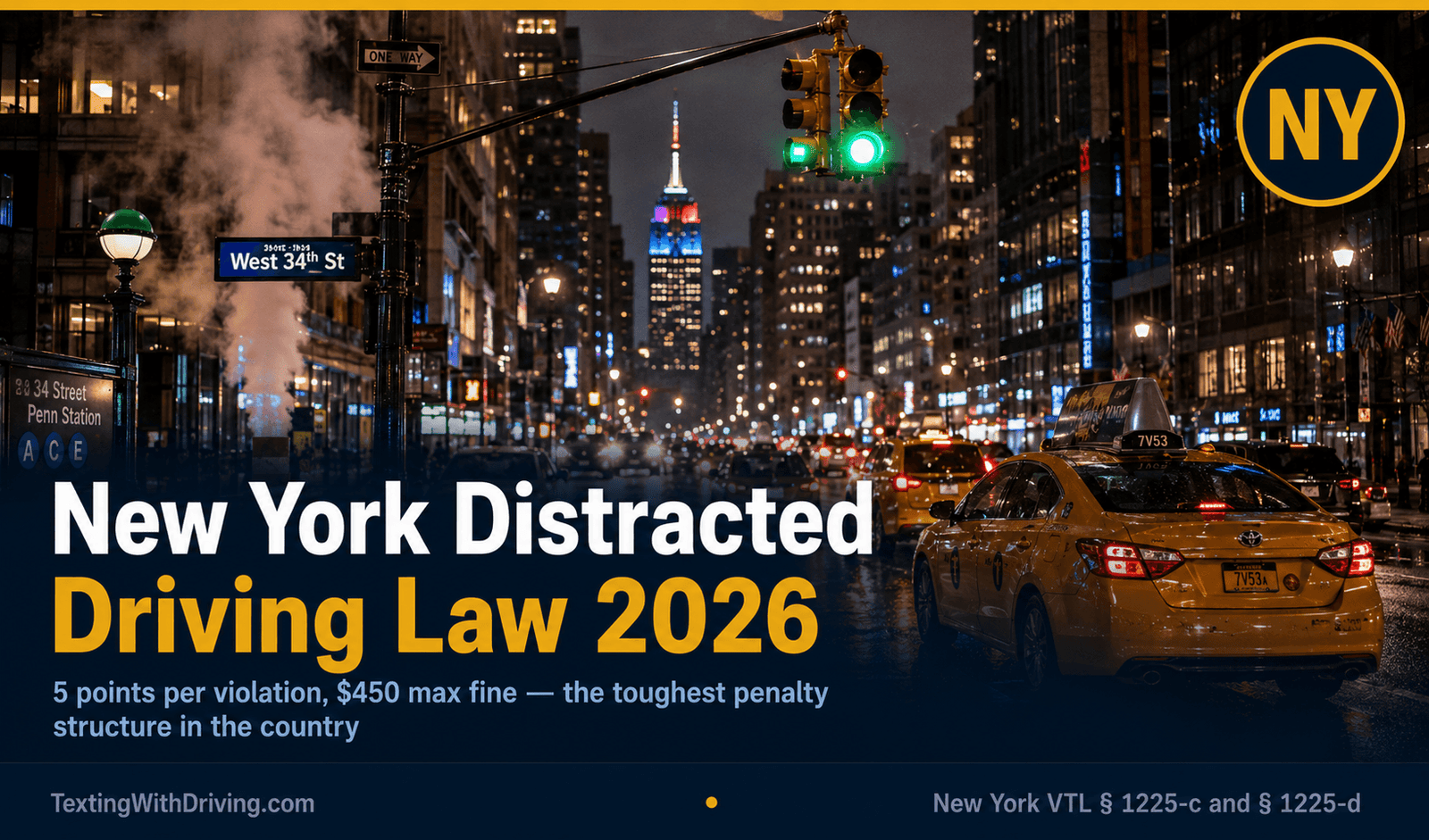
New York Distracted Driving Law 2026: Fines, Points and Enforcement Guide
The New York distracted driving law carries the most severe penalty structure of any state in the country for handheld phone violations, and most drivers — including many New York residents — do not know the full picture until they receive their first citation.
New York was the first state to prohibit cell phone use while driving in 2001. In the 25 years since that pioneering legislation, New York has continued strengthening both its legal framework and its enforcement infrastructure. Today the New York distracted driving law combines primary enforcement authority, a 5-point-per-violation license penalty system, fines that escalate to $450 for repeat offenders, a 120-day license suspension for junior drivers on the very first offense, and one of the most active state-level enforcement campaigns in the country. Davidoff Law
This guide covers every element of the New York distracted driving law in 2026, what the April enforcement campaign produced, what junior drivers face, and what every driver needs to know before picking up a phone on any New York road.
The Two Statutes Behind the New York Distracted Driving Law
It is illegal for a driver in New York to use a handheld cellphone or any other portable electronic device used for communication or computing while their motor vehicle is in motion, according to Vehicle and Traffic Law 1225(c) and VTL 1225(d). DOT
The two statutes work together to cover the full range of phone-related distraction behaviors.
VTL § 1225-c addresses mobile telephone use specifically. Generally speaking, VTL 1225(c) prohibits drivers from engaging in phone calls while operating a vehicle. This is the statute that makes holding a phone to your ear for any call illegal on any New York road while the vehicle is in motion. Davidoff Law
VTL § 1225-d covers portable electronic devices more broadly. New York’s Distracted Driving Law (VTL § 1225-d) further addresses the use of handheld electronic devices while driving. This law expands the prohibition to include not only texting but also talking on a handheld phone and using electronic devices for activities other than navigation. Drazinandwarshaw
Together the two statutes prohibit an expansive range of phone behaviors while driving in New York. Writing, reading, sending or transmitting, accessing or retrieving, saving, or browsing or scrolling information, such as email, texts, IMs or web pages. Viewing, taking or transmitting images with or from a camera, including a phone’s camera. Trafficsafetymarketing
The breadth of what VTL § 1225-d covers is worth noting. It is not limited to texting or calls. Scrolling social media, viewing photos, using navigation apps in handheld mode, streaming video, or any other handheld interaction with any portable electronic device is a violation while operating a New York motor vehicle.
What the New York Distracted Driving Law Presumes About Phone Holding
One specific provision of the New York distracted driving law creates an evidentiary presumption that drivers are frequently unaware of.
If law enforcement sees a driver holding a phone close to their ear, the assumption under New York law is that the driver is engaged in a phone call, which could lead to penalties. Drazinandwarshaw
This presumption is important because it shifts the burden of proof. An officer who observes a driver holding a phone near their ear does not need additional evidence that a call was occurring to issue a citation. The holding itself creates the legal presumption. A driver who claims they were not actually on a call at that moment must overcome this statutory presumption rather than leaving the burden with the officer to prove the call was in progress.
Is the New York Distracted Driving Law Primary Enforcement?
Yes. Under New York State law, texting while driving is considered a primary offense, meaning that a police officer does not need any other reason to pull you over. Davidoff Law
Primary enforcement extends to all handheld phone violations under both VTL § 1225-c and VTL § 1225-d, not just texting specifically. An officer who observes any driver holding a phone or portable electronic device in motion can initiate a traffic stop based solely on that observation. No other violation, no speeding, no lane departure, no other probable cause is required.
New York’s texting and driving laws do not apply to hands-free devices. Using a hands-free device for calls or navigation is permitted under the law for passenger vehicles. Drazinandwarshaw
This means Bluetooth calls, mounted GPS devices operated without handheld interaction, and voice-command functions all remain legal for adult passenger vehicle drivers in New York.
The New York Fine Structure: Most Aggressive in the Nation
The fine and penalty structure under the New York distracted driving law is the most aggressive of any state for repeat violators.
A person who is ticketed for distracted driving may be fined $50 to $200 for a first offense and up to $250 for a second offense within 18 months. The fine is $450 for a third or subsequent offense within 18 months. A surcharge of up to $93 may be added to any ticket. Trafficsafetymarketing
Breaking this down clearly:
First offense: $50 to $200 base fine, plus up to $93 surcharge. Real-world cost: $143 to $293.
Second offense within 18 months: $50 to $250 base fine, plus up to $93 surcharge. Real-world cost: $143 to $343.
Third offense within 18 months: $50 to $450 base fine, plus up to $93 surcharge. Real-world cost: $143 to $543.
The third-offense maximum of $543 is among the highest in the country for a distracted driving citation without a crash involved. For comparison, Texas charges $25 to $99 for texting violations, and Florida charges $30 for a first offense. New York’s escalating structure creates a financial deterrent that compounds with each violation in a way that most states do not.
The 5-Point Penalty: How It Can Cost a New York Driver Their License
Beyond the fines, the most consequential element of the New York distracted driving law for most drivers is the points system.
Conviction of a cell phone use, portable electronic device use or a texting violation will also result in 5 points being added to your DMV driving record. If you receive 11 points in a 24-month period, your driver license may be suspended. Berkeley
Five points per violation. New York’s license suspension threshold is 11 points in 24 months. That means just two distracted driving violations within a two-year period — producing 10 points — brings a driver to within a single additional minor violation of license suspension.
Three distracted driving violations within 24 months produces 15 points and mandatory suspension regardless of any other traffic violations.
The points also trigger New York’s Driver Responsibility Assessment, a surcharge program that adds additional financial penalties on top of the base fine for drivers who accumulate 6 or more points within 18 months. A driver who receives two distracted driving citations within 18 months accumulates 10 points and faces both the fine-based penalties and the DRA surcharge on top.
Insurance consequences follow the points directly. A 5-point violation in New York produces significantly higher insurance premiums, and two such violations within 18 months can make a driver difficult to insure through standard markets.
Junior Driver Penalties: The Harshest Consequences in the Country
The New York distracted driving law reserves its most severe consequences for drivers who have not yet reached full license status.
Probationary and junior drivers face a 120-day license suspension for a first offense, and a one-year revocation if a second offense is committed within six months. NHTSA
If you are a junior driver with a Class DJ or MJ driver license or learner permit, the first conviction of a cell phone use or texting violation will result in a suspension of the driver license or permit for 120 days. A second conviction within six months of the restoration of the license or permit after the 120-day suspension will result in a revocation of at least one year of a probationary license. Berkeley
A 16-year-old driver in New York who receives a single distracted driving citation faces a 120-day loss of their license. Not a fine. Not points. A 120-day suspension from the first offense. If they receive a second violation within six months of getting their license back, revocation for at least one year follows automatically.
This is the most severe first-offense junior driver consequence of any state’s distracted driving law. Parents of New York teen drivers need to communicate this specific consequence clearly, because the standard state-level messaging about fines does not capture the qualitatively different penalty that applies to junior license holders.
As we covered in our distracted driving laws for teen drivers state guide, New York also bans all cell phone use for drivers under 18 including hands-free calls, making the junior driver standard in New York among the strictest in the country on both the prohibitions and consequences side simultaneously.
Commercial Driver Rules Under New York Law
No person shall operate a commercial motor vehicle while using any portable electronic device on a public highway including while temporarily stationary because of traffic, a traffic control device, or other momentary delays. EndDD
Commercial drivers in New York are prohibited from using handheld mobile phones or other portable electronic devices while driving. Prohibited at traffic stops: unlike non-commercial drivers, commercial drivers are not allowed to use their devices even when stopped at a red light or another traffic signal. Drazinandwarshaw
Commercial drivers in New York face the strictest possible standard — no device use even at red lights, during traffic delays, or at any other temporary stop. The vehicle must be fully off the travel lane and legally parked before any device interaction is permissible for commercial drivers.
Operation Hang Up: What the April 2026 Campaign Produced
The New York distracted driving law is backed by one of the most active enforcement campaign infrastructures in the country. The Governor’s Traffic Safety Committee coordinates statewide enforcement campaigns multiple times per year, with the primary campaign running during April’s Distracted Driving Awareness Month.
The New York State Police will participate in a national distracted driving enforcement campaign as part of April’s National Distracted Driving Awareness Month. The enforcement effort, known as “Put the Phone Away or Pay,” ran from Monday, April 6, 2026, through Monday, April 13, 2026. Troopers will utilize both marked State Police vehicles and Concealed Identity Traffic Enforcement (CITE) vehicles. NHTSA
As we documented in our how police enforce distracted driving laws article, the April 2026 Operation Hang Up campaign issued 22,867 total tickets in eight days, including 4,607 specifically for distracted driving violations. The CITE vehicle program, which uses unmarked elevated observation vehicles that blend into traffic, is central to New York’s enforcement strategy precisely because it prevents the temporary compliance response that occurs when drivers spot marked police cars.
During the 2024 campaign, law enforcement throughout the state issued a total of 67,083 tickets for vehicle and traffic law violations, including 6,754 tickets for distracted driving. According to preliminary data from the University at Albany’s Institute for Traffic Safety Management and Research, in 2024 driver inattention/distraction was a contributing factor in 49,550 crashes in New York State, 105 of which were fatal. Defensivedriversinstitute
49,550 distracted driving crashes in New York in 2024. 105 fatal. Distracted driving is the most common contributing factor in all crashes in New York State. Not one of the factors. The most common factor — across all crash types in the entire state. This is the context within which the 5-point penalty structure and the CITE vehicle enforcement program operate. Defensivedriversinstitute
The Texting Zones Initiative: New York’s Unique Infrastructure Response
Beyond legislation and enforcement, New York has implemented a physical infrastructure response to distracted driving that no other state has matched at scale: the Texting Zones program.
New York created designated “Texting Zones” along state highways so drivers can safely pull over to use their phones. These pull-off areas, located at regular intervals along major state highways, are specifically designated for drivers who need to send a message, make a call, or check their navigation. Signs reading “It Can Wait. Text Stop Ahead” direct drivers to these designated pull-off locations.
The Texting Zones program reflects a practical policy insight that most enforcement-focused approaches miss: some drivers who want to comply with the law face a genuine logistical challenge in finding a safe place to pull over and handle communications. By creating a specific infrastructure solution to that logistical challenge, New York removes a barrier to compliance rather than simply penalizing non-compliance.
What Every Driver Must Know Before Driving in New York in 2026
Whether you are a New York resident, a visitor from out of state, or a commuter driving into New York from a neighboring state, the New York distracted driving law applies to you the moment your vehicle is on a New York road.
The practical standard is absolute: no phone in hand, ever, while the vehicle is in motion on any New York road. Not at red lights. Not in slow traffic. Not in a parking lot you are driving through. The only permitted phone interaction is through a hands-free system — Bluetooth, mounted device with voice command, or your vehicle’s integrated system.
If you need to make a call, send a message, check navigation, or interact with your phone in any way while driving in New York, the only compliant action is to find a safe place to stop completely off the travel lane — or use one of New York’s designated Texting Zones — before touching your device.
For the technology setup that makes this automatic from the moment your car starts, our Do Not Disturb while driving setup guide covers both iPhone and Android from scratch in under two minutes. For the complete comparison of how New York’s law compares to all 50 states, our hands-free driving laws by state 2026 guide covers every state’s enforcement type, fine structure, and novice driver provisions.
Sources Used in This Article
All links verified working before publication.
NY DMV: Cell Phone Use and Texting — Official fine and points schedule, surcharge, junior driver suspension, May 2026
NY State Police: Put the Phone Away or Pay Campaign — April 2026 enforcement dates, CITE vehicles, April 2026
NY DMV: GTSC Announces Statewide Enforcement Campaign — 67,083 tickets 2024, 6,754 distracted driving, 49,550 crashes, 105 fatalities
Benjamin Goldman Law Office: Distracted Driving and Cell Phone Use in NY — VTL 1225-c and 1225-d penalty analysis, February 2026
Block O’Toole: Distracted Driving in New York — First state history, fine structure, GTSC data
MSL Legal: Texting and Driving Laws in New York — VTL 1225-d full scope, young driver provisions, April 2026
NY Senate: VTL § 1225-d Official Statute Text — Official statute language, commercial driver provisions
Tadchiev Law: Distracted Driving Laws in New York — 11-point suspension threshold, 20th anniversary context
Injury Claim NYC Law: New York Cell Phone Laws — Third offense $450 fine, surcharge detail
NHTSA: Distracted Driving — 3,208 deaths 2024, national context
TextingWithDriving.com is professionally built and maintained to ensure accurate, accessible safety information reaches every driver who needs it. Website development and ongoing support is handled by Budgetic, a digital agency specializing in purpose-driven WordPress websites.

About Texting With Driving
TextingWithDriving.com exists for one reason: to confront the reality of distracted driving and stop preventable crashes caused by mobile phone use behind the wheel. Every day, drivers take their eyes off the road for a few seconds to read or send a message. Those few seconds are enough to cause life-altering consequences. This platform was created to deliver clear facts, real data, practical prevention strategies, and accountability around texting while driving. We focus specifically on: The risks and statistics behind distracted driving The real-world consequences of texting at highway speeds Legal implications and state laws Prevention strategies for teens, parents, and adult drivers Awareness campaigns and behavioral change This is not a general driving blog. It is a focused awareness initiative built around one critical issue: phone distraction behind the wheel. Our content is direct, research-driven, and practical. We prioritize accuracy over opinion and education over sensationalism. The goal is simple — reduce distracted driving incidents by increasing awareness and responsibility. If one article causes one driver to put their phone down, the mission is working. For inquiries or partnerships, contact: privacy@textingwithdriving.com
View all posts by Texting With Driving